by T. Stanfill Benns | Jan 17, 2020 | New Blog
+St. Peter’s Chair at Rome+
(See Unity Octave prayers following this post)
It has been suggested that in presenting some of the material on this site the opinions of questionable theologians have been used and therefore this destroys the arguments presented. Such statements only prove that a) the objectors have not read the site in its entirety and b) they have not comprehended the reasons for citing the various sources, even though these reasons are made quite clear in the course of the demonstrations. More to the point, it is not the opinions of these theologians that are presented as actual proofs here. Rather it is the sources they provide to document their cases, namely documents issuing from the Roman Pontiffs, the Ecumenical Councils, the Pontifical Congregations and the consensus of scholastic theologians.
Msgr. Joseph C. Fenton, in the January 1956 issue of the American Ecclesiastical Review (“Appraisal in Sacred Theology”), told his readers that “The theologian is expected not only to present accurate teaching, doctrine strictly in conformity with the statements of the Church’s magisterium, but also to prove or demonstrate the propositions he sets forth.” Proofs from divine revelation and Church teaching must accompany those things that are “objectively certain.” Reasons advanced for opinions must be “serious and highly pertinent.” The theologians and other authors used to support what is written on this site are not cited primarily because of the author’s own specific reliability, but rather because of the proofs they present in their works and their loyalty to the Continual Magisterium. Their citation of numerous papal documents supporting their arguments is the most compelling reason for citing their works.
Even so, Fenton comments, “It is definitely not enough to have one’s teachings in harmony with those solemn judgments of the magisterium in which dogmas of the Catholic faith are defined.” Here Fenton cites the teaching of Pope Pius IX found in Tuas Libentur (DZ 1683) where the Pope reminds German theologians they must also “subject themselves to the doctrinal decisions set forth by the Pontifical Congregations and to those points of doctrine which are retained by the common and constant agreement of Catholics as theological truths which are so certain that to render opinions opposed to these points of doctrine, if not heretical, are at least deserving of some other theological censure.” In addition, those things also are forbidden which even approach heresy and non-infallible papal teachings, which also must be obeyed.
A tendency noted by Msgr. Fenton in another article, written before his departure from the Catholic University of America in the early 1960s, warns of yet a further danger — that of demeaning the teachings of the manuals of dogmatic theology used to demonstrate truths of faith to Catholic college students and to instruct seminarians. “We are speaking…of the manuals in the field of fundamental dogmatic theology, which were in use and were influential at and after the turn of the twentieth century… Probably the most important of these manuals were those of Louis Billot, who will most certainly be counted among the very ablest of all the theologians who labored for the Church during the early part of this century. Even more widely known than the works of Billot were those of the Sulpician Adolphe Tanquerey. Many thousands of priests were introduced to the study of sacred theology, and particularly of fundamental dogmatic theology, by courses based on Tanquerey’s De Religione: De Christo Legato: De Ecclesia: De Fontibus Revelationis, the first of the three volumes of his Synopsis theologiae dogmaticae ad mentem S. Thomas Aquinatis accommodata. This particular volume had gone into its twenty-first edition in 1925. If the theses taught by Tanquerey were opposed to those of ‘the most authentic Catholic tradition of all ages,’ then thousands of priests, educated during the first part of the twentieth century were being led into error by the men whom Our Lord had constituted as the guardians of His revealed message.” Here Rev. Fenton also mentions Revs. Garrigou-LaGrange, Van Noort, Devivier-Sasia, Yelle, DeGroot, E.S. Berry and many others.
Msgr. Fenton continues: “Now it is quite obvious that the common teaching of the manuals of fundamental dogmatic theology since the turn of the twentieth century has been the doctrine, which has been taught to the candidates for the priesthood within the Catholic Church, at least up until the past few months. We are dealing with books, which have been employed in teaching in seminaries and universities. If these books all contain common teaching opposed to or even distinct from genuine Catholic doctrine, then the ordinary and universal magisterium of the Catholic Church has been very much at fault during the course of the twentieth century.
“It is quite obvious that the individual opinions of individual authors do not constitute Catholic doctrine and could not be set forth as such. But there is a fund of common teaching (like that which tells us that there are truths which the Church proposes to us as revealed by God, and which are not contained in any way within the inspired books of Holy Scripture), which is the unanimous doctrine of the manuals, and which is the doctrine of the Catholic Church. The unanimous teaching of the scholastic theologians has always been recognized as a norm of Catholic doctrine. It is unfortunate that today there should be some attempt to mislead people into imagining that it has ceased to be such a norm in the twentieth century.
“The Catholic priest knows perfectly well that there is never going to be, and that there never could be, any ‘return’ to a more authentic Catholic doctrinal tradition through the abandonment of the common teaching of all the twentieth-century manuals of fundamental dogmatic theology. The living and infallible magisterium of the Catholic Church never abandons the most authentic Catholic tradition. That tradition is manifest in the teaching of the twentieth-century manuals, and in the condemnations of the various Modernistic propositions.”
It is this “fund of common teaching” that is consulted when weighing the worth of any given article or work used on this site, and if the teachings presented do not reflect that fund, then they are not quoted. Long before the “new theology” of Vatican 2 became the norm, Msgr. Fenton was down in the trenches doing all in his power to expose and defeat it. His many works, contained in this author’s library, provide a good sounding board for who and what was not in tune with Church teaching.
Anticipating Humani Generis
Prior to the issuance of Pope Pius XII’s Humani Generis in Aug. 1950, Msgr. Fenton penned an admirable defense of the infallibility of papal encyclicals in a two-part article for the American Ecclesiastical Review. In opening statements to both articles, he emphasized the role played by those participating in the Vatican Council regarding the possibility of infallible statements in the encyclicals. In Part II he relates how, thanks to (then) Abp. Henry Edward Manning and Bishop Ignatius Senestry, the Council rejected the teaching that “the Holy Father can speak infallibly only when he solemnly proclaims a dogma of Divine faith or when he solemnly condemns some teaching as heretical.” It is clear from the excerpts below that Catholics are bound even by non-infallible statements in the encyclicals and are certainly irrevocably bound by those papal encyclicals and other papal documents, according to Humani Generis, entered into the Acta Apostolica Sedis. This is precisely what was stated in the article Material-Formal Hypothesis Condemned As Heresy under Recent Articles on the content page of this site.
“Doctrinal Authority of Papal Encyclicals,” Pt. I; American Ecclesiastical Review, Aug. 1949
“Most theologians… insist the [Holy Father] has the right to demand, and actually has demanded, a definite and unswerving internal assent to his [encyclical] teachings from all Catholics… This sincere assent… due to teachings presented even in a non-infallible way …is definitely and seriously obligatory. The obligation holds until such time as the Church might come to modify its position on some particular portion of the teaching or …serious reasons for such modification might become apparent… The Catholic’s duty to accept the teachings conveyed in the encyclicalseven when the Holy Father does not propose such teachings as a part of his infallible magisterium is not based merely on the dicta of the theologians. The authority which imposes this obligation is that of the Roman Pontiff himself.” And here he cites the teachings of the Vatican Council and Pope Pius IX’s Tuas Libentur. Msgr. Fenton further points out that such an assent also must be extended to the non-infallible decisions of the various Roman Congregations.
“Doctrinal Authority of Papal Encyclicals,” Pt. II; American Ecclesiastical Review, Sept. 1949
Fenton wrote: “According to the Vatican Council… the Church can teach infallibly by solemn judgment or by its ordinary and universal magisterium” (DZ 1792). After explaining at length in both parts of his article that a good number of theologians deny this clear teaching or simply gloss over it, in Part II he details the dangers of this attitude and demonstrates where it had led at the time of his writing. “There is an attitude [of theologians] towards the encyclicals that can be productive of doctrinal evil and …lead toward a practical abandonment of their teaching. According to this attitude, it is the business of the theologian to distinguish two elements in the content of the various encyclicals. One …would be the deposit of genuine Catholic teaching which …all Catholics are bound to accept at all times.
“The other …would be a collection of notions current at the time the encyclicals were written. These notions… would enter into the practical application of Catholic teaching, as ideas Catholics can afford to overlook… This attitude can be radically destructive of a true Catholic mentality. The men who have adopted this mentality imagine they can analyze the content of an individual encyclical or a group of encyclicals in such a way that they can separate the pronouncements which Catholics are bound to accept from those which would have merely an ephemeral value. They, as theologians, would then tell the Catholic people to receive he Catholic principles and do as they liked about the other elements. In such a case, the only true doctrinal authority actually operative would be that of the individual theologian.”
In other words, the authority of the theologian, not the Holy Father himself, would be used to determine what was recommended for Catholic belief, Fenton points out. “It is very difficult to see where this process would stop,” Fenton continues. “The men who would adopt this course would inevitably force themselves to treat all the doctrinal pronouncements of the Popes after the fashion of the teachings of private theologians… If a man chooses to dissect the encyclicals of Pope Leo XIII, there is no reason why the documents which emanate from Gelasius or from St. Leo I should not be subject to the exact same process. If the statements of Pius IX are not valid exactly as they stand, it is difficult to see how those of any other Roman Pontiff are any more authoritative.” Msgr. Fenton notes that while private theologians are obligated and privileged to study the encyclicals and explain them to the people, they are forbidden to interpret them.
“The Holy Father, however, not the private theologian, remains the doctrinal authority. The theologian is expected to bring out the content of the Pope’s actual teaching, not to subject that teaching to the type of criticism he would have a right to impose on the writings of another private theologian… The pronouncements of the Roman Pontiffs, acting as the authorized teachers of the Catholic Church, are definitely not subject to that sort of evaluation… This tendency to consider the pronouncements of the ecclesia docens, and particularly the statements of the papal encyclicals, as utterances which must be interpreted for the Christian people, rather than explained to them, is definitely harmful to the Church. It is and it remains the business of Catholic theologians to adhere faithfully to the teachings of the encyclicals and to do all in their power to bring this body of truth accurately and effectively to the members of Christ’s Mystical Body.”
Today we have those who are not even clerics spouting the opinions of the very remiss theologians Msgr. Fenton describes above as though it were gospel. This in spite of the fact that in Humani Generis Pope Pius XII declared the encyclicals (and even papal addresses) can and often do contain infallible statements. Anything entered into the Acta Apostolica Sedis is binding, and even what is not there entered deserves a firm internal assent. This is not just the opinion of Msgr. Fenton, but of the majority of theologians, even before Pope Pius XII’s definition. Instead there are many who continue to teach today that the encyclicals are open to interpretation and still do not bind. Unless they wish to be counted among the nouvelle “theologians” who later became the architects of Vatican 2, they would do well to cease and desist and follow only the teachings of the Roman Pontiffs, in their entirety.
Unity Octave Prayers
Pope Leo XIII first suggested the following prayers in 1897 when he asked Catholics to pray for Christian unity by reciting a novena. Later, the actual Church Unity Octave was established and blessed by Pope St. Pius X in 1909, who set the dates for the Octave. Prayers begin with the date of the Chair of St. Peter (Jan. 18) and end with the Conversion of St. Paul, (Jan. 26). Pope Benedict XV extended its observance to the Universal Church on Feb. 25, 1916. All today should join in these prayers.Priest: How the Sacred Heart must grieve to behold so many divisions among Christian Churches separated from the one true Church He founded. Pray that Christ’s plea may be realized:
ANTIPHON: (Cantor) Ut omnes unum sint, sicut tu Pater in me* et ego in te; ut et ipsi in nobis unum sint, ut mundus credat* quia tu me misisti. (John 17: 21)(Translation: That they may all be One, as Thou, Father, in Me and I in Thee; that they also may be one in us, that the world may believe that Thou has sent me.)
- (Priest) “I say unto thee, that thou art Peter;”
- (All) “And upon this Rock I will build My Church.”
Priest: LET US PRAY. O Lord Jesus Christ, Who didst say to Thine Apostles: “Peace I leave with you, My peace I give unto you,” regard not our sins but the Faith of Thy Church, and grant unto her that peace and unity which are agreeable to Thy Will. Who livest and reignest, God forever and ever.
All: Amen
Prayer to Our Lady, Help of Christians, to Protect the Church
All: Mary, Immaculate Virgin, Mother of God and our Mother, thou seest how the Catholic Faith is assailed by the devil and the world – that Faith in which we purpose, by the help of God, to live and die – Do thou, O Help of Christians, renew thy victories as of old, for the salvation of thy children.To thee we entrust our firm purpose of never joining assemblies of heretics. Do thou, all holy, offer to thy Divine Son our resolutions and obtain from Him the graces necessary for us to keep them unto the end. Bring consolation to the visible head of the Church – support the Catholic Episcopate; protect the clergy and the people who proclaim thee Queen. Hasten, by the power of thy prayers, the day when all nations shall be gathered around the Supreme Pastor. Amen.Priest: Mary, Help of Christians,
ALL: Pray for us.
(Those praying the Octave are asked to direct each day to the following intentions):Beginning Wednesday, Jan. 18: The return of all the “other sheep” to the one fold of St. Peter, the One Shepherd.
Jan. 19: The return of all Oriental Separatists to Communion with the Apostolic See.
Jan 20: The submission of Anglicans to the Authority of the Vicar of Christ.
Jan 21: That the Lutherans and all other Protestants of continental Europe may find their way back to the Holy Church.
Jan 22: That Christians in America may become one in communion with the Chair of St. Peter.
Jan. 23: The return to the Sacraments of lapsed Catholics.
Jan. 24: The conversion of the Jews.
Jan. 25: The Missionary conquest of the world for Christ.
by T. Stanfill Benns | Jan 8, 2020 | New Blog
+Our Lady of Prompt Succour+

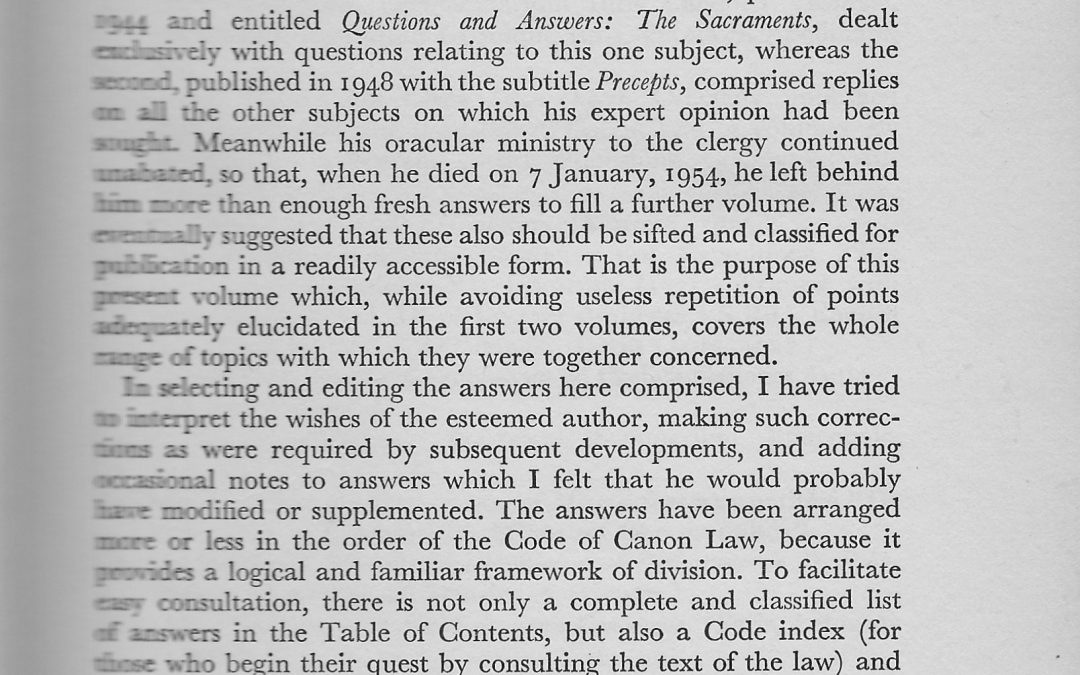
This is the introduction to Priests’ Problems, by Canon E.J. Mahoney, D.D., who one reader has accused of being a liberal nobody in the theological world. (This because some cannot accept the fact that several popes, to some degree unknown, have reportedly provided secret jurisdiction to certain oriental schismatic sects.) Far from being a nobody, it appears Can. Mahoney was considered knowledgeable enough to advise numerous priests in Ireland and England for over two decades. The Clergy Review was the equivalent of Homiletic and Pastoral Review and the American Ecclesiastical Review in this country. People who don’t have access to the actual theological works (or to the Internet for that matter) should refrain from making specious objections.
This same individual also has disparaged Rev. Ignatius Szal’s The Communication of Catholics With Schismatics (1948) because Rev. Szal later became a member of the Novus Ordo Church. This individual claims to have read his work and intimates Szal’s conclusions are not in keeping with pre-V2 dogmatic theology. Of course this same person questions whether Pope Pius XII was a true pope and is also a member of the Feeney sect. And as is so often the case, no proof whatsoever for these claims is offered.
While Szal later fell from grace, his work was soundly based on papal decrees and decisions of the Holy Office. Both prior and later theological works confirm what he presented in his dissertation. In no way whatsoever does his work deviate from what other leading and orthodox theologians taught prior to Pope Pius XII’s death regarding the status of schismatics. When King Henry VIII became a notorious heretic and left the Church, the Church did not denounce his Defense of the Seven Sacraments following his excommunication, a work which earned him the title of Defender of the Faith by Pope Leo X. The practice of the Church, not human opinion, must be followed in these uncertain times. And certainly Canon Mahoney and Rev. Szal’s works, being approved prior to the death of Pope Pius XII, are superior by far to anything concocted by Traditionalists of whatever shade.
The works of approved authors quoted on this site are nothing in themselves; their value is deduced from the faithfulness they demonstrate regarding papal teaching. That is why they are quoted. Notice also above that Rev. McReavey, who succeeded Can. Mahoney, notes that always those answers given must be reconciled with the most recent decisions of the Holy See and papal decrees. This is something that all those pretending to be devoted to the study of pre-V2 theology today fail to do.
The sources I have quoted are sound; if they deviate from the faith in any way then those making this claim are obligated to demonstrate how and where and present solid proofs. Unless and until this occurs, the use of these authors stands.
by T. Stanfill Benns | Jan 6, 2020 | New Blog
+The Epiphany+
We hear much these days about political conservatives and their connections to white supremacy ideology, also known as Christian Identity or British Israel (BI). British Israel is the belief that the people of the British Isles, genetically, racially and linguistically are the descendants of the 10 lost tribes of Israel. In other words, the people of Great Britain (and by way of descent, the U.S.) have become the “new Israel,” or chosen people and are basically blood descendants also of the Davidic line. Many believe that the rulers of England are blood relations of King David, and that the throne on which the English kings are consecrated sits over the same stone used to consecrate the Israelite kings. Christian Identity beliefs in America later evolved from this theory.
While politicians and Christian clerics deny white supremacy is linked to this belief, it may well be true to an extent few would be willing to believe. Certainly not all Christian Conservatives embrace this belief system. But many of those who do have gone to great lengths to conceal their true beliefs in order to pass as everyday Christians. Sadly, this applies to Traditionalists every bit as much as it does to Protestants. And In fact, the name Traditionalists chose for themselves long ago itself may be a clue to who and what they truly are.
But first, a brief personal history of my experience with white supremacy as a Traditionalist. The very first (and only) Trad group I joined, the Orthodox Roman Catholic Movement, had its own branch, so to speak, which promoted these White Supremacist beliefs. I handled mail for a Traditionalist ORCM “priest,” Dan Jones, from 1980 until 1982, and also wrote for his newsletter, Sangre de Cristo Newsnotes. Anyone who subscribed to that newsletter into the 1990s knows Jones was advocating for and posting advertisements from (Protestant) Christian Identity groups and individuals, and he received mail criticizing him for this. He also printed a long series promoting the “Siri” theory, beginning in the late 1980’s. Certain members of the Siri group also promoted British Israel.
I left Jones’ group in 1982, after a showdown with him over an article he had instructed me to write for his newsletter, sympathetic to Identity beliefs. I pulled the article before it went into print and for this and other disturbing reasons, friends and I left Jones at about the same time. The next group I would become involved with also espoused Identity-related and other Gnostic beliefs, and after nine months I left them as well. I would run into yet another Trad group in the early 2000s that promoted British Israel (synonymous with Christian Identity), and by then I understood this belief was somehow intertwined with the Traditionalist movement, so I quickly rejected the ideas presented in their literature.
This tendency in Traditionalism had been evident from the beginning, following the publication of the book ghostwritten by a fellow Mexican for the Mexican dissident priest Rev. Joaquin Saenz-Arriaga in the early 1960s (The Plot Against the Church). It was Saenz who helped establish the ORCM in the U.S. He also was patronized by the publication Veritas, which was notorious for its anti-Semitic bias. This periodical, published every other month, was quite popular among Traditionalists. It seems that for the most part, then, Traditionalists seemed to willingly assimilate Identity teaching — at least insofar as they blamed the Jews for dismantling their Church — into their own brand of Catholic belief.
But that belief contradicts Catholic teaching. In his encyclical Mit Brenunder Sorge, written in 1937 shortly before the beginning of World War II in Europe, Pope Pius XI wrote: “Whoever exalts race, or the people, or the state, or a particular form of state, or the depositories of power, or any other fundamental value of the community… above their standard value and divinizes them to an idolatrous level, distorts and perverts an order of the world planned and created by God… He is far from the true faith in God.” In a later address to Belgian pilgrims on Sept. 6, 1938, Pius XI said: “Abraham is called our patriarch, our ancestor. Through Christ and in Christ we are the spiritual descendants of Abraham… No, it is not possible for Christians to take part in anti-Semitism… [For] Spiritually, we are Semites.”
Let’s then compare the beliefs of “Christian” Identity, defined by Pope Pius XI as a contradiction in terms, with his teaching on this subject. Christian Identity began as British Israel. One source quotes John Henry Cardinal Newman as commenting that he became a Catholic precisely because the BI philosophy had totally taken over the Anglican church! This tells us there is no affinity between Catholic belief and BI/ ”Christian” Identity. The earliest book on BI appeared in England in 1590 and another work was published there in 1649.They hold the white race as the only race chosen by God to rule the nations and by and large have always discriminated against people of color.
The Ku Klux Klan has been associated with Identity beliefs. These proliferated in America in the 20th century, and were promulgated by Henry Ford, Fr. Charles Coughlin and others. Fr. Coughlin was asked by the Vatican to stop preaching BI on the radio in the 1930s by none other than Pius XII, then acting as Pius XI’s cardinal Secretary of State. He personally came to the U.S. to speak to Coughlin. Some claim the deal Pius XII cut with Coughlin was entirely political, but in reality it reflected everything later taught doctrinally by Pius XI in Mit Brenunder Sorge.
Pius XI forbade Catholics to exalt any one race or people over the other. That means Identity groups could not teach that they alone were destined to rule over other races based on their “divine” Davidic bloodline, or any other pagan ideal of racial supremacy (some claim “Atlantean” descent and its superior technological knowledge, reminiscent of Sir Francis Bacon’s work). Pius XI also condemns the idolatry of a particular form of state or government, (National Socialism, or for that matter what we see today as the positive idolatry of democracy as the only acceptable form of government, a concept rejected by the Church). And finally he condemns anti-Semitism outright in his radio address to the Belgians. He then goes on to announce that it is Catholics, (not Protestant Identity groups) who are descended from the Israelites and explains that such a descendance is not in the physical or any other sense but is strictly spiritual. The Jews were the physical descendants and Catholics are the spiritual descendants, encompassing both Old and New Testaments. Christ spiritualized everything, fulfilling all foretold regarding His birth, life and death in the Old Testament. Holy Scripture tells us to “avoid foolish questions and genealogies and contentions and strivings about the law” (Titus 3:9).
It appears there may have been (and most likely still is) a so-called “Catholic” secret society known as the Priory of Sion which Marcel Lefebvre and other clerics belonged to that embraced a philosophy similar to Identity. Lefebvre’s various religious establishments went by the name of “priories.” He is said to have resigned from the Priory in 1981. This society may have promoted the belief that certain members of the Catholic clergy are descended from Christ Himself and Mary Magdalene, reviving the old Gnostic heresy that Christ somehow did not die during His Crucifixion and escaped with Mary Magdalene to France, or some other location, there to father children. Another version of this blasphemous heresy would have the clergy and faithful descended from the family of Our Lady pre-eminent by blood in the Church, a heresy proposed by a faction of the Judaizers which was condemned in the early centuries by Pope St. Sylvester. This heresy also involved the descendants of Jesus’ family, who claimed that Jerusalem, not Rome was the intended center of Christianity.
Regardless of what any of these revolting beliefs might be, we know that no one could possibly adopt them and remain Catholic. But apparently, this has not stopped Traditionalists from joining forces with Identity groups and thus automatically resigning any Church membership they may have once possessed. That this occurred either before, or at the very establishment of Traditionalism is demonstrated by the name ‘Traditionalist’ itself, as we have commented in other places. The name was used to lure dissident Catholics unhappy with Vatican 2, who believed Tradition referred to the preservation of the Latin Mass and the supposed continuation of the Catholic Church.
They were largely ignorant of the earlier error by this same name (Traditionalism) as it was proposed by Lammenais, Bonald and Bonetty. Nor did they understand that it was condemned as a heresy and why it was condemned by the Church, although those “clerics” establishing and heading various sects across the U.S. and internationally were obligated under Canon Law and papal teaching to warn the faithful of such dangers. (See the article on the heresy of Traditionalism at https://catholicencyclopedia.newadvent.com/cathen/15013a.htm. This condemned belief holds that universal agreement is the rule of certitude as well as the rule of faith and must be trusted because man cannot rely on his reason, which totally contradicts the Vatican Council’s teaching on reason. And it is absolutely the principle adopted by supposedly “Catholic” Traditionalists.
In examining the various meanings of Traditionalism in all its varieties, as demonstrated on Wikipedia, we discover that none of them are Catholic and several can be classified as corresponding to some “Traditional Catholic” beliefs. Identity believers actually refer to themselves as Traditionalists supposedly of the political/conservative variety and this comes closest to what is identified as the Traditionalist School. But this is only a revival of the old Traditionalism condemned by the Church, with connections to dangerous far right movements today. There is also Spanish Traditionalism with its attempt to revive the Bourbon monarchy of Spain, referred to on some Siri sites as affiliated with the Great Monarch and “Catholic Restoration.” It is a broad, all-inclusive term that can mean a number of different things, none of them Catholic.
Whatever nonsense they believe, it is not the teaching of the Roman Pontiffs, as demonstrated above. Catholics do not listen to the teachings of men, only the teachings of the Church. No pope in history has ever approved Catholics persecuting Jews or anyone of another race or religious belief. And the Church has always identified Freemasonry, not Jewry, as the primary corrupting force in the Church (see the articles about the Jews at the top of our recent articles page.) One of the most dire consequences of this entire falsification of true Catholic Faith is that all those wishing to obey the Roman Pontiffs and keep the faith at home are now tarred with the same brush as those professing Identity beliefs. If they dare to defend the many contributions made by the Church to civilize the world, with the majority of those making these contributions of the white race, they are branded — even though this is an historical fact. If they object to the current trend of racial intermarriage on grounds that the Church has always supported — that the partner is not Catholic, their families may not be entirely happy about the union as a whole, the general climate of racial tension today deliberately created by the far left — they are branded.
If they strongly uphold the traditions of the Church and her teachings on the family, the rule of civil law, moral and social matters and embrace Catholic culture, they are branded, because those presenting as Catholic profess the same. They are racist if they oppose the unrestrained immigration of those from Mexico, a good number of whom are cartel members, gang members and seasoned criminals. Forget the common good of all who have every right to expect their government to protect them from such dangers. And although the Catholic Church has for centuries repelled the invasion of Muslim infidels (but has never approved the persecution of Muslims by Catholics), it is racist to even express the opinion this is unwise from a religious standpoint. So when they begin to hunt down the White Supremacists, no distinction will be made between Traditionalists and those simply trying to honor the teachings of Divine Revelation as confirmed by the continual magisterium. This even though this author has, since the 1980s, condemned BI/Identity as anti-Catholic, written books explaining this pernicious error, and posted articles to this website denouncing the Traditionalist position.
But maybe that was the plan all along — to get rid of the chaff along with the wheat. God, however, knows His own. In the end the message is the same: Those not obeying the laws and teachings of the Church are not Catholic. Traditionalism has been condemned by the Church, and all that issues from it, whether it calls itself Catholic or not. They are every bit as non-Catholic as any Protestant sect. We are not Traditionalists; and this is one of the primary reasons we long ago abandoned their ranks. Every effort has been made to warn the unwary of falling into this heretical trap, and we are done. The end of Traditionalism has arrived; no longer can it be considered Catholic IN ANY WAY, no more so than the Anglicans — who for decades following the Reformation insisted on calling themselves Catholics — or the Old “Catholics” of Germany who rejected the definition of papal infallibility.
What we see before us is the second Protestant Reformation, engineered by the Modernists and ultimately Freemasonry, gathering everything up that was once Catholic and twisting it into a bigoted, generic sort of “Christianity.” And this to fit their political purposes and the sick emotional needs of those they wish to deceive. We have no intention to continue beating this dead horse, and so the horse is buried here today. The epitaph on this spot reads: “Therefore God shall send them the operation of error to believe lying, that all may be judged who have not believed the truth, but have consented to iniquity” (2 Thess. 2: 10-11).
by T. Stanfill Benns | Dec 31, 2019 | New Blog
+St. Sylvester+
I had every intention of wishing you all a Mary ChristMass this year, but God had other plans. And so belatedly I am here, since it is still the ChristMass season, to tell you a story inspired by an email sent by a reader.
For the past eight years, we have helped our son, who has some physical disabilities, raise his son. They lived just behind us and we were privileged to have been able to see him almost every day. He was a beautiful, delightful child, and I am not just saying this because he was my grandchild. He loved God, he was a bright, funny, caring, helpful little boy who wanted to be a soldier or policeman. He especially adored his dad more than anything and could never have survived being separated from him.
Our son was tormented, knowing the spiritual dangers he would be exposed to these days, especially in light of the fact that he and the child’s mother did not share the same Catholic beliefs. So he asked God to take him should he run the risk of losing his soul.
On Dec. 20, while traveling with his mother, he died instantly in a head-on collision when a car traveling in the opposite direction crossed over in front of his mother’s car. He had no visible injuries and was asleep when it happened. He was a sweet little guy, and one of the last things he did was to try and chop wood for his dad and bring it into the house to save him the time and trouble.
A friend, learning of the tragedy, sent me a photo of his ChristMass tree which bears a large cross. As a child, ChristMass was always a very special time for my family, as my parents were married the day after ChristMass and we celebrated our family’s founding that time of year. That carried over into our own families, and the families of our children. But then Dad died around ChristMass time, and this year our little grandson followed him the day after. On ChristMass Day, God gifted us with His only begotten Son. That gift was a parent’s love for His earthly children. And He sent His Son even though He knew that sweet Child was born for one reason and one reason only — to die for our sins.
Our family has been asked to return to God a precious gift He sent us and allowed us to enjoy for over eight years. As difficult and heartrending as that is, we are trying our best to accept it as our ChristMass cross and realize that nothing is too much to suffer if it means a soul could be spared. Please pray for our grandson, and our family.
Wishing all a blessed and peaceful New Year.
by T. Stanfill Benns | Dec 17, 2019 | Blog
+St. Eusebius, Bishop and Martyr of the Arian heresy+
I have no intention of endlessly repeating myself on the Siri matter in these posts. Now those pushing this ridiculous hypothesis are regurgitating the Ad Evitanda Scandala justification, misusing Pope Martin V’s constitution to claim that practically no one can be a heretic or schismatic and all are free to communicate with this farcical body of Traditional clerics to “save” themselves. As if… They continue to paint the position of those adhering to Church law and teaching as Pharasaical rigorists who deny God’s mercy and goodness and condemn their “fellow” Catholics, contrary to Church law and teaching. And they ignore Canon Law and the many papal documents presented on this site which demonstrate the Church’s true teaching.
Incredibly they even ignore the final part of Ad Evitanda Scandala itself, which clearly states that notorious heretics and schismatics are excluded from Martin V’s constitution. Further, Pope Pius VI removes the ability of those ordained and consecrated by schismatics and heretics to convey these orders in his Charitas. Because these orders were never received with papal approval, he declares them null and void. Pope Pius VII later upheld Charitas as absolutely binding. And the Siri bunch knew all this in 2012, following a tangle with this author that resulted in a pages-long article explaining communicatio in sacris. I have the back and forth emails to prove this, and they are not pretty.
Fortunately I also have the application of Ad Evitanda Scandala clarified by none other than St. Robert Bellarmine. So if those following this topic wish to champion Siri advocates over St. Bellarmine, whose works Trads rightly and wrongly cite in their arguments on various issues, fine. They only prove they are unable to conduct reliable research and value their own opinion over that of a distinguished Doctor of the Church. In his work de Romano Pontifice, lib II, Cap. 30, Bellarmine writes:
“There is no basis [for the argument] that, by Decree of the Council of Constance, they alone lose their jurisdiction who are excommunicated by name or who assault clerics. This argument, I say, has no value at all, for those Fathers… argued on the basis of the very nature of heresy. The Council of Constance only deals with the excommunicated, that is, those who have lost jurisdiction by sentence of the Church, while heretics already before being excommunicated are outside the Church and deprived of all jurisdiction. All the ancient Fathers teach that manifest heretics immediately lose all jurisdiction” (see Archives, jurisdiction for full quote in article on
Ad Evitanda Scandala).
The teaching of the Church above is based at least in part on Pope Paul IV’s
Cum ex Apostolatus Officio, that dreaded bull detested and discredited by Traditionalists. It also destroys their contention that their “clerics” can invoke Can. 2261§2 to receive supplied jurisdiction from the law itself. For to receive such jurisdiction one must at least be a member of the Church as well as a provably legitimate pastor, and neither is the case where Traditionalists are concerned. This, once again, has been demonstrated repeatedly on this site from papal and conciliar teaching, as well as authors approved by the Church prior to 1958. But those who contest them either cannot read or refuse to accept Church teaching, as is required to maintain their membership in the Mystical Body. And once faith is lost, as Rev. John Kearney the Irish catechist warns, only a rare miracle of grace, begged for from Our Lord, can restore it, (see
https://www.betrayedcatholics.com/?s=Communicatio+in+Sacris for the necessary background on the refutation written to the Siri supporters in 2012).
And sadly, there is more
We have gone to great lengths, in several articles, to demonstrate the heretical nature of the material-formal pope heresy. This is best summarized in the most recent article posted to the Recent Articles page (see Articles page, bottom listing). It also is verified by what is written here and in our last blog post regarding St. Robert Bellarmine. The results of following such false teaching will now become all too clear. If anyone would like to know the true position of ISOC, and those supporting Giuffre, including Tradition In Action (TIA), this was stated in TIA’s response to British newspapers in 2017, regarding their true stand concerning the heretical pope heresy. We would love to give you the link for Catholic Info where this article and others were first posted, but their site is currently unavailable. In a letter to those accusing TIA of heading the movement to unseat Francis, it’s founder stated the organization’s position as follows:
“A pope can be an apostate and even a heretic and not lose his pontificate, i.e., he is still a valid pope. In this case Catholics should resist his bad teaching and obey him while he continues to rule the Church. This position of resistance is the one TIA adopts.” No wonder they are unconcerned that Siri participated in the NO and endorsed its popes — they never left the Counterchurch, just as their friends the Lefebvrites and others of the Remnant persuasion never left it. And so TIA sums up the material-formal papacy heresy in a nutshell, for themselves and their collaborators.”
In a DVD advertised on the site, they also unveil their plan for “papal restoration” — attend Mass and receive the Sacraments! It doesn’t seem to matter where, how, or from whom, as their suggestions indicate. While TIA assured the British publishers they are not backing anyone for Francis’ replacement, here they are pounding the Siri drum. And while ISOC runs a disclaimer that the views and opinions of those they interview are not necessarily their own (possibly to shield them from their critics), this is a lame excuse when what is presented is passed off as Catholic truth. It explains why no one respects approved theologians, past popes or truths of faith. If Catholics are expected to pick and choose their own “truths” from among the dishes of flyspeck served up by Francis, what can anyone expect???!
In the 1980s, a former member of the St. Pius X Society informed me that the hidden agenda of the organization was to eventually redirect its members back into the Novus Ordo. It appears that this is exactly what is happening with the ISOC and its affiliates, regardless of any disclaimers. The determination of who is a canonically elected pope and whether any given election is valid is a matter of infallible Church teaching, not the adoption of opinions and views. Who is and was pope is a dogmatic fact and cannot be subject to debate or speculation, but must be judged by papal decrees and Canon Law. That is another Church teaching that has been treated exhaustively here. No proofs of any kind rising to this level have ever been submitted by Giuffre.
There is but one conclusion possible from all that has been cited above. Those promoting ISOC in any way are a species of Novus Ordo non-Catholics at best. They have denied the existence of papal infallibility and the necessity of a certainly valid Pope to head the Catholic Church. Even worse, they have portrayed the Vicar of Christ Himself as capable of leading the Church astray, even in his public capacity as teacher, voiding the promises He made to His Church regarding the gates of hell. Christ did not invest the faithful with infallibility, to determine which lies of the usurpers are capable of belief. This is the Christ who warned us through St. Paul that the devil could present even as an angel of light, and not to accept any other Gospel from any man, or even from such an angel. Certainly this is another Gospel, presented without even a scintilla of authority, and reject and denounce it we must.
We wish that we could end this discussion here. But there is yet another sinister side to these collected groups that must be revealed. And this will be left for our next post.