by T. Stanfill Benns | Aug 1, 2023 | New Blog
+St. Peter’s Chains+
Prayer Intentions for the Month of August, Dedicated to the Most Pure Heart of Mary
“O pure and Immaculate Virgin… rescue us from every necessity that presses upon us and from all the temptations of the devil; …deliver us from the fire that is not extinguished and from the outer darkness.” (Raccolta 339)
(First Friday and Saturday this week)
ATTENTION: Please see the beautiful Catechism video on our home page that has been generously contributed to this site by an anonymous donor. In a separate article coming soon, we will add our comments on this lovely work. Narrated in a voice especially appealing to children, this video will also serve as a suitable introduction to the faith for adults who are either just now converting or wish to refresh their knowledge of the faith as they first learned it from parents and teachers.
Introduction
In presenting this excellent piece by Msgr. Joseph C. Fenton on the charity that must characterize theological debate, I would first like to make a few distinctions. Monsignor Fenton is speaking here of the charity that truly Catholic theologians, dedicated to defending, preserving and explaining the truth to others are to observe in the course of their written debates. His article was written not long after the Americanist and ecumenist, John Courtney Murray, wrote a scathing denouncement in the American Ecclesiastical Review of the Review’s editor, Rev. Francis Connell’s position on Church/state relations. At the time Murray was not yet publicly sanctioned by Pius XII for his views, so Fenton was holding back. But once such sanctions are no longer necessary because the pertinacity and intent of the writer is unmistakably apparent, one need not hesitate to lower the boom on heresy. This Fenton effectively did in later articles, but by then Murray was actually gaining ground.
Today those attempting to defend the Church and papal teaching rarely, if ever, enjoy the company of dedicated Catholic colleagues well educated in the faith who are also writing to champion the same unchangeable truths. Instead one is surrounded by those who are either critical of everything written or who actively challenge the Church’s teaching contained in such writings. The theologians Msgr. Fenton speaks about here were fighting in an arena that enforced rules and engaged referees but we, today, do not enjoy such a luxury. There is no one to call the final play; no court of final appeal. It’s every man for himself and the devil take the hindmost, when simple obedience to papal teaching would have settled everything.
And this is exactly what Msgr. Fenton was fighting as he explained in an October 1961 article where he exposes Murray’s misuse and deliberate misapplication and misinterpretation of papal encyclicals, something that Traditionalist pseudo-clergy are wont to do. What Murray taught was basically that all men had the inherent right to embrace error and that no country or its leaders have the moral obligation to discern the truth and promote it. Nor should the Catholic Church be allowed to actively evangelize and proclaim that it is the only possessor of the truth. And in essence, Murrays views are reflected in the attacks made by so-called Catholics on writers insisting on strict obedience to the Roman Pontiffs and Canon Law. For they are saying in so many words that all are allowed their opinion on these matters and cannot be sanctioned, when the popes declare otherwise, as Fenton notes below.
In this first part of Msgr. Fenton’s article, he explains how the “modernist spirit” as defined by Pope Benedict XV, had already permeated the clergy and infected Catholic writers. And most particularly he points out the damage done to Catholic unity, which can be achieved today ONLY by faithfully following and obeying all the teachings of the continual magisterium. Fenton writes below: “Theological discussion is meant to contribute towards unity in the line of thought by reason of its accuracy. It attains that accuracy through the faithful adherence to the teaching of the Church’s magisterium… It is meant to serve the unity of charity within the true Church of Jesus Christ by showing Catholics how and why they must consider and treat each other as brothers in Christ precisely by reason of their membership in God’s household, the Church. Obviously any theological discussion, oral or written, which treats A FELLOW-MEMBER of the Church contemptuously and which works to bring others to despise or to dislike an opponent militates against this unity of charity within the Catholic Church.”
And this is especially true when one opponent insists on obedience to papal pronouncements and Canon Law, and the others insist on ignoring these laws and teachings or misinterpreting them, as in Murray’s case. Notice above that I have capitalized Fenton’s term, FELLOW-MEMBER. I do not consider the opponents usually addressed here as true Catholics, (with a few exceptions), particularly Traditionalists openly defying papal authority and those who pretend to be pray-at-home-Catholics while embracing the Feeneyite heresy, Liberalism, or some other error condemned by the Church as heretical. Under Can. 2200, in our present situation, such people must be considered material heretics, hence non-members of the Church, especially if they have been sufficiently warned and notice of their errors has been provided to them. To protect our own faith, we have no choice but to avoid them and leave any final decision to God Himself. Only a public retraction of their error, three years of penance and good behavior can readmit them to the Church per se, as taught by Canon Law.
That being said, we proceed to Msgr. Fenton’s article, which provides all true Catholics of good will the key to charity and unity in these times. (All emphases below is the editor’s.)
+ + + + + + + + +
Pope Benedict XV and the rules for theological discussion
(Msgr. Joseph C. Fenton, American Ecclesiastical Review, July, 1956)
One of the more interesting and important phenomena in the Catholic life of our time has been the emergence, here in the United States, of a rather considerable controversial literature in which Catholic writers have taken issue with theological views expressed by other Catholics. Unfortunately, along with the increase in the quantity of theological controversy, there has sometimes been more than a suggestion of quite untheological acerbity. In most instances, the men who lapsed from the standards of proper theological discussions were not the theologians themselves, but rather over-enthusiastic admirers of some real participant who succumbed to the temptation of trying to exalt their hero by trying to discredit a theologian who opposed some of his views. Nevertheless, all of those interested in the work of theological discussion should profit greatly from a consideration of what a great twentieth-century Roman Pontiff taught about the proper norms for such discussion. The Pontiff was Pope Benedict XV, and he included this material in his encyclical letter Ad beatissimi, issued Nov. 1, 1914.
The section of the document dealing with our subject is a rather long one, but it must be cited in its entirety. This knowledge of the entire section of the Ad beatissimi will give us the opportunity to see the immediate context of the various admonitions given here by Pope Benedict XV. It should prevent anyone from making or accepting any interpretation of an individual command or statement which might be incompatible with that context. The pertinent passage reads:
“The first element on which the success of any society of men depends is the concord of its members. We shall therefore make it one of Our chief cares to do away with, and to prevent, dissension and discord amongst Catholics, and thus to secure unity of plan and of action. The enemies of God and the Church clearly see that a way to victory over us is opened, whenever our defence is weakened by divided counsels; hence they are ever on the alert, when they find us united, to divide us by craftily sowing in our midst the seed of discord. Would that their scheme had not so often been successful, to the great detriment of religion.
“For this reason it is wrong that anyone should set aside the commands of lawful authority on the pretence that he does not approve of them; let each submit his opinion to the judgment of authority, and then obey as a duty of conscience. No private person is allowed, by the medium of books or of newspapers, to put himself forward as teacher in the Church. All know to whom God has given the teaching authority of the Church; to him it belongs to decide when and how he shall speak; the duty of others is to receive his words with reverence and obedience. In matters about which the Holy See has not given a decision, and in which, without injury to faith and ecclesiastical discipline, there may be differences of opinion, each may lawfully defend his own.
“But in such disputes there must be no offensive language, for this may lead to grave breaches of charity; each is free to maintain his own opinion, but with propriety, and if others do not accept his view, he must not cast suspicion on their faith or spirit of discipline. We desire that the practice, lately come into use, of using distinctive names by which Catholics are marked off from Catholics, should cease; such names must be avoided, not only as “profane novelties of words,” that are neither true nor just, but also because they lead to grave disturbance and confusion in the Catholic body. It is of the nature of the Catholic faith that nothing can be added to it, nothing taken away; it is either accepted in full or rejected in full: “This is the Catholic faith, which unless a man believe faithfully and steadfastly, he cannot be saved.” There is no need to qualify by fresh epithets the profession of this faith; let it be enough for a man to say: “Christian is my name, Catholic my surname”; only let him take heed to be in truth what he calls himself.
“As for those who devote themselves to the good of the Catholic cause, the Church now asks of them not to be over-eager about useless questions, but, following the leadership of him whom Christ has appointed guardian and interpreter of the truth, to use all their power to preserve the faith in fullness and freedom from error. There are still men, and these not a few, who, as the Apostle says: “having itching ears, when they will not endure sound doctrine, according to their desires will heap to themselves teachers, and will indeed turn away their hearing from the truth, but will be turned unto fables.”
“Some there are who, puffed up and emboldened in mind by the wonderful advance of natural science — an advantage due to the gift of God — have gone so far in their rashness that, exalting their own judgment above the authority of the Church, they have not hesitated to reduce the deep things of God, and the whole revelation of God, to the measure of their own understanding, and to accommodate them to the modern spirit. Hence have arisen the monstrous errors of Modernism, which Our Predecessor justly declared to be “a synthesis of all heresies,” and which he solemnly condemned.
‘That condemnation, venerable Brethren, We now renew to the full; and since this so pestilential evil has not been altogether stamped out, but even yet secretly creeps here and there, We admonish all to be most carefully on their guard against its contagion; one can well say of it, what Job said of another plague: “It is a fire that devoureth even to destruction, and rooteth up all things that spring.” We desire that Catholics should reject, not only the errors of Modernism, but also its tendency—what is called the Modernistic spirit; a spirit that fastidiously rejects what is ancient and is ever on the search for novelties — novelties in the way of speaking of divine things, in the celebration of divine worship, in Catholic practices, and even in the exercises of private devotion. We desire, therefore, that the old rule be religiously observed: “Let nothing be introduced but what has been handed down” (a rule which, while being inviolably observed in matters of faith, must be taken as a guide also in matters liable to change; although even here the sentence holds good: “Not new things, but in a new way.”?!; AAS, VI, 19, Nov. 25, 1914).
The lessons contained in this section of the Ad beatissimi can be summarized under a comparatively few headings.
(1) The first, and perhaps the most needed, lesson inculcated in the encyclical is that of the intimate and essential purpose of theological writing and of public discussion within the field of this science. These things are meant to contribute to the advantage of the Catholic Church itself, and Pope Benedict describes the setting aside of the commands of lawful doctrinal authority as wrong because such conduct divides and thus weakens the teaching activity of the Church. Obviously there are other reasons why it is morally reprehensible to take no heed of authoritative teachings within the Church. The Ad beatissimi, however, reminds us that one reason why such an attitude is wrong is that it is definitely disadvantageous to the unity and the solidarity of the Church itself.
Here Pope Benedict XV repeats a lesson previously given by Pope Pius IX in his letter Tuas libenter. In this document, Catholics engaged in the speculative sciences were warned that they must give an assent of divine faith, not only to dogmas which had been explicitly defined by oecumenical councils and by the Roman Pontiffs, but also to those doctrines “which are taught as divinely revealed by the ordinary magisterium of the Church spread throughout the world, and which consequently are accepted with universal and constant consent by the Catholic theologians as belonging to the faith.” And the Tuas libenter insists that these Catholic scholars, and particularly the theologians with whom he is primarily concerned, must act thus “in order that, by their writings, they may bring new benefits to the Church.”*
The Ad beatissimi brings out the fact that unity among the Catholics themselves is one of the advantages or benefits which the Church has a right to expect from the theological writings of its own children. The unity Pope Benedict seeks in the Ad beatissimi is a strong and highly definite thing. This is brought out much more clearly in the Latin original of the encyclical than in the authoritative translation published in the Acta Apostolicae Sedis, the one quoted in this article. Where the English version describes the Holy Father as working “to secure unity of plan and of action” among Catholics, the Latin text says that he is striving “ut… ii [Catholici] iam unum idemque omnes et sentiant et agant — so that… they [Catholics] now all feel and act one and the same.” Here the language and the thought of Pope Benedict closely parallel those of Pope Leo XIII in his Immortale Dei. We can gather the full meaning of what is taught in the Ad beatissimi if we compare it with the passage in the older encyclical in which the same ideas are set forth. Pope Leo wrote:
“If, in the difficult times in which our lot is cast, Catholics will give ear to Us, as it behooves them to do, they will readily see what are the duties of each one in matters of opinion as well as action (quae sua cuiusque sint tam in opinionibus quam in factis officia). As regards opinion, whatever the Roman Pontiffs have hitherto taught, or shall hereafter teach, must be held with a firm grasp of mind, and, so often as occasion requires, must be openly professed. Especially with reference to the so-called “liberties” which are so greatly coveted in these days, all must stand by the judgment of the Apostolic See, and have the same mind.” (oportet Apostolicae Sedis stare iudicio, et quod ipsa senserit, idem sentire singulos, DZ 1880).
Thus, according to both these encyclicals, the unity of Catholics is meant to involve, in the realm of judgment, an attitude of whole-hearted acceptance of the teachings of the Roman Pontiff by all the members of the true Church. The members of God’s supernatural kingdom here on earth must actually hold what the supreme teacher whom God has set in charge of the Church as the Vicar of His Son teaches them to hold. In the Immortale Dei this is presented as the duty incumbent upon all Catholics. In the Ad beatissimi, it is described as the objective which Pope Benedict XV is working to accomplish. It is likewise an objective towards which all theological writing is expected to contribute. Any public lecture or writing by a theologian which militates against this objective is by that very fact a failure. Thus, in the realm of judgment, not only the unity of Catholics in the acceptance of Catholic dogma, but that agree- ment by which all are of the same mind with the Roman Church must stand as a valid norm of acceptability for public theological discussion.
The Ad beatissimi shows also that the union of charity must be served if public statements or writings in the field of theological discussion are to serve the Church as they are meant to do. The encyclical insists that Catholics must not only think the same way, but that they must also do the same things (“unum idemque et sentiant et agant”’). The factor that unites men in their activities within God’s supernatural kingdom on earth is, of course, divine charity, the supernatural love for God which necessarily involves the love of our neighbors, and particularly of those who are closest to us as our fellow members of Our Lord’s Mystical Body. Theological discussion is meant to contribute towards unity in the line of thought by reason of its accuracy. It attains that accuracy through the faithful adherence to the teaching of the Church’s magisterium.
It is meant to serve the unity of charity within the true Church of Jesus Christ by showing Catholics how and why they must consider and treat each other as brothers in Christ precisely by reason of their membership in God’s household, the Church. Obviously any theological discussion, oral or written, which treats A FELLOW-MEMBER of the Church contemptuously and which works to bring others to despise or to dislike an opponent militates against this unity of charity within the Catholic Church. In doing this, it not only fails to bring any new advantages to the Church, but it actually hinders Our Lord’s cause in this world.
We would be very much mistaken if we were to think that this lesson of the Ad beatissimi is merely a commonplace, something which no Catholic had ever dreamed of denying. Unfortunately, in contemporary Catholic writings there have been some men, a few of them extraordinarily influential, who have deplored “Catholic solidarity” or “group-consciousness” among Catholics. What these individuals seem to want is to have Catholics in the United States primarily and enthusiastically aware of their membership in our American civil society. They seem to imagine that special attention to and pride in their membership in the true Church of Jesus Christ, and the recognition of their fellow Catholics as brothers and sisters in Christ who must be given an eminent position in the order of divine charity, are factors which would militate against this awareness of membership in the American nation.
One of the more disturbing symptoms of the ills of our time was the quiescent acceptance by Catholic critics generally of a book which claimed that Catholics were free to like or to dislike their fellow-members of the true Church. This assertion actually constituted the most practical and absolute denial of the function of charity as a bond of union within the Mystical Body of Jesus Christ. It was a flat contradiction of Our Lord’s basic commandment to His disciples: “A new commandment I give unto you: That you love one another, as I have loved you, that you also love one another. By this shall all men know that you are my disciples, if you have love one for another” (John 13: 34).
It is the special glory of the Ad beatissimi that it speaks to us in our own time to remind us of the essentially practical import of this urgent command of Our Saviour, and that it brings the implication and the application of this command into the field of theological debate. The theologians of our time stood in urgent need of this lesson. (End of Pt. 1 of Fenton article)
And those calling themselves Catholics writing on the Internet today are in desperate need of this important lesson! (To be continued next week.)
by T. Stanfill Benns | Jul 19, 2023 | New Blog
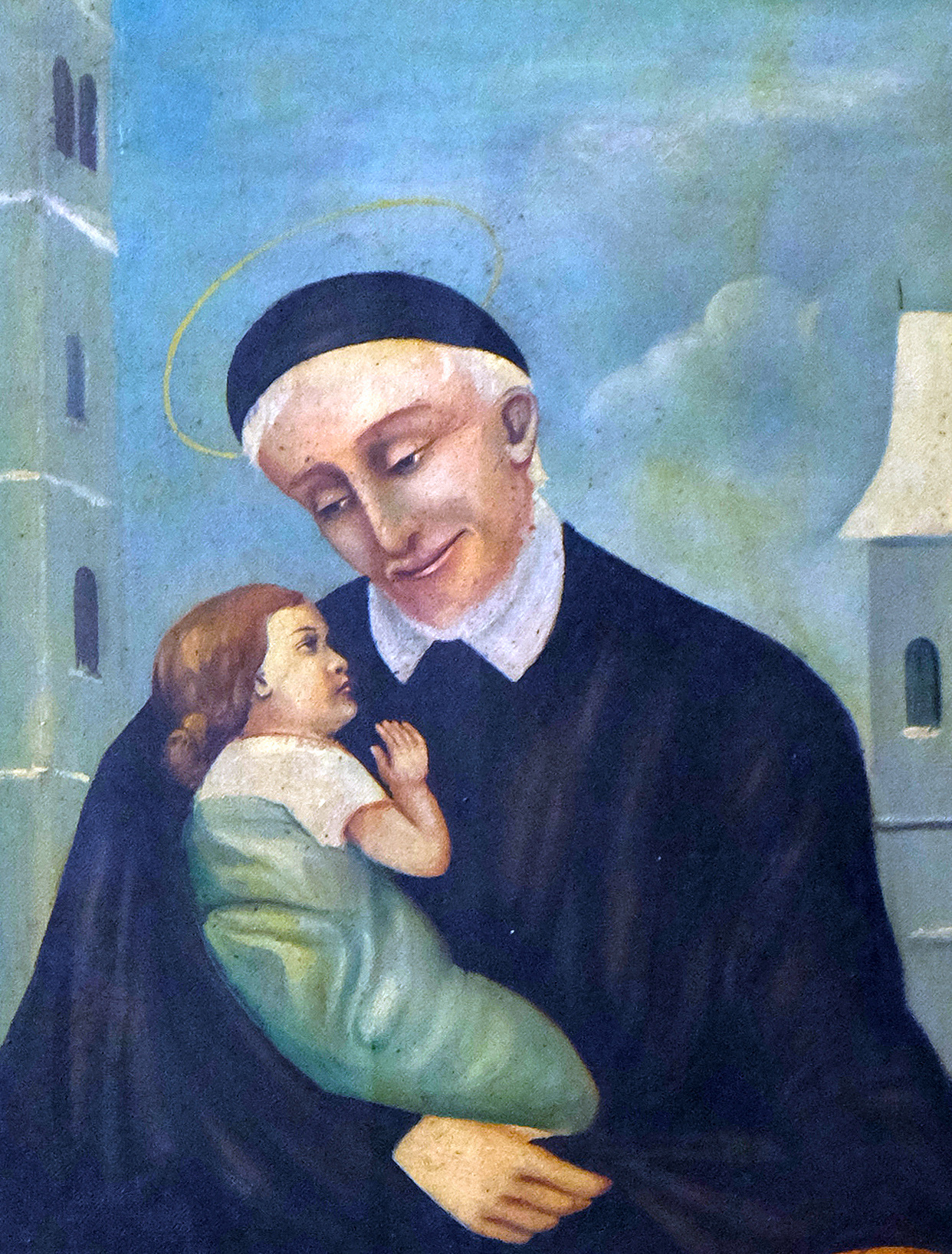
+Feast of St. Vincent de Paul+
The articles we have presented here over the past several weeks boil down to two things, in the end: refusal to obey the Roman Pontiffs and an inability to recognize and call out heresy. Some will say, well that was Pope Pius XII’s job. But they could say it also of Popes Liberius and Honorius, and they were not held by the Church, in the end, to be heretics or even certainly blameworthy, in the opinion of some theologians. The pope is the one person in all this who is immune from heresy. He received the charism of infallibility only in matters of faith, morals and discipline (Vatican Council). If he declares a man a heretic, he is definitely a heretic, and we must accept this. If he fails to condemn a man for something we believe to be heresy, but he has not yet determined is heresy, that is a different story. It does not mean he is wrong in not condemning such individuals or that we are wrong in our perceptions either. He may have reasons for not condemning them that we know nothing about and cannot even imagine.
It is the condemnation of a heretic that would be infallible; the lack of a condemnation is a moral fault concerning the pope and a grave sin if he is culpable, but we are not allowed to judge the pope. This goes to impeccability as we explained in another blog. All that Cum ex Apostolatus Officio states is that if it ever “appears” that a pope has “strayed from the faith or fallen into some heresy,” then he is assumed to have been a heretic pre-election. In no way could this ever appear to apply to Pope Pius XII, although certain vicious Traditionalist factions have alleged this. Under Canon Law, only the pope can judge whether bishops or cardinals are heretics, when we have a pope; the only reason we are able to judge the cardinals and bishops today is out of sheer necessity, because we have no pope. And even then, in doing so we must strictly abide by Canon Law according to Vacantis Apostolicae Sedis.
The bishops and cardinals could publicly accuse a pope of heresy or of dereliction of his duty, and ask for a retraction or clarification, as they did with Pope John XXII concerning the Beatific Vision. But no such public event ever occurred in the case of Pope Pius XII. The clearly heretical intent of the cardinals and bishops only manifested itself with the election of Roncalli, whom they knew would support their ecumenical heresies. And that is exactly what happened. I have never insinuated that Pope Pius XII’s will was so attenuated by Montini and his other advisors that they actually controlled all that he did. Persuasion and indirect influence are not the same as someone running the show in the name of a pope, as some have observed is happening with the U.S. government today. That did not happen with Pope Pius XII. They attempted to sway him, and to a certain extent, in some cases, they were successful; but in others they were not. More on this in a separate article soon to be posted.
First, the cardinals violated Vacantis Apostolicae Sedis (VAS) by ignoring Roncalli’s suspected heresy, and Roncalli and an undetermined number of other cardinals incurred censures which could only be lifted by a FUTURE pope, barring them from election. That they elected him anyway was itself a heresy, for it not only violated VAS, and nullified their actions, but also denied the teachings that the pope must be canonically elected, that is according to the existing law. Errors against this teaching are condemned (see Denzinger’s, nos. 570 d, 650, 652, 674; also Canons 147 and 219). Then, in accepting him as a true pope, they also incurred schism, creating a new church with a false head. And later, in joining in “worship” of him and with him, they committed communicatio in sacris (Can. 2314 §3).
The same is true of the bishops, who should have known on approving and accepting the missalettes, if not before. And it must be understood that these missalettes were distributed all over the Unites States, at least, for they were in the pews of our parish church in Kansas by 1959. And as noted previously, the liturgical movement was international. Under Can. 2200, the bishops are ALL considered heretics the moment they accepted Roncalli as pope, since none ever left him. On this application of Can. 2200, even St. Thomas Aquinas agrees: “Concerning such things, anyone may have a false opinion without danger of heresy, before the matter has been considered or settled as involving consequences against faith, and particularly if no obstinacy be shown; whereas when it is manifest, and especially if the Church has decided that consequences follow against faith, then the error cannot be free from heresy. For this reason many things are now considered as heretical which were formerly not so considered, as their consequences are now more manifest” (Summa Theologica, Q. 32, Art. 4, Pt. I). Malice and obstinacy are presumed in the case of those who are obligated to know the laws and teachings of the Church. Their external acts convict them of schism and heresy and they are outside the Church.
The Oath Against Modernism
EVERYTHING that happened in 1958-59 can be laid up to the fact that the cardinals and bishops violated the oaths they took at their episcopal consecration to: “…be obedient to Blessed Peter the Apostle, and to the holy Roman Church, and to our Holy Father, Pope …. and to his successors CANONICALLY ELECTED. I will assist them to retain and to defend the Roman Papacy…”; in their oaths on acceptance of the Cardinalate: “For the praise of Almighty God and the honor of the Apostolic See, receive the red hat… By this you are to understand that you must show yourself fearless, even to the shedding of blood, in making our holy Faith respected, in securing peace for the Christian people and in promoting the welfare of the Roman Church…” and at the election of the pope (see Vacantis Apostolicae Sedis, para. 12a). Add to this the Oath Against Modernism, contained in every book of Canon Law and required to be professed by all the bishops. Monsignor Joseph C. Fenton wrote on this topic as follows, quoting from Pope St. Pius X’s Oath Against Modernism:
“We believe that no bishop is ignorant of the fact that the wily Modernists have not abandoned their plans for disturbing the peace of the Church since they were unmasked by the encyclical Pascendi dominici gregis. For they have not ceased to seek out new recruits and to gather them into a secret alliance. Nor have they ceased, along with their new associates, to inject the poison of their own teachings into the veins of the Christian body-politic by turning out anonymous or pseudonymous books and articles. If, after a re-reading of the above-mentioned encyclical Pascendi: “If this audacity, which has caused Us so much grief, be considered very carefully, it will become quite apparent that these men are just as the encyclical describes them: enemies who are all the more to be feared by reason of their very nearness to us. They are men who pervert their ministry in such a way as to bait their hooks with poisoned meat in order to catch the unwary. They carry with them a form of doctrine in which the summary of all errors is contained. While this plague is spreading abroad over that very part of the Lord’s field from which the best fruits might be expected, it is the duty of all Bishops to exert themselves in defense of the Catholic faith and most diligently to see to it that the integrity of the divine deposit suffers no loss.
“What these men were really working for was the transformation of the Catholic Church into an essentially non-doctrinal religious body. They considered that their era would be willing to accept the Church as a kind of humanitarian institution, vaguely religious, tastefully patriotic, and eminently cultural. And they definitely intended to tailor the Church to fit the needs and the tastes of their own era… What they sought was a declaration on the part of the Church’s magisterium to the effect that these old formulas did not, during the first decade of the twentieth century, carry the same meaning for the believing Catholic that they had carried when these formulas had first been drawn up. Or, in other words, they sought to force or to DELUDE the teaching authority of Christ’s Church into coming out with the fatally erroneous proposition that what is accepted by divine faith in this century is objectively something different from what was believed in the Catholic Church on the authority of God revealing in previous times.
“’All these prescriptions, both Our own and those of Our predecessor, are to be kept in view whenever there is a question of choosing directors and teachers for seminaries and for Catholic universities. Anyone who in any way is found to be tainted with Modernism is to be excluded without compunction from these offices, whether of administration or of teaching, and those who already occupy such offices are to be removed…’ (end of Pope St. Pius X quotes).
Monsignor Fenton comments:
“In other words, the obligation of the individual Bishop to exclude Modernists and sympathizers with Modernism from the administrations and from the professorial staffs of seminaries and of Catholic universities definitely did not begin with the first promulgation of this law by St. Pius X. Given the position and the obligation of the Bishop within the true Church of Jesus Christ, and given the nature and the necessity of the Catholic faith, it is always the clear duty of the Bishop to exclude from the dignity of teaching in the Church in any position under his control any individual who will teach or favor the contradiction of the divinely revealed message. Modernism was and is such a contradiction. Thus it was and always will necessarily remain the duty of the Bishop to see to it that any individual who teaches or who supports Modernism in any way be excluded from any co-operation in the apostolic task of teaching the divine message of Jesus Christ within His Church.
“In the Si diligis, Pope Pius XII explains the directives issued by St. Pius X in the Pascendi and in the Sacrorum antistitum. The members of the apostolic hierarchy of jurisdiction, the Pope and the residential Bishops throughout the world are responsible before God Himself for the teaching in the Catholic Church. All the legitimate teaching in the Church is issued by them or under their direction. They have full responsibility and full competence to see to it that the faithful of Christ receive His message in all of its purity and integrity.Naturally if they themselves contradict, or transform, or withhold any portion of the revealed truth, which has been entrusted to them, they will have been recreant to the commission they have received from Our Lord Himself. … The man who takes the Oath calls upon God as His Witness that he rejects these false judgments and firmly accepts the statements of Catholic doctrine opposed to them. The man who taught or in any way aided in the dissemination or the protection of Modernistic teachings in a seminary or in a Catholic university after the issuance of the Sacrorum antistitum would mark himself, not only as a sinner against the Catholic faith, but also as a common perjurer.” (“Sacrorum Antistitum and the Background of the Oath Against Modernism,” Catholic University of America Press, October 1960. End of Fenton quotes.)
And perjury goes directly to the “…silence, subterfuge or manner of acting” which signals “an implicit denial of their faith, a contempt of religion an insult to God or scandal to their neighbor,” the very definition of heresy found in Can. 1325. But eventually, of course, their heresy became undeniably explicit.
That someone as astute as Msgr. Fenton could not see Modernism’s full impact, even in 1960, testifies to the fact that the campaign to destroy the Church was so well disguised, had gone so deeply underground, that until Roncalli was elected the extent of its true damage was almost imperceptible. Msgr. Fenton would later comment in his diary, while attending the first session of the false Vatican 2 council: “The sense or feeling of this gathering seems to be entirely liberal. I am anxious to get home. I am afraid that there is nothing at all that I can do here. Being in the council is, of course, the great experience of my life. But, at the same time, it has been a frightful disappointment. I NEVER THOUGHT THAT THE EPISCOPATE WAS SO LIBERAL…” (Oct. 31, 1962). Perhaps in a way, Msgr. Fenton had lived too long in an ivory tower, as so often happens with those in academia, and had entirely lost touch with the episcopacy. But it is also likely that the bishops had been careful not to reveal overt signs of their liberalism/ Modernism. After all, that is precisely how double-agents operate.
So if anyone wishes to know why these bishops were already rotten to the core, the answer is stated above. Modernism never left the Church. It simply went more deeply underground. It lurked in the shadows and hid under false pretenses. After Pope Pius XII became ill and began to decline in 1953, it moved in for the kill. As one Catholic theologian explained it: ”Careless, unprecise departures from traditional and enshrined doctrinal expressions have a way of coming back like boomerangs upon the unsuspecting pious, whose enthusiasms are not always as contagious as their errors. Storms do not spring forth from a clear, unclouded sky. Movements spring forth from ideas and even from clever shibboleths and catch phrases” (“The Historical Backgrounds and Theology of Mediator Dei,” by Albert F. Kaiser, C.P.P.S., Pt. 1; American Ecclesiastical Review, December,1953). Men secretly working behind the scenes had everything ready to implement their plans the moment Pope Pius XII breathed his last; and they did. And their years of secret preparation paid off handsomely.
All Catholics must hate heresy
It is appropriate here to remind Catholics that not only must they study their faith in order to learn to recognize heresy and flee the moment they detect it; they must also pray for the gift of piety, that they may hate it. Why this is true is explained below.
“These men falsify the oracles of God, and prove themselves evil interpreters of the good word of revelation. They also overthrow the faith of many, by drawing them away, under a pretence of [superior] knowledge, from Him who rounded and adorned the universe; as if, forsooth, they had something more excellent and sublime to reveal, than that God who created the heaven and the earth, and all things that are therein. By means of specious and plausible words, they cunningly allure the simple-minded to inquire into their system; but they …and these simple ones are unable, even in such a matter, to distinguish falsehood from truth…” — St. Irenaeus, Against the Heresies
“In Christ’s Church, those are heretics, who hold mischievous and erroneous opinions, and when rebuked that they may think soundly and rightly, offer a stubborn resistance, and, refusing to mend their pernicious and deadly doctrines, persist in defending them.” — St. Augustine of Hippo
“What, then, shall a Catholic do … If some novel contagion attempts to infect, no longer a small part of the Church alone but the whole Church alike? He shall then see to it that he cleave unto antiquity, which is now utterly incapable of being seduced by any craft or novelty.” — St. Vincent of Lerins’ Commonitorium
“[Heretics] mean one thing in their heart; they promise another with their lips. They speak with piety and conceal impiety. They speak Christ and hide the Antichrist, for they know that they will never succeed with their seduction if they disclose the Antichrist. They present light only to conceal darkness; through light they lead to darkness.” St. Jerome, Homilies on the Psalms
“The declared enemies of God and His Church, heretics and schismatics, must be criticized as much as possible, as long as truth is not denied… It is a work of charity to shout: “Here is the wolf!” when it enters the flock or anywhere else.” — St. Francis de Sales, The Devout Life
“And therefore it is that everyone who has in him the gift of piety has also an instinctive hatred of heresy. The instinct which detests and recoils from heresy is part of the gift of piety, because piety loves the revealed truth of Jesus Christ. We are thought to be intolerant and bigoted, because we will keep no peace with heresy. But how can any man love Jesus Christ, and not love every jot and tittle of His truth? And if we love His truth, that which contradicts it must be hateful, for it contradicts Himself.” — Henry Cardinal Manning, The Internal Mission of the Holy Ghost, p. 236.
Fr. Frederick Faber on Heresy
“If we hated sin as we ought to hate it, purely, keenly, manfully, we should do more penance, we should inflict more self-punishment, we should sorrow for our sins more abidingly. Then, again, the crowning disloyalty to God is heresy. It is the sin of sins, the very loathsomest of things which God looks down upon in this malignant world. Yet how little do we understand of its excessive hatefulness! It is the polluting of God’s truth, which is the worst of all impurities.
“Yet how light we make of it! We look at it and are calm. We touch it and do not shudder. We mix with it and have no fear. We see it touch holy things, and we have no sense of sacrilege. We breathe its odor and show no signs of detestation or disgust. Some of us affect its friendship; and some even extenuate its guilt. We do not love God enough to be angry for His glory. We do not love men enough to be charitably truthful for their souls.
“Having lost the touch, the taste, the sight, and all the senses of heavenly-mindedness, we can dwell amidst this odious plague, in imperturbable tranquility, reconciled to its foulness, not without some boastful professions of liberal admiration, perhaps even with a solicitous show of tolerant sympathies.
“Why are we so far below the old saints, and even the modern apostles of these latter times, in the abundance of our conversations? Because we have not the antique sternness? We want the old Church-spirit, the old ecclesiastical genius. Our charity is untruthful, because it is not severe; and it is unpersuasive, because it is untruthful.
“We lack devotion to truth as truth, as God’s truth. Our zeal for souls is puny, because we have no zeal for God’s honor. We act as if God were complimented by conversions, instead of trembling souls rescued by a stretch of mercy.
“We tell men half the truth, the half that best suits our own pusillanimity and their conceit; and then we wonder that so few are converted, and that of those few so many apostatize.
“We are so weak as to be surprised that our half-truth has not succeeded so well as God’s whole truth. Where there is no hatred of heresy, there is no holiness.
“A MAN, WHO MIGHT BE AN APOSTLE, BECOMES A FESTER IN THE CHURCH FOR THE WANT OF THIS RIGHTEOUS INDIGNATION.” — Fr. Frederick Faber, The Precious Blood, 1860
Conclusion
So it is now clear: Only those lacking true piety make excuses for cardinals and bishops, commissioned as defenders of the faith, who defect from that very faith. As Louis Cardinal Pie, the ultramontane friend of Henry Cardinal Manning, stated in one of his sermons: “The first requirement for holiness is orthodoxy.” Cardinal Pie also remarked: “Everything has to be redone to create a Christian people: this will not happen by a miracle or by a series of miracles especially; it will be through the priestly ministry, or it will not happen at all, and then society will perish… The true dignity, the true liberty, the true emancipation of modern nations lies in their right to be governed in a Christian manner… The time has not come for Jesus Christ to reign? Well, then the time has not come for governments to last” (Cardinal Pie, meeting with Emperor Napoleon III). Cardinal Pie died in 1865.
With this blog we end the discussion of the bishops and when they first fell into heresy. In the next few weeks, for those who are yet interested, we will post articles on the site under the Papacy and the Mass which will track the gradual development of the Novus Ordo Missae over time, explaining how it was intended to democratize the Church and prepare the way for the New World Order. Links to these articles will be provided in future blogs.
by T. Stanfill Benns | Jul 13, 2023 | New Blog
+St. Anacletus, Pope and Martyr+
Some readers have expressed almost disbelief that the “for all men” in the consecration of the wine could have been printed in the 1959 missalettes and been openly approved (or ignored) by the bishops; and that after all these years, this is just now coming to light. But this was first made public on my site in an article entitled Death Knell for “Good Pope John,” which was later retitled and rewritten. I myself only became aware of it in 2004, and this almost by accident. At the time, like everyone else, related it only to the aberrations revolving around the Mass. This because I already had proven that Roncalli was invalidly elected and all the clergy were excommunicated and unable to function. Greater emphasis now needs to be placed upon this find to prove to those still in doubt that the bishops were complicit in all the Vatican 2 changes, lost their offices under Can. 188 n. 4 through heresy and schism in January 1959 and violated the oath they took at their consecration to obey the pope and defend the faith.
Some have asked why the date of the Great Apostasy even matters, but truth always matters. Perhaps we should ask the question: Why didn’t those championing the Mass early on, or those who exited the NO and followed them into the Traditionalist movement ever notice it? The man who wrote the most comprehensive study of the “for all men,” Patrick Henry Omlor, did not write his work until 1967-68, when “for all men” debuted in the U.S., even before Paul 6 made it official in 1969. That happened on October 22, 1967, Black Sunday, when the U.S. bishops first introduced the revised Vatican 2 “mass,” with a vernacular canon containing the words “for all men.” What is striking about Omlor’s singular work The Robber Church, is that it clearly states that:
“THIS “FORM” IS HERETICAL. Since UNTO denotes efficacy, this ‘form’ says that the benefits of Christ’s Passion are actually communicated to ALL MEN UNTO the forgiveness of sins. And this is contrary to faith… The mutilation in question (to wit, ‘FOR ALL MEN SO THAT, etc.’) is a forgery of Christ’s words recorded in Holy Writ… St. Thomas Aquinas defines HERESY as ‘a species of unbelief, belonging to those who profess the Christian faith, but corrupt its dogmas.’” (Summa Theol., II-II, Q. 11, Art. 1).”
What is most notable here is that throughout his work, Omlor applies these words only to the invalidity of the consecration. Nowhere does he even so much as intimate that the men promoting such a blatant heresy could themselves be rank heretics. There is a sense of outrage only that the Mass is violated and mutilated. In other words, he entirely misses the point. And it demonstrates that even someone such as Omlor, seminary and college educated prior to Vatican 2, was clueless regarding the true hierarchical structure of the Church, its inner workings, and the devastating implications of such a heresy.
That bishops could allow Christ’s very words to be falsified and remain blameless is a travesty, one that obviously prevails even now. And this after decades of proofs that the destruction was the result of careful planning, engineered by Masonic agents of the Devil, who long ago infiltrated the Church. The denial of this infiltration and the full realization of its consequences is what keeps many confused and attached to Traditionalist groups. So below we will try to explain why the laity did not recognize the treachery in the 1959 missalettes, and why the liturgy was the very bait used to deceive them.
Michael Davies on the Liturgical Movement
I am no fan by any means of Michael Davies but what he says here is an example of Baalim’s ass speaking the truth. “Crushed by St. Pius X, the Modernists understood that they could not penetrate the Church by theology, that is, by a clear exposé of their doctrines. They had recourse to the Marxist notion of praxis, having understood that the Church could become modernist through action, especially through the sacred action of the liturgy. Revolutions always use the living energies of the organism itself, taking control of them little by little and finally using them to destroy the body under attack. It is the well-known process of the Trojan horse.” Wikipedia defines Marxian praxis as “…concrete practical activity that directly influences social life;” the belief that “theoretical contradictions can only be resolved through practical activity…doing something, and then only afterwards, finding out why you did it… trusting experience, before institution or dogma” – Wiki). This “experience” is addressed by Pope St. Pius X in his encyclical Pascendi dominici gregis as follows:
“…Given this doctrine of experience united with the other doctrine of symbolism, every religion, even that of paganism, must be held to be true. What is to prevent such experiences from being met within every religion?… But this doctrine of experience is also under another aspect entirely contrary to Catholic truth. It is extended and applied totradition, as hitherto understood by the Church, and destroys it.” The Pope goes on to explain that by appealing to human traditions via the power of suggestion, the Modernists would then involve people in experiencing their religion (greater lay involvement) and in this way attract both new converts and awaken the “sluggish.” And this they accomplish both by “books and oral transmission.”
Kinkead’s Baltimore Catechism no. 3 lists approved “books of worship” as belonging to revealed Traditions in the Church (Q. 560). So the reformers went straight for Tradition, knowing that Catholics were generally uneducated in dogma, (as St. Pius X pointed out in Acerbo Nimis) and also knowing that many of them wanted a more active role in the Mass. This to appeal to the “sluggish” and attract others to the faith who were put off by Latin and passive attendance at Mass. And so by preaching and encouragement, beginning in the 1920s, clergy and religious fostered the idea of liturgical reform, eventually holding annual liturgical conferences and organizing groups (promoting these changes. This rather than focusing, as Pope St. Pius X and his successors urged, on education in Church teaching and participation in the forms of Catholic Action that promoted catechesis. And yet as Davies noted in the 1970s, “…most Catholics know very little about the liturgical movement.”
The groundwork already had been laid; the bottom rungs of the Masonic pyramid accomplished. Materialism had eroded the Catholic ideal of self-denial over time and Catholic and Protestant Liberalism emerged en force in the late 1800s. The Great Depression and the war years only hastened the spread of these two errors. Then came the push for liturgical reform, accomplished in increments. This is nothing more than gradualism, another Marxian tool based on evolutionary principles used to facilitate change: “In politics and society, gradualism is the theory that social change can be achieved in small, discrete increments,” rather than sudden eruptions, such as revolutions or uprisings. In other words, heat the water very slowly, little by little, to boil the frog. “Gradualism is one of the defining features of political liberalism and reformism,” and reformism is defined as “…a political doctrine advocating the reform of an existing system or institution instead of its abolition and replacement” (Wikipedia).
In condemning excesses in liturgical reform in Mediator Dei, Pope Pius XII brought the reformers resorting to methods of praxis and gradualism up short, writing: “The entire liturgy has the Catholic Faith for its content…. For this reason whenever there was a question of defining a truth revealed by God, the Sovereign Pontiff and the Councils, in their recourse to ‘theological sources,’ as they are called, have not seldom drawn many an argument from this sacred science of the Liturgy…[Lex orandi, lex credendi]: The rule for prayer determines the rule for belief.’ [However] The Sacred Liturgy does not decide or determine independently and of itself what is of Catholic Faith… If one desires to differentiate and described the relationship between faith and the Sacred Liturgy IN ABSOLUTE AND GENERAL TERMS, it is perfectly correct to say…‘let the rule of BELIEF determine the rule of prayer.’”
In other words, only the pope may determine what is of Catholic faith; As Pope Pius XII also taught in Sacramentum Ordinis: “The Church has no power over the substance of the Sacraments; i.e., over those things which, with the sources of divine revelation as witnesses, Christ the Lord Himself decreed to be preserved in a sacramental sign.”
Davies continues: “After the Second World War, the movement became a force that nothing could stop. Protected from on high by eminent prelates, the new liturgists took control little by little of the Commission for Reform of the Liturgy founded by Pius XII, and influenced the reforms devised by this Commission at the end of the pontificate of Pius XII and at the beginning of that of John XXIII. Already masters, thanks to the Pope, of the pre-conciliar liturgical commission, the new liturgists got the Fathers of the Council to accept a self-contradictory and ambiguous document, the constitution Sacrosanctum Concilium. Pope Paul VI, Cardinal Lercaro and Fr. Bugnini, themselves very active members of the Italian Liturgical Movement, directed the efforts of the Consilium which culminated in the promulgation of the New Mass.
“How could Pope Pius XII, the Pastor Angelicus, the most scholarly Pope of the century, and one whose orthodoxy could not possibly be questioned, have allowed the young wolves of the liturgical movement to consolidate their power during his pontificate? Father Bonneterre makes it clear that this saintly pontiff was well-aware of the subversive elements within the Liturgical Movement. In His encyclical Mediator Dei, perhaps the most sublime exposition of the true nature of the Mass ever to be written, Pope Pius wrote: “We observe that certain people are too fond of novelty and go astray from the oaths of sound doctrine and prudence…. They sully this sacred cause with errors, errors which affect the Catholic faith and ascetical teaching.” Father Bonneterre insists that, alas:
“‘Pope Pius XII did not know the true position of the Liturgical Movement. Its most dangerous leaders were being supported and protected by the highest dignitaries of the Church. How could the Pope have suspected that the “experts” who were so highly praised by Cardinals Bea and Lercaro were, in fact, the most dangerous enemies of the Church? …The news of the death of the Angelic Pastor was received with almost delirious joy by the deviated Liturgical Movement.” The aged Dom Lambert Beauduin had not the least doubt as to the cardinal he hoped would be elected, and confided his hopes to Father Bouyer: ‘If they elect Roncalli,’ he said ‘all will be saved. He will be capable of calling a Council and canonizing ecumenism…’ Silence fell; then, with a return of his old mischievousness, he said with flashing eyes, ‘I believe we have a good chance. Most of the cardinals are not sure what to do. They are capable of voting for him.’” (The Destruction of the Traditional Roman Rite; Davies quotes end here.)
As noted in our June 23 blog, Beauduin and Roncalli were known to be friends. If Pope Pius XII had been the advocate for the type of liturgical reform the progressives desired, why would they have been delirious with joy at his death? No, the liturgical reform was merely a prelude to the theological reform that would succeed it, and “for all men” was the mantra which would be the key to transforming not just the liturgy, but the very scope of Catholic theology.
Whence cometh the theology behind “for all men”?
It seems the fear of Communism drove Pope Pius XII to cast the Church’s lot with America, which he believed was dedicated to fighting Communism and to winning the fight. This explains why the pope seemingly tolerated the installation of the OSS-funded Pro Deo group headed by the suspected CIA operative Fr. Felix Morlion, O.P., a friend of the man who was rewarded by the Pope for having done the Vatican a great service during the war years — William “Wild Bill” Donavan. Morlion, with Giovanni Baptiste Montini’s assistance, established his intelligence service, Pro Deo, in the Vatican. This occurred in 1944 during WWII, once Rome was liberated from the Nazis. Montini had been collaborating with the OSS using priests in various countries as spies, however, long before Pro Deo’s move to Rome (Messianic Legacy, Lincoln Leigh and Baigent, 1986). And it was precisely at this very time that the liturgical movement began to explode. It is no coincidence that Morlion would later figure into the very heart of the ecumenist movement and would play a major role in the theology that would emerge from the false Vatican 2 council.
In The Phantom Church of Rome, I went into great detail regarding the extent of what the American government called doctrinal warfare, first implemented in 1953. In his book John Courtenay Murray, Time/Life, and the American Proposition, international attorney David Wemhoff described it as a “planned attack against a basic hostile doctrinal system” combined simultaneously with a propaganda-style campaign to promote socially acceptable religious ideals. Originally developed as a program to combat Communism, it was redesigned to primarily target (religious) “decision makers and their staffs.” It grew “out of the propaganda agencies of World War II,” agencies that were later coordinated from the Vatican by then pro-secretary of state Giovanni Montini. Using Montini’s contacts, priests and other clergy engaged in teaching positions were employed to pump neo-Modernist poison into the veins of the Catholic intelligentsia. And who was one of those well-versed in at least the campaign to combat the spread of Communist ideology? None other than Felix Morlion.
A later-released 1957 intelligence document reveals that: “Felix A. Morlion, O.P., is a Belgian who became a Dominican after engineering studies at Louvain. He served for Psychological Warfare Activities in the United States from 1941-44 with other leaders of anti-totalitarianism. He was first on the Nazi blacklist for his Brussels International Pro Deo Center. The impact of the American way of life brought him and his associates to plan the creation of a university to apply the philosophy of the American Founding Fathers to the international promotion of democracy under God.” It was Morlion, Wemhoff relates, who first hosted the promulgation of the American proposition at Pro Deo University in November of 1953. It was a much-awaited reversal of Pope Leo XIII’s condemnation of Americanism, seemingly coming from the Church Herself. Embattled as She was, it appeared that a Catholic institution endorsed democracy as the savior of the world and a governmental system that would be acceptable to, and even protective of, the Catholic faith.
Democracy and the Novus Ordo church
We wonder today why democracy is touted as the only acceptable system of government in the world, without understanding how those barriers were first beaten down by those who would later canonize it at the false Vatican 2 council. So now we know. The infamous “innocent “ cardinals would do nothing to oppose the American proposition and later would approve Dignitatus Humanae on Dec. 7, 1965, almost unanimously. The U.S. branch of Pro Deo was headed up by Francis Cardinal Spellman (Wemhoff, p. 367). Spellman also was the de facto head of the Knights of Malta, its “protector and spiritual advisor” (Messianic Legacy). Later Pope Pius XII would refuse to appoint a new head for the Knights of Malta, setting up a commission to determine if they had been infiltrated by Freemasons. The K of M remained headless until after Pope Pius XII’s death, when Roncalli appointed a new head for the group.
Henry Luce, owner of Time magazine and the tireless promoter of John Courtney Murray’s American proposition, taught by Morlion at his university, is featured with Murray as the antagonists in Wemhoff’s book. It was the American proposition that Msgr. Joseph C. Fenton and his one-time boss Rev. Francis J. Connell so strenuously opposed at the false Vatican 2 council. Murray’s proposition was best summarized in a 1999 Crisis magazine article: “Murray claimed that America was a pluralistic society divided into four disparate camps: Protestant, Catholic, Jewish, and secularist [as also described in Protestant, Catholic, Jew by the Jewish theologian Will Herberg in 1955]. For all Americans, the First Amendment’s clauses amounted to “articles of peace” that enabled them all to coexist. Murray wanted more than mere coexistence, though. He hoped that Americans would rediscover the natural law and use it.” This in direct contradiction to Catholic teaching. As Fr. Francis Connell insisted, the Church must preach Christ’s message to all nations, America included, and civil authorities must recognize Christ as their true King.
Murray was censured by the Holy Office in July 1955, but the fact was not widely broadcast. As a 2008 article published by the liberal Catholic World later revealed : “[T]he Holy Office was preparing an official condemnation… of Jacques Maritain and another architect of the Council, John Courtney Murray, also others who played a role in… the Declaration on Religious Liberty…… only the death of Pope Pius XII on October 8, 1958… prevented this from happening.”(Catholic World, “Censuring of John Courtney Murray Part Two,” by Robert Nugent; March/April 2008) “…In the spring of 1963, during a break in the Council, Murray was still persona non grata in some quarters. Murray, along with Godfrey Diekmann, Gustave Weigel and Hans Kung, was barred from speaking at the Catholic University of America at the urging of the Apostolic Delegate to the U. S. (1958-1967) Egidio Vagnozzi. Finally, on April 4, 1963, at the insistence of Cardinal Francis Spellman, Murray received his official invitation to attend the Council as a peritus and later served as the chair of the commission drafting the document on religious liberty.”
That document on human liberty, Dignitatis humanae, states: “The declaration of this Vatican Council on the right of man to religious freedom has its foundation in the dignity of the person, whose exigencies have come to be fully known to human reason through centuries of experience… It follows that a wrong is done when government imposes upon its people, by force or fear or other means, the profession or repudiation of any religion, or when it hinders men from joining or leaving a religious community. All the more is it a violation of the will of God and of the sacred rights of the person and the family of nations when force is brought to bear in any way in order to destroy or repress religion, either in the whole of mankind or in a particular country or in a definite community.” In other words, no one would be able to identify anyone as a heretic in a Catholic country and Church authorities would not be able to discipline him, nor enjoin the civil arm to arrest them and prevent error from being taught to the faithful.
Given the above, a Martin Luther would be allowed free rein even in a Catholic state, and no one could prevent him from ensnaring Catholics. The democratic notion that: “religious freedom has already been declared to be a civil right in most constitutions, and it is solemnly recognized in international documents” supersedes the teaching of the Church and places Catholics under the civil rule of democracy worldwide. Yes, centuries of experience that have witnessed the fatal promotion of democracy as the only government compatible with free exercise of religion — free meaning the RIGHT to choose to believe and promote error. This despite all the papal condemnations of errors arising from democracy. And to call a council in the face of the ONLY Vatican Council, and despite the refusal of previous popes to do so, was sheer madness. Below find a summary of thinking that guided both Pope Pius XI and Pius XII NOT to call such a council, taken from the work of Joseph A. Komonchak, co-author of the work, The History of Vatican II.
The dangers of an ecumenical council
[Joseph de Maistre, in his work The Pope wrote]: “’I never saw a council assembled without danger and inconvenience…. To speak truly, I must say that I avoid, as much as I can, assemblies of priests and bishops; I never saw so much as one concluded in a happy and agreeable manner, and which did not tend rather to increase evils than to remove them’ (St. Gregory Nazienzen)… The more enlightened the world becomes, the less will a general council be thought of. There have just been twenty-one the whole time since the origin of Christianity, which would give about one general council to each period of eighty years; but we see that for two centuries and a half religion has done very well without them; and I do not believe that any one thinks of them, notwithstanding the extraordinary wants of the Church, for which the Pope will provide much better than a general council, if men only understand how to make use of his power. The world is become too great for general councils, which seem only to have been intended for the youth of Christianity…” (Caprile’s Il Concilio Vaticano II, V [Rome: Ed. “La Civiltà Cattolica,” 1969], 681-701), cited from the latter, 692).
Earlier Caprile had summarized Billot’s view: “Providence itself, in his opinion, took it upon itself to close the Vatican Council by means of a series of well-known events. It thus appears to have wanted to make us see that, with the definition of pontifical infallibility, the age of Councils is terminated, since they are ‘so expensive, so inconvenient, so full of difficulties and dangers of every sort… [Cardinal Billot said in full]: “Finally, here is the most serious reason, the one which would seem to me absolutely to militate for a negative reply. Resuming the Council is desired by the worst enemies of the Church, the modernists, who are already getting ready — as quite certain indications reveal — to profit from the estates general of the Church in order to make revolution, a new 1789, the object of their dreams and hopes.
“They will not succeed, of course, but we would see again those very sad days of the end of the pontificate of Leo XIII and of the beginning of that of Pius X; we would see things even worse, and it would annihilate the happy fruits of the Encyclical Pascendi which silenced them all.” Billot was also especially fearful that “…the proportion, considerable both in numbers and in means of action, of the Irish-American element in Council, would introduce procedures of discussion and propaganda more in accord with democratic usage than with ecclesiastical traditions.” Cardinal Bonzano was concerned about “the danger that a certain number of bishops, especially foreigners, would try to emphasize their own rights, in opposition to the prerogatives of the primacy of the Supreme Pontiff, under the pretext that Rome centralizes too much” (Caprile, V, 688). ‘” Komonchak observes:
“Councils are no longer necessary, are too expensive, and too full of difficulties and dangers, that there were no matters which either had not already been dealt with by the popes or could not be dealt with by them in the future, and that the unsettled state of the Roman Question made it unwise to hold a Council, which would demonstrate the ability of the pope to carry out his task even without the temporal power. Other reasons advanced against the idea of the Council included the political and psychological conditions of the world (particularly nationalism among the hierarchies), certain dangerous tendencies among the bishops and clergy (modernism, democracy, episcopalism [better understood as Gallicanism]), a lack of theological preparation and skills, the technical and financial difficulties, and the fear of how the press would exploit a Council.”
“Information about the idea of an ecumenical council during the reign of Pope Pius XII was revealed late in 1959 by Cardinal Ernesto Ruffini. On October 28, 1959, in a lecture on the first year of Pope John’s pontificate, Ruffini wrote: ‘Twenty years ago, at the feet of Pius XII, I, the least of all priests, dared to call for an Ecumenical Council. It seemed to me to be urgently required by the circumstances, and that there was as much material to treat as the Council of Trent had had. The venerable Pontiff did not reject the proposal and took note of it, as he used to do on important matters. I know that he later spoke about it with other prelates, but Divine Providence reserved to his successor the difficult and arduous enterprise.’”
But Pope Pius XII did at least investigate the possibility of calling a council. “In March 1948, Monsignor Alfredo Ottaviani, Assessor of the Holy Office, discussed the subject with Pius XII, urging the need to clarify and define certain doctrinal points… The Pope stated some of the difficulties about calling a Council, but authorized some initial preparatory work, to be carried out secretly and within the Holy Office… Two weeks later, on March 15, 1948, Ottaviani presided over a meeting of six consultors and informed them of the pope’s charge. (Ibid. Komonchak and end of his quotes. See https://jakomonchak.files.wordpress.com/2012/01/pius-xi-pius-xii-on-a-council.pdf).
After calling for the preparatory work and pursuing the possibility, however, the council idea was abandoned. Pope Pius XII’s health was given as the reason, the pope being too compromised by his illness to withstand all the necessary preparatory work and other organizational details that would accompany such an effort. And perhaps the pope, like his predecessor, realized in the end — particularly after his vision of Christ and miraculous recovery from his poison-induced illness — that a council would not be the solution, but a great danger. In both sets of the preparatory council documents from Popes Pius XI and XII listed by Komonchak, there is not one mention of the liturgy or the Mass as a possible focal point; almost the entire focus was on doctrinal matters and a few social issues. This tells us what we need to know: first vacate the papacy, then destroy the Mass. We end with this warning from the Council of Trent:
“It is certain that the Church was instructed by Jesus Christ and His apostles and that all truth was daily taught Her by the inspiration of the Holy Ghost. Therefore, it is obviously absurd and injurious to propose a certain ‘restoration and regeneration’ for her as though necessary for her safety and growth, as if she could be considered subject to defect or obscuration or other misfortune. Indeed these authors of novelties consider that a foundation may be laid of a new human institution, and what St. Cyprian detested may come to pass, that what was a divine thing may become a human church.”
Conclusion
It must be remembered that throughout the Church’s history, the popes have, for better or for worse, relied upon the protection of various heads of state when outside forces threatened to disturb the Church’s autonomy. This happened particularly in the early days of the Church when the emperors assisted in selecting the pope and during the Avignon exile in France. Gradually all lay intervention was excluded. But throughout papal history, various countries and factions lent aid to the papacy and helped protect the pope. Pope Pius XII may have believed that the U.S. was a trustworthy ally at first, but later realized his mistake. He was convinced that the threat of atheistic Communism was of paramount importance and thought that American officials were fighting to curb this menace. Unfortunately he underestimated the extent of Masonic influence in this country and the vast inroads it had made into government. He also was the victim of an unparalleled disinformation campaign carried out by a coterie of Jesuit infiltrators who were advising him, something Msgr. Fenton refers to in his diaries.
The false Vatican 2 council was everything and much more than Pius XI and Pius XII had feared or Card. Billot had predicted. Modernism and democracy were canonized. The secret societies ruled those passing as popes, who were among their own members. The true Church was replaced by the Church of Antichrist. And the “innocent cardinals” made it all possible. In our previous blog it was noted that Ruffini, Ottaviani and certain “other cardinals” were the very ones who, once it appeared Roncalli would be elected, urged him to call a council (Bro. Michael of the Trinity, The Whole Truth About Fatima; Peter Hebblethwaite. See his work at: https://www.catechistcafe.com/books/john-xxiii-pope-of-the-century-by-peter-hebblethwaite-part-4). Given what Komonchak says above about the eagerness of Ottaviani and Ruffini to hold such a council, their visit to Roncalli prior to his election, based on Ottaviani’s own account, is credible. And we will go a little further here.
It seems to us that this established the necessary nexus that made Roncalli’s election possible. For according to the link above, Ruffini and Ottaviani visited Roncalli the day before his election to secure a promise the council would indeed be called. And surely that request for such a favor was accompanied by an offer to cast their votes for Roncalli; that is simply how things are usually done. And we are to believe these two so-called conservative cardinals were innocent?! We know Roncalli himself was a Mason, although this was learned only after his death. We also know Lienart was a Freemason and that Spellman was compromised. Ottaviani and Ruffini are now thrown into this mix. How many others were there who should never have been admitted to the Conclave?
The entire Wemhoff book, all 911 pages of it, is documented proof of what happened to the Catholic Church, when and how it happened and the absolutely incredible lengths those implementing its destruction were willing to go to in order to accomplish it. The intricate web of complicity Wemhoff reveals leaves no doubt that American Catholics especially were deliberately brainwashed and conditioned to believe what Vatican 2 later taught long before Pope Pius XII died. Their natural quietistic apathy and neglect to learn the faith on an adult level, their desire to be served rather than dedicate themselves to the service of God, their love of conformity was glaringly obvious and has been documented in such works as The Mystery of Iniquity by Rev. Paul Furfey and Peter Michaels’ This Perverse Generation, among other works.
As difficult as it may be to admit it, our parents and grandparents were largely oblivious to what was going on in the Church and chose to simply follow their pastors blindly. They had come to take the Church for granted. The few who did realize something was wrong were either ridiculed or ignored. Many of them gave up. The pastors being struck the flock was scattered, just as Our Lord predicted. We now must struggle each day to simply keep what we know of the faith alive, study to learn it completely to the best of our ability, sacrifice ourselves for our loved ones and the poor souls, ignore the chaos that surrounds us and pray for deliverance. Those coming from the outside to create that chaos must be excluded from our purview as much as possible, for involving us in their ridiculous reassessments of the situation only obscure the truth and disturb our hard-won peace. “…Rejoice, be perfect, take exhortation, be of one mind, have peace; and the God of peace and of love shall be with you” (2 Cor. 13:11).

by T. Stanfill Benns | Jul 7, 2023 | New Blog
+Sts. Cyril and Methodius+
Those insisting that one must “protect” Pope Pius XII from accusations of heresy by dating the Great Apostasy as the end of the false Vatican 2 council on Dec. 8, 1965, are ignorant of not only history, but papal teaching, Canon Law and proven facts. None of these have been sufficiently appreciated or understood, so below we will try to better explain their relevance to our particular place in time.
As already stated in the comments to a previous blog, Pope Pius XI judged Roncalli to be a “suspected” Modernist somewhere between 1924 and January of 1925, when he was relieved of his teaching position at the Lateran Seminary for his liberal and unorthodox views expressed to seminarians there. There also were concerns that he remained in touch with an old priest classmate who had been defrocked and excommunicated for teaching condemned doctrines. Yet Pius XI later approved Roncalli’s consecration as bishop in March of 1925. After Roncalli’s consecration, he was appointed titular archbishop and envoy to Bulgaria, and was later named apostolic delegate! That was considered a demotion for his suspected heresy, believe it or not, because Bulgaria was “a remote area in the Balkans” and he spent 20 years in that region, later serving in Turkey during World War II. As some Vatican officials said of Paul 6’s departure from the Vatican and appointment as archbishop of Milan under Pius XII, Roncalli’s so-called promotion may well have been “…the old device… in play again: Promoveatur Amoveatur: Let him be promoted that he may be removed” (William Barrett, Shepherd of Mankind: A Biography of Pope Paul VI, 1964, p. 235).
This easily demonstrates that the methods and decisions of the popes are beyond our ability to understand or judge. It is not to be wondered then that in 1943, Pope Pius XII appointed Roncalli nuncio to France, seeing that despite his predecessor’s concerns, Pius XI had not failed to appoint him to these previous positions. Roncalli’s elevation as cardinal in 1953 was a last-minute affair arranged by Montini who recommended him as a replacement for the ailing Patriarch of Venice, due to pass away at any time (he died in December 1952). That primate, Patriarch Carlo Agostini, had already been chosen as a cardinal, so in filling Agostini’s position, one usually associated with the cardinalate, Roncalli also took his slot in the naming of new cardinals. If Pope Pius XI, who listed Roncalli as a suspected heretic later made him an archbishop and an apostolic delegate, why would Pope Pius XII have not concluded that he was cardinal material? As stated before, that doesn’t mean he was papabile, i.e., a suitable candidate for election. All this confusion can be traced to a total lack of understanding regarding the jurisdiction of bishops and their delegation of that jurisdiction.
The office of bishop
- Bishops retain jurisdiction from the pope who granted it for as long as they retain the office:
- When a bishop dies, his jurisdiction and any jurisdiction he delegated apparently dies with him.
- During an interregnum, bishops normally retain their offices (Can. 183). But this only applies to the ordinary jurisdiction possessed by bishops.
- The Catholic Encyclopedia states under the title Ecclesiastical Jurisdiction that: “Delegated jurisdiction expires on the death of the delegate… [or] on the loss of office…”
- Canon 208 further states: “As the canonist Rev. Charles Augustine observes in a footnote to Can. 430 regarding bishops , “…there is also civil death and canonical death (excommunication)…”
- However an episcopal see becomes vacant, whether through death or loss of office, the jurisdiction of the vicar-general ceases (Can. 371).
- Regarding Can. 188 n. 4 and tacit resignation, Cum ex… provides that: “…Each and, every one of their statements, deeds, enactments, and administrative acts, of any kind, AND ANY RESULT THEREOF WHATSOEVER, shall be without force and shall confer no legality or right on anyone. The persons themselves so promoted and elevated shall, ipso facto and without need for any further declaration, be deprived of any dignity, position, honor, title, authority, office and power.”
- The results of administrative acts by bishops included delegated jurisdiction. The fact that priests validly ordained continued to celebrate Mass and administer the Sacraments by invalidly invoking epikeia, Can. 209 and Can. 2261 §2 tells us that they knew they had no jurisdiction to begin with, despite what some of them said or believed.
The bishops publicly lost their offices in January 1959 when they tacitly resigned by promoting the heresy of “for all men” in the missalettes; this proved that they actually lost them on the election of Roncalli, because later it was discovered he was invalidly elected and never became pope; they only possessed the appearance of bishops until January 1959. As Cum ex… teaches, the discovery or manifestation of the heresy, whenever that occurs, wipes out everything Roncalli did FROM THE BEGINNING; there are no dates involved. The bishops never became members of the Apostolic College; they became members only of a non-Catholic sect, and the excommunication for that act, given the fact they were bound to renounce him once Roncalli’s heresy became manifest to elect a truepope, dates back to Roncalli’s election because they never left him. In authorizing the distribution of the missalettes, they both officially acknowledged him as pope and indicted themselves as heretics and schismatics.
Confusion of acts and the time sequence
This confusion arises from para. 7 of Cum ex… which states that those avoiding the usurper as a heresiarch, even the cardinals who elected him, may depart “at any time” without fear of incurring censure. The bishops also could have asked for help from secular authorities and even the laity in deposing Roncalli and at any time could only mean during that usurper’s reign. The very fact that despite these guarantees none of the hierarchy pulled away, renounced Roncalli or posited a new election is what convinces us that it was a conspiracy from the beginning, which this author and others have proven that indeed it was. So the vacancy begins with Pope Pius XII’s death on Oct. 9, 1958, and now can never be filled. And on Oct. 28 with Roncalli’s election, the entire Apostolic College ceased to exist.
The proponents of the “Great Apostasy in 1965” theory further pretend that one can apply Cum ex… to a past event when its application to that event was never invoked at the time. For an interested party to consult the old law, or even know to consult it — and for it to actually be APPLIED — one would need to first have been a) familiar with Canon Law and b) conscious of the fact that some heresy was involved, or at least suspect it was involved. After studying the matter, one would then need to have serious doubt about its application in those circumstances — that is, whether Roncalli was a heretic or invalidly elected and how this could happen.
Following Can. 6 n. 4, one would then have to determine what laws best fit the situation at hand and discover their sources. This is how Cum ex… was uncovered in the 1970s. But this was never done immediately following Roncalli’s election. No one questioned either his election or his orthodoxy. Once Roncalli died, any “excuse” provided in para. 7 of the Bull that might have been used by the bishops to escape censure for heresy no longer applied. They formally became heretics in January of 1959 and remained such. We can now look back and know that all this was pre-planned. The bishops may not have suspected Roncalli when first elected but were bound to leave when the missalettes were being compiled, even before their release, because they had to approve them. They first manifested their heresy in January of 1959, but under a false pope and with no intent on the part of the cardinals or bishops to replace him, the Church had already ceased to exist with the election of Roncalli.
The priests, some of whom had fallen under Modernist and Americanist influences, could possibly have been invincibly ignorant, but not the bishops. Under Can. 2200, they are presumed to be outside the Church until proven otherwise. And at any rate, possessed no jurisdiction, they could not lawfully function without committing sacrilege.
“Great Apostasy in 1965” contradicts papal teaching
One of the disturbing aspects of the1965 deadline drawn by our opponents is that it also was erroneously taught by David Bawden in my first self-published work, Will the Catholic Church Survive…? Bawden drew two lines just as the current opponents draw them: One in 1958 when Roncalli was elected, and the second line, “…in 1965, when … Paul VI attempted to infallibly define heresy as Catholic doctrine which is obviously impossible. Those who remained in the Church after 1965 immediately and irrevocably resigned any position they may have had in the Church (Canon 188 n. 4). So we can state without fear of contradiction that in1965 the bishops all left the Catholic Church to join an heretical sect. Between 1958 and 1965 we have a gray area. A Pope will have to decide on a case-by-case basis the status of these bishops and their activities. However we can and must presume according to Can. 2200 that they knew the facts and left the Church in 1958 until the contrary is proven.” (p. 161).
We now believe that the motivation for establishing this 1965 date was an attempt by Bawden to leave the door open for a valid episcopal consecration following his “election.” In drawing this line and including this “gray area,” Bawden failed to mention that Vacantis Apostolicae Sedis infallibly forbids these bishops to do anything other than, in the absence of the cardinals, call for a new election. Most importantly, he failed to understand the true nature of apostolicity, which demands that the bishops be united to the Roman Pontiff in order to function in any way whatsoever, except to gather to elect a new pope. This we see below:
- Pope Pius IX: “Without the pope there is no Church and there is no Catholic society without the Holy See…” (Allocution to religious superiors, June 24, 1872; this same teaching can also be found in The Catechism of the Council of Trent and the teachings of St. Thomas Aquinas). “No one can be considered a bishop who is not linked in communion of faith and love with Peter…” (Etsi multa).
- Pope Leo XIII: “Above all things the need of union between the bishops and the successors of Peter is clear and undeniable. This bond once broken, Christians would be separated and scattered, and would in no wise form one body and one Flock… From this it must be clearly understood that Bishops are deprived of the right and power of ruling, if they deliberately secede from Peter and his successors; because, by this secession, they are separated from the foundation on which the whole edifice must rest. They are therefore outside the edifice itself; and for this very reason they are separated from the fold, whose leader is the Chief Pastor; they are exiled from the Kingdom, the keys of which were given by Christ to Peter alone.” (Satis Cognitum) Their break from St. Peter and his successors WAS deliberate, because Pope Pius XII already had clearly forbidden any changes to be made in “the substance of the Sacraments,” and they were bound to know this.
- Henry Cardinal Manning: “The Bishops, in howsoever great a number they may be assembled, can never form the body, or represent the Episcopal College, if they have not at their head S. Peter in his successor” (The Pastoral Office).
- Msgr. G. Van Noort, S.T.D.,: “Apostolicity of government or mission or authority means the Church is always ruled by pastors who form one, same juridical person with the apostles. In other words, it is always ruled by pastors who are the apostles’ legitimate successors… For on no one but the APOSTOLIC COLLEGE under the headship of Peter did Christ confer the power of teaching, sanctifying and ruling the faithful until the end of the world. This triple power therefore necessarily belongs and can only belong to those who form one moral person with the apostles; THEIR LEGITIMATE SUCCESSORS” (Christ’s Church, Vol. 2, 119-122, 1959).
- According to St. Robert Bellarmine, the bishops would not even have needed to determine that Roncalli was actually a heretic, and certainly there was more than sufficient grounds for doubt. “A doubtful pope is no pope,” Bellarmine taught. “Therefore if a papal election is really doubtful for any reason, the one elected should resign, so that a new election may be held. But if he refuses to resign, IT BECOMES THE DUTY OF THE BISHOPS TO ADJUST THE MATTER, for although the bishops without the pope cannot define dogmas nor make laws for the universal Church, they can and ought to decide, when occasion demands, who is the legitimate pope; and if the matter be doubtful, they should provide for the Church by having a legitimate and undoubted pastor elected. That is what the Council of Constance rightly did.” The learned Cardinal Zabarella, writing at the time of the Council of Constance, taught the same.
Speaking of both Traditionalists and Novus Ordo adherents alike, the proponent of the 1965 Great Apostasy theory wrote in his book: “…Common error would keep them in a virtual state of “non-existence”, where the Code of Canon Law and the Magisterium would remain “stranded”, and it is only when they are perceived that the apostasy would “magically” appear out of the blue, so those who perceive it are capable of choosing the moment that interests them… But led by their intolerable moral arrogance, they decide instead that it began when it suits them, because if they had the courage to admit that the apostasy began formally and publicly on December 8th, 1965, and that there has been no Pope since October 9th, 1958, then they would be forced to accept the cold, hard truth…”
But in dating that apostasy to December 1965, isn’t that likewise suspending the Church in “a virtual state of non-existence,” between October of 1958 and December of 1965, stranding both Canon Law and the magisterium? Have they not indeed also chosen “the moment that interests them,” contrary to Canon Law and the teachings of the Roman Pontiffs, which this author and his associates profess to scrupulously uphold?! These men claim they support Pope Pius XII’s Vacantis Apostolicae Sedis, yet they fail to uphold the very Sacred Canons and papal teaching this infallible constitution demands them to obey.
This same author goes on in an accusatory email to further assert: “Does anyone in their right mind see Cardinals Alfredo Ottaviani, Ruffini, Siri, etc., and the 250 members of the Cœtus Internationalis Patrum during the Vatican 2 cabal, and can anyone even dare to compare them with infamous wretches like Congar, Danielou, Lubac, Haring, Kung, Rahner, Schillebeeck, Suenens, Ratzinger, Wojtyla, Helder Camara and other heretical and apostate scum?… Can anyone consider the former as apostates before the fateful day of December 8th, 1965?” And to answer this last question, well actually YES, since they have no excuse whatsoever for their ignorance and never fled from the evil Vatican 2 bathhouse! Who exactly is not in their right mind here? The faithful had the Catholic decency to depart when the Novus Ordo Missae was released, but these men stand excused? Not on your life! Try doing some realresearch:
Ruffini, Ottaviani and certain “other cardinals” are the very ones who, once it appeared Roncalli would be elected, urged him to call a council (Bro. Michael of the Trinity, The Whole Truth About Fatima; see also https://www.catechistcafe.com/books/john-xxiii-pope-of-the-century-by-peter-hebblethwaite-part-4). This in spite of the fact that both Pope Pius XI and Pope Pius XII were warned NOT to call a council because of the Modernist infiltration of the bishops (The Phantom Church in Rome, p. 331; see HERE.) Was Siri one of these “other cardinals”? Whether he was or not, what he said following the very first session of the false Vatican 2 council condemns him as a collaborator: “It may take 50 years before the full achievements of the Council are discerned… But certain fruits are evident already, and they are important” (Twelve Council Fathers, by Walter Abbot, S.J., 1963). But he already had incurred excommunication for failing to challenge the election of Roncalli.
The Great Apostasy in 1965 author also erroneously concludes — without documenting his conclusion — that for the great apostasy to occur, men must become apostates, separating this designation from heresy and schism. Yet this is NOT how any of the scriptural commentators interpret St. Paul’s prophecy on the Great Apostasy in 2 Thess. 2:3. Rev. Leo Haydock reports that nearly all commentators generally interpret it as simply a great falling away from the faith, not apostasy as it is defined outside the law. In law we find that it may be any of the three species — heresy, apostasy or schism — and with this Rev. Ayrinhac agrees. All are a falling away from the faith. Holy Scripture actually says revolt, not apostasy, although the Greek for revolt is apostasy as Henry Cardinal Manning points out. Still Manning himself does not lay it up to any more than a “departure.” Yet this objector boldly dares to state as an absolute certainty, based on no proof at all, that: “Undoubtedly, the fraud occurred on December 8th 1965… It is unquestionable… as we have canonically argued… that it was on this date that the Great Biblical Apostasy took place.” But scholastic theology proves otherwise.
Why the 1965 Great Apostasy theory is illogical and absurd
We have stated numerous times before that if lay people dare to venture into the field of scholastic theology and Canon Law, they are bound to follow Canon Law and the basic principles of scholastic argument as laid down by St. Thomas Aquinas, and this by papal command: “We command you to follow the doctrine of St. Thomas as the Catholic doctrine, and study to embrace it with all your power” (Pope Urban V, letter to the Academy of Toulouse). For as Rev. Michael J. Mahony S.J. states in his 1918 work Logic: “Untrained reason is liable to err, especially in the solution of more difficult problems” (p. 6). St. Thomas’ philosophic system is that of logic. As Mahony explains, “[By] scholasticism we discover through experience that reality, which is independent of the mind, is constituted according to those laws and that antecedently to our knowing them.” In other words we don’t know them naturally although we may have an inclination to know them naturally; we must study them. And to do this, we must study the writings of those who employ them and are familiar with them.
As Rev. Mahony explains it, “Like judgment, reasoning is an act by which the mind perceives the agreement or disagreement between two objective ideas… Every act of reasoning therefore is a judgment, though mediate; but every judgment is not an act of reasoning because a judgment may be immediate… We may therefore define the act of reasoning thus: Reasoning is that act of the mind (intellect) by which the agreement or disagreement of two ideas is perceived through a comparison between them introducing a third idea” and that constitutes a syllogism. The principle of contradiction is stated thus: The same thing cannot be affirmed and denied of the same thing, at the same time and under the same respect” (p. 51-53). And as Mahony notes under his fallacies in argument, false induction can consist in false observation and false interpretation. And that is what we are dealing with here.
In setting out “Rules of Inference” for scholastic philosophy students, Rev. A.C. Cotter S.J. states: “The philosopher is supposed to admit from the start whatever is evident or at least whatever is perfectly evident. He is supposed to hold whatever it would be absurd to doubt or deny…,” (ABC of Scholastic Theology, p.40). And given papal teaching and that of the theologians above, is it not absurd to believe that once separated from St. Peter’s successor the “body of bishops,” without the HEAD bishop, could survive as an independent entity for any length of time? This is the cockamamie teaching of the very Traditionalists the 1965 proponents excoriate! Cotter continues along this same line: “A statement is theoretically absurd if it denies implicitly what it affirms explicitly… That statement is called absurd (preposterous, irrational, crazy) which contradicts a self-evident truth” (p. 135). Here we offer a syllogism on our topic, paraphrased from Rev. Cotter’s demonstration of the absurdity of relativism.
“That theory is absurd if it denies implicitly what it affirms explicitly.” Proof of the minor: The theory that the Great Apostasy happened in 1965 explicitly states that John 23 was a false pope and the False Prophet and that the time of the Church on earth ended with the death of Pope Pius XII. But it implicitly claims that the entire body of bishops without their indispensable head continued to exist independently, without incurring censure, until the Great Apostasy of the bishops occurred at the final session of Vatican 2 on Dec. 8, 1965. To believe this theory one would need to:
- Contradict infallible Church teaching and Canon Law stating that a sitting pope cannot err in matters of faith and morals and that no one may judge the pope.
- Deny the self-evident truths that (a) The revolt must come after he who withholdeth is taken out of the way and before the Man of Sin be revealed (2 Thess 2). Roncalli also created Montini as a Cardinal in January of 1959, the same month he approved the missalettes and announced the convening of the false Vatican 2 council. He then collaborated with him in changing the Church, and this began even before he was elected. (b) “Without the Pope there IS no Church…”
- Dismiss the proven fact that the election of Roncalli by the cardinals was invalid on several counts;
- Dispense from Can. 2314 §3 which declares such men outside the Church for recognizing a non-Catholic religion;
- Refuse to believe that the consecration of the wine falsified in the 1959 mass booklets as “for all men” was heretical and publicly and notoriously deprived these bishops of their offices in 1959. (But in retrospect these offices all ceased on the election of Roncalli.)
- Falsely excuse the bishops from censure when they never even invoked Cum ex…, never renounced Roncalli and were all formally guilty of heresy the day the missalettes were released.
Syllogism: Because (a)”A statement is theoretically absurd if it denies implicitly what it affirms explicitly,” then (b) that the Great Apostasy began in 1965 is such a statement, so (c) therefore it is absurd. I can state this because: “Two strictly contradictory propositions can neither be true nor false together; hence if one of them is true I can at once infer that the other is false and vice versa, (Cotter, p. 72).
Conclusion
Faces on the Internet are anonymous and too often represent others behind the scenes who are seeking to sabotage the Church. From now on, no one who cannot present a curriculum vitae that can be easily verified and whose complete work is not first offered for editing/comment will be permitted to present ANY of their material on this site. A signed Profession of Faith/Oath Against Modernism also will be required. Those promoting absurd theories such as the 1965 Great Apostasy show who they truly are by proving they cannot possibly substantiate their case with Church teaching or Canon Law and will not withdraw their erroneous conclusions. Those who are incorrigible, as one seminary professor describes them, are suffering from an incurable pride and must never be admitted to the seminary. Nor will they be tolerated here.
It has been repeatedly stated on this site that we believe only Scripture and Tradition, the Roman Pontiffs and the Sacred Congregations, the ecumenical councils, the ancient Fathers, and only then the approved scholastic theologians and canonists. Msgr. Joseph C. Fenton teaches that “Theological propositions set forth must not only be in strict conformity with the magisterium, but fully capable of demonstration.” Proofs from divine revelation and Church teaching must accompany those things that are “objectively certain.” Reasons advanced for opinions must be “serious and highly pertinent… “Proper reasoning and the correct and adequate use of sources” is essential to theological procedure. In demonstrations from reason, the thesis of theological propositions must remain as the legitimate and certain conclusion. Too many would-be theologians today become entangled in the web of modern thinking and abandon logic as well as Catholic principles in proving their arguments. Only Catholic truth assisted by right reason can safely arrive at the desired destination or conclusion.
And that certainly is not the case with this 1965 proposition above, as we have shown.
Pope Leo XIII wrote, “God in His infinite providence has decreed that men for the most part should be saved by men…St. Chrysostom says, ‘We should be taught by God through men’.” And yet we must be painfully careful not to commit the soul that God has entrusted to us to the false Christs and ravening wolves of the world, even if they appear in sheep’s clothing, claiming special gifts of divine inspiration and assuming the name or possessing the countenance of an angel. For as St. Paul taught, “But though we or an angel from heaven…preach to you a Gospel besides that which you have received, let him be anathema. Nor do I now persuade men, or God? Or do I seek to please men? If I yet pleased men, I should not be the servant of Christ,” (Gal. 1: 8-10).
We can never allow human respect, or fear of ridicule or reprisal to color our assessment of those who boldly assert falsehoods. They will continue to confront us, and we will never fail to take up the weapons left us by Holy Mother Church and hasten to defend the faith.
by T. Stanfill Benns | Jun 29, 2023 | New Blog
+Feast of Sts. Peter and Paul+
+Prayer Society intentions for the Month of July,
Dedicated to the Precious Blood of Jesus+
Eternal Father, I offer Thee the merits of the Most Precious Blood of Jesus, Thy beloved Son and my Divine Redeemer, for the conversion of the enemies of our holy Faith.
In response to accusations by certain parties that the premises on which the book The Phantom Church in Rome are based must inevitably result in the conclusion that Pope Pius XII was an heretical pope, I offer the following. The objections of these critics will appear as OBJ and my response as ANS.
OBJ. 1: The crime of apostasy, heresy or schism must be manifested externally, either in words, writings or acts that reveal desertion from the Christian Church, denial of any article of faith or separation from the unity of the Church, according to Can. 2195, §1. Saint Thomas says in Summa Theologica Part II-IIae – Question 39 “Therefore, those who spontaneously and intentionally depart from the unity of the Church, which is the main unity, will be considered as schismatics in the strict sense.”
ANS: In last week’s blog I demonstrated beyond any doubt that such heresy was manifested in word, writing and acts by these bishops under orders of Roncalli and/or his unHoly Office. This only three months following his invalid election. Were all the bishops parties to this? Even if they were not, and we know they later proved their guilt beyond a reasonable doubt, they were OBLIGATED to know that what they were promoting was heresy. It occurred in sufficient numbers that it could not be denied or ignored (Can. 2197) and anyone who remained silent regarding said heresy and schism from the Church and teachings of Pope Pius XII and all his predecessors also incurred guilt under Can. 1325. And here I would like to add further proof of this willful and intentional disobedience and rebellion, issued only three months before Pope Pius XII’s death:
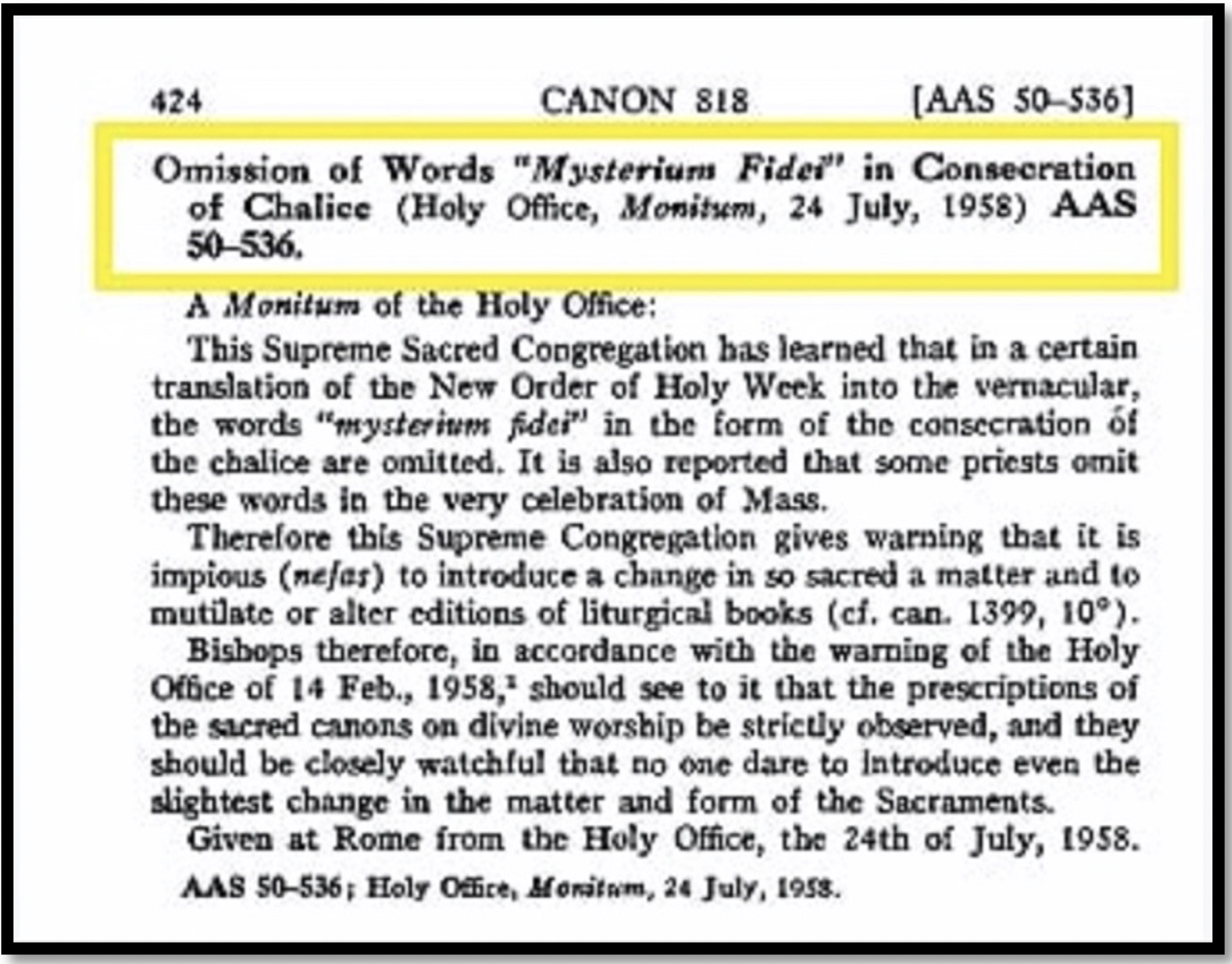
OBJ. 2: You state: “I have proven he was both [a usurper and a Masonic agent] and a heretic pre-election. It was the electing cardinals who designated Roncalli as their “pope,” uncanonically placing a heretic in Peter’s Chair.” Are you saying that Pope Pius XII was a formal heretic, by electing as a potential candidate for the papacy a heretic, Modernist and Freemason known to all the Cardinals and the Episcopal Body on October 28, 1958, making him a Cardinal on January 2, 1953 and keeping him until October 9, 1958, and therefore Pope Pius XII was not Pope?
ANS: Pope Innocent III and Canon Law teach that NO ONE may judge the pope. And as one reader pointed out, this applies especially to a pope who was ill and in a most precarious situation, at the mercy of Antichrist himself and his False Prophet! As I explained in my last blog, Roncalli was nominated as a cardinal by Montini, who had not yet shown his true colors to Pope Pius XII. The pope cannot be judged for committing heresy while in office given the Vatican Council definitions which did not yet exist in Pope Paul IV’s time. One would need to prove beyond any doubt that Pope Pius XII, then, was invalidly elected or that he was a heretic pre-election (Can. 2233 and St. Paul: “But PROVE all things; hold fast that which is good” 1 Thess. 5:2). This is something only a future ecumenical council and/or a canonically elected pope could determine.
OBJ. 3: Are you suggesting that before the “election” of Roncalli, the Cardinals chosen by His Holiness Pope Pius XII and His Holiness Pope Pius XI were not legitimate, and it was because of them that the “election” was invalid, and not that it was invalid by the apostate person of Roncalli himself, who, we insist again, was elevated to the Cardinalate by Pope Pius XII?
ANS: No; I am only saying that because the cardinals must designate the man to become pope, they are responsible for first investigating his character. The cardinals electing Roncalli were occult heretics prior to Pope Pius XII’s death who then openly and freely manifested their heresy by electing Roncalli at the behest of the American government/CIA, thereby violating Pope Pius XII’s infallible election law Vacantis Apostolicae Sedis (VAS) in this and in numerous other ways, deposing themselves and invalidating the election. This is the very “obstinacy and rebellion” referred to in your communique (see below). I never said that ALL the cardinals defected, only those who voted for Roncalli (35 out of 51 or thereabouts.) The cardinals rebelled first of all by failing to follow the commands of Pope Pius XII contained in VAS.
Violations of VAS by paragraph
1) Without a two-thirds plus one vote by CATHOLIC cardinals who have not tacitly resigned from their offices by heresy (Can. 188 n. 4, VAS para. 35), the election is “ipso iure null and void,” (para. 68).
2) Roncalli promoted himself for election prior to Pius XII’s death, a fact proven from several different sources, contrary to the excommunication in para. 93 and Can. 2330 n. 6. If the cardinals attempted to absolve him from that excommunication, this is a usurpation of papal jurisdiction (para. 1), since this excommunication is reserved in a most special manner to the Roman Pontiff. That absolution therefore was invalid under VAS and Roncalli was invalidly elected, since Can. 2265 §1, n. 2, which VAS teaches must be followed along with all the other canons, states: “Every excommunicated person whatsoever is incapable of acquiring dignities offices, benefices ecclesiastical pensions or any position in the Church.” Number one of this same canon would also deprive them of the right to vote, but VAS allows excommunicates (for everything but heresy governed under para. 35) to vote.
3) Any lay interference automatically incurs excommunication reserved in a most special manner to the Roman Pontiff, (paras. 94, 95, also para. 3; Can. 2330, n. 7,8), and there are numerous sources of great import documenting the fact that this actually occurred.
4) Any act violating any of the provisions of VAS itself, especially, or of the Sacred Canons in general is null and void. These would include:
- any attempt to usurp papal jurisdiction (para.1);
- all the canons decreeing excommunication of the cardinals, if not observed;
- any usurpation of papal jurisdiction or unopposed attempts to subvert the election (para. 2).
- The election of one not yet absolved by the Roman Pontiff himself from those censures in VAS especially reserved to him, for this would be a usurpation of papal jurisdiction.
OBJ. 4: We quote from The Communication of Catholics with Non-Catholics, Catholic University of America dissertation on canon law, 1948, on schism: “One must withdraw directly (expressly) or indirectly (by his actions) from obedience to the Roman Pontiff and separate from ecclesiastical communion with the other faithful; the withdrawal must be done with obstinacy and rebellion; in relation to those things by which the unity of the Church is constituted.”
ANS: As already stated above, that withdrawal WAS made with obstinacy and rebellion by a) disobeying the binding decrees of Pope Pius XII, especially VAS in electing an unworthy candidate; b) accepting the authority and “papacy” of John 23 by distributing the 1959 mass booklets, c) preparing for and attending the first session of the false Vatican 2 council, and d) by observing the 1962 missal changes and other calendar changes.
OBJ. 5: Canon 2229 §2. Canon 2316: “A person who knowingly and on his own account helps in any way to propagate heresy, or who communicates in sacred rites (in divinis) with heretics in violation of the prohibition of Canon 1258 incurs suspicion of heresy.” If the law uses the words: “He has the audacity, dares, knowingly, intently, recklessly, on purpose” or other similar words that require full knowledge and full deliberation, any reduction of imputability by the understanding or by part of the will exempts from the penalties ‘latae sententiae’.
ANS: It is presumed that cardinals and bishops act knowingly and on purpose, with full knowledge and deliberation, since they have been educated in the teachings of the Church and Canon Law. This was already stated above. You will notice that Can. 2314 §1 (3) does not use this wording, so they are not exempt. Moreover it cites Can. 188 n. 4 which REMOVES THEM FROM THEIR OFFICES AS BISHOPS FOR RECOGNIZING RONCALLI AS A LEGITIMATE POPE AND FAILING TO DEPART FROM HIM TO ELECT A TRUE POPE. This happened in 1958-59, NOT in 1965! Furthermore, the Very Rev. H. A. Ayrinhac, S.S, D.D., D.C.L., in his Penal Legislation in the New Code of Canon Law writes under Can. 2316: “under the former legislation those who helped the spread of heresy were among the fautores hereticorum who incurred the same excommunication as the heretics themselves. The penalty now is suspicion of heresy and the law more explicitly defines the circumstances under which is it is incurred. The assistance must be given not simply to heretics personally but to the heresy so as to contribute to its propagation.”
In questioning the culpability of the cardinals and bishops, we have a doubt regarding the application of this law. What does the Code of Canon Law tell us to do whenever there is a doubt regarding the application of a law? It tells us to return to the old law under Canon 6 n. 4. What is the old law? Well Rev. H. A. Ayrinhac has just told us what the old law was — heretics who cooperate with the principal agent in the spread of heresy. incur the same excommunication. And guess what the old law governing Can. 2316 is? It is no less than Cum ex Apostolates Officio and we know what that law says — these bishops lose all offices for publicly pronouncing heresy. So there we’ve solved our problem. Now we will examine whether or not under Can. 2316 bishops would be presumed to know or could be considered ignorant (invincibly or otherwise) of the fact that they were committing heresy.
Rev. MacKenzie comments: “The very commission of any act which signifies heresy, e.g., the statement of some doctrine contrary or contradictory to a revealed and defined dogma gives sufficient ground for juridical presumption of heretical depravity. There may be excusing circumstances which excuse from grave responsibility in the external forum and the burden of proof is on the person whose action has given eyes to the imputation of heresy. In the absence of proof all such excuses are PRESUMED not to exist” and here MacKenzie refers obliquely to Canon 2200 of the Code, for later he writes: “…Ignorance must be proved. By virtue of Can. 2200 §2 the fact that a delict has been committed establishes a PRESUMPTION that the delinquent was fully responsible. A mere assertion of ignorance will not suffice. Laypersons will be able to prove this claim more easily than clerics…”
Regarding the election of a future pope, Pope Pius XII’s Vacantis Apostolicae Sedis also sheds further light on this matter: “We command those individuals to whom it pertains and will pertain for the time being to vote, that the ordinances must be respectively and inviolably observed by them, and if anyone should happen to try otherwise relative to these things, by whatever authority, KNOWINGLY OR UNKNOWINGLY, the attempt is null and void” (para. 108). Below I will provide lengthy quotes from theologians well versed in this subject. We must remember that clerics as referred to by Rev. MacKenzie would more likely refer to those who are deacons and priests. Bishops are much higher on the chain than what is assumed here.
Teaching on ignorance and heresy
We must first remember that from the very beginning of his usurpation, John 23 made it very clear that he intended to modernize the Church. This should have served as a grave warning to the bishops. In his 1935 work Canon Law, Abp. Amleto Cicognani quotes Pope Celestine, who said: “No priest may be ignorant of the canons;” and Pope Leo I: “If ignorance is hardly tolerable in laymen, how much more so in those who are over them; such ignorance is inexcusable and intolerable.” Another pope, whose Bull is the basis for nearly every Canon governing heresy in the Code, taught:
“We likewise consider it fitting that those who do not refrain from evil through love of virtue should be deterred therefrom through fear of penalties. Bishops, Archbishops, Patriarchs, Primates, Cardinals [etc.]…, who must teach others and give them good example to keep them in the Catholic Faith — when these prevaricate, they sin more gravely than others; for they not only lose themselves, but drag down with them to perdition and the pit of death countless other peoples entrusted to their care and government or otherwise subject to them… All and sundry Bishops, Archbishops, Patriarchs, Primates, Cardinals…WHO, IN THE FUTURE, SHALL STRAY OR FALL INTO HERESY OR SHALL INCUR, INCITE OR COMMIT SCHISM… being less excusable than others in such matters… (all these persons) are also automatically AND WITHOUT ANY RECOURSE TO LAW OR ACTION, completely and entirely, forever deprived of, and furthermore disqualified from and incapacitated for their rank” (Cum ex Apostolatus Officio, para. 3). But our critics are attempting to excuse these cardinals and bishops by having recourse to Can. 2316, when Cum ex… governs this very canon?
In his work, Ignorance in Relation to the Imputability of Delicts (1941), Rev. Innocent Swoboda, O.F.M., J.C.L. observes: “One who is well versed in the law, or one who holds an office in regard to the things pertaining to the office,” is PRESUMED to be unable to claim ignorance of the law or its penalty or ignorance of some fact concerning the delict. Swoboda explains that in priests, (far less bishops), a knowledge of the law is so strongly presumed that even if ignorance is claimed, it would most likely be considered crass by an ecclesiastical court, or culpable, (meaning the offender is at fault). Crass ignorance is subjectively defined by Swoboda as: “A complete lack of diligence when it is known that the truth could be easily discovered… A complete and total failure to use any effort to fulfill the obligation of knowing the law or the pertinent facts surrounding the law. The failure itself may arise from mere sloth or from a sinful habit of acting without due consideration of the results of one’s own conduct… Only the ignorance of those things which can be easily learned can be considered crass or supine.”
And Rev. Eric MacKenzie writes in his 1932 Canon Law dissertation, The Delict of Heresy, p. 48: “Mere ignorance of the penalty does not remove all imputability from the delict but only diminishes it… If the delinquent making this claim be a cleric his plea for mitigation must be dismissed either as untrue or else as indicating ignorance which is affected or at least crass and supine. His ecclesiastical training in the seminary with its moral and dogmatic theology, its ecclesiastical history, not to mention its Canon Law — all ensured that the Church’s attitude toward heresy was imparted to him. Thereafter his professional associations and his contacts with Church affairs offer further guarantee that HE HAD AMPLE OPPORTUNITY TO KNOW ABOUT HERESY. Hence his present ignorance is unreal or if it be real, it can only be explained as deliberately fostered.” But our critics would excuse these men?
Can. 2200 states that: “…Given the external violation of a law, the evil will is PRESUMED in the external forum until the contrary is proved.” Rev. Chas. Augustine (Bachofen) concurs with Rev. MacKenzie, stating that, “The text adds that if the fact of the violation of the law is certain, the intention or dolus is presumed until the contrary is proved. Hence the proof of ignorance rests on the perpetrator. This is also recognized by civil law.” He adds: “For any culpable act there is required under Canon 2228: (a) knowledge that what the offender is doing is criminal (meaning knowledge that a censure is attached to the delict); (b) culpa(bility), as distinguished from dolus which can arise from ignorance, carelessness or thoughtlessness… (c) [Also], the evil effect must be foreseen at least in a general or confused way, and (d) [there must have been] an obligation to avoid the evil effect. And according to Pope Paul IV and Revs. MacKenzie and Swoboda above, it will be practically impossible for anyone who holds an office in the Church to prove their innocence.
Let’s analyze these point by point:
- a) Knowledge of the crime. Even a good Protestant would admit that it is a terrible thing to change words in the Bible, and if one examines ANY Bible, Catholic or Protestant, it will become clear that nowhere can be found the words “for all men.”
- b) Lack of culpability cannot be granted to those who have received a commission as a successor of the apostles and taken an episcopal oath to preserve the faith and protect the faithful from all error.
- c) The evil effect, Modernism, had been well outlined by Pius XII as well as Pope St. Pius X and these bishops had studied such things in the seminary and the pontifical universities.
- d) These men were strictly obliged to avoid such evils.
The Holy See has clarified the above in regard to both the laity and the clergy in the following decision from the Sacred Congregation of the Propaganda, July 20, 1859. As Revs. Woywod-Smith report in A Practical Commentary on the Code of Canon Law: “Formal heresy only is punished with Canon 2314; wherefore, as Cerato remarks, persons born and educated in an heretical sect without knowing the true faith, cannot be said to have stubbornly denied the Catholic faith, and thus, do not incur the penalties of Canon 2314 §1 (3)” [as these critics being addressed here say of the bishops]. “NEVERTHELESS, in the external forum, they are not free from them, for according to Canon 2200, when there is an external violation of Church law, malice is PRESUMED in the external forum until its absence is proven. The Holy See insists that converts from heretical or schismatic sects be not received into the Church until they have first abjured the heresy or schism and been absolved from the censure” (p. 511). The cardinals and bishops later proved their guilt by proceeding to convene the false Vatican 2 council and establish the Novus Ordo religion. Any further questions?
And when exactly did these bishops renounce their heresies and obtain absolution and abjuration if they only just became formal heretics or apostates in 1965? If the Holy See requires this abjuration and absolution of converts, how much more so a CARDINAL OR BISHOP who once held the faith, whole and entire; whereas, a baptized convert is most likely to have been ignorant. This ruling is obviously in place so that the faithful are protected from ANY person who has ever been publicly outside the Church, by requiring a public act or submission to the Church and Her authority before admitting them to the communion of the faithful. Both the canonists Revs. E. J. Mahoney and Adolphe Tanquerey teach the same on this subject.
There is also further consideration of this point under Canons 2207.This canon reads: “Besides other aggravating circumstances, an offense is made worse by the greater dignity of the person who commits the offence or … by the abuse of authority or office for the purpose of committing an offense.” Rev. Charles Augustine comments on this canon as follows: “The higher the dignitary who commits a crime or against whom a crime is committed the greater the crime itself. For not only is the scandal greater but the law itself surrounds these persons with greater protection and inflicts severer penalties for crimes committed against them. Consequently clergymen are more severely punished than laymen… Heresy is more severely punishable in clerics than in laymen. Authority and office may be abused and such abuse is the more detestable the higher the office and being an abuse of a public trust also enhances imputability.”
Finally, as reported in my previous blog, the cardinals could easily have had access to the truth regarding Roncalli’s suspected heresy, which would have disqualified him from election. They were required to have been aware of the laws regarding heresy and the election of a pope. The cardinals are members of the Sacred Congregations and the proof of Roncalli’s suspected heresy issued from one of those congregations. They had a strict obligation to investigate the worthiness of the candidates; in fact they took an oath to do so. Canon 16 § 1 and §2 state: “No ignorance of invalidating or disqualifying laws excuses from their observance unless the law expressly declares otherwise (1). Ignorance or error as a rule is not presumed when it concerns a law or its penalty or one’s own act or when it concernsthe generally known acts of third persons. Concerning the acts of third persons which are not generally known, ignorance is presumed until the contrary is proved (2).”
Therefore there IS NO EXCUSE for the ignorance of the cardinals or the bishops regarding their lack of due diligence in discerning those laws or acts that disqualified Roncalli from election. Abp. Amleto Cicognani comments on this canon: “Wherefore an act performed even in ignorance or error contrary to the prescriptions of an invalidating or disqualifying law, unless it be given as a penalty for an offense, is invalid just as if a person performed the act with full knowledge. Hence the legislator decreed no ignorance of invalidating or disqualifying laws excuses from their observance; namely no ignorance of the aforementioned laws can make acts valid which they have rendered invalid nor can it make persons capable of acting whom they have declared incapacitated from acting.” Rev. Bernard Wuellner S. J. states the same in his Summary of Scholastic Principles (1957): “Laws justly declaring an incapacity to act or to receive benefits invalidate the attempted act or reception even if they are inculpably unknown or facts pertaining to their application in a concrete instance are unknown.”
OBJ. 6: If Roncalli introduced 47 false cardinals, more than half, to the false conclave of 1963, is it not evident that election was anti-canonical by the members of the conclave and by the person elected of Montini himself?
ANS: Roncalli may have remained only suspect of heresy all the years preceding his election, though in retrospect we know that his heresy was more than proven by his subsequent written works and actions. That suspicion was enough to disqualify him, just as it disqualified Cardinal Morone from being elected following the death of Pope Paul IV. I demonstrated that the “elections” of both Roncalli and Montini were uncanonical over 30 years ago in my first published work, Will the Catholic Church Survive…? This according to the method advised under Can. 18 when there arises a doubt about some fact not covered in the law. Canon 18 reads: “Ecclesiastical laws are to be interpreted according to the proper meaning of the terms of the law considered in their context. If the meaning of the terms remains doubtful or obscure one must have recourse to parallel passages of the Code, if there are any, or to the purpose of the law and its circumstances and the intention of the legislator.”
In his dissertation Canonical Elections, (Catholic University of America Press, 1939), Rev. Anscar Parsons states that, “The election of the Holy Father has been the prototype for the election of inferior prelates.” As both Rev. Parsons and Rev. Timothy Mock (Disqualification of Electors in Ecclesiastical Elections, Catholic University of America Press, 1958) explain, the election of an unworthy candidate is null and void from the beginning, because QUALIFIED ELECTORS are bound to know that the one they elect is duly qualified. By unworthy is meant a person branded by infamy of law or fact or a notorious apostate, heretic, schismatic or public sinner. Canon 2391 §1 provides the parallel passage of the Code mentioned in Can. 18: “A college which knowingly elects an unworthy person is automatically deprived, for that particular election, of the right to hold a new election.” The fact that this election was based on the wishes and desires of the U.S. government alone, in violation of VAS — not to mention all the other violations noted above — indicates the intent to deliberately act contrary to the commands of Pope Pius XII, i.e., knowingly.
This takes us back to the election of Roncalli himself, which not only disqualifies him as a candidate but voids the election of Montini and all who followed him. Rev. Parsons comments that those considered unfit or unworthy of election are “…those who are legally infamous or laboring under censure [also] notorious apostates, schismatics… public sinners and persons whose conduct is sinful or scandalous… In normal cases it is PRESUMED that the chapter made its choice with full deliberation and knowledge, because it is their duty to investigate the qualities of the person whom they elect … If the majority elect someone who is unworthy, all the voters, even those who are innocent are deprived of the right to vote in this instance” (p. 197).
Rev. Mock agrees with Parsons, writing: “…The burden of proof …will be upon the electors to show that they did not know of the defect in the candidate. The electors are PRESUMED to know the qualifications required by law” (p. 137). Parsons poses the question: “Is the election of an unworthy person void from the beginning? It seems that it is. For the law says that the chapter is deprived of the right to proceed ‘…to a new election.’ In making this disposition, the legislator seems to suppose that the original choice was null and void” (p. 197.)” The electors showed their true intent by the subsequent election of Montini, the CIA’s star operative in the Vatican, and the eventual devastation he wreaked upon the Church. What further damning evidence could anyone possibly hope for to prove this case?!
Conclusion
In the end, we have the principle of St. Robert Bellarmine confirmed by the practice of the Church Herself: “A DOUBTFUL POPE IS NO POPE, and there is plenty of doubt to go around regarding Roncalli’s election. So what is this hoorah posed by these objectors REALLY all about? These critics have accused me of deliberately refusing to answer their claims. I have answered them at length here, and the burden of proving their own case — that these cardinals and bishops can be held invincibly ignorant and free of censure — now rests with them. Those cardinals and bishops electing and recognizing Roncalli as a true pope are PRESUMED to have known the law and to have acted with full knowledge and deliberation; they are PRESUMED to have been fully aware of the qualifications of Roncalli. Most importantly, Canon 2200 PRESUMES malice until the contrary is proven. And all those miscreant cardinals and bishops not only did not prove their innocence, but they also did everything necessary to prove their guilt!
These presumptions are crucial, for Canon 1827 reads: “He who has a PRESUMPTION of law in his favor is freed from the burden of proof which has thus shifted to his opponent. If the latter cannot prove that the presumption failed in the case, the judge must render sentence in favor of the one on whose side the presumption stands.” My 1958 designation of the beginning of the end of the Great Apostasy with the election of Angelo Roncalli STANDS.
by T. Stanfill Benns | Jun 23, 2023 | New Blog
+Vigil of the Nativity of St. John the Baptist+
Baptism of our Lord, stained glass window in the Church of St. Ambrose and Theodulus, Stresa, Lago Maggiore, Piedmont, Italy
The attitude of those who today study theology often as amateurs and with little or no opportunity to discuss their work with others, should be one of mutual support and cooperation. This however has not been the case. The tendency to foster one’s own opinions and pet theories should have been set aside to work for the good of the Church in a spirit of true charity, but in these days charity has grown cold. Obedience to Divine law and infallible truths, open mindedness and objectivity should have been the primary goals but all were off on their own tangents, this author, in the early days of writing, included. No real standards for arriving at truth were ever set down; laymen daring to wade into the theological fray were likely to be chewed up and spat out by the pseudo-clerics who then prevailed. And later even laymen writing as amateurs would mount attacks on their fellows in defending the sedevacantist, Traditionalist and other positions. But it is never too late to change direction and work together for the glory of God and the good of His Church. This is our prayer and our constant petition.
***********************
The above excerpts were taken from an article I originally penned in 2009, based on the writings of Msgr. Joseph C. Fenton. I have had occasion to return to this article many times. Today it is in reference to a false claim made in the work that has been running as a series on this site for the past several months — Javier Morell-Ibarra’s Survival Guide for Catholics. Unfortunately I will no longer be able to offer this work on my site since the author has refused to correct the statement of a conclusion that contradicts Canon Law and Church teaching on heresy. I do this with regret as there are many things otherwise commendable in Mr. Morell-Ibarra’s work, but this false conclusion cannot be overlooked, even considering the overall import of his book.
Relying solely on his own opinion and not bothering to base anything he says on the teachings of approved theologians and papal documents, he states as a certainty that the Great Apostasy occurred with the conclusion of the false Vatican 2 council and the signing by all the bishops of Vatican 2 documents. I early on registered my opposition to his initial statement HERE (please reread this blog to better understand what follows) but held off to see if he would answer my objections and/or clarify his assertion. I had hoped he would explain further as the book progressed; however this was not the case. In fact when approached privately, he refused to offer any substantial proofs to refute the objections in my past blog and has even accused me of making it appear that Pope Pius XII knowingly elevated a heretic to the office of cardinal.
Evaluating proofs
Morell-Ibarra uses Cum ex… and Can. 188 §4 to justify his assumption without any explanation. But that is not what we are allowed to do when attempting to arrive at certitude regarding such serious matters. As the scholastic theologian Bernard Wuellner S.J. writes:
- Every judgment must be based on proof.
- In doubt, facts cannot be presumed, but must be proved.
- When in doubt one must stand by presumption.
- There is no argument against the evidence.
- No argument or conclusion contrary to the evident facts is valid, (#s 6-9 taken from Rev. Bernard Wuellner, S. J., “Summary of Scholastic Principles,” 1956).
The Catholic Encyclopedia states regarding proofs: “The proper test of truth is evidence, whether the evidence of a truth in itself or by participation in the evidence of some other truth from which it is proved. Many truths, indeed, have to be accepted on authority; but then it has to be made evident that such authority is legitimate, is capable of knowing the truth, and is qualified to teach in the particular department in which it is accepted.”
When crime scene investigators evaluate the commission of a crime such as murder, they do so based on the evidence that’s found at the crime scene and what can be deduced from witnesses and circumstances surrounding the crime. Oftentimes it happens that it takes many years for the particulars of certain crimes to become known well enough that charges can be made to show what actually occurred, who really committed the crime, how it was committed, whether or not there were accomplices and so forth. In many ways when Catholics came on the scene of what happened to the Church you might in some respects call it a cold case, because many years had elapsed since the actual start of the damage done to the Church. What we were doing was looking at it from a perspective of what had already happened, not from what was actually happening at the time the crime was committed. And Traditionalists obscured our understanding and view of what had happened and what was then taking place.
Heresy, apostasy and schism are categorized by the Church as crimes — soul murder, to be exact. One does not look remotely at a crime scene where the carnage done is patently obvious to those investigating the murders then calculate the guilt of the parties based on how long it took to be certain that the perpetrators actually committed the crime. One who confesses to a murder is held guilty of that murder retroactively, not just from the moment he confesses. It is ridiculous to pretend otherwise. Likewise in Canon Law, the moment that one publicly adheres to heresy, apostasy or schism, he incurs the censure; he is guilty of the crime. And Can. 2314 §1 (3) states that heretics and those who join a false religion lose all offices under Canon 188 §4, issuing from Cum ex apostolatus officio. The moment one affiliates with a false religion, he suffers the penalties for communicatio in sacris which includes infamy of law. And this infamy invalidates all ecclesiastical acts. But already the tacit resignation of an ecclesiastical office based on heresy deprives the offender of all jurisdiction and power.
We must separate the realization by the faithful that these acts had taken place and the actual fact that it already HAD taken place according to the laws and teachings of the Church. A delict does not have to be known by all to be notorious heresy; in a small community 10 who realize it suffices, according to the canonists Woywod-Smith. Some 2,215 bishops attended the first session of the false Vatican 2 council in 1962, and that is no small number. Only 46 of that number voted against the proposed changes in the liturgy, so over 2,100 were well informed of what they were doing and where the Church was going. For already in January of 1959 they had begun to revise the liturgy themselves, with the blessing of John 23. They knew what they were doing was contrary to what the Church had always taught, that it was an innovation; that is why they called it liturgical renewal. These bishops had studied sacred theology and were obligated to know the truths of faith. They simply decided those truths were no longer relevant.
The mutilation of the Consecration of the wine
Now we know that the primary reason everyone exited the Novus Ordo, for the most part, was the institution of the Novus Ordo Missae, especially the change in the consecration of the wine in the Canon of the Mass. And there is a very good reason why the words of the Consecration were at issue. It is because these are Christ’s very own words, and the Church long ago forbid them to be changed. If nearly half of the laity recognized that when it was finally formalized, what excuse could the bishops possibly produce for failing to recognize it sooner? The following series of Henry Denzinger’s Sources of Catholic Dogma citations here proves that any public denial of the dogma that these were Christ’s very words and that they must be retained was nothing less than the promulgation of heresy.
DZ 415: “We must however distinguish accurately between three things which are different in this sacrament; namely the visible form, the truth of the body and the spiritual power. The form is the bread and wine, the truth of the flesh and blood, the power of unity and of charity. Therefore we believe that the form of words as it is found in the canon the apostles received from Christ and their successors from them” (Pope Innocent III)
DZ 585: “It is not established in the gospel that Christ arranged the Mass” — condemned as heretical against John of Wycliffe at the Council of Constance by Pope Martin V.
DZ 698: “The words of the Savior by which he instituted the Sacrament are the form of this Sacrament, for the priest speaking in the person of Christ affects the Sacrament” and this was given for belief to the Armenians at the council of Florence from the Bull Exultate Deo.
DZ 876: Christ… soul and divinity, exist under the species of bread and wine, but the body indeed under the species of bread and the blood under the species of wine by the force of the words. Therefore it is very true that as much as contained under either species is under both. For Christ whole and entire exist under the species of bread and under any part whatsoever that species, likewise the whole Christ, is present under the species of wine and under its parts” (Council of Trent)
DZ 953 (which pretty well sums up all the rest): “If anyone says that the Canon of the Mass CONTAINS ERRORS and should therefore be abrogated, LET HIM BE ANATHEMA. (Pope Pius IV, Council of Trent).
DZ 956: If anyone says that the… words of consecration pronounced in a low voice is to be condemned, or that the mass should be celebrated in the vernacular only…Let him be anathema.
Note here that not only did they SAY the wording of the consecration should be changed — THEY ACTUALLY CHANGED IT; first in the mass booklets and later in the Missale Romanum and the missals used by the laity. The Popes condemn such a practice below.
Pope Benedict XIV, commenting on the explicit refutation by St. Thomas Aquinas of the argument that the words “for all men” ought to be used instead of “for many”, says:
“Therefore We say that the blood of Christ was shed for all; however, as regards sufficiency, and for the elect only, as regards efficacy, as Doctor Thomas explains correctly: ‘The blood of Christ’s Passion has its efficacy not merely in the elect among the Jews, but also in the Gentiles’ …. And therefore he says expressly, for you the Jews and for many, namely the Gentiles.” (Book II, Ch. XV, para. 11: De Sacrosancto Missae Sacrificio)
(1) In the letter Super quibusdam (Sept.29,1351), Pope Clement VI taught: “The Roman Pontiff, regarding the administration of the Sacraments of the Church, can tolerate and even permit different rites of the Church of Christ….always without violating those things which pertain to the integrity and necessary parts of the Sacraments.”
(2) Council of Trent, Session III, Chap. 2 : “It (the Council) declared furthermore that this power has always been in the Church, that in the administration of the Sacraments, without violating their substance, she may determine or change whatever she may judge to be more expedient for the benefit of those who receive them or for the veneration of the Sacraments, according to the variety of circumstances, times and places.”
(3) Pope St. Pius X in the letter, Ex quo nono (Dec.26, 1910): “It is well known that to the Church there belongs no right whatsoever to innovate anything touching on the substance of the Sacraments.”
(4) On November 30, 1947, Pope Pius XII issued the apostolic constitution, Sacramentum Ordinis, which reiterates and clarifies the same principle. “As the Council of Trent teaches, the seven Sacraments of the New Law have been instituted by Jesus Christ, Our Lord, and the Church has no power over the substance of the Sacraments; i.e., over those things which, with the sources of divine revelation as witnesses, Christ the Lord Himself decreed to be preserved in a sacramental sign.”
Addis and Arnold’s Catholic Dictionary says: “The Council of Trent defines that though the Church may change rites and ceremonies, it cannot alter the ‘substance’ of the Sacraments. This follows from the nature of a Sacrament. The matter and form have no power in themselves to give grace. THIS POWER DEPENDS SOLELY ON THE WILL OF GOD WHO MADE THE GRACES PROMISED DEPEND ON THE USE OF CERTAIN THINGS AND WORDS, SO THAT IF THESE ARE ALTERED IN THEIR ESSENCE, THE SACRAMENT IS ALTOGETHER ABSENT.”
What is heresy?
In his Canon Law dissertation The Delict of Heresy, (1932, Catholic University of America), Rev. Eric MacKenzie defines a heretic as “One who pertinaciously denies or doubts a truth revealed by God and authoritatively proposed by the Church [for belief]… THE VERY COMMISSION OF ANY ACT WHICH SIGNIFIES HERESY; E.G., THE STATEMENT OF SOME DOCTRINE CONTRARY OR CONTRADICTORY TO A REVEALED AND DEFINED DOGMA, GIVES SUFFICIENT GROUND FOR JURIDICAL PRESUMPTION OF HERETICAL DEPRAVITY”
That Christ Himself proposed the words of the Consecration formula for the bread and the wine is a truth revealed in Holy Scripture. That truth is defined and proposed for belief by the Catholic Church above. Canon 1325 tells us: “The faithful are bound to profess their faith publicly whenever silence, subterfuge or their manner of acting would otherwise entail an implicit denial of their faith, a contempt of religion, an insult to God or scandal to their neighbor.” The bishops and cardinals above all the rest were bound to enforce this canon. It did not matter that these words “for all men” did not appear in the Missale Romanum before 1969; that would have invalidated the consecration, yes, but the fact that it was stated and distributed publicly was clearly heresy.
These TRAITORS erred by silence; they explicitly, not implicitly, allowed this heresy to be taught to the faithful, and they implicitly ranged themselves under a false pope whose stated intent, in his January 1959 announcement of the council, was to modernize the Church. It was their job to make certain that all missals published in the various dioceses were free from error. No one spoke out; no one demanded they be pulled from the pews. To the best of my knowledge I am the only one who has ever published proofs that this heresy even existed prior to the issuance of the Novus Ordo Missae. And it was first promulgated by Roncalli and his bishops, not Montini. We learn from a Catholic University of America publication written in 2003 by Jerome Hall, S.J., Intelligent and Active Participation, the Liturgical Press, that:
“In 1958, the Kyriale was followed by Our Parish Prays and Sings, which sold more than five million copies, most of them in paperback. That hymnal’s current successor, The Collegeville Hymnal, appeared in 1990. In1967, as the eucharistic liturgy was translated into English, the monastery began to publish the scriptural texts and music for singing the Mass together with the text of the Ordinary.” To these five million plus copies can be added mass booklets also translating pro multis from the Latin to for all men, such as the ones issued by the Paulist Fathers, also in January of 1959. The copy below is a first edition of Our Parish Prays and Sings, imprimatured in January 1959 for Collegeville Press. It is proof that bishops both embraced and implemented the beginnings of Roncalli’s modernization plan and promulgated it. One cannot say it was not a notorious act.
All the bishops allowing its use assented to it, and the better part of the clerics and religious involved in the Liturgical Movement for decades were aware of its gradual development. That it was a deliberate act geared to lay the foundation for Roncalli’s 1963 heresy on religious liberty in Pacem in Terris is obvious. That it dovetailed with the mistranslated and falsified “lead all souls to Heaven” Fatima prayer between the decades is yet another proof of what was afoot long before liturgical renewal set in. One cannot plead ignorance in the case of bishops, for as the canonists agree, such ignorance is impossible in those who are required by virtue of their office — who took an oath at their consecration — to know, preach, teach, defend and protect the faith and preserve the faithful from error.
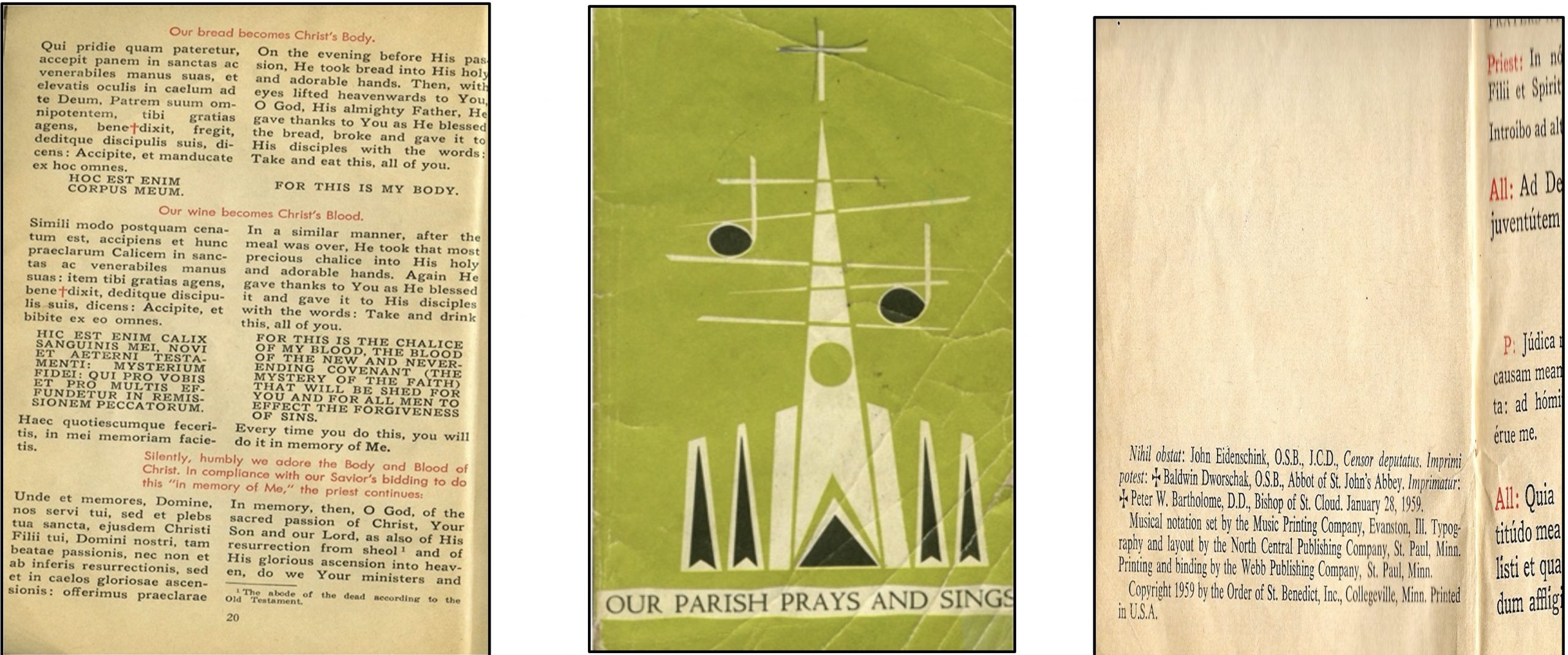
According to Hall’s work, the guiding light of Collegeville Press, the Benedictine monk, Lambert Beauduin — a rabid liturgical renewal advocate — had been a dear friend of Roncalli’s for decades. Beauduin’s works inspired the founding of the Press. In 1957, Roncalli said that he owed his ecumenical vocation to Beauduin. And the heretical fruits of that vocation were published for all to see in the work above, distributed by once-Catholic bishops.
Does Roncalli’s pre-election heresy implicate Pope Pius XII?
Mr. Morell-Ibarra has stated that to insist the Great Apostasy began before 1965 would necessarily paint Pope Pius XII as complicit with it, but I have never even come close to intimating this in anything I have written. I have always placed the blame on the cardinal-electors for failing in their duty and electing an unworthy candidate, and Pius XII could scarcely have controlled or predicted their actions.
Did Pius XII necessarily know of Roncalli’s lapses? It could easily have been hidden from him by Montini or made to appear of no consequence, and this was most likely the case. Certainly Pius XII did not begin to suspect Montini’s actions until later in 1953-54, after his physician Galeazzi-Lisi reported he had been ”accidentally” poisoned. And when he discovered he was a traitor, he sent him to Milan as Archbishop minus the usual red hat. Paul Murphy reports, based on conversations with Pius XII’s housekeeper, Sr. Pasqualina, that “Roncalli wasn’t anyone to stand up in defense of Pius’s papacy for he had not shown that much liking for the Holy Father or for the style of his regime. Pius had kept a tight rein on Roncalli and allowed him no latitude in decision making. Under the imperious Pope the cardinal was never his own man” (La Popessa, p. 379). So Pius seems to have done what he could, given Roncalli’s appointment prior to his discovery of Montini’s various betrayals. Was Montini the one who recommended Roncalli for the cardinalate? What follows seems to confirm this was the case.
“Giovanni Montini knew Angelo Roncalli well. They came from the same part of the country and had met each other innumerable times at the Vatican when Montini had been Pro-Secretary of State. It had been Montini’s intervention with Pope Pius XII which had sent Roncalli to Paris as nuncio. Montini and Roncalli had worked closely together during the days of the worker priests… Knowing of the Archbishop’s shy longing for the title of cardinal, Montini had again brought to the attention of Pius XII the sterling qualities Roncalli had brought to his work in Ankara and finally in Paris. At the consistory of January 12, 1953, one of the two consistories Pius 12 had held in his lifetime, Pius had named Angelo Roncalli a cardinal of the Holy Roman Church.
“It had been Montini who told Pius that the pace and pressures of the diplomatic post in Paris were a little wearing for a 71-year-old … who had been in the service of the Church for almost half a century. On his visit to Rome to thank Pius XII, Roncalli had a long talk with Montini… Montini [later] confided to one of his friends that Cardinal Roncalli was one of the wisest men he had ever known. The new patriarch of Venice had kept in close touch with Montini during the first month of his stay in Venice. He went to him for advice and counsel whenever he felt in need of such advice” (Andre Fabert, Pope Paul VI, 1963).
“For years the Holy Office had maintained a dossier on Roncalli which read “suspected of Modernism.” The file dated back to 1925, when Roncalli, who was known for his unorthodox teachings, was abruptly removed from his Professorship at the Lateran Seminary in mid-semester (he was accused of Modernism) and shipped off to Bulgaria. This transfer to Bulgaria began his diplomatic career. Of particular concern to Rome was Roncalli’s continuing, close association with the defrocked priest, Ernesto Buonaiuti, who was excommunicated for heresy in 1926” (Lawrence Elliot, I Will be Called John, 1973; pgs. 90-92). Pope Pius XI began an investigation of Roncalli after he maintained correspondence with Buonaiuti even after he was defrocked. The file then lay dormant for 14 years until Pius XII was elected pope. And it would be another 14 years before he made Roncalli a cardinal, at the behest of Montini.
Elliot writes: “Roncalli was to learn nothing of this until 1958 when he became Pope and, visiting a certain Congregational office, asked to see his own file. There he found marked alongside his name the charge “suspected of Modernism.” As evidence, the file contained a postcard addressed to him by Buonaiuti. Then the rarely manifested Roncalli anger erupted. Demanding a pen, he wrote beneath the condemnatory words: ‘I, John 23rd, Pope, declare that I was never a Modernist!.” Sometime later, when talking to a group of seminarians concerning doctrinal principles he remarked: “I am the living example that a priest who has been placed under observation by the Holy Office can still become Pope.” It is to be wondered why, since that file was still available in 1958 prior to Roncalli’s election, those electing him did not access it and reject him as a candidate. The above comments on unworthy candidates by Rev. Parsons certainly makes it clear that investigation of candidates is the responsibility of the electors. The Congregational offices are generally manned or at least overseen by Cardinals.
Past papal miscalculations
In 1560 Pope Paul IV’s successor Pius IV authorized a revision of the process against Giovanni Cardinal Morone, tried by Pope Paul IV for heresy, and this even after he attempted to promote himself as a candidate for pope while still under suspicion of heresy. “As a result the imprisonment of the cardinal and the whole procedure against him were declared to be entirely without justification, [Cum ex… not withstanding]; the judgment also recorded in the most formal terms that not the least suspicion rested upon his orthodoxy.” He was later appointed cardinal protector of England. So was Pius IV suspect of favoring a man apprehended and charged with heresy? Pope St. Pius V later reaffirmed Cum ex… and judged that any previous cases against those accused of heresy could be reopened (see Inter multiplices).
And what about the following: “In the ninth century Pope John VIII over indulgently allowed the Slavs their own tongue in the celebration of the liturgy. But on reading a letter later of the pontiff’s, the 95th, one hardly wonders at his admission of the drawbacks of such a dispensation. In fact Gregory VII revoked it but too late; too late to save the Russians…” (Tito Casini, The Torn Tunic, 1967). More recently we could cite Pope St. Pius X’s support of Charles Maurras and Action Francais, later condemned by Pope Pius XI. Shall we declare them all suspect? We are not to judge the popes, and this is a judgment against them if we presume they could tolerate heresy.
During the election of Pope Pius IV, Morone was one of three frontrunners, but ran full force into Cardinal Ghislieri, the future Pope St. Pius V. Of all people, Cardinal Hergenrother is reported to have written, in his The History of the Popes, that Morone’s campaign was “quashed by the intervention of Cardinal Ghislieri, who pointedly remarked that Morone’s election would be invalid owing to the question mark hanging over his orthodoxy.” So where were the saints among the cowardly cardinal-bishops who elected Roncalli?
Do we now excommunicate these popes for their actions? Heaven forbid, although the wicked have certainly cast their aspersions. We do not judge the popes, not understanding or ever being able to know the exact circumstances, the advice provided by their consulters, their frame of mind or any number of other determining factors.
The bishops disobeyed Pope Pius XII
I have shown both in my first work Will the Catholic Church Survive…? And in my most recent work, The Phantom Church in Rome, compelling proofs that Roncalli could never have been validly elected. In electing him, then following him and implementing his directives, the cardinals and bishops lost their offices by publishing heresy and deceiving the faithful. This is further confirmed by an allocution from Pope Pius XII delivered in November 1954 which taught:
“We note with joy that in many dioceses there have sprung up special liturgical institutes, that liturgical groups have been established, that …rallies on liturgical matters have been held and that gatherings have been or will be organized on an international level. But venerable brothers however you show favor, and rightly, to the practice and development of the sacred liturgy, do not allow those studying this subject in your diocese to withdraw from your guidance and watchfulness or to adapt and change the sacred liturgy according to their own judgment contrary to the Church’s clearly declared norms. IT IS THE FUNCTION OF THE APOSTOLIC SEE ALONE TO DETERMINE THE SACRED LITURGY AND TO APPROVE LITURGICAL BOOKS (Can. 1257).
“And particularly with regard to the celebration of Mass, all customs to the contrary being revoked, a priest celebrating must observe accurately and devoutly the rubrics of his ritual books and take care not to add other ceremonies or prayers at his own whim (Can. 818)… The Church is fitted and authorized, as also are the bishops for the faithful entrusted to them in accordance with Canon Law, to promote ecclesiastical discipline and see to its observance, that is to establish an external norm of action and conduct for matters which concern public order and which do not have their immediate origin in natural or divine law. Clerics and laity may not exempt themselves from this discipline; rather all should be concerned to obey it …” (AAS, 46-666; Canon Law Digest, Vol. 4).
This binding allocution was primarily addressed to the bishops, who were required to read it and obey it. By ignoring its binding nature and embracing instead the wishes and desires of the usurper Roncalli, these bishops clearly chose Roncalli as their false pope, and committed heresy at his bidding. For as noted in this allocution: “It is the function of the Apostolic See alone to determine the sacred liturgy and to approve liturgical books.” It can thus be concluded that Roncalli himself approved the publication and issuance of these works, and that from then on, these bishops should have run from the perfidious Novus Ordo bathhouse to elect a true pope.
Conclusion
In attempting to reconcile this issue, I recommended to Mr. Morell-Ibarra: If you wish to explain your apostasy theory, follow what Henry Cardinal Manning states in his book Temporal Power of the Vicar of Jesus Christ, which would then give it some credibility other than your own: “The revolt is an apostasy or a dicessio. a ‘departure’; a seditious separation from some authority… The authority then from which the revolt is to take place is that of the Kingdom of God on earth [as] prophesied by Daniel…
“The inspired writers expressly describe its notes. The first is schism: “It is the last hour and as you have heard that Antichrist cometh even now there are become many antichrists, whereby we know that it is the last hour. They went out from us but they were not of us. For if they had been of us, they would no doubt have remained with us.” The second note is “the rejection of the office and presence of the Holy Ghost. This necessarily involves the heretical principle of human opinion as opposed to divine faith; of the private spirit as opposed to the infallible voice of the Holy Ghost speaking through the Church of God. The third note is that the denial of the Incarnation. By the denying the mystery of the Incarnation, either the true Godhead, or the true manhood, or the unity or divinity of the person of the Incarnate Son” This is apostasy, or the denial of Christ Himself… [These are] the three notes of Antichrist.”
Denial of the Incarnation should be something quite obvious to the average Catholic as a logical consequence of Card. Manning’s first two points, but unfortunately it is not. For “rejection of the office and presence of the Holy Ghost” is a denial of the Third person of the Blessed Trinity, and the Trinity is one and undivided; deny one of its Members and you deny all. Christ’s Vicars speak in His name; they are His living voice on earth. When all the heretical bishops stood at the final session of Vatican 2 and declared that the Church had spoken, they officially denied the existence of the papacy, the Apostolic College and the Incarnation, for the only inspiration that concluded that council was the satanic spirit of Antichrist.
We then have schism, which began with the invalid election of Roncalli by the cardinal-bishops and cardinal-priests and the subsequent subjection to him of the rest of the bishops, communicating with him in his schism when he was not assisted by the Holy Ghost. Next, we have the heresy of the bishops themselves shortly after his election. And finally there is the completion of this cycle with the false election of Montini and the public affirmation by the bishops of the already existent false religion, followed by the falsification of the Sacraments and the Novus Ordo Missae — the apostasy. This describes it perfectly, but Mr. Morell-Ibarra apparently is not a fan of Henry Cardinal Manning and does not think much of his assessment of our times. Cardinal Manning, however, is the approved theological expert, not Morell-Ibarra.
The bishops denied “the infallible voice of the Holy Ghost speaking through the Church of God ” in distributing mass booklets containing heresy. They instead expressed “the heretical principle of human opinion as opposed to divine faith.” If Mr. Morell-Ibarra wishes to assert that they retained their offices as bishops until 1965 (and for what reason?) he must first disprove what the Church Herself teaches above regarding the Consecration formula and the ipso facto censures for heresy. If he merely wishes to demonstrate that after incurring schism and heresy they fell finally into apostasy, that is another matter. We sincerely hope it is the latter.