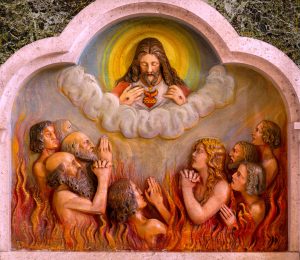
Never despair that a departed friend or relative is lost
+Feast of All Souls+
Prayer Society Intention for November, Month of the Holy Souls in Purgatory
“O Lord Jesus Christ, King of glory, deliver the souls of all the faithful departed from the pains of hell and from the bottomless pit.” (Raccolta)
Introduction
The following chapters are taken from the work Paths to Eternal Glory,” a collection of sermons for funerals by Rev. Clement Henry Crock, (1948). They provide us with hope for our beloved departed, especially those whose deaths were sudden, and remind us to pray always for them, regardless of whether their departure appeared to us to be holy or not. One story from a book on Purgatory tells of a soul everyone thought had gone straight to heaven, but who instead languished in Purgatory with no one to pray for him. We must never presume to know God’s will for our departed brethren, but be generous with our prayers for these poor souls. For they suffer pains for their sins only slightly less than those suffered in hell and cry to us for relief.
Despair of None, Pray for All
There are many grateful souls in heaven whom we have eternally befriended through our prayers and good deeds, just as we aim to do for our departed friend today by uniting our prayers with yours in his behalf this morning and promise to do in days to come. Grateful indeed are the souls who were temporarily detained in purgatory to satisfy God’s justice and whom we aided in their speedy release, but especially grateful are those souls who even while on earth were considered great sinners and at the moment of their death were considered lost, but who on account of some special prayers by friends employing God’s mercy, were at the last moment granted a special grace of repentance and now and are now numbered among the blessed in heaven.
According to the Fathers of the Church and many distinguished theologians, it will be surprising to all on the final judgment day how vast is the number in heaven of those who belong to this latter class. We should therefore never despair of the salvation of anyone, but continue to pray for all, no matter how far from the ideal the life anyone has been, even down to the very moment of death. We must never presume to judge anyone before his time. Only God is our judge. No matter how great the sinner, the Church condemns no one to eternal torments. She may publish decrees declaring that one or the other is in heaven, but through all the centuries she has never published a decree declaring that anyone is in hell.
In the life of St. Francis de Sales, we read that one day some of his friends were discussing the passage of Holy Scripture which states, “Many are called, but few are chosen.” They were speaking of the parable in the Gospel of Saint Matthew in which the kingdom of heaven is likened to a vineyard in which the master employs all the laborers who apply. In the evening at the close of day, all received the same wages agreed upon. Some complained, but the master merely answered that he had paid them all what he had promised. It was Jesus who told the story, and in relating it, He added, “The last shall be first and the first last, for many are called but few are chosen.” Hearing the discussion, Saint Francis commented thus: “I am of the opinion that very few Christians will be lost because they have the root of the true faith which sooner or later will mature its fruit which is eternal life. The torpid root awakens to life and operates through divine mercy. And when asked about the story of the Gospel, he replied, In truth, if we compare the number of Christians to the rest of the world and unbelieving nations, their number is very small, but of this number, I believe very few will be lost.”
Many theologians and Fathers of the Church concur with St. Francis, for once God has granted the gift of faith through baptism, God will also, they argue, give the means to live according to that faith and to persevere in it. And as to the Gospel story, far from being an expression of divine wrath, it is, on the contrary, a proof of God’s mercy towards the sinner and of the wonderful efficacy of perfect contrition which, in a moment, can make one a friend of God. Their conclusion is further confirmed by another parable in St. Matthew’s Gospel in which the kingdom of heaven is likened to a marriage feast. Some of the invited guests rejected the invitation. Then the servants were ordered to go out into the highways and byways and to call to the marriage feast as many as they could find. They invited all, good and bad, and the marriage feast was filled with guests. Of them all there was but one who did not have on a wedding garment. That is interpreted to mean that only one came with a soul unadorned with sanctifying grace.
Therefore, following the example of the pious and learned Father de Ravignon, we would rather prefer to speak at this sad moment of those mysteries of divine grace called into existence at the hour of death. We prefer to believe that at the last moment a great number of apparently unreconciled sinners are converted and expire reconciled with God. For there are in certain deaths, as my thirty years as a priest have confirmed, mysteries of mercy and moments of special grace where the eye of man sees only strokes of justice. By a flash of light, God sometimes reveals himself to souls whose greatest misfortune was not to have known Him or to have ignored Him, but at the last breath He may have granted the dying a special sigh calling for pardon, a sigh that was accepted by Him who understood the cry of the thief hanging beside Him on the cross and granted his dying request. As long as a single breath of life remains, no barrier is placed between the soul and grace, therefore we must never despair of God’s mercy, but continue to hope and to pray for our departed, no matter what may seemingly have been their end.
St. John Chrysostom imagines that one of his audience interrupts him saying, “But I mourn this dear deceased because he died a sinner.” And his immediate reply was, “Is not this a vain pretext? For if such be the cause of your tears, why did you not make more effort to convert him when he lived? You must in the first place go to his help as far as you are able, not with tears, but with prayers, supplications, alms, and sacrifices. Is it not one of God’s ways to do good to some out of regard for others?” Let us then show ourselves eager to aid our dear deceased, and let us earnestly and perseveringly pray for them. And was it not the prayers and patience on the part of St. Monica that aided in the conversion of her pagan husband? Was it not persevering prayer for 18 long years that resulted in the conversion of her wayward son, Augustine?
Having a pagan father, Augustine had grown up among all the evils of a pagan civilization. Numerous and grievous were the sins of his youth, as he himself testifies to in his Confessions. But eventually God granted St. Monica’s request, and before her death, she saw her repentant son already on the road to become the great St. Augustine, second only to the great apostle St. Paul. And many another mother has prayed for a wayward son and obtained the grace of final repentance. This was directly revealed to St. Gertrude by the Lord himself, saying, “For my divine light… piercing into the future, having made known to Me that thou wouldst offer this prayer for him, I placed good dispositions in his heart to prepare him for the enjoyment of the fruits of thy charity. And after death ensued, Jesus added, “I take singular pleasure in the prayers addressed to me for the dead, when natural feeling is added to the good will which renders them meritorious, and when both concur to give this work of mercy all the plenitude and perfection it is capable of receiving.”
Who knows what effect the sight of eternity has on a dying person when he already feels the presence of the judge into whose hands it is so terrible to fall? It is easy to forget God and eternal truths while one is in good health. Business and amusements and the bustle of life remove and dull the sense of faith. But when all about us vanishes and one feels like slipping away, then all illusions are likewise dispelled and the heart and mind turn to the contemplation of their eternal destiny. One moment of contrition, even one phrase such as “Pardon me, God”: yes, even less, a mere sigh of the heart suffices to reconcile the sinner with the merciful God whom he has grievously offended.
In conclusion, therefore, let us follow the example of Saint Francis de Sales, who would never have people despair of the conversion of sinners, even with their last breath. Let us never pass unfavorable judgment, for we can draw only uncertain conclusions. We judge from the exterior alone and even the most prudent are often deceived by appearances. For which of us can comprehend the mercy of God who wills not the death of a sinner, but the salvation of the whole world? Did not our Lord, by the mouth of Isaiah, say, “Can a woman forget her infant, so as not to have pity on the son of her womb? And if she should forget, yet will not I forget thee. Behold, I have graven thee in my hands.” Therefore, in the words of St. Gertrude, pray, suffer, act. Your prayers, while consoling and sanctifying you for the present, will also contribute to save those whom you love. Until the crown of victory is theirs, their plaintive cry continues to be, “Have pity on me, at least you, my friends, for the hand of God has touched me.” Let us pray for the faithful departed
Never despair of the Salvation of Any Soul
Of all the sorrows that crush the heart of friends over the death of a loved one, the most depressing is the thought that he might have gone into eternity as a reprobate, unrepentant, that, in the words of Saint Paul, he might have appeared before the judgment seat of God without affection, without fidelity, without mercy. For such there could only be an eternity of torments amongst the damned in hell; for such our prayers are of no avail; for such there is no possible hope of a happy reunion; in the case of such, all affection for friends or relatives has ceased and nothing but hatred and scorn has forever taken possession of that soul. How can such a nightmare of memories ever be reconciled with the happiness of those who hope to join the Blessed in heaven and will be there forever without them?
If it is true that the original elements of natural affection remain even in hell, it is alas only true in so far as these elements are evil and disunited from God and the Blessed in heaven; “…for as they have resolved against possessing the knowledge of God, God has given them up to a reprobate sense” (St. Paul, Romans 1:28). Moreover, these affections no longer produce anything in hell but fruits of bitterness, a hatred so much the greater as there seemed the greater love while here on earth. On the other hand, heaven is love and light, and the Blessed there can feel no affliction over the thought of that same depraved relative or friend who will never join them. For from the lofty heights of eternal glory, we shall better perceive the horror of sin, the perverse obstinacy of the sinner, and the justice of his condemnation. There God is and will forever be the center of attraction, freely accepted, keeping the souls of the blessed forever in the orbit of salvation.
The saints, it is true, witness with attention from the eternal hills the vicissitudes of that struggle which will lead those whom they love either to heaven or to hell. They love and long to see the divine attraction itself, the very power of mercy acting upon the sinner and subduing the obstinate and determined resistance. But at length they see that ungrateful prodigal, that man who crucifies Jesus repeatedly, voluntarily yield to the allurements of sin, to the impulses of his passion. Therefore, says St. Paul, “They are without excuse, seeing that although they knew God, they did not glorify him as God.” And thus the affection of the Blessed for such souls on earth is weakened in proportion to their separation from the sovereign good, and for those who are lost, the affection becomes totally extinct.
(Quoting one theologian, he writes): “Henceforth the blessed will only that which God wills, because they love only what God loves. For as the Lord has revealed, the inhabitants of Heaven have their desires fully accomplished, and are never at variance with Me. Their free will is so bound by charity that they cannot desire anything but what I have desired. Their will is so conformed and united to mine that the father and mother who behold their children in hell, that the children who behold their father and mother delivered over to eternal sufferings, grieve not at that sight. They even rejoice in seeing that those parents or those children who persisted in being my enemies justly punished.”
But once again I assert, never to despair of the salvation of any soul. One of the first companions of the famous Dominican preacher Lacordaire was Father Hernsheim. Born in Strasbourg of Jewish parents, he became a Christian as a youth and was baptized. However, during his secular studies at the university, he lost his faith. Soon after he obtained the degree of Doctor of Philosophy, he became so seriously ill that the physicians feared for his life. Let Father Hernsheim himself tell what followed. When face-to-face with death, he declared after he had recovered, the world seemed a mere nothing. “In an instant, I loved God more than those things to which I had clung so passionately. I took the crucifix in my hands and meditated on the sufferings of our Savior. I prayed with the incredible fervor. to the Mother of God and to the saints, and often repeated in a kind of ecstasy the simple and consoling words, Hail Mary, full of grace, but with special joy I repeated the last part, Pray for us sinners now and at the hour of our death. I felt that God poured out all his mercies upon me, for I was burdened with sin before Him. Had someone then spoken to me of a philosophic system, he would have been an object of utter contempt. Beside me were all my pamphlets in which I had written all the doctrines that were ever conceived by man, but all this vanished in the face of death and appeared like smoke.”
Therefore, following the example of St. Francis de Sales, we should encourage all to have hope for the deceased, no matter how impenitent a death a person may seem to have died. This saint based his principle chiefly on the doctrine that, as the first grace of justification is not merited by any previous good work, so also the final grace of perseverance need not necessarily depend upon our merits. How consoling, therefore, are those thoughts of the great and saintly son of Holy Mother Church. How comforting to those who have had dear ones snatched away suddenly, seemingly unprepared. God is infinite mercy. He would have us trust him implicitly and murmur not as those who have no hope.
Let us then never despair of the salvation of anyone, but rather let us pray for all the departed. For in bringing the lost sheep back to the good shepherd and the prodigal child back to his father, we prepare for ourselves in heaven the fulfillment of the words of the prophet saying, “Lift up thy eyes round about and see all these are gathered. Together they are come to thee. I live, saith the Lord, thou shalt be clothed with all these as with an ornament and as a bride. Thou shalt put them about thee” (Isaias. 49, v. 18). Let us pray for the faithful departed!