by T. Stanfill Benns | Apr 30, 2023 | New Blog
+St. Catherine of Siena+
+ Prayer Intention for May, Month of the Blessed Virgin Mary+
“Obtain for me forgiveness of my sins O Mary; pray for me, a poor sinner to thy Jesus, whose lacerated body thou didst hold in thy arms.” (Sorrowful Mother prayer booklet)
(Prayer associates request: Please pray for a special intention.)
Introduction
The recent articles on Millenarianism here bring Pope Paul IV’s 1559 Bull Cum ex apostolatus officio (Cum ex…) to the forefront once again. As the 1911 Catholic Encyclopedia notes under Antichrist: “The defenders of the Papal-Antichrist theory have made several signal blunders in their arguments; they cite St. Bernard as identifying the Beast of the Apocalypse with the Pope, though St. Bernard speaks in the passage of the Antipope; they appeal to the Abbot Joachim as believing that Antichrist will be elevated to the Apostolic See, while the Abbot really believes that Antichrist will overthrow the Pope and usurp his See… Since Antichrist simulates Christ, and the Pope is an image of Christ, Antichrist must have some similarity to the Pope, if the latter be the true Vicar of Christ.”
Later, La Salette predicted Rome would lose the faith and become the seat of Antichrist. Other prophecies predict the same. St. Paul told us that the pope would first be taken out of the way before the revolt could come, and the Man of Sin could be revealed. This makes sense only if Antichrist is a usurper or antipope. And Pope Paul IV described exactly how this could happen and put measures in place to prevent it.
But Antichrist was not an antipope but a false pope, for there was no one to oppose him; he was a usurper who reigned unopposed, and this had never happened before in the history of the Church. Cum ex… seems to have anticipated this possibility, for once the heresy of any bishop, cardinal or pope becomes CLEAR, the election itself is assumed to be illegitimate, invalid and cannot possess even quasi-legitimacy by “any SEEMING possession of government, by universal obedience accorded him [or] by the passage of any time in said circumstances” (para. 6).
If this bull is read carefully, it implies, rather than explicitly states, that the election was invalid. And no declaration that this heresy has occurred, by any specified body, is necessary; heretical statements, written or vocalized, are sufficient; delinquents were and are condemned by their own acts, as Can. 2200 states, until the supposed commission of the act is investigated and resolved or absolved. The doubt itself is enough, as the case of Liberius demonstrates and St. Robert Bellarmine teaches.
Certainly, everything began to become clear by the end of the false Vatican 2 council, and it became perfectly clear when the Sacraments were “revised” in 1968 and the Novus Ordo Missae was introduced in 1969. Otherwise why would almost half of what then constituted the Church left her ranks, including clergy and religious? There have been immoral and scandalous popes who remained in office in the past, although they were sanctioned by members of the clergy and faithful. But never was there a time when a pope was said to have been guilty of schism and/or heresy and remained a pope, as the case of Pope Liberius cited by St. Robert Bellarmine proves. For Bellarmine states that:
“For although Liberius was not a heretic, nevertheless he was considered one, on account of the peace he made with the Arians, and by that presumption the pontificate could rightly [merito] be taken from him: for men are not bound, or able to read hearts; BUT WHEN THEY SEE THAT SOMEONE IS A HERETIC BY HIS EXTERNAL WORKS, they judge him to be a heretic, pure and simple [simpliciter], AND CONDEMN HIM AS A HERETIC.” This occurred in the unsettled days of the Arian heresy, and while Liberius was deposed and exiled, he later returned as Pope to unseat his contender, the Arian claimant Felix. Liberius was more or less exonerated of any claims he committed actual heresy by the Vatican Council Fathers.
Not only were the heresies of J.B. Montini (Paul 6) and Angelo Roncalli (John 23) public, these heresies were acknowledged implicitly by the departure of the faithful which primarily occurred between 1969-1972. How else could these Catholics have justified leaving the Church? As stated before, this was the conclusion, not the beginning, of the Great Apostasy. There can be no doubt whatsoever that everything Pope Paul IV warned against actually occurred, just as he envisioned it.
A Modernist and Freemason, Roncalli, campaigned for the papacy prior to the death of Pope Pius XII and was invalidly elected. He never became pope because one who is a professed heretic/apostate (Freemasonry is a pagan religion) is incapable of election. Furthermore, there was never a two/thirds plus one majority to elect him because quite obviously many of the cardinals electing were also Modernist heretics, so their votes were invalid. This was later proven by their participation in the false Vatican 2 council. This invalidity without the necessary majority vote is clearly stated in Pope Pius XII’s Vacantis Apostolicae Sedis (VAS). Still, certain Traditionalists of the recognize and resist (R & R) persuasion pretend that a declaration is needed to prove heresy, despite Pope Paul IV’s teaching it is not needed, and that cardinals and bishops issuing from the usurpers are to be presumed innocent until proven guilty, in contradiction of Can. 2200.
Recognizing and refuting the distortions of papal teaching
These so-called R & R theologians claim that in promulgating Cum ex…, Paul IV intended “to depose a validly elected Pope should he become a heretic and annul his juridical and sacramental actions.” But unless the English language has suddenly become unintelligible, this is definitely not what Paul IV taught. He taught that: “If at any time it becomes clear… [that] any Cardinal of the aforesaid Roman Church… or likewise any Roman Pontiff BEFORE HIS PROMOTION OR ELEVATION AS A CARDINAL OR ROMAN PONTIFF, has strayed from the Catholic Faith or fallen into some heresy…” (para. 6). This precludes any assumption that the pope could fall into heresy in his official capacity. What he is saying is that the election is then invalid and he was never elected. He prefaces his remarks with what appears to be the teaching of Pope Innocent III, in para. 1 of Cum ex…: “The Roman Pontiff, who is Vicar of God and of Jesus Christ on earth, holds fullness of power over peoples and kingdoms, and judges all, but can be judged by no one in this world — (even he) may be corrected if he is apprehended straying from the Faith.”
As S.B. Smith notes in his Ecclesiastical Law, Vol. 1, “For although, according to the more probable opinion, the Pope may fall into heresy and err in matters of faith, as a private person, yet it is also universally admitted that no Pope ever did fall into heresy even as a private doctor.” First Pope Paul IV puts his readers on guard with the quote from Pope Innocent III in order not to surprise them, owing to the delicate nature of the subject. Then later he explains how such a thing could happen, clearly stating such a heresy would need to have occurred before a heretic or schismatic was elected, invalidating the election.
John XXII was corrected for what many believed was a deviation from the faith, but that particular dogma had not yet been defined. We must note here that correction and deposition are two very different things, as the definition of each reveals. A pope could be corrected as a private doctor, according to most theologians. But a pope teaching in his official capacity could never err, period. When he does, we know he is not a true pope. And it is very obvious that since these R & R critics believe Bergoglio (Francis) and his predecessors to have been true if bad popes, any admission that Cum ex… is still very much in force would demolish their precariously built sandcastle.
Competent ecclesiastical authority
They next fault Paul IV for his failure to “establish an ecclesiastical body capable of declaring null the pontificate of the validly elected Pope whose election had been invalidated by heresy.” But if one is never elected in the first place, he is not a pope but a usurper; he is only the equivalent of a lay person. Deposing him is not an option since he never held the office as Pope Paul IV carefully explains. He need only be removed by the ecclesiastical or even the civil authorities (Cum ex…, paras. 6,7). Traditionalists in general fail to identify jurisdictional power with an office, validly bestowed by competent ecclesiastical authority in harmony with the Sacred Canons, (Can. 147). Pope Pius XII’s authentic interpretation of this canon, stressing the importance of competence for validity, is entered into the AAS. Clearly the cardinals attending the 1958 conclave were incompetent. Canon 160 applies to papal elections and this canon directs clerics to VAS as the governing papal election law.
College of cardinals disqualified
The R & R bunch also exhibits their ignorance of Canon Law: “If the Pope had already been a public heretic, the accusation of heresy must also have been extended to the College of Cardinals who elected him.” Here we turn to the law for ecclesiastical elections as Canon Law directs, (Canons 6 n. 4; 18), whenever there is a doubt regarding some element of the law. As Rev. Anscar Parsons explains in his Canon Law dissertation Canonical Elections, (CUA, 1939): “Historically the election of the Holy Father has been the prototype for the elections of inferior prelates” so ecclesiastical election law is a logical place to go. Parsons goes on to explain that an election can be invalid for several reasons, and some of these were definitely in play in the election of Roncalli.
First, he cites fraud, fear, and deceit, which goes to Can. 104 This canon clearly invalidates any action performed under these conditions, as explained at length in previous articles. Did it exist in Roncalli’s election? It obviously did, seeing the controversial and disastrous outcome. Secondly, he cites outside interference, (Can. 2390 §2) and such interference has now become a matter of public record, from various quarters (see The Phantom Church in Rome). Thirdly, he addresses the election of an unworthy person, (Can. 2391 §1), writing:
“In normal cases it is presumed that [the electors] made their choice with full deliberation and knowledge because it is their duty to investigate the qualities of the person whom they elect. Is the election of an unworthy person void from the beginning? It seems that it is. The law says that [electors are] deprived of the right to proceed to a new election [under Can. 2391 §1]. In making this disposition, the legislator seems to suppose that the original choice of the unworthy person was null and void.”
Certainly Roncalli’s qualifications were far less than stellar. He was on the Modernist watchlist and was a suspected Freemason, and this from several sources. He also was not in good standing with Pope Pius XII, having botched the worker priest movement and for choosing to receive his cardinal’s hat from notorious French anti-Catholic Vincent Auriol, among several other questionable incidents. He also was a known advocate for liturgical renewal. Wasn’t all of this precisely WHY he was elected? And can anyone doubt that those electing him were of the very same mind?
Cum ex.. is NOT about deposing a validly elected pope
And obviously the R & R proponent criticizing Cum ex… doesn’t know Church history, either, or wish his readers to learn it. For he claims the following: “An organ to depose a Pope does not exist in the Church… Should such an organ exist, it would be doctrinally prevented from deposing a validly elected Pontiff.” This would apply to a true pope, yes; but we are not talking here about validly elected popes, nor was Pope Paul IV. Here they are assuming what they have not proven and cannot prove, which is a fallacy of logic: that Paul IV was suggesting that a validly elected popecould be deposed. But Cum ex… never mentions deposition of a pope validly elected. It states only that those recognizing a man elected pope is a heretic may “…depart with impunity at any time from obedience and, allegiance to said promoted and elevated persons… And.., if they attempt to continue their government and administration, allmay implore the aid of the secular arm against those so advanced and elevated.”
Pope Paul IV assumes that his cardinals and bishops know that a heretic is not able to be elected pope; he says this in quotes from para. 6 above. The only way such a thing could happen is if the pre-election heresy was discovered after the heretic appeared to take office as pope. Pope Innocent II’s campaign to unseat the antipope Anacletus II, led by St. Bernard; the deposition of antipopes by the Council of Constance, validly convened by the true pope Gregory XII; also the total anathematization issued to antipope Felix V by Pope Eugene IV at the Council of Florence (Felix later resigned) — these are the primary instances of deposition by the rightful popes, and they occurred to unseat antipopes, not those validly elected. REMOVAL of an imposter was possible only because the office was never obtained, as Paul IV clearly elucidates. The only time in history that deposing popes ever came up for discussion was at the Council of Constance by the Gallicans, who were later condemned as heretics by the Vatican Council. And, Pope Paul IV was well aware of this, writing after the fact.
Pius IX not liberal in his religious beliefs
This R & R commentator’s final sally, yet another confusing statement, is about Pope Pius IX, claiming he was a liberal before election so was invalidly elected. “After taking the name of Pius IX and converting, he practically declared Catholic Liberalism a heresy. If the Bull of Paul IV were to be applied to this case… his election should be annulled and all the juridical and sacramental acts of his pontificate should have been invalidated.” Nice try, but no cigar. Was any research on Pope Pius IX’s supposed liberalism ever conducted? Or were the rags and salacious novels of the day that slandered him simply taken as truth?
Had one book alone been read, that of Rev. Herbert Thurston, S.J., No Popery, the liberalism slander might have been laid to rest. Liberalism was a tendency among those considered Catholic for many years before it ever became an outright heresy, so much so that Fr. Sarda-Salvany details the variations of this error in his work, Liberalism Is a Sin. Pope Pius IX came from a well-to-do and distinguished family. And if such tendencies ever really existed to begin with, they were soon extinguished when he ascended to the papacy, as the Catholic Encyclopedia explains.
Prior to his election as pope, Giovanni Cardinal Mastai-Ferretti’s “…great charity and amiability had made him beloved by the people, while his friendship with some of the revolutionists had gained for him the name of liberal…” But after experiencing the true colors of Italian revolutionaries calling themselves liberals, when riots and murders exploded in Rome causing him to flee from the city for a time, the Encyclopedia reports: “Pius IX returned to Rome, no longer a political liberalist.” And as Fr. Sarda-Salvany explains,
“To affect the confusion of ideas is an old scheme of the devil. Not to understand clearly and precisely is generally the source of intellectual error. In time of schism and heresy, to cloud and distort the proper sense of words is a fruitful artifice of Satan and it is as easy to lay snares for the intellectually proud as for the innocent… No political form of any kind whatsoever, whether democratic or popular, is of itself (ex se) liberalism. Forms are mere forms and nothing more. Forms of government do not constitute their essence; their forms are but their accidents… These various forms of themselves have nothing to do with liberalism — any one of them may be perfectly and integrally Catholic.”
So much for the arguments of the R & R crowd. Now for an interesting side note on Pope St. Pius V’s confirmation of Pope Paul IV’s Cum ex… and its bearing on the hierarchy’s membership in the Church. While Traditionalists championed Pope St. Pius V’s Quo Primum as their “go-to” document to justify celebrating the Latin Mass, they conveniently ignored and suppressed the fact that another document, a similarly worded motu proprio entitled Inter Multiplices, confirmed Cum ex… and cast a dark shadow on their own Catholicity. A little background is necessary here to fully explain the import of the motu proprio.
Inter multiplices and those suspect of heresy
Pope Paul IV wrote his bull at the time of the Protestant Reformation because he suspected one of his cardinals, Giovanni Morone, of heresy. He accused Morone of reading forbidden books and associating with Lutheran ministers and those sympathetic to the heretics; also for promoting himself for election as pope. Many believed Morone was innocent, but Paul IV had him arrested and tried for heresy. Morone’s trial lasted two long years, and during that time, Pope Paul IV published Cum ex… When the pope died shortly afterward, Morone, still a prisoner, was released to attend the conclave. At first he was one of three frontrunners, but ran full force into Cardinal Ghislieri, the future Pope St. Pius V. Joseph Cardinal Hergenrother was an outspoken critic of Cum ex…, styling it in his 1876 work The Catholic Church and Christian State as only a “disciplinary,” non-infallible document.
Yet in another work, The History of the Popes, Hergenrother wrote that Morone’s campaign to become pope was quashed by the intervention of Cardinal Ghislieri, who pointedly remarked that Morone’s election would be invalid owing to the question mark hanging over his orthodoxy. In 1560, the pope succeeding Pope Paul IV, Pope Pius IV, authorized a revision of the process against Morone, and as a result the imprisonment of the cardinal and the whole procedure against him were declared to be entirely without justification.”
Morone’s trial and later exoneration must have disquieted Pope St. Pius V because one of the first things he did on assuming the papacy was to issue his Inter Multiplices, Dec. 21, 1566. In this document he ordered that: “Many indicted, accused parties who had been indicted even in the aforesaid Holy Office or tried by inquisitors for heretical perversity and investigated for heretical perversity… [have] obtained or extracted, just as though they were innocent of the charges against them (1) definite declarations of absolution from the aforesaid judicial processes and inquisitions, (2) declaratory pronouncements of their life and teaching through a previous canonical clearance of a charge based on the oaths of others with respect to their presumed good and Catholic faith, or (3) decrees from the same Holy Office, from other ordinaries of places or delegates and inquisitors, and even from Roman Pontiffs who were our predecessors…
“The aforementioned Roman Pontiffs confirmed these judicial pronouncements and decrees with the added imposition of permanent silence, along with a prohibition lest said Holy Office or other inquisitors might be able to or should go forward in respect to additional details. …We completely and perpetually revoke them, each and every one whatsoever by means of this Our universal constitution that will be valid perpetually… Accordingly, the result was that the aforesaid investigated parties — under the cover and protection of the aforementioned declaratory pronouncements, Apostolic letters, and especially the force of a prohibitory proviso (made in secret against the inquisitors sitting in session) — never truly returned to the bosom of the Church, sometimes by even remaining openly steadfast in their old errors against the Catholic faith…”
Because of the secret nature of the Inquisition regarding high-ranking clerics, it is not known if Morone was ever re-tried, or what might have resulted from the renewed investigations undertaken by the Inquisition. Pope St. Pius V seems to have based this ruling on his own personal experience with Morone, who was shepherded through the Council of Trent proceedings by none other than Pope St. Pius V’s good friend St. Charles Borromeo. And the pope further declared, in concluding Inter Multiplices, that:
“The same accused, denounced, and investigated individuals CAN AND SHOULD BE INVESTIGATED AND TRIED AGAIN, even if they were or are Bishops, Archbishops, Patriarchs, Primates, [or] CARDINALS of the same Holy Roman Church, especially where it would appear, BY MEANS OF NEW, SUPERVENING EVIDENCE OF THE SAME OR ANOTHER SPECIES OF HERESY (including evidence relating to past time), and through other evidence, that the party had been absolved by illicit means before he had been denounced or investigated… And [these are]RESPECTIVELY TO BE GIVEN AND CONCEDED IN THE FUTURE BY OUR SUCCESSORS, THE ROMAN PONTIFFS, who emerge in the course of time, and by the Apostolic See (completely and wholly as well), just as if the aforementioned judgments, decrees, and Apostolic letters, including canonical clearances, had not been issued in favor of the aforesaid denounced, accused, and investigated persons…
“And We renew, in accordance with this motu proprio, the constitution against heretics and schismatics previously issued by [Our] predecessor Paul [Cum ex…], namely the one dated at Rome at St. Peter’s, in the year of our Lord’s Incarnation, February 15, 1558 [sic], in the fourth year of his pontificate, AND WE ALSO CONFIRM IT AS INVIOLABLE AND WISH AND COMMAND THAT IT BE OBSERVED TO THE LETTER, ACCORDING TO ITS CONTENTS AND WORDING.” (The Codus Iuris Canonici, 1957, by Peter Cardinal Gasparri gives the date of Cum ex … as “15 Febr. 1559,” but other sources list it as here — Feb. 15, 1558).
That Inter multiplices confirmed Cum ex… is important because it also illustrates the reasoning behind the exclusion of Morone from the list of papabile and confirms the necessity of investigation prior to election as Rev. Parsons teaches. This the cardinals were bound to do per the oaths they took as required by Pius XII’s election constitution (VAS) to elect the most worthy candidate. “Canonists” such as (admitted former Freemason) John Salza uphold Roncalli’s legitimacy and insist on a papal decision to prove his pre-election heresy.
But while Salza cites various canons to “prove” his case, he fails to cite (VAS or) Can. 2200 which commands us to consider those guilty of heresy until proven innocent, just as Morone was judged as not yet proven innocent by Pope St. Pius V, then a cardinal. This in turn leads us to VAS, which refers everything to the future pope, and the interpretation of the constitution to the cardinals. But that did not give the cardinals the power to determine if Roncalli was a heretic, for as Salza admits in his treatise, only the pope could so judge him, as was done with Morone. This would therefore be a usurpation of papal authority during an interregnum, an act invalidated and voided by VAS itself.
Roncalli’s heresy was suspected and publicly broadcast prior to his election as his biographers demonstrate (see The Phantom Church in Rome, Ch. 10, B and D ). Salza judges his statements to be not notorious, but he is not the pope. Pius XII commands that all the papal laws and canons, especially VAS, be upheld during an interregnum and voids and invalidates anything done contrary to them. Regarding the lay interference in the 1958 election; the use of fraud and fear noted by this author and alleged by many others; also the election of an unworthy candidate — all are proscribed and censured latae sententiae under Can. 2330, nos. 6,7, and 8 and each one invalidates the election. All these same excommunications are found in Pope St. Pius X’s previous election constitution, Vacante sedis apostolica, revised by Pope Pius XII.
Revs. Woywod-Smith comment under this canon that St. Pius X’s constitution “…rules that every excommunication imposed and decreed by this constitution is reserved exclusively to the Supreme Pontiff…There is some controversy whether absolution in an urgent case from these excommunications can be given in accordance with Canon 2254… but it seems to us that the concession of the said canon does not apply to the penalties of the constitution against offences committed in reference to the election of the Supreme Pontiff because Can. 2330 states that in regard to them the constitution exclusively governs.” Pope Pius XII may be gone, but VAS is still very much in force.
Pope Pius XII and Apocalypse, Ch. 12
And yet, as Mr. Morell-Ibarra and the Anchorite note below, Pope Pius XII still rules us from Heaven through his papal election constitution Vacantis Apostolicae Sedis. As explained in my just-mentioned book:
“[Pope Pius XII] did what any good householder would do on leaving his place of residence for an unspecified amount of time: he locked all the doors and barred the windows; he took the keys with him, forbidding anyone to enter his residence until his return, or the return of Our Lord Himself or His assigns; he bequeathed detailed instructions to his servants, the faithful, in order that they might carry on until that time; he made certain that no decisions could be made in his name; and he demonstrated by his actions that the Church would experience an interruption in her normal processes.” That “interruption” was the culmination of the Great Apostasy and the reign of Antichrist. For he allegedly told Montini when he exiled him as an archbishop to Milan, “One day my son, you will return.”
And perhaps we may find Pius XII even mentioned in Chapter 12 of the Apocalypse, where we read: “And a great sign appeared in heaven: A woman clothed with the sun, and the moon under her feet, and on her head a crown of twelve stars: And being with child, she cried travailing in birth, and was in pain to be delivered… And the dragon stood before the woman who was ready to be delivered; that, when she should be delivered, he might devour her son. And she brought forth a man child, who was to rule all nations with an iron rod: and her son was taken up to God, and to his throne. And the woman fled into the wilderness, where she had a place prepared by God, that there they should feed her a thousand two hundred sixty days” (vs. 1-2; 4-6).
In his The Apocalypse of St. John, (1920), Rev. E. S. Berry wrote on these verses: “This indicates that the first troubles of those days will be inaugurated within the Church by apostate bishops, priests, and peoples — the stars dragged down by the tail of the dragon… The dragon stands before the woman ready to devour the child that is brought forth. In other words, the powers of hell seek by all means to destroy the Pope elected in those days. The woman brings forth a son to rule the nations with a rod of iron. These are the identical words of prophecy uttered by the psalmist concerning our Savior Jesus Christ (Psalm 2, vs.9).
“They confirm our application of this vision to the Pope, the vicar of Christ on earth, to rule the nations in His stead and by His power… It is now the hour for the powers of darkness. The newborn son of the Church is taken to God and to his throne… The mystery of iniquity gradually developing through the centuries cannot be fully consummated while the power of the papacy endures. But now that ‘he that withholds’ is taken out of the way during the interregnum, that wicked one shall be revealed in his fury against the Church… The Church deprived of a chief pastor must seek sanctuary in solitude, there to be guided by God himself during those trying days.”
Fr. Berry came very close to predicting exactly what would happen to the Church. The apostate priests and bishops are the tools used by the dragon to devour the pope destined to rule with an iron rod. Taking advantage of his good nature, they conspired to misinform, misdirect and confuse him, and they succeeded. He is not martyred immediately after his election as Berry thinks; his is a long and painful martyrdom of the spirit, surrounded by murderous traitors who try to poison him and false friends who secretly undermine and upend every good thing he attempts.
The enemy triumphs: Pope Pius XII dies and the False Prophet and Sea Beast reign, but the Church is protected. The pope yet rules from Heaven with an iron rod — Vacantis Apostolicae Sedis and all Pope Pius XII’s related encyclicals and other pronouncements — and the faithful are nourished spiritually with the Sacraments and the graces they need to do good and avoid evil. And so we have witnessed the end of the Church’s time on earth, and now await the coming of our Lord and Savior, in all majesty and glory.
Mr. Javier Morell-Ibarra’s Catholic Survival Guide, Pt. 8
(The following is an excerpt from Mr. Morell-Ibarra’s latest translation of his work. See the full translation of his work here. Going forward, each section of this timely and pungent work, as it is translated, will be added by this author weekly and a preview and link will be provided for readers.)
NOTICE FROM MR. MORELL-IBARRA:
The end of the section on Traditionalist fables can be read at the link above. The next chapters will deal with explaining the current situation, which is no less than the Great Tribulation, then we will offer some spiritual reflections about the world and its many deceptions for the soul. This will be followed by an in-depth description of the unfathomable mystery of the operation of error and how it operates over the entire world, offering a most fundamental remedy to escape this universal chastisement as we await the Parousia of Our Lord in awe and expectation.
More on the end of the centuries, consummation of the ages
- Return to the recurring fable that Our Lord would be with us until the end of the centuries, which the “Traditionalist” false christs literally interpret as the end of the physical world or the last day, in a desperate, suicidal attempt to justify the impossible, namely, that the intruders could function without a Pope granting them mission and jurisdiction, which is heretic and blasphemous.
We are going to definitely dismantle this perverse fable, which has confused and deceived so many unwary souls, making them fall into the clutches of the false pastors of the “Traditionalist”-sedevacantist bogus clergy, adding a pertinent update, since one of the false prophets defending these sacrilegious usurpers has maliciously contributed a fragment of the Encyclical “Ad Catholici Sacerdotii” of Pope Pius XI -specifically section 14 of a translation into Spanish-, to try and justify the untenable opinion that there is and will be both a valid and licit Catholic hierarchy and a valid and licit Sacrifice of the Holy Catholic Mass until “the end of the world”, a time which, apparently, he identifies with the “end of the (PHYSICAL) world”.
“14. And since then, the Apostles and their successors in the Priesthood began to elevate to heaven their pure offering prophesied by Malachi, for which the name of God is great among the nations; and at all hours of the day and night IT WILL CONTINUE TO BE OFFERING HIMSELF WITHOUT CEASING UNTIL THE END OF THE WORLD“. But reading theTEXT AS IT WAS ORIGINALLY PUBLISHED, THAT IS, IN LATIN (Acta Apostolicae Sedis (AAS), number 28, year 1936, page 11 of the document, (https://www.vatican.va/archive/aas/index_sp.htm), it is verified that it reads: “AD INTERITUM USQUE HUMANI AEVI PERPETUO PERAGETUR”, whose translation into English is: “IT WILL CONTINUE IN PERPETUITY UNTIL THE END OF THE HUMAN ERA”. And that “END OF THE HUMAN AGE” appears as “CONSUMMATION OF THE AGE” in Mt. 24, 3 and in Mt. 28, 20. This is explained in more detail below.
Fragment of said encyclical in its original version (in Latin) obtained from AAS 28 [1936], page 11 of the document: “Hoc ex tempore Apostoli eorumque in sacerdotio successores illam, quam Malachia Propheta vaticinatus est, «oblationem mundam» caelesti Numini offerre instituerunt, qua quidem divinum nomen magnum est in gentibus; quaeque iam, in quavis terrarum orbis parte ac qualibet diei noctisque hora, caelo admota, AD INTERITUM USQUE HUMANI AEVI PERPETUO PERAGETUR.”
Which, translated into English, it reads:
“And from then on, the Apostles and their successors in the priesthood began to offer to heavenly God the “pure offering” prophesied by the Prophet Malachi(*), for which the name of God is great among the nations; which, already offered in all parts of the earth, and at all hours of the day and night, IT WILL CONTINUE to be offered IN PERPETUITY UNTIL THE END OF THE HUMAN AGE [i.e., until the “CONSUMMATION OF THE AGE“, which does not mean the end of the PHYSICAL world , but rather the end of an “ERA OF HUMAN HISTORY” (cf. Mt. 24, 3). And knowing the events that have taken place since the death of the last true Pope (Pope Pius XII) up to the present, it is evident that this ”HUMAN ERA” to which Pope Pius XI referred was the “AGE OF THE MESSIAH ON EARTH” (cf. Mt. 28, 20), which, evidently, ended with the emergence of the AGE OF THE ANTICHRISTS (an era or epoch of great apostasy thanks to the infamous Vatican 2 cabal), being initiated – the era of the antichrists – by modernist masonic agent Roncalli and continued by the iniquitous Montini and the other anti-Christian successors until currently Bergoglio, THE ERA OF “HOMO PECCATI”, 2 THESSALONIANS 2.
(*) Cf. Malachi 1, 11.
Consummationem saeculi/End of the Centuries/End of the world. Verbum Dei. Commentary on Holy Scripture. B. ORCHARD, E. F. SUTCLIFFE, R. C. FULLER, and R. RUSSELL. Published by HERDER (1957), Imprimatur of 1956, Momor (Gospels).
Next, we will read the impressive work done by our brother the Anchorite to refute such a twisted fable of the Anomos once and for all.
The “End of the Century” Does Not Mean the “End of the Physical World” — by the Anchorite.
- Summary
The true Catholic Church approved, at least since 1953, the interpretation of the “consummation of the century”, “consummation of the world” or “end of the world” in Saint Matthew 24,3 as: “consummation of an era of human history». According to this interpretation, “the consummation of the world” means the end of an “epoch of human history”, but it does not mean the “end of the physical world”. In addition, in Saint Matthew 28, 20, Our Lord Jesus Christ speaks of the “century”, whose interpretation is, also according to said exegesis, “the era of the Messiah on earth” [era of the Messiah on earth, which spanned from the institution of the Catholic Church by Christ Our Lord until the usurpation that occurred in October 1958 by antipope Roncalli, usurpation that marked the beginning of what can be called the “era of the antichrists” and that we are still living with antipope Bergoglio].
- Bibliographic evidence
2.1. Saint Matthew 24, 3 (Holy Bible, Monsignor Dr. Juan Straubinger)
«3 Afterwards, having gone to sit on the Mount of Olives, his disciples came to Him in particular, and said to Him: “Tell us when this will happen, and what will be the sign of your advent and of the consummation of the age”.»
2.2. Exegesis of Saint Matthew 24, 3 [1]
“The remark was unexpected, and the disciples walked, perhaps in silence, perhaps in heated discussion, until they reached the top, where they stopped to rest. The four privileged disciples of our Lord (Mc) proposed the double question: “When?” “What signs will there be?” […]. The “end of the world” (συντελεία του αιώνος) has a more decisive force to signify the end of the world than the term “parousia”. However, the word αιών means not the physical world or the universe, but “era”, “epoch” of human history; for Paul’s use of it, cf. ALLO, Vivre et Penser, Series 1.a, 1941, 179. Therefore, the “era” here may be that of the old economy. In 28, 20, where the perspective changes, [said “era”] is the new messianic era [which begins with the abrogation of the Old Law when Our Lord Jesus Christ instituted the New Law through his Holy Catholic Church].»
2.3. Saint Matthew 28, 16-20 (Holy Bible, Monsignor Dr. Juan Straubinger)
«16 The eleven disciples therefore went to Galilee, to the mountain where Jesus had commanded them. 17 And when they saw him they worshiped him; some, however, doubted. 18 And coming up Jesus spoke to them, saying, “All power has been given to me in heaven and on earth. 19 Go therefore and make disciples of all nations, baptizing them in the name of the Father and of the Son and of the Holy Spirit; 20 teaching them to keep everything I have commanded you. And behold, I am with you every day, until the consummation of the century.”
2.4. Exegesis of Saint Matthew 28, 20 [2]
«Faith and ritual are not enough. There are moral obligations. “In a few words our Lord initiates a regime hitherto unknown to ancient peoples: a doctrine not only religious but moral at the same time”, LAGRANGE, Mt 545. Its precepts and its spirit are known to the apostles, who, however, will need the light and strength of His presence [that of Our Lord Jesus Christ] in the difficult days that are to come. This light and this strength will assist them until the age of the Messiah on earth comes to an end [thus, it is shown that, in this passage, the words “until the end of the age” are interpreted as “until the age of the Messiah on earth comes to an end.” And didn’t “the era of the Messiah on earth” come to an end with the consummated usurpation by the antichrists (era of the antipopes or antichrists) after October 9, 1958, followed by a generalized apostasy, both of hierarchy and faithful, to join the Whore of Babylon prophesied in the Apocalypse, all of which continues to be fulfilled up to the present moment?]. Therefore, the promise has stood firm for [nearly] two thousand years [note that this exegesis was first published in 1953, in the 1st English edition of this work; and which was later translated into Spanish, with an Imprimatur of 1956]».
by T. Stanfill Benns | Apr 6, 2023 | New Blog
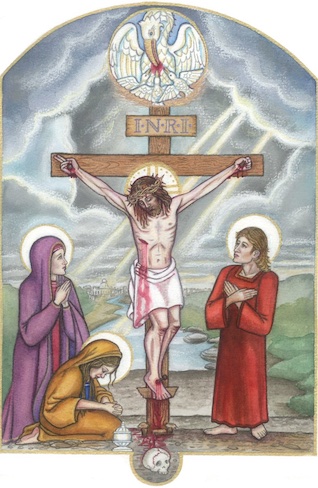
Please Join Us in the Tre Ore
Traditionally, from Noon to 3 p.m., on Good Friday, Catholics have observed the Tre Ore, which consists in three hours of meditation on each of the seven words of Christ as He hung on the Cross. Each “word” is a source of contemplation, as the Scripture is read in which Jesus utters the phrase. Each meditation was generally followed by a sermon, hymns by the choir, intercessions and prayer. Booklets to observe this devotion are still available from p
re-1959 and one of them is offered here as a free download. (The actual devotions in this book begin on p. 45).
+Holy Thursday +
In presenting the pages of Mr. Javier Morell-Ibarra’s book as an introduction to the full read of his work, it was not my intention to create controversy or re-examine issues already settled, only to demonstrate that others have a full appreciation of what has happened to the Church and why we need to pray at home. However, several readers have already raised questions regarding the issues addressed by Mr. Morrell-Ibarra, some of which I answered in my last blog and others which have been discussed in the comments from readers. Additional comments received this past week will be addressed below.
Judging others
One reader has objected to Mr. Morell-Ibarra’s condemnation of those following the leaders of various Traditionalist and “independent“ sects as harsh, unCatholic and uncharitable, and this topic needs to be better understood. When I first created this website, I was more inclined to condemn only the leaders of these sects as formal heretics, which they most certainly are, being public and notorious, not to mention acting fraudulently under Can. 104. I later began to include those among the laity who were (or should have been) better educated in the faith, based on the words of Henry Cardinal Manning below:
“Whensoever the light comes within the reach of our sight, or the voice within the reach of our ear, we are bound to follow it, to inquire and to learn… The Church of God… lays all men under responsibility; and woe to that man who says, ‘I will not read; I will not hear; I will not listen; I will not learn;’ and woe to those teachers who shall say, ‘Don’t listen, don’t read, don’t hear; and therefore, don’t learn.’” This rightly condemns both Traditionalist leaders and their followers, whenever they have access to the truth yet do not avail themselves of it. This amounts to the sin of resisting the known truth, which St. Thomas Aquinas treats below in his Summa Theologica.
“Augustine [Fulgentius] (De Fide ad Petrum iii) says that “those who despair of pardon for their sins, or who without merits presume on God’s mercy, sin against the Holy Ghost,” and (Enchiridion lxxxiii) that “he who dies in a state of obstinacy is guilty of the sin against the Holy Ghost,” and (De Verb. Dom., Serm. lxxi) that “impenitence is a sin against the Holy Ghost,” and (De Serm. Dom. in Monte xxii), that “to resist fraternal goodness with the brands of envy is to sin against the Holy Ghost.” And in his book De unico Baptismo (De Bap. contra Donat. vi, 35) he says that “a man who spurns the truth, is either envious of his brethren to whom the truth is revealed, or ungrateful to God, by Whose inspiration the Church is taught,” and therefore, seemingly, sins against the Holy Ghost….” He further comments:
“I answer that: According to the various interpretations of the sin against the Holy Ghost, there are various ways in which it may be said that it cannot be forgiven. For if by the sin against the Holy Ghost we understand final impenitence, it is said to be unpardonable, since in no way is it pardoned: because the mortal sin wherein a man perseveres until death will not be forgiven in the life to come, since it was not remitted by repentance in this life… According to the other two interpretations, it is said to be unpardonable, not as though it is nowise forgiven, but because, considered in itself, it deserves not to be pardoned… Reply to Objection 1, Art. 3: We should despair of no man in this life, considering God’s omnipotence and mercy. But if we consider the circumstances of sin, some are called (Ephesians 2:2) “children of despair” [‘Filios diffidentiae,’ which the Douay version renders ‘children of unbelief.’”
Several times in the Apocalypse we are told that these children of whom St. Thomas speaks will not repent, despite many chastisements and punishments from God. Mr. Morell-Ibarra speaks of the Katejon, or operation of error, and in St. Paul’s 2 Thess. 2: 10-11 we read: “God will send them the operation of error to believe lying; That all may be judged who have not believed the truth but have consented to iniquity.” The Douay-Rheims commentary states: “God will suffer them to be deceived by lying wonders and false miracles in punishment of their not entertaining the love of truth.” This punishment is something that cannot be loosed except by prayer that God work a miracle of grace for these people, and this is totally up to God, not us. We can berate them all we like and beg them to “Come out of her my people,” but their exit is not dependent on us, but on God alone. In last week’s blog it was pointed out that the Church, under Can. 2200 holds these people accountable and considers them outside the Church (until they publicly retract their errors and devote three years to penitential works). And based on this canon and what has been said above, so must we also believe.
Mr. Morrell-Ibarra is correct in describing the condition of those who seem unable to break away from Traditionalism as existing in an obsessive/compulsive state, for it is a stubborn and perverse form of scrupulosity that enmeshes these people in Traditionalist errors, and even secular psychologists link scrupulosity to obsessive/compulsive disorders (https://iocdf.org/faith-ocd/what-is-ocd-scrupulosity/ — this link is provided only for corroboration purposes; no endorsement is implied). It also can be linked to hypnotism, which is reinforced by the repetitive attendance at the “Latin mass” and the belief that Traditionalist “sacraments” convey “magical” graces. Of course the true Latin Mass and prayers of the Church could never be said to effect such things, but we are talking here of services provided by those who are NOT Catholics, far less priests or bishops, and whose performances constitute an horrific sacrilege before God.
What we believe that Mr. Morrell-Ibarra is trying to convey in his work is the horror of these sins and the immediate need to desist from them, based on the terrible price to be paid if one dies in impenitence. As Rev. Felix Sarda Salvany states, we can love our neighbor even when injuring him if we are defending the rights of God and His Church. No to do so is to embrace the liberal idea of charity. But flogging a dead horse is not productive, either. Many have criticized this author for the repeated harsh treatment of Traditionalists, but as time continues to run out for them, it is difficult not to become more vociferous in condemning their errors. At this point, however, prayer and sacrifice, which we also have repeatedly requested, is probably our best and only option.
A further note on hypnotism here is in order. In their book Snapping (1979), written on the methods used by cults to seduce the vulnerable, Flo Conway and Jim Siegelman explain that:
“The previously held notion that an individual must be put to sleep in order to be hypnotized has been categorically disproved… Practitioners of hypnosis… admit that through lies and carefully contrived suggestions a hypnotist could prompt his subject to commit any action, even a crime, in the firm belief that he was performing the act to accomplish some greater good. In these latest findings about hypnosis and the power of suggestion there are important clues through the destructive effects of many cult and group techniques but — like brainwashing, ego destruction and coercive persuasion — the term hypnosis tells nothing about the dramatic alterations of awareness and personality and the lasting disruptions of thought and feeling we learn about from participants in cults and mass therapies. The techniques employed by cult and group leaders bear no resemblance to the classical induction of hypnosis, nor are the effects confined to simple trance states or feats of memory and imagination. Their attack is comprehensive and profound, not simply altering belief and behavior as in brainwashing but producing lasting changes in the fundamental workings of the mind. And their tools are those of everyday communication, ordinary skills and natural abilities that have been honed to the sharpness of precision instruments” (p. 103).
“By far the most widespread and frightening threat to personality posed by America’s cults and mass therapies is the impairment of an individual’s most fundamental capacity of mind: quite simply his ability to think, not just to think for himself, but to think at all — to make sense out of the information he receives from experience and to use that information in a way that will best serve his survival and personal growth. Almost every major cult and group teaches some form of not thinking; mind control, or as it is often called self-hypnosis as part of its regular program of activity. This process may take the form of prayer, chanting, speaking in tongues or simple meditation. Initially this quiescent state may provide physical and emotional benefits, feelings of inner peace and relaxation, or a calming of nervous tension. After a while, continued practice of the technique may even bring on various forms of euphoria and emotional high, a feeling of bliss or lightness of mind or body.
“In this state an individual may have sensations of being in intangible realms or alternate realities. He may see divine visions receive spiritual communications, or experience breakthrough moments of revelation or enlightenment with the extended cessation of thought. However the cumulative effects of inactivity may wear upon the brain until the point is reached when it readjusts itself to its new condition, suddenly and sharply. When that happens, as we have discovered, its information processing capacities may enter a state of disruption or complete suspensionproducing individual states of mind that incorporate all the other forms of information disease: disorientation, detachment, withdrawal delusion and the trancelike, altered state visible in the cults” (p. 172).
Sadly, the rituals used by these Traditionalist pseudo-clergy to simulate Holy Mass and the Sacraments is what often serves as the means of this hypnosis. Some are so obsessed with these sacrilegious acts that they would be unable to function without them, literally, believing they would lose their souls. These are the “lies and carefully contrived suggestions… to commit any action, even a crime, in the firm belief that [one] was performing the act to accomplish some greater good” mentioned in the quotes above.
As the authors explain, hypnosis is fused with many other techniques, resulting in a profoundly complicated process that only highly trained professionals could hope to reverse. We are not those professionals, which is why we must resort to prayer for these poor tormented souls, especially praying the exorcism prayers for them. Having warned them twice, once privately ourselves and then with one or two others, as Our Lord teaches, we are no longer required by the Church to reproach them, but only to pray for them. We are, however, when the need arises, required to warn others to avoid them.
Inspirations of the Holy Ghost
As Catholics, we must always follow what we believe to be inspirations of the Holy Ghost; not to do so, especially living in this age of perfidious error, is sinful. However, those of us who try to present what the Church teaches to others must be especially careful not to refer to such inspirations as a sort of motive of our own credibility, for while we may be certain we are meant to drive home some necessary point or truth and exert ourselves to a great degree to do so, we are always liable to error and are only as good as the authenticity of the sources we quote and our level of understanding regarding these sources. Only the Supreme Pontiffs have been granted an infallible charism by the Holy Ghost to perceive and present these truths free of error, and our inspirations cannot possibly compare in any way to this unique grant by Christ.
Henry Cardinal Manning describes this grant as “…a charisma of indefectible faith and truth…. a gratia gratis data, or a grace, the benefit of which is for others.” It is a gift strictly attached to the papal office, and it is not one that is of inspiration, but one where “Peter’s faith was kept from failing, either in the act of believing or in the object of his belief… not the discovery of new truths, but the guardianship of old.” (The True Story of the Vatican Council). It is an unfailing assistance, and this we could never pretend to possess. So we must be careful lest we appear to be ascribing to ourselves those gifts which only the popes can possess. We can quote them and insist that others are bound to obey what they say, but it is by their power, and never any merit or inspiration of our own, that we do so.
Till the consummation of the age
As readers have noted, the consummation of the world/age in Matt. 28:20 has become a controversial issue. While all the older Douay-Rheims Bible versions do state “consummation of the world,” the Latin Vulgate (edited under the auspices of the Pontifical University Salmanticenses, 1959) actually states: “usque ad consummatio saeculi,” translated as “consummation of the age.” An Internet article by one B.S. Strauss, identifying as a Catholic layman, observes that “…The Vatican Council solemnly teaches that the Lord promised shepherds and teachers until the consummation of the age – usque ad consummatio saeculi — which, according to Catholic commentary, begins with the revelation of Antichrist, who is announced to reign before the return of the Lord. Hence, apostolic succession seems to have come to an end already, and we deal with shepherds of vengeance.”
This he then proceeds to prove by numerous quotes from Scripture, the Fathers and the Vatican Council. He notes that while the Vatican Council does not define the consummation of the age, neither does it state that there will be teachers and pastors until that time. In fact, he notes well, false prophets, false christs and hirelings, not to mention antichrists and Antichrist proper, are all that is predicted for this time. Those wishing to read his entire work can request it by emailing answers@betrayedcatholics.com.
HOW Christ will remain always with His Mystical Body unto the consummation and how the truth will be taught to the very end has been explained here and here. It will not be preached to the faithful by these pseudo-bishops and pretend priests, or a canonically elected pope, who has not reigned since the death of Pope Pius XII and is now incapable of being elected. Rather it will be spread by those drug from the byways and ditches to attend the marriage feast. They happen to be us, who have, by the grace of God, recognized the truth and refused to follow these false christs (false popes) and their attendant false shepherds, or Traditionalist hirelings.
Mr. Morell-Ibarra comments on the above as follows:
“I have seen that one of your readers wonders why the Catholic Bible I am using translates the term “consummationem saeculi” as “…even to the consummation of the centuries.” She objects that in the Douay-Rheims Bible, it reads, “…even to the consummation of the world.” Well, let us shed some light on the translation of this verse, which undeniably proves it is the most common interpretation of this biblical passage. The thing is all the books we have in our possession from the 18th and 19th centuries, and we have quite a few of them,all of them translate it as the consummation of the century/centuries in all the kingdoms of Spain.” (He here includes as proofs images showing translations of the verse in question dating from 1671, and others dating from 1793, 1798 and 1786. There are even translations dating from 1611, 1592 (!) and 1589 !!).
“As it can be seen, all of them state very clearly “hasta la consumación del siglo“, that is, “until the end of the century”, NOT “until the end of the world”, which was a much later translation. In addition to that… the Vulgate Bible of Scio (19th century) is clearly translated as “until the consummation of the centuries/century.” Now, you will have to agree with me that this translation of the term “consummationem saeculi” is much more common, because it has been translated like this since the 16th century, as Cefas and I have had the chance to check, which makes this translation more trustworthy. That is a fact that admits no objection.
“Furthermore, there is also this comment which could be helpful: “The “consummation of the world” (ovvreleía toú aióvos) has a more decisive force to signify the end of the world than the term “parousia”. However, the word “aiww” means not the physical world or the universe, but “era”, “epoch” of human history, for the use St. Paul makes of it, (cf. ALLO, Vivre et Penser, Series 1.*, 1941, 179.) Therefore, the “era” here may be that of the old economy. In Matt. 28: 20, where the perspective changes, it is the new messianic era.” (B. ORCHARD, E. F. SUTCLIFFE, R. C. FULLER Y R. RUSSELL, VERBUM DEI. COMENTARIO A LA SAGRADA ESCRlTURA Verbum Dei. Comentario a la Sagrada Escritura. B. ORCHARD, E. F. SUTCLIFFE, C. FULLER Y R. RUSSELL. Editorial HERDER,1957; Imprimatur de 1956, Momor Evangelios). Finally, the Dogmatic Constitution Pastor Aeternus from the Vatican Council in 1870 also translates it as “hasta la consumación de los siglos“, or “until the end of the centuries.” (End of Mr. Morell-Ibarra’s comments)
So it appears that this later translation “consummation of the world” must be discarded for the interpretation “consummation of the age(s) or century” with one caution: it cannot, as some have attempted to do, be used to indicate that another age will then commence — that of a certain period of peace for a restored Church on earth, headquartered in Jerusalem, following the conversion of the Jews. This notion was condemned by the Holy Office in 1944: “In recent times, on several occasions, the Supreme Sacred Congregation of the Holy Office has been asked what must be thought of the system of mitigated Millenarianism which teaches, for example, that Christ the Lord, before the Final Judgment, whether or not preceded by the resurrection of the many just, will come visibly to rule over this world. The answer is: The system of mitigated Millenarianism cannot be taught safely” (DZ 2296).
As we have explained in recent articles, some have hinted at a possible “papal restoration” facilitated by a “Great Monarch” will be inaugurated in Jerusalem prior to the Second Coming, to last for an unspecified amount of time. Versions of this were suggested by Yves Dupont, Holzhauser and in several private prophecies. But the New Jerusalem will be brought down to a renewed earth only from Heaven, following the Final Judgment; and that is what they confuse this with. Then and only then will there finally be peace on earth.
Mr. Morrell-Ibarra continues his work below, covering some of the topics we have just addressed. Please note that we offered proofs in our last blog that the date he sets for the Great Apostasy cannot apply to Catholic clergy ordained and consecrated prior to 1965, owing to their obligation to know the law, especially invalidating laws such as Vacantis Apostolicae Sedis. Canon 2200 PRESUMES even material heretics are outside the Church until proven innocent. And only a future canonically elected pope could determine such innocence.
Mr. Morrell-Ibarra’s Catholic Survival Guide, Pt. 4
- Fable of the Episcopalian heretic Berkeley and his fallacy that “esse est percipi”, that is, “to be is to be perceived”, or the absolute empiricism/idealistic empiricism/subjective idealism trap, into which ALL THE FALSE PASTORS AND FALSE CHRISTS OF THE TRADITIONAL PSEUDO CLERGY fall, misapplying the common error only when they have realized the deception, and decreeing that the Great Apostasy begins only when it suits them.
The development of this highly widespread, warped fable goes as follows: Some fake “traditionalist” clergy and their misled followers say that on December 8, 1965, the Great Apostasy did not take place and the Catholic world did not apostatize by accepting the new false religion that synthesized its teaching at the end of the Vatican 2 bogus council and was accepted by the formerly Catholic hierarchy. Instead, they say, it took shape when some were able to perceive it at the end of the 1970s, beginning of the 1980s; others say that this happened with the imposition of the Novus Ordo Missae by Montini-Paul 6; others claim that it occurred in the mid 80s with the Assisi pandemonium organized by Wojtyla-JP2; others hold that it was accomplished when Ratzinger-Benedict16 stepped down as top usurper; others say that the Apostasy was effected with Bergoglio and his pandering to Pachamama, and so on.
Thus there existed some sort of limbo where heresy and apostasy would not exist, simply because they are not perceived by many (!?), so common error would keep them in a virtual state of “non-existence”, where the Code of Canon Law and the Magisterium would remain “stranded”, and it is only when they are perceived that the apostasy would “magically” appear out of the blue. So those who perceive it are capable of choosing the moment that interests them to save their so-called power of order and jurisdiction, for instance, or their membership in the Holy Apostolic and Roman Catholic Church. And from hence the common error is cleared and all those who are not in the same position, once this starting line has been drawn, are automatically defined as being in apostasy, heresy and schism, a line that can be moved by sympathy or some other vested interest.
Therefore, the apostasy would not exist until it becomes evident and is perceived by X actors, who would then confirm the end of common error from the moment the apostasy becomes a reality for them and starts to be, which is obviously ridiculous.
This is nothing more than a bunch of chimerical ideas intended to save the members of the particular sects, since they are the ones who arbitrarily determine when the operation of error should begin, which is precisely when, by some remote grace, they discover the deception. But led by their intolerable moral arrogance, they decide instead that it began when it suits them, because if they had the courage to admit that the apostasy began formally and publicly on December 8, 1965, and that there has been no Pope since October 9, 1958, then they would be forced to accept the cold, hard truth, which is they are not what they say they are, that is, Catholic clerics, but they are all in a state of infamy of law for heresy, schism and apostasy and are not willing to accept that they fell into the Operation of error, as the entire Catholic world did, accepting a false religion and adhering to their ranks, consciously or unconsciously.
- Fable of “SALUS POPULI SUPREMA LEX ESTO”, that is, “let the salvation of souls be the supreme law”, or “necessity knows no law”, which is the battle cry of all schismatics to try and implement their schisms, even if it means disobeying the Papacy and its Infallible Magisterium, which together with the 1917 Code of Canon Law (CIC) completely incapacitate and invalidate these dangerous charlatans, depriving them of any desire to usurp the jurisdiction that only the Pope possesses fully and universally, but whom those prideful individuals are hell-bent on ignoring and belittling over and over again.
- Model fable of “OCD traditionalism” (Obsessive Compulsive Disorder).
The “Traditionalist” fake clergy and sects truthfully say: Vatican 2 was a bogus council! The Novus Ordo Missae is a false rite! More than a billion people are deceived! More than four hundred thousand clerics belonging to the conciliar sect are invalid! Bergoglio is not the Pope!
The fake clergy of the conciliar sect reply to them: You, prophets of misfortunes and calamities! Servants of Satan! You lead us to despair and distress! What happened to the promises of Our Lord Jesus Christ? You say the gates of hell have prevailed! You say that Jesus lied! Anathema! We also tell them (to the “Traditionalist” fake clergy and sects): Your private chapel or sect is invalid and illicit, gravely sinful and sacrilegious, unlawfully established against Pope Pius XII’s infallible Magisterium and the 1917 CIC.
The “Traditionalist” fake clergy and sects reply to us: You, prophets of misfortunes and calamities! Servants of Satan! You lead us to despair and distress! What happened to the promises of Our Lord Jesus Christ? You say the gates of hell have prevailed! You say that Jesus lied! Anathema! Thus, our readers will be able to verify the blindness and hypocrisy with which these dangerous delinquents who violate the Magisterium and the CIC reason and act.
- Recurring fable of the promise of Our Lord Jesus Christ in Matthew 28: 20.
The “Traditionalist” intruders and imposters clamor wherever they go:
“We know from Matthew 28:20 that there will be Bishops until the end of the world!”
“We know from Matthew 28:20 that there will always be a Holy Catholic Sacrifice!”
“Therefore, our “chapels” (sects, garages, cellars, etc.) are valid and lawful!”
We answer them:
And what do we do with Saint Peter then?… Wasn’t Saint Peter included in the promise of Our Lord Jesus Christ?… And the prophet Daniel, what did he say about the cessation of the Holy Sacrifice?… “And he shall confirm the covenant with many, in one week: and in the half of the week the victim and the sacrifice shall fail: and there shall be in the temple the abomination of desolation: and the desolation shall continue even to the consummation, and to the end” (Dan. 9:27).
And what does the Magisterium say about your schismatic “chapels”?…
Deep down, all those modern pharisees reason like those who were scandalized by Our Lord Jesus Christ when He announced to them the kind of death with which He should die, as we read in John 12: 32-34: “And I, if I be lifted up from the earth, will draw all things to myself. (Now this he said, signifying what death he should die.) The multitude answered him: We have heard out of the law, that Christ abideth for ever; and how sayest thou: The Son of man must be lifted up? Who is this Son of man?” “et ego si exaltatus fuero a terra omnia traham ad me ipsum hoc autem dicebat significans qua morte esset moriturus respondit ei turba nos audivimus ex lege quia Christus manet in æternum et quomodo tu dicis oportet exaltari Filium hominis quis est iste Filius hominis”.
With the obstinacy those blind individuals exhibit, they are clearly showing us that they do not believe that Saint Peter and his Successors have been placed by Our Lord as the foundation and cornerstone of the mystical edifice of the Church, since they blasphemously imagine that the Church can continue to expand without the fidelity and obedience due to the Rock of the Papacy and its Magisterium. This proves their null catholicity, since whoever denies the dogma of papal infallibility is NOT Catholic, but schismatic and heretical. Furthermore, in their supine ignorance, they refuse to accept that the Holy Sacrifice of the altar must cease at the time of the Antichrist, also called the time of Satan unchained, thus contradicting the divinely inspired Holy Scripture, which constitutes a sin against the Holy Ghost.
Finally, they dig their own grave by ignoring the discipline imposed by Pope Pius XII’s Magisterium and the Code of Canon Law when they dared to seek the Holy Episcopal Orders at a time when it was strictly prohibited to do so, belittling and ignoring the serious warnings of the legitimate Successor of Saint Peter, Pope Pius XII, who made it very clear in his Apostolic Constitution Vacantis Apostolicae Sedis that during the vacancy of the Holy See NOBODY can usurp the Jurisdiction and prerogatives that only the Pope possesses by divine right; therefore NO ONE can move or confer any Orders until a new Pontiff has been legitimately chosen and confirmed by the Holy Ghost. It will now be understood by all the enormous sin against the Third Person of the Most Holy Trinity these arrogant sophists commit every time they dare to question and disobey the Vicar of Christ and his infallible Magisterium.
by T. Stanfill Benns | Mar 25, 2023 | New Blog
+Feast of the Annunciation+
A reader reports that Traditionalists now are claiming they cannot be excommunicated because no true pope or council has ever formally condemned the Novus Ordo and Traditionalists sects as heretical or schismatic, maintaining they can appeal to Can. 2261 §2 to ”supply” jurisdiction for all their activities. Of course this entirely skirts the issue of ALL Traditionalist ordinations and consecrations, invalidated by Pope Pius XII’s 1945 papal election constitution Vacantis Apostolicae Sedis (VAS). But then Traditionalists have been intent on going their merry way and doing as they please without bothering to obey the pope for decades, a calculated lawlessness that these sects have always practiced and encouraged. That a declaration of the Novus Ordo and Traditionalist sects is necessary to consider them heretical and schismatic is an outrageous supposition condemned by the constant teaching of the Church, as easily seen here. The specific application of VAS to the validity of their masses and sacraments is demonstrated in the paragraphs below. Please save this as an easy reference to why these sects are not Catholic.
An easy way to determine the invalidity of all Traditionalist operations
Traditionalists cannot continue to justify their operations on the basis of epikeia and necessity as explained here by pretending that no law exists which provides ground rules to be observed in this so-called “emergency.” If they consider those ruling from Rome as usurpers, they must also admit the Church currently exists during an interregnum. Ample proofs have been available for decades that such an interregnum began with the death of Pope Pius XII. And if we are now experiencing such an interregnum, and their intention is to preserve the Catholic Church exactly as it existed on the death of Pope Pius XII, then there is definitely one, infallible law and one law only that Traditionalists were bound to follow: Vacantis Apostolicae Sedis (VAS).
The first three paragraphs of this papal constitution infallibly lay down the parameters that must be met in order to preserve the integrity of the Church’s laws, rights and teachings during one of the most dangerous periods imaginable — when the Roman Pontiff has passed away and the Church no longer possess a visible head. It invalidates all actions that usurp the jurisdiction of the Roman Pontiff during an interregnum and any attempt to either change or dismiss VAS itself or any of the sacred canons contained in the 1917 Code of Canon Law. This application of VAS to the Code has been stated by the canonists themselves, (Woywod-Smith, Bouscaren-Ellis). VAS further enjoins any and all to defend the rights of the Church during this most vulnerable time from any incursions made by Her enemies.
The second part of VAS involving the election of a Roman Pontiff requires that a new election be held in no less than three months’ time. Those failing to elect during this time period lose the right to elect (Anscar Parson, Canonical Elections), so this right was lost long ago. While claiming to acknowledge the existence of VAS, Traditionalists deny that they are in violation of this infallible constitution. And they have done nothing to prove that it does not apply to them exactly as it is said here to apply. They have not proven it was somehow abrogated, that it is not infallible, or that it is no longer enforceable. None of their pseudo-clergy have presented the teachings of popes and councils in an official position paper to vindicate their claims. They have not done so because they cannot; VAS is a codification of all papal election laws from the earliest times. All previous laws were abrogated in establishing this law. Below we will see that no matter what objections they might bring, VAS entirely and completely obliterates Traditionalists’ very existence and renders all of their acts invalid.
- Bps. Ngo dinh Thuc and Marcel Lefebvre could not validly create priests and bishops during an interregnum because a papal mandate and confirmation of episcopal appointment could not be obtained. These are acts that have been reserved exclusively to the Roman Pontiffs for centuries. To presume the possession of the mandate and confirmation of any appointment is therefore a usurpation of papal jurisdiction according to VAS that invalidates any attempt at consecration. In addition, men who never became bishops could scarcely establish seminaries or validly ordain priests, acts which can be executed only by a validly consecrated bishop.
- Some claim that the supposed orders conveyed by Thuc and Lefebvre cannot be considered invalid because these men were approved and appointed under Pope Pius XII. But the validity of Lefebvre and Thuc’s ordinations/consecrations in the 1970s-80s and the subsequent ordinations conferred by their “bishops” has been questioned even by Traditionalists for decades. Therefore they are already doubtful and to be avoided. But this is not all.
- For in presuming the validity of these ordinations and consecrations without a decision by the Holy See, Traditionalists usurp papal jurisdiction BECAUSE ONLY THE POPE MAY DETERMINE SUCH VALIDITY. Therefore said presumption is null, void and invalid.
- VAS also invalidates THE EXERCISE of any orders received after 1958, just as Pope Pius VI’s Charitas and other papal decrees have done, even by bishops approved under Pope Pius XII. Because of their adherence to the Novus Ordo (and later, Traditionalist sects), the men conveying these orders, even if they used the old rite, were at least suspect of communicatio in sacris and therefore presumed to have incurred this censure under Can. 2200 (and possibly other censures as well). Can. 2200 holds them guilty until the pope determines otherwise. To presume the lifting of these censures and vindicative penalties, which is clearly an act of papal jurisdiction, is to usurp said jurisdiction. Therefore any EXERCISE of these orders, even if otherwise valid, constitutes a presumption of absolution from these censures, a usurpation of papal jurisdiction rendering them null, void and invalid.
- It is a proven and indisputable fact that the only source ever cited for supplying jurisdiction throughout the history of the Church is the Roman Pontiff, who holds supreme jurisdiction in the Church. To claim that such jurisdiction is supplied in his absence by the law itself is an absurdity, (since Canon Law itself is predicated on papal law and the perpetual existence of the Roman Pontiff); and to say that it is supplied by Christ is heresy. VAS forbids appeal to the supplying principle and invalidates any such appeal as a presumption of papal jurisdiction during an interregnum.
- Any attempt to change or dismiss canon law also is nullified. This would include the violation of Can. 6 n. 4, which requires Traditionalists to adhere to the old law regarding heresy, meaning no declaratory sentence is needed for its existence; Can. 104, reflected in VAS, which invalidates anything done based on error; Can. 147, which requires that in order to possess jurisdiction, certainly validly ordained or consecrated clergy must first receive an office from competent authority; Can. 200, which requires proof of jurisdiction be presented; Can. 804, which requires presentation of the celebret in order to say mass in a place other than the priest’s proper diocese; Can. 2265 §1 which forbids those excommunicated form advancing to orders. And these are only a few among many.
Traditionalists are only laymen simulating the Sacraments, and this we know infallibly from the mouth of Pope Pius XII. Mr. Morrell-Ibarra offers Scriptural proofs of this simulation below.
Installment #2 of Javier Morrell-Ibarra’s Catholic Survival Guide and Reference Handbook
The Great Montinian or conciliar Harlot is the parent sect from which all these false Christs and their false prophets arise, who are all miasmas of the mystical body of the Antichrist, putrefying elements that walk towards their perdition while trying to deceive the greatest possible number of candid souls with little or no formation in the Faith, the Doctrine, and the Magisterium…
In this sense, we can also compare the enormous sin of these false shepherds with the sin committed by King Saul [cf I Kings 8-14], who dared to celebrate the holocaust without being a priest, which was contrary to the Law and was a serious fault, even though his intention was to prevent his people from dispersing, which is exactly what the heretical and schismatic intruders do today, since they try to establish themselves in the visible Church without even being priests, under the fallacious pretext of preventing the faithful from dispersing after the great apostasy of the conciliar sect, in addition to other outlandish excuses that these hypocrites have fabricated to justify their unjustifiable transgression and disobedience to the Magisterium of Pope Pius XII and the Holy Canons. As we read in the commentary on this passage in the Bible by Mons. Straubinger:
“This is a great lesson to show us how faith and trust in God must be maintained even against all appearances, without trying to resort to our human prudence to correct what we believe to be an error by the infinite Wisdom.” This constitutes, in effect, exactly the same sin of those fraudulent impostors, who dare to impiously judge as an “error” by Pius XII the fact that he has bound on earth and in Heaven that absolutely no one can usurp the functions of the Pope during the time that the See is vacant. For such reason these intruders, at the height of their malicious pride and satanic human prudence, have thought it convenient to “consecrate” and “order” one another, as if they could, without Peter and against Peter, thus demonstrating to all their little faith and trust in God, and their null Catholicity, because whoever is not united to the Holy See is not Catholic but heretical and schismatic.
“Whoever leaves the chair of Peter, on which the Church is founded, is not in the Church. For whoever does not maintain unity with the Church, does not have the Faith either.”—Saint Cyprian
… “They devoted themselves solely to the study of the books of Holy Scripture, without presuming to ask their own thoughts for its interpretation, but rather they sought it in their writings and in the authority of the ancients, who, in turn, as was evident, they received from the apostolic succession the rule of their interpretation.” … — Saint Gregory of Nazianzus and Saint Basil.
In addition, the episode narrated in Numbers 16 about the sedition carried out by Korah, Dathan and Abiram, with the horrible end they had, serves to perfectly illustrate the incredible perversity and daring of these miserable false prophets of the traditionalist-sedevacantist sects, who emulate those proud Israelites in their satanic attempt to create a secular priesthood, completely outside the authority instituted by God, who at that time were Moses and Aaron, and in our time is the Vicar of Christ. Let us read the excellent comments given to us in Bishop Straubinger’s Bible in connection with this passage: “In this chapter we are presented with the first known attempt to create a lay priesthood, independent of the authority instituted by God. Moses, who was not a priest, immediately recognized the scope of this movement, which if imposed would have undermined the foundations of theocratic rule. For this reason it was not meekness (cf. 12, 3) that impelled him this time to intercede for the criminals, but rather, moved by holy zeal, he asked God not to accept the oblation of the criminals (v. 15).Korah, the first cousin of Moses and Aaron, seems to have revolted out of sheer ambition and envy, because, being of the same family, he wanted to participate in the honors and privileges of the priests. He did not recognize the idea of a priesthood instituted by God, proclaimed the equality of priests and laity, and practically denied Aaron’s authority as the spiritual leader of the people.
We also find similar movements in Christian times, from the Gnostics to the modern sects, all of which coincide in denying what Saint Paul says in Hebrews 5, 4. “No one takes this honor except he who is called by God as Aaron was”. That is why Saint Augustine compares Korah with the heretics who divide the Mystical Body of Christ. cf. 19, 6; I Corinthians 12, 4 ss.; Ephesus 4, 11. Dathan and Abiram had very other reasons to revolt. They didn’t care so much about spiritual authority. They were Reubenites, sons of Jacob’s firstborn, and because of this they believed they had the right to exercise some authority over the other tribes. They could not understand that God had given all power into the hands of Moses and Aaron, who were from the tribe of Levi. These two movements, that of the Levites who aspired to the priestly dignity, and that of the Reubenites who sought to recover the rights of the birthright, which they had lost (cf. Genesis 49, 4 and note), united, and organized a riot that threatened to destroy all the work that Moses had done at God’s command.”
As we see, disobedience and rebellion against God and His High Priests are at the origin of all evil and sin. Therefore, it is not surprising that there are very clear parallels between what is said in this passage and what the Lord warns us in the book of Apocalypse, with the same and identical words, when Yahweh warns the Israelites to stay away from the tents of those impious men [Koreh, Dathan and Abiram] so as not to be in solidarity with their sins. And in parallel we have in Apoc. 18: 4 the following warning: “Come out of her my people, so as not to be in solidarity with her sins and not participate in her plagues.” It is evident that both in Numbers and in the Apocalypse we are told to flee the company of those criminals because of the existence of sacrilege and desecration. From which it follows that God’s punishment will also fall on these unfortunate heirs of Korah who are the false christs of today, just as it did on Korah, Dathan and Abiram for being sacrilegious and profane, just as it fell on King Saul, also sacrilegious and defiling, as we have seen before. We will quote this episode again later, as it masterfully exemplifies the same sin that the usurpers and imposters commit today.
But I would not want to end this section without first mentioning the terrible threat from Jesus Christ Our Lord that hangs over the heads of false christs and their false prophets, as well as all those who believed the insane fables of these impostors and were seduced by their rhetoric and their false prodigies, falling into their clutches, that is, joining their sects and participating in their sacrileges and acts of desecration. It is especially significant and overwhelming that Our Lord warns us about these disobedient hypocrites in Matthew 7:15-20, calling them by the name of false prophets and comparing them to bad trees that cannot produce any good fruit, so they will be cut down and will be cast into the fire: that is, at the end of their thread of life, they will be condemned to hell for all eternity. Indeed, shortly afterwards Our Redeemer explains to us what the sentence of condemnation of those arrogant wretches will be based upon. It is URGENT that those who have been deceived by these individuals read this and immediately get out from under their pernicious influence, because they are risking eternal life: “Not everyone who says to me: “Lord, Lord”, will enter the kingdom of heaven, but the one who does the will of my heavenly Father. Many will say to me on that day: “Lord, Lord, did we not prophesy in your name, and cast out demons in your name, and do many wonders in your name?” Then I will declare to them: «I never knew you. Away from Me, you workers of iniquity!” (Matt. 7: 21-23).
Yes, this terrible warning from the Lord applies directly to all these false shepherds, who are blind, dropsical, swollen with arrogance and eager for the false glory that their fraudulent titles and non-existent dignities of “bishop”, “father”, “abbé”, “brother” or “sister” give them, to the point of despising and disobeying the Divine Will of the Heavenly Father which is expressed in that the Catholic Church. This Church must be governed by Saint Peter and his Successors, whose infallible Magistery must be faithfully obeyed by of ALL the faithful, whether they are Bishops, Priests, Religious, or simple laymen: we are all obliged to obey the Popes to obtain the salvation of our soul. Because whoever obeys the Pope obeys God, but whoever does not obey him is disobeying God Himself, thus imitating the arrogant Lucifer when he sang his impious and blasphemous “Non Serviam” before the Blessed Trinity in the midst of the heavenly court, which earned him ipso facto expulsion from Heaven and being precipitated deep into the abyss of fire.
In addition, this other warning from Our Lord Jesus Christ also applies to false christs and false prophets and to those who have been deceived by them: One said to him: “Lord, will those who are saved be few?” He answered them: “Fight to enter through the narrow gate, because many, I declare to you, will try to enter and will not be able to. As soon as the owner of the house has woken up and has closed the door, you, being outside, will start knocking on the door saying: “Lord, open for us!” But he, answering, will tell you: “I don’t know you (nor do I know) where you are from.” * Then you will begin to say: “We ate and drank before you, and you taught in our squares.” *But he will tell you: «I tell you, I don’t know where you are from. Away from me, all you workers of iniquity.” There will be weeping and gnashing of teeth, when you see Abraham, Isaac, and Jacob, and all the prophets in the kingdom of God, and yourselves cast out. And from the east and from the west, from the north and from the south they will come to sit at the table in the kingdom of God. And so there are last who will be first, and first who will be last. (Luke 13, 23-30).
The comments on this passage in Bishop Straubinger’s Bible are very illuminating:
[* 26. You taught in our squares: In verse 27, He insists that he does not know them. In addition, it is written that “no one will hear his voice in the squares”, because he will not be turbulent (cf. Matthew 12, 19 and note). If they listened, then, it was to others, as Jesus told him (John 5, 43 and note); to others who did not seek the glory of the one who sent them, but their own glory (John 7, 18 and note), for which they could not have faith (John 5, 44 and note). Those were not, therefore, the true disciples to whom He said: “Whoever listens to you listens to Me” (Luke 10, 16), but the false prophets about whom He had warned so much. Cf. Matthew 7, 15 and note.
* 27. See Matthew 15, 8, quoting Isaiah 29, 13. Matthew 7, 23; 25, 41. Jesus condemns in advance those Christians who are content with the mere name of such and with their external link to the Church.]
Indeed, for at the decisive hour of Judgment, many deceived by the false Christs and their false prophets will uselessly plead before Our Lord that they “ate and drank before Him”, that is, they received what they believed were the Holy Sacraments from the hands of those intruders and impostors, who also preached to them without having any mission or jurisdiction over them. To them those poor gullible souls gave undue credit, thinking that with their false preaching Our Lord was “teaching them in their squares”, that is, in their schismatic and heretical “chapels” and garages, in total contempt and flagrant disobedience of the Papal Magisterium and the 1917 Code of Canon Law, which severely prohibit attending celebrations performed by intruders who have been excommunicated for schism and heresy.
How terrible their surprise will be when they discover at the crucial moment of Judgment that Our Lord will not recognize them or know where they come from, since in fact all these sectarian and schismatic communities have been generated in the spirit of rebellion and contempt for the divine authority of the Vicars of Christ to teach, bind and loose, believing in their infinite pride that they could function bypassing all channels and disciplines established by the Holy See. For this reason, we affirm that those proud rebels did not seek the Glory of God but their own, a false, vain human glory, seeking to be praised and venerated by the blind and the simple who were completely deceived in their particular sects. These include the SSPX, IMBC, CMRI, SSPV, Palmar de Troya, Sociedad Sacerdotal Trento, Mont Carmel, Avrillé, and other small groups and schismatic organizations. This as well as all the false “wandering clerics” that emerged from these sects and now pretend to function independently, deceiving thousands of poor, blind abductees who also supported them financially and made sacrilegious simoniacs out of them.
For NONE of those imposters was sent by God since there was no Pope who could grant them permission and a canonical mission, as well as provide the Jurisdiction necessary to function, without forgetting that they constantly belittled and ignored the voice of Peter in the person of Pope Pius XII, who strictly prohibited the misdeeds and illegalities that these fools perpetrated at the height of their boldness and hypocrisy. This is why we affirm that all of them are cursed and have been sentenced by God. The most terrifying thing will be, without a doubt, when they will have to hear from the lips of Our Lord Jesus Christ those harsh words of “I don’t know you (nor do I know) where you are from”, followed by the fearsome sentence of condemnation “Get away from me, all workers of iniquity.”
Now you understand our insistence that all those who have been deceived by these dangerous tricksters who traffic in sacred things must IMMEDIATELY abandon these schismatic sectarians, who have their conscience seared (I Timothy 4, 2) and walk towards their perdition. This while turning many ignorant souls into mere consumers of sacraments that are nothing but sacrilege and desecration, as the Magisterium and Canon Law warn us, making them concur in communicatio in sacris with those lepers of schism and heresy.
Let no one be deceived, because all those who give credence to the fables of those impostors and grant them an authority and legitimacy they do NOT possess, participating in their simulations and allowing themselves to be fed, that is, spiritually instructed by them, should know that they are being complicit in a very serious sacrilege. This despite the fact that there is no consecration, nor therefore transubstantiation in all those horrible simulations, since those who commit them are only simple laymen in disguise, but those who have allowed themselves to be mentally abducted by those false pastors do think that they are truly receiving the Body and Blood of Christ. Hence the terrible warning in I Corinthians 11, 29 against those who receive Communion without making due discernment of the Body of the Lord, becoming guilty of the Body and Blood of Our Lord Jesus Christ, eating and drinking their own damnation.
So that our readers understand the tremendous seriousness of the sacrilegious crime of the simulation of the Holy Sacrifice of the Mass, we invite you to read the following:
“It seems superfluous to us to demonstrate in many words what a grave and horrendous crime is committed by anyone who, without being invested with priestly Orders, dares to celebrate the sacrifice of the Mass, since the reasons why it is justly considered such a sacrilegious crime are so evident to all that it must be detested and punished with a rigorous application of sanctions”.
[…] “No itinerant bishop, priest or deacon should be received without letters of recommendation; and when they present letters, carefully examine their content; and receive them if they are of proven piety; otherwise, do not even give them what is necessary and let them not be admitted to communion in any way: many things can result from surreptitious behavior.” — Pope Benedict XIV, Encyclical Quam Tumba
“We firmly believe and confess that, no matter how honest, religious, holy and prudent one may be, he cannot and should not consecrate the Eucharist or celebrate the sacrifice of the altar, if he is not a priest, regularly ordained by a visible and tangible bishop. For this office, three things are, as we believe, necessary: a certain person, that is, a priest properly constituted for that office by the bishop, as we have said before; the solemn words that were expressed by the Holy Fathers in the canon, and the faithful intention of the one who utters them. Therefore, we firmly believe and confess that whoever believes and claims that, without previous episcopal ordination, as we have said, they can celebrate the sacrifice of the Eucharist, is a heretic and is a participant and consort in the perdition of Korah and his accomplices, and is to be segregated from the entire Holy Roman Church.” — Pope Innocent III, Eius exemplo, 1208.
Finally, this severe threat from Our Lord Jesus Christ in the form of a parable also hits the false christs and their false prophets, as well as their unfortunate acolytes who preferred the seduction of the perfidious fables of those hypocritical charlatans to the solid, infallible Truth of the Holy Word of God revealed in Scripture and the Magisterium: Parable of the marriage feast and the guest who had not on a wedding garment (Matthew 22, 10-14). This is applicable to those deceived by the false Christs and their false prophets, as well as to all those ravenous wolves themselves, since many of them will have lived in an apparently pious manner in the eyes of the world and their own deceived conscience, but they will not possess the essential Grace that would have made them Catholics. This grace is submission, fidelity and obedience to the Papacy and its infallible Magisterium, which those disobedient, arrogant individuals so many times ignored or openly despised, impiously wanting to believe that they could function without the permission of the Pope and without having received any mission or jurisdiction from the Vicar of Christ: for this reason they will be reputed as schismatics and non-Catholics at the hour of Judgment. We also recommend reading the comments taken from Bishop Straubinger’s Bible.
“And his servants going forth into the ways, gathered together all that they found, both bad and good: and the marriage was filled with guests. And the king went in to see the guests: and he saw there a man who had not on a wedding garment. And he saith to him: Friend, how camest thou in hither not having a wedding garment? But he was silent. Then the king said to the waiters: Bind his hands and feet, and cast him into the exterior darkness: there shall be weeping and gnashing of teeth. *For many are called, but few are chosen.”
[* 14. This parable also refers first of all to the chosen people of the Old Covenant. The Father first invites the Jews to the wedding feasts of his Son with mankind through his “servants”, the prophets. Those who despised the invitation will lose the dinner (Luke 14, 24). The “other servants” are the apostles that God sent without reproving Israel (Luke 13, 6 ss.), during the time of the Acts, that is, when Jesus had already been immolated and “everything was ready” (verse 4; Acts 3, 22; Hebrews 8, 4 and notes). Rejected this time by the people, as He was by the Synagogue (Acts 28, 25 ff.) and then “burnt the city” of Jerusalem (verse 7), the apostles and their successors, inviting the Gentiles, fill the room of God (Romans 11:30). The man who does not wear a bridal garment is the one who lacks sanctifying grace, without which no one can approach the Wedding Banquet of the Lamb (Apoc. 19, 6ff.). Cf. 13, 47 ss. and notes]
And in the same chapter 22 of the Gospel of Saint Matthew, we read this revealing verse 29 a little later:
And Jesus answering, said to them: “You err, not knowing the Scriptures, nor the power of God.”
On which we add this juicy comment taken from Bishop Straubinger, complemented by our own reflections highlighted in purple:
[ 29. You err because you do not understand the Scriptures! Is this not a reproach that we all have to accept? Few are, in fact, those who know the Bible today, and it is not surprising that those who do not study the Scripture of Truth fall into error, as Jesus teaches so many times, and the Supreme Pontiffs remember it so much when they demand its reading daily in homes. Cf. verse 31; 21, 42; John 5, 46 and note. And even fewer are those who know the true hidden treasure of the infallible Magisterium of the Vicars of Our Lord Jesus Christ, which is also the Word of God inspired by His Holy Ghost to the Supreme Pontiffs for the instruction and government of all the Catholic faithful. That is why there are so many today who err and fall into the twisted sophistry and the fables of the Anomos spread by the false prophets, those lepers of schism and heresy, precisely because they did not know the Magisterium that could have protected them against those grave errors and deviations!]
It is universally known that the Holy Apostolic and Roman Catholic Church is founded on the solidity of Saint Peter, the Stone and the Rock, but these sects want us to believe that we must disobey Pope Pius XII, the fundamental rock of the Church, and that we must follow them —they who say they know the spirit of the letter, which is none other than disobedience and non serviam; that we must follow them to their dens of thieves, intruders, foxes and wolves, navigate their rafts and allow ourselves to be guided by these pirates, buccaneers, corsairs, filibusters, thieves and desecrators of the treasures of the Holy Apostolic and Roman Catholic Church. They would have us be deceived by the brilliance of their fake mitres, hooks and their plunder and booty, with the excuse of the rite, incense and pomp, and that we make a defection of Saint Peter, Prince of the Holy Apostles and Fundamental Stone of the Holy Apostolic and Roman Catholic Church, who speaks in his successors assisted by the Holy Trinity in full. Those perfidious thieves that came out of the depths of the great Babylon want to kidnap us through sophistry and disguises to take us back from where God Almighty freely got us out of without us deserving it. What a betrayal of the Good Lord and His compassion it would be to re-enter where He took us out of for our soul’s health, that is, our salvation!
May God grant us that we do not fall for our personal sins and get lost, and may He keep us steadfast in not abandoning His Holy Catholic Church founded on Peter, on the solidity of the Stone, instead of delving into the false churches with feet of clay and quicksand, thus abandoning the Mystical Body of Christ our Lord!
by T. Stanfill Benns | Feb 6, 2023
Traditionalists today forget that the Catholic Church cannot exist without a true pope. This also is the teaching of St. Thomas Aquinas, the Catechism of the Council of Trent, the Popes themselves and the theologians.
Pope Pius IX teaches this fact from his own mouth: “May God give you the grace necessary to defend the rights of the Sovereign Pontiff and the Holy See; for without the Pope there is no Church, and there is no Catholic Society without the Holy See,” (Allocution to religious superiors, June 24, 1872; Papal Teachings: The Church, by the Monks of Solesmes, translated by Mother E. O’Gorman, St. Paul Editions, 1962; no. 391, p. 226 ).
St. Thomas Aquinas writes: “In order that the Church exist, there must be one person at the head of the whole Christian people,” (Summa Contra Gentilis, Vol. IV, 76).
The Catechism of the Council of Trent teaches: “It is the unanimous teaching of the Fathers that this visible head is necessary to establish and preserve unity in the Church,” and this from Christ’s guarantees to St. Peter found in Holy Scripture, (Revs. McHugh and Callan edition, p. 104.).
Revs. Devivier and Sasia, whose work was personally endorsed by Pope St. Pius X, wrote: “As it is to the character of the foundation that a building owes its solidarity, the close union of its parts, and even its very existence, it is likewise from the authority of Peter that the Church derives Her unity, her stability, and even Her existence Herself. The Church, therefore, cannot exist without Peter,” (Christian Apologetics, Vol. II, p. 111).
Traditionalists today may call themselves priests and bishops, but they are doubtfully valid at best, are usurping the powers of the papacy and pretending to perpetuate the Church without a pope contrary to all Church teaching. It is the popes — NOT the bishops and priests, so-called — to whom we must listen. Men not certainly lawful pastors have no power over us whatsoever. The rights of priests are dependent on the bishop, the bishops’ rights and duties are dependent on the pope, and we have no true pope OR bishops. This is evident from what is stated below.
What are the rights and duties of a priest?
“Consequently, it is not easy to say in a way applicable to all cases what are the duties and rights of a priest; both vary considerably in individual cases. By his ordination a priest is invested with powers rather than with rights, the exercise of these powers (to celebrate Mass, remit sins, preach, administer the sacraments, direct and minister to the Christian people) being regulated by the common laws of the church, the jurisdiction of the bishop, and the office or charge of each priest,” (http://www.catholicity.com/encyclopedia/p/priest.html). Canon 108: “Those who have been assigned to the ministry, at least by the first tonsure, are called clerics.” Canon 118: “Only clerics can obtain the power of either orders or ecclesiastical jurisdiction…”
Apostolicity means possessing both orders AND jurisdiction.
“Apostolicity of mission consists in the power of holy orders and the power of jurisdiction derived by legitimate transmission from the Apostles. Any religious organization whose ministers do not possess these two powers is not accredited to preach the Gospel of Christ. For ‘How can they preach,’ asks the Apostle, ‘unless they be sent?’ (Rom. 10:15). It is Apostolicity of mission which is reckoned as a note of the Church.” (http://www.catholicity.com/encyclopedia/c/church.html see “apostolicity” header).
From the Catechism
What does Father Thomas Kinkead tell American Catholics on lawful pastors in the catechism used in Catholic schools in the 1940s and 1950s, before the decline of the Church? In his An Explanation of the Baltimore Catechism, #4, Fr. Kinkead writes in Q. 115: “What is the Church? A. The Church is the congregation of all those who profess the faith of Christ, partake of the same sacraments, and are governed by their lawful pastors under one visible head.” The Baltimore Council’s approved catechism (#3) for adults also written by Rev. Kinkead tells us in the answer to question # 494 that lawful pastors are “those in the Church who have been appointed by lawful authority and who have therefore a right to rule us.” Note that this says nothing of the supposedly “validly” consecrated bishops who have created these priests; it mentions only lawful authority. Valid consecration is not sufficient; if a bishop has not been approved by the pope and consecrated with the papal mandate he cannot function validly, (see Etsi multa and Charitas below).
“Even if valid orders exist, where jurisdiction is lacking there is no real apostolicity. Schism, as well as heresy, destroys apostolic succession,” (Rev. Thomas Cox, Pillar and Ground of Truth, 1900). In his Manual of Christian Doctrine, written for religious congregations and Catholic institutions of higher learning, seminary professor Rev. John Joseph McVey wrote in 1926:
Q. 60: Who after the pope are lawful pastors of the Church?
A. The bishops who have been canonically instituted, i.e., who have received from the Sovereign Pontiff a diocese to govern.
Q. 73: Why is it not sufficient to be a bishop or priest in order to be a lawful pastor?
A. Because a bishop must also be sent into a diocese by the Pope, and a priest must be sent into a parish by the bishop. In other words, a pastor must have not only the power of order, but also THE POWER OF JURISDICTION, (emph. McVey’s).
Q. 77: How is the power of jurisdiction communicated?
A. Priests receive their jurisdiction from the bishop of the diocese; bishops receive theirs from the pope; and the Pope holds jurisdiction from Jesus Christ. A bishop who did not have his spiritual powers from the Pope, a pastor who did not have his from the lawful bishop, would be AN INTRUDER OR SCHISMATIC,” (emph. McVey’s). So not only are Traditionalist “priests” and “bishops” illicitly ordained and consecrated, without a true pope they possess NO jurisdiction whatsoever.
Canonical mission is the conveying of the actual office by the Pope (to bishops) or the bishop (to priests), or the superior (to religious). (Delegated) jurisdiction, the power to execute the duties of that office, is granted to priests only by a validly ordained and consecrated bishop whose consecration was approved by a canonically elected pope (meaning his election was held without any doubts whatsoever about its legitimacy as prescribe by Canon Law and Pope Pius XII’s papal election constitution governing papal elections.) This means only bishops consecrated prior to Pope Pius XII’s death on Oct. 9, 1958 are considered validly consecrated.
Heretics and schismatics lose all jurisdiction
St. Robert Bellarmine says. “There is no basis for that which some respond to this: that these Fathers based themselves on ancient law, while nowadays, by decree of the Council of Constance, they alone lose their jurisdiction who are excommunicated by name or who assault clerics. This argument, I say, has no value at all, for those Fathers, in affirming that heretics lose jurisdiction, did not cite any human law, which furthermore perhaps did not exist in relation to the matter, but argued on the basis of the very nature of heresy. The Council of Constance only deals with the excommunicated, that is, those who have lost jurisdiction by sentence of the Church, while heretics already before being excommunicated are outside the Church and deprived of all jurisdiction.
“For they have already been condemned by their own sentence, as the Apostle teaches (Tit. 3:10-11), that is, they have been cut off from the body of the Church without excommunication, as St. Jerome affirms… All the ancient Fathers…teach that manifest heretics immediately lose all jurisdiction, and outstandingly that of St. Cyprian (lib. 4, epist. 2) who speaks as follows of Novatian, who was Pope [i.e. antipope] in the schism which occurred during the pontificate of St. Cornelius: “He would not be able to retain the episcopate [i.e. of Rome], and, if he was made bishop before, he separated himself from the body of those who were, like him, bishops, and from the unity of the Church.’” (An Extract from St. Robert Bellarmine’s De Romano Pontifice, lib. II, cap. 30, (http://www.cmri.org/02-bellarmine-roman-pontiff.html. This link is placed merely for purposes of attribution; no endorsement of this site is hereby intended.)
St. Robert Bellarmine, (de Romano Pontifice, Bk. 2, Chapter 40) also teaches: “The Holy Fathers teach unanimously not only that heretics are outside of the Church, but also that they are ipso facto deprived of all ecclesiastical jurisdiction and dignity …Saint Nicholas I (epist. Ad Michael) repeats and confirms the same. Finally, Saint Thomas also teaches (II-II, Q39, A3) that schismatics immediately lose all jurisdiction, and that anything they try to do on the basis of any jurisdiction will be null…” Further, St. Robert Bellarmine cites the unanimous teaching of the Fathers in his work “de Romano Pontifice,” where he states: “Heretics who return to the Church must be received as laymen, even though they have been formerly priests or bishops in the Church. St. Optatus (lib. 1 cont. Parmen.).”
Without such jurisdiction priests cannot act validly (confession, marriage, etc.), unless the Church supplies it, (in “emergency” situations). Priests must be assigned an office by a valid bishop in communion with the pope. A valid bishop can only convey an office if he possesses jurisdiction (Pope Paul IV’s Cum ex Apostolatus Officio, 1559, still retained in the 1917 code) and no one who has committed heresy possesses jurisdiction. Without this office and valid assignment to it by a valid bishop, priests cannot say Mass publicly.
Revs. Woywod-Smith, A Practical Commentary on Canon Law, (under Can. 804) write:
“699. A priest who desires to say Holy Mass in a church other than that to which he is attached must show authentic and still valid letters of recommendation (commonly called ‘Celebret’) to the priest in charge of the church. A secular priest must obtain these letters from his Ordinary, a religious priest from his superior, and a priest of an Oriental Rite from the Sacred Congregation of the Oriental Church. A priest who has a proper ‘‘Celebret’’ shall be admitted to say Mass, unless it is known that in the meantime he has done something for reason of which he must be kept from saying Holy Mass…
“If the priest has no ‘Celebret,’ but the rector of the church knows well that he is a priest in good standing, he may be allowed to say Mass. If, however, he is unknown to the rector, he may nevertheless be permitted to say Mass once or twice,” provided he fulfill certain conditions.
“700. The Council of Chalcedon (451) ruled that no strange cleric or lector should be permitted to minister outside his own town without letters of recommendation from his own bishop. Pope Innocent III issued the same prohibition but said that the priest who did not have his letters of recommendation might be admitted to say Mass if he desired to do so out of devotion: he might not, however, say Mass before the people, but privately. The Council of Trent again made the rule absolute—as the Council of Chalcedon had it—that no priest should be permitted to celebrate Mass and administer the Sacraments without letters of recommendation from his own bishop.”
As St. Pius X taught in Acerbo nimis (1905): “Pastors…are obliged by the precept of Christ to know and to nourish the sheep confided to them; now to nourish is first of all to teach… (a) And so the Apostle said, ‘Christ sent me not to baptize but to preach the Gospel, (b) indicating thus that the first office of those who are set up in any way for the government of the Church is to instruct the faithful in sacred doctrine.” So how is it that Traditionalists violate this teaching by rushing to provide Mass and Sacraments and failing entirely to instruct the faithful in sacred doctrine? How is it that despite Pope Boniface VIII’s teaching that unless all the faithful are subject to the Roman Pontiff, they cannot save their souls, Traditionalists fail to require strict obedience to papal law and teaching?
Canon 147 teaches: “An ecclesiastical office cannot be validly obtained without canonical appointment. By canonical appointment is understood the conferring of an ecclesiastical office by the competent ecclesiastical authority in harmony with the sacred canons,” and this canon has been officially interpreted by Pope Pius XII to mean exactly what Pope Pius IX taught in the paragraph from Graves diurturnae quoted below, and the Council of Trent taught in the 1500s.
“This Holy Synod teaches that, in the ordination of bishops, priests and other orders…those who are called and instituted only by the people, or by the civil power…and proceed to exercise these offices, and…those who take these offices upon themselves, are not ministers of the Church, but are to be regarded as ‘thieves, robbers and those who have not entered by the door,’” (DZ 960; Canons 108-109; Can. 147.) “”If anyone says that … those who have neither been rightly ordained nor sent by ecclesiastical authority, but come from a different source, are the lawful ministers of the Word and of the Sacraments, let him be anathema.” (The Council of Trent, Sess. 23, July 15, 1563; DZ 967, 424). Having taught this infallibly, would “the Church” really be willing to supply jurisdiction for them?
When Can. 209 says the “Church” supplies, that term is interpreted to mean the Roman Pontiff, who is the only one throughout history who has EVER supplied jurisdiction. The Pope is the ONLY one who holds primacy of jurisdiction in the Church. All this is according to the Vatican Council decrees and is further explained in Rev. Francis Miaskiewicz’s Canon Law dissertation Supplied Jurisdiction According to Canon 209, (1948, Catholic University of America). And when Canon 2261 §2 says priests may act in emergency situations to administer the Sacraments, it is assumed that the Church (the Pope) will supply jurisdiction. But we have no true pope to supply it, so priests cannot now receive this jurisdiction. Without it they cannot act, as NO ONE may usurp papal jurisdiction during an interregnum. This Pope Pius XII infallibly teaches in his papal election constitution, (Vacantis Apostolica Sedis, 1945):
“We declare invalid and void any power or jurisdiction pertaining to the Roman Pontiff in his lifetime, which the assembly of Cardinals might decide to exercise (while the Church is without a Pope)… If anything contrary to this prescript occurs or is by chance attempted, we declare it by Our Supreme authority to be null and void.” And if even the cardinals (some of whom are also bishops) cannot exercise it, and they are superior in rank to bishops, certainly bishops could not presume to do so. Only the pope can supply the papal mandate; this is an act of papal jurisdiction.
Validly consecrated bishops such as Lefebvre and Thuc long ago incurred heresy and communicatio in sacris by celebrating the Novus Ordo Missae. They publicly admitted they celebrated this false liturgy in communion with a false church and Lefebvre never left that church. (Thuc vacillated back and forth between Traditionalism and the Novus Ordo throughout his life.) Therefore they incurred the penalty for notorious heresy, (Can. 2314 §1). Canon 2314 §3 further provides that if they commit communicatio in sacris (Can. 1258) they also incur a vindicative penalty, which only the pope is able to lift, (Can. 2295). Canon 2294 (Revs. Woywod-Smith commentary) classifies any act performed under the imposition of a vindicative penalty invalid. Furthermore, in his papal election law, Pius XII declares any act usurping papal jurisdiction during an interregnum null and void. One cannot presume to act validly and licitly without a papal dispensation from this penalty while the Church is without Her head.
So first of all, Lefebvre and Thuc are notorious heretics and schismatics (notorious by fact, meaning Catholics know what they did was an act of treason against the Church, they know that they did it because they have confessed it or otherwise confirmed it publicly and they know what they did was wrong; Can. 2197 no. 3). These two men automatically lost their offices and all jurisdiction. They cannot plead ignorance; for as Pope Celestine I taught: “No priest may be ignorant of the canons,” far less a bishop! These men were forbidden to function by papal decree, interregnum or no, (see Etsi multa and Charitas below). So even when not operating during an interregnum, past papal laws have declared the operations of such schismatics/heretics null and void in similar cases. During an interregnum, the acts of those who violate papal laws or usurp papal jurisdiction are infallibly declared null and void by Pius XII above.
Schismatic bishops can validly consecrate when a canonically elected pope is reigning, because then the reigning pope can judge and rectify such consecrations. But during an interregnum, such consecrations are null ab initio, (from the outset) because the pope infallibly forbids it. All affairs are to be referred to the future pope in advance of their accomplishment. Any attempted these consecrations are considered as though they never happened. Traditionalists cannot presume to consecrate bishops without a papal mandate, as Pope Pius IX unequivocally demonstrates in Etsi Multa. If a priest is not consecrated a bishop, he cannot validly ordain priests because technically he is still a priest himself. And since Traditionalist consecrations of bishops never happen, ordinations cannot happen either.
All comes back to Can. 147, explained above. In order to function as a valid and lawful pastor, one must be assigned an office. All must be done in accordance with the canons. All offices are lost on the commission of heresy, (Can. 188 no. 4 and Can. 2314 §2; also St. Bellarmine above).
Pope Pius IX, Etsi Multa (November 1873)
“24. But these men [the Old Catholics], having progressed more boldly in the ways of wickedness and destruction, as happens to heretical sects from God’s just judgment, have wished to create a hierarchy also for themselves, as we have intimated. They have chosen and set up a pseudo-bishop, a certain notorious apostate from the Catholic faith…
“25. But as even the rudiments of Catholic faith declare, no one can be considered a bishop who is not linked in communion of faith and love with Peter, upon whom is built the Church of Christ; who does not adhere to the supreme Pastor to whom the sheep of Christ are committed to be pastured; and who is not bound to the confirmer of fraternity which is in the world.
26. We additionally excommunicate whoever has adhered to them and belonging to their party has furnished help, favor, aid, or consent. We declare, proclaim, and command that they are separated from the communion of the Church. They are to be considered among those with whom all faithful Christians are forbidden by the Apostle to associate and have social exchange to such an extent that, as he plainly states, they may not even be greeted,” [Vitandus!] (http://www.papalencyclicals.net/Pius09/p9etsimu.htm).
Pope Pius IX, Graves Diurturnae (March 1875):
“We have already reproved and condemned this deplorable sect [the Old Catholics] which has produced from the old store of the heretics so many errors opposed to the principal tenets of the Catholic faith. This sect overthrows the foundations of the Catholic religion, shamelessly rejects the dogmatic definitions of the Ecumenical Vatican Council, and devotes itself to the ruin of souls in so many ways… [The faithful] should totally shun their religious celebrations, their buildings, and their chairs of pestilence, which they have with impunity established to transmit the sacred teachings. They should shun their writings and all contact with them. They should not have any dealings or meetings with usurping priests and apostates from the faith who dare to exercise the duties of an ecclesiastical minister without possessing a legitimate mission or any jurisdiction. They should avoid them as strangers and thieves who come only to steal, slay, and destroy.”
http://www.papalencyclicals.net/Pius09/p9graves.htm
Pope Pius IX, Quartus Supra (January 1873)
“As Our predecessor Pius VI warned in his Apostolic letter condemning the civil constitution of the clergy in France, discipline is often so closely related to doctrine and has such a great influence on its preservation and its purity, that the sacred councils have not hesitated to cut off from the Church by their anathema those who have infringed its discipline.” www.papalencyclicals.net/Pius09/p9quartu.htm
Pope Pius VI, Charitas (April, 1791)
“They must not grant dimissorial letters for ordinations. Nor must they appoint, depute, or confirm pastors, vicars, missionaries, helpers, functionaries, ministers, or others, whatever their title, for the care of souls and the administration of the Sacraments under any pretext of necessity whatsoever… For We declare and proclaim publicly that all their dimissorial letters and deputations or confirmations, past and future, as well as all their rash proceedings and their consequences, are utterly void and without force…” www.papalencyclicals.net/Pius06/p6charit.htm
It is a sin of presumption to think Christ would supply jurisdiction in the pope’s absence as some teach today. There is no law in the Church anywhere that says in the present “emergency” situation Our Lord would supply jurisdiction; Charitas above says no “pretext of necessity” would justify such a belief. Pope Pius XII’s infallible papal election constitution says it does not/cannot occur. Even Our Lord cannot supersede a pope’s infallible decree, for He promises to bind in Heaven whatever His Vicar binds on earth, and He is ever true to His promises. The Church’s teachings must be taken as a whole, as a flawless composite of integral truth. One truth cannot contradict the other. If the Traditionalist scenario is true then the popes quoted above are liars. We are to obey God not men, and God speaks to us only through his VICARS and those in communion with them. The choice is and has always been our own. The Church infallibly commands us to be subject to the Roman Pontiff if we wish to be saved (Boniface VIII). And we cannot be subject to them by following men who refuse to observe the teachings of the continual magisterium and insist on functioning outside communion with a canonically elected pope.
by T. Stanfill Benns | Feb 2, 2023 | New Blog
+Feast of the Purification+
Month of February, Dedicated to the Holy Family
Prayer Society Intention
Oh Jesus, Mary and Joseph, we humbly beseech Thee to protect our families in these tempestuous times fraught with so many evils. Please keep us ever faithful and always pure in body, mind and soul. Amen.
To our readers
Owing to formatting problems resulting from a WordPress glitch, readers attempting to access site articles may have been unable to decipher some of the site content and for this we apologize. Please know that these errors, with a few exceptions, have now been corrected. Next, we will be working to update links in site articles, but this will be a slow process; please be patient. Non-working links or other issues may be reported at answers@betrayedcatholics.com
The article featured on the homepage addressing epikeia has been updated to include a part two on “necessity knows no law,” since Traditionalists continue to use this legal principle to justify their operations. It comes at the end of the epikeia article and is only five pages long. See https://www.betrayedcatholics.com/epikeia-negates-the-churchs-divine-constitution/ . This is further proof that Traditionalists, from the outset, have tried to make their followers believe that legal principles are superior to revealed truth and can rightfully replace what has been infallibly taught by the Roman Pontiffs.
The Vatican Council on interpretation of papal decrees
The headline above may seem self-evident. But if it truly was understood, there would be no need for many of the articles posted to this website. Nor any need to repeatedly refute the allegations lobbied against these articles/this author. Unfortunately, the misrepresentation and misunderstanding of this most essential dogma is so deeply rooted that it seems a special effort should be made to better explain and demystify it. The entire thrust of the Vatican Council held in 1869 was to define the primacy and the divine nature of jurisdiction entrusted by Christ to Saint Peter and his successors, to rule the Church in His name: “He who hears you, hears me.” For those so enamored of the episcopal power, close to 700 bishops and heads of religious orders, at one time or another, attended the Vatican Council, the largest gathering in Church history. A total of 533 affirmed these dogmas, with only a scant few dissenters. Sixty of those who left to avoid the final vote later accepted the definition. The infallible decrees of this council declared the following, which will be followed by my comments.
Probably the most important of these infallible Vatican Council decisions for us today is the following: “God cannot deny Himself… but a vain appearance of such a contradiction arises chiefly from this: that either the dogmas of faith have not been understood and interpreted according to the mind of the Church or deceitful opinions are considered as the determinations of reason, therefore ‘Every assertion contrary to the truth illuminated by faith we define to be altogether false’” [Lateran Council V, no. 738.]; (DZ 1797).
Comment: Since God cannot deny Himself, this means that the Vatican Council decisions regarding the dogmas of faith must issue directly from God through His Son and to His Vicars on earth, but that is not how they are received today by Traditionalists. As noted earlier on this blogspot, some wishing to oust Francis even have suggested there should be changes to the Vatican Council decisions. Yes, changes, to what God has issued through the mouths of the Apostolic College His Son established to rule in His name! Why has this happened? Because “the dogmas of faith have not been understood and INTERPRETED according to the mind of the Church.” How would this occur?Only by ignoring the laws and teachings of the Roman Pontiff, both past and prior to Pope Pius XII’s death, regarding the doctrines in question. The lawgiver himself, that is the Roman Pontiff and his predecessors, are the only ones Canon Law designates as able to determine the nature of his own laws and pronouncements. Approved theologians pre-1959 may explain them but they cannot interpret them.
Numerous “deceitful opinions… considered as the determinations of reason” have been advanced by those who are not valid clerics, and therefore unable to even explain various points, far less speculate on the intent of the lawgiver. They may appear to be reasonable, but their reasoning has been time and time again shown as consisting in logical fallacies and theological errors. Their actual deceit has been demonstrated in recent blogs on this site, a deceit that under Canons 103 and 104, nullifies and invalidates their actions. “For the doctrine of faith which God revealed has not been handed down as a philosophic invention to the human mind to be perfected.”
Comment: And that is exactly what Traditionalists have done by resorting to mere legal principles such as necessity and epikeia, which they pretend can override the Holy Ghost inspiring the pope and Christ speaking through him.
And then there is also this: “For the doctrine of faith …has been entrusted as a divine deposit to the spouse of Christ TO BE FAITHFULLY GUARDED AND INFALLIBLY INTERPRETED. Hence also that understanding of the sacred dogmas must be perpetually retained which Holy Mother Church has once declared and there must never be recession from that meaning under the specious name of a deep deeper understanding.”
Comment: God’s revelations are not to be interpreted by men. They are entrusted only to the Roman Pontiff who alone is guided by the Holy Ghost in his determinations. Anyone who dares to attempt to interpret papal documents, when the popes are quite clear in what they mean and what they teach, are usurping the papacy. This is especially true during an interregnum, when all such attempts are declared null, void, and invalid in Pope Pius XII’s 1945 election constitution, Vacantis Apostolicae Sedis (VAS). And how does one faithfully guard what God has revealed as presented in an infallible document? Certainly not by ignoring it, minimizing it, dismissing it, and disputing it!! As recently emphasized in various blogposts, those who do such things are not just disposing of the necessity of the papacy — they are denying that Christ founded His Church on Peter the Rock and that the Holy Ghost speaks through the Roman Pontiffs to us.
“But that the episcopacy itself might be one and undivided, and that the entire multitude of the faithful, through priests closely connected with one another might be preserved in the unity of faith and communion, placing the blessed Peter over the other apostles He established in him the perpetual principle and visible foundation of both unities, upon whose strength the eternal temple might be erected and the sublimity of the Church to be raised to heaven might rise in the firmness of this faith. And since the gates of hell to overthrow the Church, if this were possible, arise from all sides with ever greater hatred against this divinely established foundation,We judge it to be necessary for the protection, safety and increase of the Catholic flock, with the approbation of the council, to set forth the doctrine on the institution, perpetuity and nature of the sacred Apostolic primacy in which the strength and solidarity of the whole Church consist…” (DZ 1821).
Comment: So the pretend episcopacy of Traditionalists is one and undivided without a pope? And the unity of faith is preserved? This would be a laugh-out-loud moment if it wasn’t such a sad and serious matter. Exactly how many Traditionalist sects are there today — hundreds, maybe even thousands? Certainly neither both unities, the episcopacy nor the entire multitude of the faithful, could ever be said to be one. The Vatican Council states that the definition of infallibility was declared specifically to prevent the overthrow of the Church and for the protection and safety of the faithful. And yet that is the one thing Traditionalists failed to secure for the faithful — a true pope; and having failed at that, they do not even uphold infallibility or obey papal decrees. So can we doubt that there has indeed been an overthrow of the Church, one they helped orchestrate and perpetuate? The Vatican Council decrees that the primacy is the strength and solidarity of the whole Church, but we must fend off attacks for Pius IX’s statement that “without the pope there is no Church”? Clearly Pope Pius IX as well as the bishops was of one mind in this matter.
“So this gift of truth and never-failing faith was divinely conferred upon Peter and his successors in this chair… that with the occasion of schism removed the whole Church might be saved as one and relying on her foundation, might stay firm against the gates of hell” (DZ 1837).
Comment: So we see that without the foundation of the primacy, the Church cannot stay firm against the gates of hell. Once again, Traditionalists failed to lobby for a papal election but they have the best interests of the Church at heart? They are indeed working for “the salvation of souls” as they have claimed for decades when Pope Boniface VIII proclaimed that in order to be saved, all must obey the Roman Pontiff? Schism everywhere we look is all the proof we need that we have no true pope. What the Vatican Council tried to protect us against is exactly what happened. And now the only protection we can claim is strict adherence to everything issuing from the continual magisterium and the censuring of any and all who presume to interpret papal teachings or speak in his name. If we cannot have Christ’s Vicar at our side, we can at least gather around his throne and pray, promising to honor all the popes have ever taught and obey their commands.
Papal documents bind infallibly even when a censure is not heretical
In his Tuas libentur, addressed to German theologians, Pope Pius IX stated; “Perfect adhesion to revealed truth [cannot] be obtained if faith and obedience were given only to the dogmas expressly defined by the Church. Or even if it were a matter concerning that subjection which is to be manifested by an act of divine faith, nevertheless it would not have to be limited to those matters which have been defined by express decrees of the ecumenical councils or of the Roman Pontiffs and of the See, but would have to be extended also to those matters which are handed down as divinely revealed by the ordinary teaching power of the whole Church spread throughout the world and therefore by universal and common consent are held by Catholic theologians to belong to faith” (DZ 1683)… “[For] it is not sufficient to shun heretical iniquity unless these errors also are shunned which come more or less close to it…” (DZ 1820; Can. 1324).
Comment: So where is the obedience to those things not condemned as heretical? Certainly this belief that we owe no obedience to such things is not limited to Traditionalists. And yet it is stated by the popes in many other places as well. Why would any sincere Catholic prefer the opinion of a theologian, or even several theologians, over the teachings of a pope, especially in these uncertain times? As Revs. Pohle-Preuss write in The Sacraments, Vol. IV (1931): “It matters not what the private opinions of…theologians [are]. It is not the private opinions of theologians but the official decisions of the Church by which we must be guided.” And as Msgr. Joseph C. Fenton wrote in one of his articles for the American Ecclesiastical Review: “It is, I believe, to be presumed that the Vicar of Christ speaks to the faithful in a way they are able to understand.” Henry Cardinal Manning wrote in his work The Vatican Council and its Definitions (1887):
“To deny the infallibility of the Church in the censures less than for heresy, is held to be heretical” (and here he lists 11 approved theologians including Ferraris, De Lugo and others). “All, therefore, affirm the Church in passing such censures to be infallible. The infallibility of the Church in all censures less than heresy may be proved from the Acts of the Council of Constance. In the eleventh article of the Interrogatory proposed to the followers of Huss are included condemnations of all kinds. “In like manner, again, in the Bull Auctorem Fidei, the propositions condemned as heretical are very few, but the propositions condemned as erroneous, scandalous, offensive, schismatical, injurious, are very numerous.
“During the last three hundred years, the Pontiffs have condemned a multitude of propositions of which perhaps not twenty were censured with the note of heresy. Now in every censure the Church proposes to us some truth relating to faith or morals; and whether the matter of such truths be revealed or not revealed, it nevertheless so pertains to faith and morals that the deposit could not be guarded if the Church in such judgments were liable to error… In like manner all censures, whether for heresy or with a note less than heresy, are doctrinal definitions in faith and morals, and are included in the words in doctrina de fide vel moribus definienda…
“…The infallibility of the Church extends, as we have seen, directly to the whole matter of revealed truth, and indirectly to all truths which though not revealed are in such contact with revelation that the deposit of faith and morals cannot be guarded, expounded, and defended without an infallible discernment of such unrevealed truths, that this extension of the infallibility of the Church is, by the unanimous teaching of all theologians, at least theologically certain; and, in the judgment of the majority of theologians, certain by the certainty of faith.” He then quotes Pope Pius IX:
“Wherefore the Church, by the power committed to it by its Divine Author, has not only the right but above all the duty, of not tolerating but of proscribing and of condemning all errors, if the integrity of the faith and the salvation of souls should so require. On all philosophers who desire to remain sons of the Church, and on all philosophy, this duty lies, to assert nothing contrary to the teachings of the Church, and to retract all such things when the Church shall so admonish. The opinion which teaches contrary to this we pronounce and declare altogether erroneous, and in the highest degree injurious to the faith of the Church, and to its authority.” (Papal Letter Gravissimas Inter, Dec. 1862)
Objections by John Lewis addressed
So it is infallibility itself that is denied by those who hold that propositions not labeled as heretical may be held without incurring the penalty for heresy because there has been no “final determination,” refusing to render obedience to papal teaching. And if anyone is to be believed among the theologians, surely Henry Cardinal Manning, who took a vow before Pope Pius IX to bring the Vatican Council and its definition to fruition, is to be trusted far and away before any other theologian, especially when he quotes so many other approved theologians. Furthermore, there is an abundance of proof that what Cardinal Manning states is straight from the mouth of Pope Pius IX as seen below. To address more recent claims by John Lewis I state the following:
- As to the assertion that no one ignores VAS, this is ridiculous. Traditionalists are ignoring VAS by the simple fact that they continue to function and hold themselves validly ordained and consecrated. This is why generally no individual names are mentioned when writing these articles: all are ignoring it.
- An apostolic constitution is a papal document that deals with serious doctrinal matters regarding the definition of dogma, changes in canon law or other ecclesiastical matters (https://www.betrayedcatholics.com/vacantis-apostolicae-sedis-vindicated/). Apostolic constitutions are issued as papal bulls because of their solemn, public form. That the manner of electing a true pope would need to be modified in the present situation, were this possible (and it is not possible without unquestionably valid bishops to elect) I affirm. That the first four paragraphs of this constitution dealing with both dogmatic and canon law matters is not a matter of the primary, but the secondary object of infallibility, I deny. Even were such a thing only the secondary object of infallibility involving a disciplinary matter, Pope Pius IX teaches:
“…Discipline is often so closely related to doctrine and has such a great influence on its preservation and its purity, that the sacred councils have not hesitated to cut off from the Church by their anathema those who have infringed its discipline… Nor can the Eastern Churches preserve communion and unity of faith with Us without being subject to the Apostolic power in matters of discipline… Teaching of this kind is HERETICAL, and not just since the definition of the power and nature of the papal primacy was determined by the ecumenical Vatican Council (DZ 1827)
“… But the neo-schismatics say that it was not a case of doctrine but of discipline, so the name and prerogatives of Catholics cannot be denied to those who object. Our Constitution Reversurus, published on July 12, 1867, answers this objection. We do not doubt that you know well how vain and worthless this evasion is. For the Catholic Church has always regarded as schismatic those who obstinately oppose the lawful prelates of the Church and in particular, the chief shepherd of all. Schismatics avoid carrying out their orders and even deny their very rank. [These] are schismatics even if they had not yet been condemned as such by Apostolic authority” (Pope Pius IX, Quartus Supra, 1873).
Three years after writing Quartus Supra, we also hear the following from Pope Pius IX, in Quae in patriarchatu: “In fact, Venerable Brothers and beloved Sons, it is a question of recognizing the power (of this See), even over your churches, not merely in what pertains to faith, but also in what concerns discipline. He who would deny this is a HERETIC; he who recognizes this and obstinately refuses to obey IS WORTHY OF ANATHEMA,” (Pope Pius IX, September 1, 1876, to the clergy and faithful of the Chaldean Rite.) See also Manning above.
- I have never said bishops do not have ordinary jurisdiction and could not function during an interregnum IF they had kept the faith. In a previous response to your objections, I pointed out that I am speaking here only of this PARTICULAR CIRCUMSTANCE AND SITUATION, not the normal course of things, since it no longer exists. I have said and continue to say no valid bishops exist and that all the valid bishops attending the false Vatican 2 council became heretics, as well as most of those those not attending the false council, since they failed to rally and elect a true pope: this was the command and intention of Pope Pius XII and all those preceding him. They are now all deceased, as noted previously.
- I am well aware that there are cardinal-priests and cardinal-bishops; I wrote a book stating this in 1990, remember? But the majority of those cardinals electing John 23 were consecrated bishops, and whether cardinals or not, they hardly lost their episcopal powers just by being appointed cardinals. This is what the Apostolic College is all about. The point I was attempting to make is that they lost their office as cardinals in bowing to secular governments and determining, prior to Roncalli’s election, that he would indeed be the one elected. This invalidated the election, as VAS decrees, and these cardinals were reduced to (infamous, excommunicated) bishops; this is verified in Pope Paul IV’s Cum ex Apostolatus Officio, the (old) law which serves as the fontes for Can. 188 no. 4, cited in VAS. You are the one who does not seem to be logically following here.
- You are arguing beside the point, (hence your argument is invalid), when you state that I falsely claim Mystici Corporis teaches “without the Pope the bishops have no power.” Bishops referred to above who defected from the Church have no power ; had any bishops remained faithful, they would have retained their power. Bishops excommunicated for heresy lose all jurisdiction and incur infamy of law. Traditional pseudo-bishops and those upholding their purported power by their actions deny that the pope alone has the power to direct and supervise all they do, and that this power can come from no other source; hence they deny infallibility as explained above. (See https://www.betrayedcatholics.com/?s=Ott). The canon law defining heresy declares that it is committed by “manner of acting” (Can. 1325), among other things.
- It is obviously the will of God that we no longer have valid bishops to elect a pope, or valid priests for that matter. The failure of Traditionalists to demand that such an election be held and try to rally remaining valid bishops and senior clergy to do this is proof they never intended to obey the pope in the first place. Some will say that this effort was made; I have yet to see any proof that this was ever the case and have pointed out in several articles that such an attempt to elect someone was actually circumvented.
- You state: “Neither of these groups (Cardinals or bishops) can cease to exist in the Church.” And yet they have physically ceased to exist, because we live in the one time exempted from their existence in Holy Scripture, when “he who withholdeth will be taken out of the way” and the flock will be scattered — the time of Antichrist. If Traditionalists don’t accept this, it is not my problem. Even Protestants look around at this world and seem to think that the Second Coming is imminent. And if it is indeed imminent, it could not happen unless Antichrist proper, the Man of Sin, had already come, although his system remains.
- As to your advice on how to argue with others, I quote from the link you provided to Vermeersch: “If we were to summarise what is needed in our interactions with other Catholics in one word, it would not be “charity”. Rather, it would be the very title of the book from which this extract is taken: “Tolerance… It often is not right for us to conclude that someone is a heretic or schismatic unless we are really compelled to do so.” I wish that I could say that I consider those I am dealing with as Catholic. Sadly, I cannot. Most of the pseudo-clergy I even consider as pertinacious heretics. I prefer Rev. Felix Sarda-Salvany’s approach in Liberalism is a Sin on this subject, whose work was approved by the Holy Office. And I am obligated in these evil times to warn people against men whose practices lead them into mortal sin and eternal damnation, not to mention the obligation I owe Our Lord to defend His Church.
Fr. Sarda states: “Sovereign Catholic inflexibility is sovereign Catholic charity. This charity is practiced in relation to our neighbor when in his own interests he is crossed, humiliated, and chastised. It is practiced in relation to a third party, when he is defended from the unjust aggression of another, as when he is protected from the contagion of error by unmasking its authors and abettors and showing them in their true light as iniquitous and pervert, by holding them up to the contempt, horror and execration of all… The love due to a man inasmuch as he is our neighbor ought always to be subordinated to that which is due to our common Lord. For His love and in His service we must not hesitate to offend men. The degree of our offense toward men can only be measured by the degree of our obligation to Him. Charity is primarily the love of God, secondarily the love of our neighbor for God’s sake. Therefore to offend our neighbor for the love of God is a true act of charity. Not to offend our neighbor for the love of God is a sin.”
And on that note I will end this, with one more observation. Several years ago I wrote an article explaining the true motive and intent of this minimization of the infallibility of the Roman Pontiffs. This in a time when the only right thing we can do is defend and uphold the Deposit of Faith and condemn the actions of those who impugn it. I suggest that those who would seek a better understanding of why this is happening should read or reread this article at https://www.betrayedcatholics.com/material-formal-hypothesis-condemned-as-heresy/ . If people objecting to what is written here would pay closer attention to what has already been said for nearly 20 years — both in the books and articles on this site — there would be none of these superfluous questions.
As the Vatican Council teaches, truths of faith presented from reason are not sufficient to facilitate conversion. What is needed is grace. This we fervently beseech God to grant all those today who wander in this vast wilderness of unbelief.