+Second Sunday in Lent+
+Prayer Society Intentions for March, Month of St. Joseph+
“Glorious Saint Joseph, pattern of all who are devoted to toil, obtain for me the grace to toil in the spirit of penance, in order thereby to atone for my many sins.” — Raccolta
Introduction
We are pleased to be able to present a set of meditations for every day in Lent from the great St. Thomas Aquinas, and regret only that we were not able to find them sooner, so they could be read from the beginning. We have selected a few excerpts below from the earlier weeks, and the meditations themselves can be found at: https://ia800201.us.archive.org/0/items/meditationsforle00aquiuoft/meditationsforle00aquiuoft.pdf
May all enjoy a peaceful and profitable Lent.
MEDITATIONS AND READINGS FOR LENT
FASTING
- We fast for three reasons. (i) To check the desires of the flesh. So St. Paul says in fastings, in chastity (2 Cor. vi. 5), meaning that fasting is a safeguard for chastity. As St. Jerome says, ” Without Ceres, and Bacchus, Venus would freeze,” as much as to say that lust loses its heat through spareness of food and drink. (ii) That the mind may more freely raise itself to contemplation of the heights. We read in the book of Daniel that it was after a fast of three weeks that he received the revelation from God (Dan. x. 2-4). (iii) To make satisfaction for sin. This is the reason given by the prophet Joel, Be converted to me with all your heart, in fasting and in weeping and in mourning (Joel ii. 12). And’ here is what St. Augustine writes on the matter. ” Fasting purifies the soul. It lifts up the mind, and it brings the body into subjection to the spirit. It makes the heart contrite and humble, scatters the clouds of desire, puts out the flames of lust and the true light of chastity.”
- There is commandment laid on us to fast. For fasting helps to destroy sin, and to raise the mind to thoughts of the spiritual world. Each man is then bound, by the natural law of the matter, to fast just as much as is necessary to help him in these matters. Which is to say that fasting in general is a matter of natural law. To determine, however, when we shall fast and how, according to what suits and is of use to the Catholic body, is a matter of positive law. To state the positive law is the business of the bishops, and what is thus stated by them is called ecclesiastical fasting, in contradistinction with the natural fasting previously mentioned.
- The times fixed for fasting by the Church are well chosen. Fasting has two objects in view: (i) The destruction of sin, and (ii) the lifting of the mind to higher things. The times self-indicated for fasting are then those in which men are especially bound to free themselves from sin and to raise their minds to God in devotion. Such a time especially is that which precedes that solemnity of Easter in which baptism is administered and sin thereby destroyed, and when the burial of Our Lord is recalled, for we are buried together with Christ by baptism into death (Rom. vi. 4). Then, too, at Easter most of all, men’s minds should be lifted, through devotion to the glory of that eternity which Christ in His resurrection inaugurated. Wherefore the Church has decreed that immediately before the solemnity of Easter we must fast, and, for a similar reason, that we must fast on the eves of the principal feasts, setting apart those days as opportune to prepare ourselves the devout celebration of the feasts themselves.
ON REFORMING OURSELVES
“Be not conformed to this world, but be reformed in the newness of your mind, that you may prove what is the good, and the acceptable, and the perfect will of God” — Romans xii. 2.
- What is forbidden is the forming of one self after the pattern of the world. Be not conformed to this world, that is, to the things which pass away with time. For this present world is a kind of measure of those things which pass away with time. A man forms himself after the pattern of things transitory when, willingly and lovingly, he gives himself to serve them. Those also form themselves after that pattern who imitate the lives of the worldly, This then I say and testify in the Lord : That henceforward you walk not as also the Gentiles walk in the vanity of their mind (Eph. iv. 17).
- We are bidden to undertake a reformation of the interior man when it is said, But be reformed in the newness of your mind. By mind is here meant the reason, considered as the faculty by which man makes judgments about what he ought to do. In man, as God first created him, this faculty existed in all the completeness and vigour it could need. Holy Scripture tells us of our first parents that God “filled their hearts with wisdom” and shewed them both good and evil (Ecclus. xvii. 6). But through sin this faculty declined in power and, as it were, grew old, losing its beauty and its brilliance. The Apostle warns us to form ourselves again, that is, to recover that completeness and distinction of mind that once was ours. This can indeed be regained by the grace of the Holy Ghost, and we should therefore use every endeavour to share in that grace — those who lack that grace that they may obtain it, and those who already have gained it faithfully to progress and persevere. Be renewed in the spirit of your mind, says St. Paul (Eph. iv. 23). Or again, in another sense, be renewed in your external actions, that is to say, in the newness of your mind i.e., according to the new thing, grace, which you have internally received.
- The reason for this warning is that you may prove what is the will of God. We know what befalls a man whose sense of taste suffers in an illness, how he ceases to have a true judgment of flavours and begins to loathe pleasantly-tasting things and to crave for what is loathsome. So it is with the man whose inclinations are corrupted from his conforming himself to the things of this world. He has no longer a true judgment where what is good for him is concerned. It is only the man whose inclinations are healthy and well directed, whose mind is made new again by grace, who can truly judge what is good and what is not. Therefore on this account is it written, Be not conformed to this world, but be reformed in the newness of jour mind that you may prove, that is, that you may know by experience. As again it says in the Psalm, ‘Taste and see that the Lord is sweet (Ps. xxxiii. 9). What is the will of God: that is, to say the will by which he wills us to be saved. This is the will of God, your sanctification (i Thess. iv. 3). The will of God is good, because God wills that we should will to do what is good, and He leads us to this through His commandments. “I will shew thee, O man, what is good, and what the Lord requireth of thee” (Micheas vi. 8). The will of God is agreeable in as much as to him who is rightly ordered it is a pleasure to do what God wills us to do.
Nor is the will of God merely useful as a means to achieve our destiny, it is a link joining us with our destiny and in that respect it is perfect. Such then is the will of God as those experience it who are not formed after the pattern of this world, but are formed over again in the “newness of their minds.” As to those who remain in the old staleness, fashioned after the world, they judge the will of God not to be a good but a burden and useless.
THE CROWN OF THORNS
“Go forth, ye daughters of Sion, and see king Solomon in the diadem, wherewith his mother crowned him in the day of his espousals, and in the day of the joy of his heart.”— Cant. iii. n. This is the voice of the Church inviting the souls of the faithful to behold the marvelous beauty of her spouse. For the daughters of Sion, who are they but the daughters of Jerusalem, holy souls, the citizens of that city which is above, who with the angels enjoy the peace that knows no end, and, in consequence, look upon the glory of the Lord ? i. e., ‘Go forth ‘, shake off the disturbing commerce of this world so that, with minds set free, you may be able to contemplate him whom you love. And see king Solomon, the true peacemaker, that is to say, Christ Our Lord.
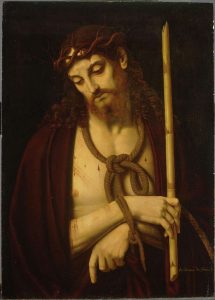
In the diadem wherewith his mother crowned him, as though the Church said, ” Look on Christ garbed with flesh for us, the flesh He took from the flesh of his mother.” For it is his flesh that is here called a diadem, the flesh which Christ assumed for us, the flesh in which He died and destroyed the reign of death, the flesh in which, rising once again, he brought to us the hope of resurrection. This is the diadem of which St. Paul speaks, We see Jesus for the suffering of death crowned with glory and honour (Heb. ii. 9). His mother is spoken of as crowning him because Mary the Virgin it was who from her own flesh gave him flesh. In the day of his espousals, that is, in the hour of his Incarnation, when He took to himself the Church not having spot or wrinkle (Eph. v. 27), the hour again when God was joined with man. And in the day of the joy of his heart. For the joy and the gaiety of Christ is for the human race salvation and redemption. And coming home, he calls together his friends and neighbours saying to them, Rejoice with me, because I have found my sheep that was lost (Luke xv. 6).
- We can however refer the whole of this text simply and literally to the Passion of Christ. For Solomon, foreseeing through the centuries the Passion of Christ, was uttering a warning for the daughters of Sion, that is, for the Jewish people. Go forth and see King Solomon, that is, Christ, in His diadem, that is to say, the crown of thorns with which His mother the Synagogue has crowned Him; in the day of his espousals, the day when He joined to himself the Church; and in the day of the joy of His heart, the day in which He rejoiced that by His Passion He was delivering the world from the power of the devil. Go forth, therefore, and leave behind the darkness of unbelief, and see, understand with your minds that He who suffers as man is really God.Go forth, beyond the gates of your city, that you may see Him, on Mount Calvary, crucified. (In Cant. 3 .)
HOW GREAT WAS THE SORROW OF OUR LORD IN His PASSION?
Attend and see if there be any sorrow like unto my sorrow. — Lam. i. 12. Our Lord as He suffered felt really, and in His senses, that pain which is caused by some harmful bodily thing. He also felt that interior pain which is caused by the fear of something harmful and which we call sadness. In both these respects the pain suffered by Our Lord was the greatest pain possible in this present life. There are four reasons why this was so.
- The causes of the pain. The cause of the pain in the senses was the breaking up of the body, a pain whose bitterness derived partly from the fact that the sufferings attacked every part of His body, and partly from the fact that of all species of torture death by crucifixion is undoubtedly the most bitter. The nails are driven through the most sensitive of all places, the hands and the feet, the weight of the body itself increases the pain every moment. Add to this the long drawn-out agony, for the crucified do not die immediately as do those who are beheaded. The cause of the internal pain was:
(i) All the sins of all mankind for which, by suffering, He was making satisfaction, so that, in a sense, he took them to him as though they were His own. The words of my sins, it says in the Psalms (Ps. xxi. 2). 60
(ii) The special case of the Jews and the others who had had a share in the sin of His death, and especially the case of His disciples for whom His death had been a thing to be ashamed of.
(iii) The loss of His bodily life, which, by the nature of things, is something from which human nature turns away in horror.
- We may consider the greatness of the pain according to the capacity, bodily and spiritual, for suffering of Him who suffered. In His body He was most admirably formed, for it was formed by the miraculous operation of the Holy Ghost, and therefore its sense of touch — that sense through which we experience pain — was of the keenest. His soul likewise, from its interior powers, had a knowledge as from experience of all the causes of sorrow.
- The greatness of Our Lord’s suffering can be considered in regard to this that the pain and sadness were without any alleviation. For in the case of no matter what other sufferer the sadness of mind, and even the bodily pain, is lessened through a certain kind of reasoning, by means of which there is brought about a distraction of the sorrow from the higher powers to the lower. But when Our Lord suffered this did not happen, for he allowed each of His powers to act and suffer to the fullness of its special capacity.
- We may consider the greatness of the suffering of Christ in the Passion in relation to this fact that the Passion and the pain it brought with it were deliberately undertaken by Christ with the object of freeing man from sin. And therefore he undertook to suffer an amount of pain proportionately equal to the extent of the fruit that was to follow from the Passion. From all these causes, if we consider them together, it will be evident that the pain suffered by Christ was the greatest pain ever suffered.