by T. Stanfill Benns | Nov 16, 2021 | New Blog
+St. Gertrude the Great+
Many years ago, I made a comment to a (then) fellow Catholic that it did not seem right that we must pay today for the failures of our Catholic ancestors to successfully fight and overcome the evils in the Church when they could do so. I received a withering look from him, and so rethought the statement.
Over the years, I have come to understand why we are left here to wage this final battle against Satan and all his cohorts. As I have pointed out many times, in this protracted and agonizing passion of Christ’s Mystical Body on earth we are to drink down to the bitter dregs the chalice our Lord accepted and endured as the price for our redemption. In His suffering in the Garden of Gesthemane; in begging his Father to be delivered from His Passion and death if this was possible; in the bloody sweat He experienced in the realization that He must obey His Father’s will to procure our redemption and, finally, in His heartrending Passion and death, He suffered without complaint. And so we too must accept our plight on this earth without murmuring or lashing out. We must not blame others for our predicament or seek comfort from the world by engaging in the many available distractions and pharmaceutical potions that assuage our pain.
Christ wished us to suffer as he suffered not to punish us or unnecessarily afflict us, but to purify us and to draw us closer to him. Yes, He begged His Father to relieve Him of this suffering and on the Cross he cried out for His assistance, owing to His human nature; but in the end He meekly bowed his head and was entirely resigned to His sacrifice. It is true that we today are reaping the whirlwind as result of our parents’ and grandparents’ misdeeds. Yet this is only fulfillment of a just sentence long ago pronounced by God when he presented the two tablets to Moses containing the 10 Commandments (Exodus 20:5, 34:7; 1 Deuteronomy 5-9). For in these passages, God proclaims from His own mouth: “I am the Lord Thy God, mighty, jealous, visiting the sins of the fathers upon the children, unto the third and fourth generation…” The Catholic Encyclopedia says this time period corresponds to anywhere from 30-100 years. So on an average this takes us at least to the late 1700s, ancestor wise. And that is precisely when the Church began to decline.
We may be victims in the sense that we had no control, as children in the 1940s-1960s, over what happened to our Church. But we must not behave as victims, a fatal flaw that could apply to all of us and probably does in certain ways. Victims suffer from guilt, and in our case that amounts to the many regrets we have for accepting the lies of the Novus Ordo and Traditionalists. This results in self-blame, which cannot be something unresolved but must be purged by confessing our sins to Christ and making reparation for them. Victims want to be rescued, which is why so many of us wound up seeking out Traditionalists in the first place. But when we realized that what the Novus Ordo and Traditionalists were doing was not Catholic, we ceased being victims and became true to Christ, choosing Him over what we felt we needed and deserved. We accepted our role as victims with Christ in His Passion.
But hard-core Traditionalists in true Modernist fashion continue to choose feelings and wants over faith. They still rely on the unCatholic and illogical explanations provided by their keepers. Having readily played into the pre-planned rescue by the new Old Catholics calling themselves Traditionalists, they refuse to face the fact they were wrong because this shames them. They resent anyone who tries to free them from these hirelings and angrily denounce them. They don’t take responsibility for researching and documenting the situation or saving their own souls. They blame the Jews and government corruption for their plight. They constantly agitate for and ruminate about a return to the Church of the 1950s which they believe would solve their dilemma and feel deprived of their right to live a fully Catholic life. They shun even the mention of praying at home as a way to keep the faith whole and entire, because they fear any prospect of isolation or possible abandonment by family and friends. All these are signs of victimization, often attributed to those abused by their partners and unable to break free. They cannot see that they are enslaved by the sects they are involved in, and truly believe they are doing all they can to lead a Catholic life. And yet the Catholic life they long for and believe they live as Traditionalists is far from being Catholic.
The world long ago lost its true understanding and appreciation of the Catholic faith beginning with the Protestant Reformation and even before that time-period, in pre-Reformation times. The papacy was the primary driving force of the Church, the one voice in the world that truly mattered. Think about it — no other leaders then enjoyed the supremacy of the papacy or were accorded such honor and respect. The Roman Pontiffs alone were then the rulers of this world. Today all rulers are bowed to as worthy of this respect and are hailed as equally prominent in world affairs. The world has overcome Christ and the voice of his Vicars. Traditionalists today think of the papacy only as a thing of the past; to them it is not a living, breathing entity yet demanding their obedience and respect. They believe the Church exists mainly for their benefit as a sort of emotional and spiritual filling station, as one author put it, where they stop by on Sundays and through the week occasionally to “air up,” or as some opine, to get their spiritual fix. I say “air up” because all Traditionalist clergy have to offer is an abundance of hot air, not true fuel for the soul.
If Traditionalists hear anything at all from the pulpit in way of papal teaching it is generally something quoted to back up Traditionalist clerics in some particular situation (such as Quo Primum to justify celebration of the Latin Mass) and is not presented in an integral or cohesive fashion. In general, little is said about the popes, and it is no wonder. One cannot pretend to be loyal to the papacy in its absence, while operating in total defiance of papal directives. Following them too closely would require removing their collars. It is this very refusal by followers of these so-called clerics to base their existence and teaching on true authority that perpetuates the victim cycle. This is true because that cycle is dependent not on intellectual union with God and a true understanding of the faith but co-dependency on men claiming to speak for God; men who have not even been vetted (and Canon Law requires this in Can. 200) to assure their listeners they are truly speaking in His name.
In other words, this free-floating rescue existence is precisely what contributes to the dereliction of responsibility in determining the true status of these men and what they are doing and teaching. Agitation and rumination in Traditionalist sects have been legion since they were first established; the drama helps perpetuate the cycle. If victims leave one sect, they blame the “priest” or certain cliques within the sect, righty or wrongly, for their exit, and head into the ether to find yet another more suitable Traditionalist sect. The prospect of figuring things out for themselves in isolation is unbearable. Without realizing it their vulnerability as victims and failure to address and correct this stance sets them up for the very thing they dread the most: being used, abused, discarded and branded as a waste of time. Those who are most likely to become involved in destructive religious sects (cults) are already victims by definition. Various sites list these predispositions as:
- great dependence on others
- lack of assertiveness
- uncritical trust of other people and groups
- wants simple “right” or “wrong” answers to complex questions
- unfulfilled desire for spiritual meaning
- cultural and religious disillusionment.
In other words, these religious organizations are looking for victims to fill their own personal needs and their respective coffers. It is a racket, not a religion. And those seeking Catholic truth are willingly obliging them by being and remaining victims, not to mention cooperating in sin.
Christ was a willing victim; He died a horrendous death for our sins as an act of perfect love. He was Truth itself nailed to a Cross. Those not wishing to discover truth because they fear what it might cost them do not wish to know Christ or suffer with Him in His Passion. In their minds they believe that as victims they have already suffered enough and that Our Lord would never be so cruel as to ask any more of them, and this comprises the majority. But there are some Catholics who are truly incapable of sorting things out and need to be guided by others. Sadly, there are few able to properly recognize their plight and help them make at least some simple sense out of the destruction that has obscured the Church from plain view. Our Lord will enclose these simple souls in His merciful Heart, but He expects far more of those able to rightly use their intellect to sort things out. These Catholics will not be so fortunate if they fail to take the measures needed to correct their course and save their souls.
There are cures for victimhood. They involve spiritual honesty and courage and a willingness to be a true victim by engaging in self-sacrifice. It requires focusing on the love, obedience and gratitude we owe our Creator rather than sentiments of self-entitlement, self-indulgence and wants and needs that contradict God’s will in these times. The first step in this process is to make some attempt to step back from whatever Traditionalist group or groups they may be involved in that offer the Latin Mass and administer the Sacraments. It may interest those who find themselves troubled and depressed that mental health professionals with a Christian background trace anxiety and depression to mistaken beliefs lodged in the subconscious. They encourage their patients to take charge of their lives and become fully aware of their beliefs, thoughts and actions. Because at some level, deep in the core of their being, certain Catholics know that something is not right — that either they are fooling themselves or at least are avoiding facing difficult decisions.
Counselors urge victims to take responsibility and face their thoughts and fears, for not all their thoughts and beliefs are true and many of their fears may be justified. Honesty and a willingness to resolve doubts are key and should be a powerful motivator. For being dishonest with oneself is lying; only by facing things head on can adverse situations be avoided, and self-confidence restored. Self-pity is nothing more than a lack of confidence in God, who is the Comforter, the Great Restorer, our Hope and our Refuge in times of sorrow and trial. He alone can offer the balm our souls need to face any tragedy, misery or general inability to cope with life. Rather than wallowing in self-pity, we have an obligation, especially in times such as these, to do all that we can to know the truth, because He is that truth! Then we must defend it — not our version of it, not what we THINK is the truth, not what others tell us is the truth — but what we ourselves have found and determined to BE that truth.
This website was constructed to help those seeking the truth. It is a lifelong journey that requires constant vigilance and dedication to possess truth at all costs. Those undertaking this journey must refuse to allow others to convince them that they are crazy, a heretic and worse; prideful, disobedient a worthless human being and more. Accepting the challenge of rising from victimization to self-realization and reformation will not only resolve self-pity issues, but it will also firmly place our Lord in His rightful position as the Director of your soul and the only one to whom you owe complete obedience, heartfelt allegiance and undying gratitude.
by T. Stanfill Benns | Oct 28, 2021 | New Blog
+Feast of Sts. Simon and Jude+
We start here with some corrections, a task much disliked by most journalists. But the truth must always reign supreme, and we all are humans capable of error. So I offer my apologies for the following clerical errors or misrenderings.
- In the works on this site Pope Pius XII’s infallible election law Vacantis Apostolicae Sedis is referred to with Apostolicamissing its “e.” Please mentally add this as it would be too laborious to correct every occurrence!
- In my last blog I referred to the teachings of the popes as absolute proofs or the equivalent thereof. This should have read irrefutable proofs and I have corrected the blog.
- A reader notes that I have said Most Holy Family Monastery teaches that Pope Pius XII and some of his predecessors were not true popes. This was a misunderstanding regarding reports made by those who formerly adhered to Most Holy Family Monastery.
Now on to our current topic.
In previous blogs, I have drawn parallels between the occurrence of Cancel Culture and what happened in the Church over a period of time beginning with the inroads made by the Modernists before the turn of the last century. The success of these infiltrators would only become visible following the death of Pope Pius XII and the changes initiated at the false Vatican 2 council. Traditionalists today react with surprise at the sudden destruction of American culture, which appears to have burst on the scene overnight, when in reality it all took place while Americans slept in their comfort-zone-controlled beds in cozy houses across the U.S., without a thought to their duty to oppose the rising tide of irreligion, immorality and lawlessness in this country. They cannot say they were not warned. For decades those classified by the powers that be as nut cases and conspiracy theorists have been sounding the alarm only to be waved off as doom-and-gloomers and fanatics by those they were trying to alert.
The same phenomena occurred just before Pope Pius XII’s death. A small minority of theologians and clergy were warning the faithful, but no one listened. Even those paying attention to what went on in their own government could and should have been aware of what was happening but they chose to look the other way, to better enjoy their comfortable lives. Even today, those trying to figure out where all this radical change is coming from and why it is so widely accepted or at least not actively opposed have no clue how it began, where it began and what to do about it. Of all people, those believing themselves to be Catholic should know, but they are oblivious to the real source of the problem. Novus Ordo “Catholics” are struggling to hold their church together in the wake of tidal wave Francis. Traditionalists are still arguing and playing mass center hopping just as they have done for the past 50 years. They are too busy playing childish games to stop and assess the real issue and deal with it: what they are involved in cannot be Catholic if it is not solidly rooted in unchanging doctrine.
I have long maintained that what we are seeing now is the direct result of the destruction of the Catholic Church in the 1940s, 1950s and 1960s — and yes, I said the 1940s. We had Communists and Freemasons in the U.S. government then and Communists and Freemasons busy destroying the Church long before then. Solange Hertz devoted an entire series of books to exposing the Masonic roots of America’s founders. The Paul Revere’s of the 1800s should have risen to sound the alarm regarding this infiltration, but instead Masonic agents only carried it deeper into the settlement of the American wilderness.
The following is taken from Dr. Cyril Andrade’s Has the Church and Its Clergy Been Infiltrated and Undermined?, written in 1990.
“Albert Vassart, a former member of the French Communist party, revealed in 1955 that Moscow had issued an order that carefully selected members of the Communist youth enter seminaries, and after training, receive ordination as priests. Some of these were to infiltrate religious orders, particularly the Dominicans. (In his essay Satan at Work, Dietrich von Hildebrand reported that the French Dominicans had become so communistic in their “evangelization” that in 1953, the Order barely escaped dissolution by the order of Pope Pius XII. Mr. Manning Johnson, a former official of the Communist Party in America, gave the following testimony in 1951 to the House Un-American Activities Committee:
“Once the tactic of infiltration of religious organizations was set by the Kremlin, the Communists discovered that the destruction of religion could proceed much better through infiltration of the Church by Communists operating within the Church itself. The Communist leadership in the United States realized that the infiltration tactic in this country would have to adapt itself to American conditions and the religious make-up peculiar to this country. In the earliest stages it was determined that, with only small forces available to them, it would be necessary to concentrate Communist agents in the seminaries. The practical conclusion drawn by the Red leaders was that these institutions would make it possible for a small Communist minority to influence the ideology of future clergymen in the paths conducive to Communist purposes.”
“Further on in his testimony, Mr. Johnson pointed out this grim fact:
“The policy of infiltrating seminaries, was successful beyond even our Communist expectations. It is the axiom of Communist organizations that if a body has a one percent Communist Party and nine percent Party sympathizers, that 10 percent can effectively control the remaining ninety percent who act and think on an individual basis.’’
“Mr. Johnson further testified that the goals of this infiltration were two-fold:
- To make the Catholic Church no longer effective against Communism;
- To direct clerical thinking away from the spiritual and toward the temporal and political … hence the teaching of the social gospel.
“Editor’s note (from Andrade): Did you know that the Second Vatican Council only mentioned Communism in one footnote of its entire 16 documents? During the Council, a petition signed by 454 Council Fathers requesting that Communism receive explicit treatment was “mysteriously misplaced”. Since Vatican I1, the Church now “dialogues” with Communists instead of opposing them —— a Marxist’s dream come true!
“Mrs. Bella Dodd spent most of her life in the Communist Party in America and was the Attorney General designate, had the [Communist] Party won the White House. After her defection, she revealed that one of her jobs as a Communist agent was to encourage young radicals (not always card-carrying Communists) to enter Catholic seminaries. She said that before she had left the Party in the United States, she herself had encouraged almost 1,000 young radicals to infiltrate the seminaries and religious orders …and she was only one Communist!” (End of Andrade quotes)
Sen. Joseph McCarthy, flayed alive for his attempt to warn Americans of Communist infiltrators within the American government, gave a telling final speech to Congress six months before he died in 1957. McCarthy wrote in his address:
“Jonathan Williams recorded in his Legions of Satan, 1781, that Cornwallis revealed to Gen. Washington that ‘…in less than 200 years…the whole nation will be working for divine world government…and they will all be under the invisible all-seeing eye of the Grand Architect of Freemasonry’…American statesmen and military leaders down through the years [have] given aid and intelligence to the enemies of the United States because they did not have knowledge of the invisible subterfuge that stalks this land. My eyes were opened the day my colleague from Ohio handed me Wagner’s Freemasonry, an Interpretation. If every American would read it, they would no longer ask why and how it has happened.”
And then there is the booklet AA-1025 — The Memoirs of an Anti-Apostle, a dramatization of the life of a seminarian — a professed Communist — who supposedly infiltrated the priesthood. The booklet is not documented and was intended to appeal to less educated Catholics searching for answers to the changes in the Church in the 1980s. Call them what you like — Communists, Modernists, Freemasons — it is all the same, for all of them were members working for the same goals and the same secret societies. Communism is listed at the upper levels of Lady Queensborough’s pyramid. Modernism was styled long ago as “Catholic” Freemasonry, as Dr. Andrade notes in his work: The Church is Under Enemy Occupation, Part II (1990). The following is taken from a letter he quotes, written by the head of the main branch of the Carbonari and dated 3 April 1844.
“In 1905, sixty years after Nubius had written giving Volpe his instructions, a novel entitled Il Santo (The Saint) was published. Its author was an Italian Modernist, Antonio Fogazzaro, (1842-1911). Subsequently placed on the Index, the novel reveals two very important facts. They are:
- The success that had been achieved by the ideas put into circulation sixty years earlier by the secret societies. We learn from Fogazzaro that there had come into existence within the Church what the characters in his novel call “a Catholic Freemasonry.” And in addition, that this group felt sufficiently confident to bring out into the open opinions and views previously restricted to a close circle of initiates. It was, as Leo XIII had made clear in 1884, quite evident that “Freemasons no longer take the precaution of concealing their intentions … They are engaged in their efforts to ruin the Church publicly, out in the open.
- Il Santo also reveals the aims of this “Catholic Freemasonry,” a genuine sectarian movement that had, in St. Pius X’s words, “pierced to the very bowels and veins of the Church.” The ultimate aim was explained as follows by Fogazzaro, at the beginning of his novel . . .
“Here we are, a given number of Catholics in and outside Italy, clergy and laity alike, who wish to see the Church reformed. We have no desire to emerge as open rebels, our wish is to see such a reformation effected by lawful authority within the Church. We seek reforms in religious education, the liturgy, the discipline of the clergy, and in the supreme government of the Church. To achieve this aim we need to form a climate of opinion which will lead to the lawful authorities acting in conformity with our views, whether this means waiting twenty, thirty, even fifty years.” (End of Andrade quote)
And so we see just how long all this has taken to lead us to where we are today. As all the popes have noted in their encyclicals on Freemasonry, the secret societies are the enemies of governments as well as the Church; the Church was simply the first item on their agenda because She was the driving force preserving faith and morals in the world. Until the 20th century and the two World Wars, She was a formidable force to be reckoned with. But when the Church ceased being that force in the 1960s, the loss of faith and moral decline was immediate. Already on the edge for two decades at the least, the laity who rejected the false V2 council simply collapsed in a heap, straying into various non-Catholic sects or no sects at all. With the pastor struck, the sheep scattered, as the prophet Zacharias and Our Lord prophesied. As the Church goes so goes the world, into the destruction prepared for her by the agents of Satan.
As Alfredo Cardinal Ottaviani wrote on Jan. 7, 1959:
“People no longer feel repugnance at giving support to new antichrists. On the contrary, they argue as to who will be first to embrace them and to exchange sweet smiles with them. Christians no longer react; they are no longer moved. How can they believe themselves to be Christians if they remain insensible to the wounds made to Christianity? A wounded arm is like a dead arm. Therefore, a Christian who no longer seems aware of what is anti-Christian no longer participates in the life of the Mystical Body.”
In a similar vein, on Feb. 20, 1949, Pope Pius XII asked the following poignant questions of faithful Romans he was then addressing:
“Now, it is well known what the totalitarian and anti-religious State requires and expects from Her [the Church] as the price for her tolerance and her problematic recognition. That is, it would desire:
- a Church which remains silent, when she should speak out;
- a Church which weakens the law of God, adapting it to the taste of human desires, when she should loudly proclaim and defend it;
- a Church which detaches herself from the unwavering foundation upon which Christ built Her, in order to repose comfortably on the shifting sands of the opinions of the day or to give herself up to the passing current;
- a Church which does not withstand the oppression of conscience and does not protect the legitimate rights and the just liberties of the people;
- a Church which, with indecorous servility, remains enclosed within the four walls of the temple, which forgets the divine mandate received from Christ: Go forth to the street corners (Matt 22:9), teach all peoples (Matt 28:19).
Beloved sons and daughters! Spiritual heirs of an innumerable legion of confessors and martyrs! Is this the Church whom you venerate and love? Would you recognize in such a Church the features of your Mother’s face? Can you imagine a Successor of the first Peter, who would bow to similar demands?” (End of Pope Pius XII quote)
Catholics in the 1960s chose for themselves the church Pope Pius XII describes above. In so doing, they signed the death warrant for this country, and ultimately for their children, grandchildren and great-grandchildren. It remains only for us to pray and do penance, making reparation while we can, and to plead with those who remain enslaved by the Traditionalist and NO heresiarchs to abandon their errors. May God forgive us and hasten to help us, unworthy though we are.
by T. Stanfill Benns | Oct 7, 2021 | New Blog
+Feast of the Most Holy Rosary+
Will wonders never cease. Often in the course of busily getting on with life we overlook things that could very much be used to our advantage, if we only knew they existed. I say this because I recently came across a Traditionalist work that seemingly refers to my own original research on the topic of following the safer course. And the author actually admits it is now the only option open to those who have doubt about the validity of the Thuc-line orders. What follows is a brief analysis of this work and its commentators. It has spawned a much more comprehensive and timely analysis now in progress that will eventually be made available to readers. After all these decades, this analysis will finally reveal the true source of error driving Traditional sects since their inception and will concisely and effectively demonstrate why and how they are forbidden by the Church to operate.
The book mentioned above, The Sacred and the Profane written by “Bp.” Clarence Kelly, cites all the same sources referenced in my first self-published work, Will the Catholic Church Survive…, released in 1990, (David Bawden contributed to this work). That work also stated that the Thuc line of bishops was at least illicit, and evidence was later published to this website proving they were questionably valid at best. Kelly’s work was not something I had reason to refer to, and to be honest I am not likely to do much more than briefly glance at works written by Traditionalists except to confirm sources, unless I am refuting their claims. I had no reason to refute this work because Kelly was right in his assumptions — Thuc was demonstrably mentally incompetent. He also was a member of the Novus Ordo church all along, right up until the consecrations of Guerard des Lauriers (ordained in 1931) and the Mexican priests Zamora and Carmona, (ordained in 1939).
In explaining what to do in a practical doubt of law or fact, Kelly cites several different moral theologians. But the main quote offered as proof was taken from the Jesuit Henry Davis’ Moral and Pastoral Theology, cited in my 1990 work, (along with Prummer, Jone and others; see pg. 26 of Will the Catholic Church Survive…). He also mentions Bernard Wuellner, S.J., often quoted on this site, as well as a few other theologians whose works I do not have. And in the conclusion to his book, he covers the simulation of the sacraments, a topic I covered beginning in 2007. So Kelly knew, and the hypocrisy of his continuation as a Traditionalist is astounding. (And here I will not even mention heresy, since he had already adhered to a non-Catholic sect re his “ordination” by Lefebvre) What is even more astounding is the continuing flow of those believing themselves to be Catholic into the arms of these false shepherds, despite the fact they have repeatedly been warned regarding their non-Catholic status.
Kelly, having taken this position on the safer course — and he documents it well — now needs to just as carefully document his explanation of WHY it cannot and does not apply to those who are pray-at-home Catholics. This means re-examining the evidence he himself advances as well as refuting what is presented on this website that compels those of us adhering to this position to practice it. He and the likes of all the others ridiculing this clear teaching of the Church all these years owe all of us an apology. But that is the least of it. These counterfeit clerics owe the TRUTH to their followers before they meet their Maker, and as we all know, that could be at any time. For they can confess and attempt to make amends on this earth or burn eternally, and hopefully they will not be joined in Hell by the thousands they have deceived. In the meantime, we will continue to keep the faith at home, and it is a blessing, not a curse, as they portray. We have peace of mind regarding our decision, which arises from formalcertitude; a clear conscience. And we can offer to God all our sadness at having lost the Church in satisfaction for our sins, praising His holy will and begging Him to open the eyes of those who so desperately need to see.
The doubt Kelly refuses to resolve
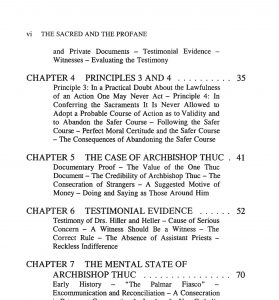
Kelly’s book is available on Amazon (and also at https://congregationofstpiusv.com/wp-content/uploads/2020/05/SacredandProfane.pdf). It was written in 1997 and published by Seminary Press in New York. But the pray-at-home position had been known and recognized by various conservative Catholic authors beginning in the late 1970s. Below is a snapshot of the contents page of his book.
Now Kelly does not explicitly endorse homealone; only implicitly. But the implications of his conclusions could not have eluded him entirely since he obviously at some time had read my book and checked out the sources for his own purposes, so he knew we advocated the homelaone position. This was nearly 25 years ago, and how many sins have multiplied regarding Traditionalist “orders” and simulated mass and sacraments since then?! These people knew we were not mistaken in our conclusions; the LEAST they could have done was to have left us alone and concede that we were following our consciences, since the moral theologians teach we have every right to do so in such cases without sinning. But they could not afford to do that because it might adversely impact their cash flow and carefully cultivated prestige.
Below is a summary from Kelly’s book regarding principles governing the safer course, taken from the theologians:
“The principles are:
1.) “. . . facts are not presumed (as certain) but must be proved.”
2.) ” . . . the burden of proof rests upon him who makes the assertion.”
3.) “In a practical doubt about the lawfulness of an action one may never act.”
4.) “In conferring the Sacraments (as also in [the] Consecration in Mass) it is never allowed to adopt a probable course of action as to validity and to abandon the safer course.”
“Notorious facts are facts which “are so obvious and well substantiated that they need no further legal proof.” (Lyddon) Such facts are notorious either by a notoriety of law or a notoriety of fact.
These are “matters that are presumed by the law itself and hence need no proof.”
“Similarly, “presumptions of law need not be proved… ” The one in whose favor the presumption stands do not bear the “burden of proof.” As Fr. Lyddon puts it: “A person in whose favor there is a legal presumption is free from the onus probandi [burden of proving]; it falls on his opponent.” [T. Benns comment — However, As the canonists Woywod-Smith point out in their Canon Law commentary, there are presumptions of law and presumptions of fact. Absolute (legal) presumptions in the Canons of the Code itself are extremely rare and a judge must decide regarding the value of simple presumptions of both law and fact.]
“Fr. Doheny says: “One of the oldest legal maxims is that the burden of proof rests upon him who makes the assertion.”
“As Fr. Eugene Sullivan says in his Proof of The Reception of The Sacraments: “The form of proof which he must present will not be that which is most convenient for him to secure, but the particular one stipulated by official precept.” The form of proof that is “stipulated by official precept” for ordination to the priesthood and for episcopal consecration is documentary proof.
“The only means explicitly provided for in the Code of Canon Law for proving the reception of Holy Orders is authentic documentary evidence. Fr. Sullivan says: “Under the law of the Code provision is made for authentic documentary evidence of the reception of the sacrament of Holy Orders… There is no canon in the Code which makes provision for substantiating the reception of holy orders in any way other than by the evidence of documents.”
And finally, in his conclusion, Kelly writes: “To resolve the prudent doubts about the Thuc consecrations it would be necessary to submit the case to the competent ecclesiastical tribunal which in this case would be the Sacred Congregation of the Sacraments. The S. Congregation of the Sacraments would have the power to issue a binding decree because it would have the competence to determine the status of the Thuc consecrations in a definitive way. But, since we do not have access to such a competent tribunal, because of the situation in the Church, we must apply the principles that tell us facts are not presumed as certain but must be proved; that the burden of proof rests with the one who makes the assertion; that we cannot act in the face of a practical doubt; AND, THAT WE MUST FOLLOW THE SAFER COURSE.” (End of Kelly quotes — all emph. mine)
The case was successfully made by Kelly regarding Thuc’s orders, even if his arguments beg the question by ignoring a universal proposition (the pope alone can issue the papal mandate and approve bishops; the Holy Office alone can determine the validity of orders already received). Moral principles taught unanimously by Catholic theologians cannot lie, even though they be misapplied in some case. But Kelly needs to use this same standard for his own ordaining bishop, Lefebvre, for it also will prove that his ordinations and consecrations were just as doubtfully valid, hence subject to review by the Sacred Congregation before they can be validly exercised. All the parameters Kelly lays out for judging these matters apply equally to Lefebvre, and on more than one count. This is not about invalidity per se, although I believe that the evidence proves it exists. WE ARE ONLY REQUIRED TO PROVE DOUBTFUL VALIDITY to avoid Traditionalists and that is another thing entirely. But we do not even have to use the method proposed in my first book and elaborated upon by Kelly to assume doubtful validity in this case, as mentioned above. The doubt is resolved if the infallible election law of Pope Pius XII is understood and obeyed.
Conclusions drawn from the above
A doubt must be based on solid motives; it cannot be a hunch or a gut feeling. Such a doubt is called a negative doubt. A practical doubt must be positive and objective. It must be supported by strong evidence from reliable sources to be positive and the motive for believing such sources must be valid. The rules in Canon Law governing evidence are mentioned by Kelly in his work but not all of them are quoted, probably because his focus was on testimonial evidence and proofs regarding ordination/consecration provided by witnesses and other documents, (this constitutes over 200 pages of his book). The proofs primarily cited in our own works also originate from this section of the Code, but they come from the highest possible source, not testimonial evidence. These canons, cited in our own works, state:
1.Those decisions concerning the law entered into the Acta Apostolica Sedis are considered authentic, (Can. 9; “Humani Generis”). They are binding in conscience and are to be held with at least a firm assent, (Can. 9; Msgr. J.C. Fenton, J.C.L., Rev. Billot and Rev. Connell as well as others).
- Canon 1812 tells us that acts issuing from the Roman Pontiff and the Roman Curia during the exercise of their office and entered as proof in ecclesiastical courts “prove the facts asserted,” (Can. 1816), and force the judge to pronounce in favor of the party producing the document, (commentary by Revs. Woywod-Smith. The Roman Curia, strictly speaking, is the ensemble of departments or ministries which assist the sovereign pontiff in the government of the Universal Church. These are the Roman Congregations, the tribunals, and the offices of the Roman Curia.)
- “Proof to the contrary is not admitted against Letters of the Roman Pontiff bearing his signature,” (Rev. Amleto Cicognani, Canon Law, 1935; p. 626, ft. note. This is irrefutable evidence, superior to an absolute presumption.) Documents entered into the Acta Apostolic Sedis do not need to be submitted in the original or be an authenticated copy, (Can. 1819).
Kelly also quotes Rev. Wuellner, who teaches:
- Every judgment must be based on proof.
- In doubt, facts cannot be presumed, but must be proved.
- When in doubt one must stand by presumption and presumption must yield to truth.
- There is no argument against the evidence.
- No argument or conclusion contrary to the evident facts is valid, (#s 5-9 taken from Rev. Bernard Wuellner, S. J., Summary of Scholastic Principles, 1956).
- No inference contrary to the evident facts is true; conjectural opinions are dangerous, (Pope Pius XII; Humani Generis).
It is a solidly established fact that an infallible decree of the Roman Pontiff, specific to our times, teaches the following: ”We declare invalid and void any power or jurisdiction pertaining to the Roman Pontiff in his lifetime, which the assembly of Cardinals might decide to exercise (while the Church is without a Pope)… Likewise we command that the Sacred College of Cardinals shall not have the power to make a determination in any way it pleases concerning the rights of the Apostolic See and of the Roman Church… The laws issued by Roman Pontiffs in no way can be corrected or changed by the assembly of Cardinals of the Roman Church while it is without a Pope, nor can anything be subtracted from them or added or dispensed in any way whatsoever with respect to said laws or any part of them. This prohibition is especially applicable in the case of Pontifical Constitutions issued to regulate the business of the election of the Roman Pontiff. In truth, if anything adverse to this command should by chance happen to come about or be attempted, We declare it, by Our Supreme Authority, to be null and void” (Pope Pius XII, Vacantis Apostolicae Sedis, 1945; entered into the Acta Apostolica Sedis).
Cardinals primarily are bishops or archbishops (a few were deacons or archpriests, according to the 1950 Catholic Almanac). So while these men held the honorary title of cardinal, they in fact also possessed episcopal orders and titles to various sees. So here Pope Pius XII was speaking primarily to bishops and a few priests. He was telling them they had no power whatsoever to change anything during an interregnum. These men were all validly consecrated and ordained, and during an interregnum they had no power; all was to be referred to a future pontiff. They had one task they needed to complete, and that was the election of a Roman Pontiff. In the event that the cardinals are not able to elect, St. Bellarmine provides the means for such action, teaching it is possible to convene an imperfect (not a general) council where the only business would be to elect a true pope; nothing doctrinal could be discussed. This was explained in Will the Catholic Church Survive…?
This law goes back to ancient times and is only a reiteration of Pope St. Pius X’s papal election law, a codification of all previous election law which Pope Pius XII rewrote. The 14th century canonist Baldus de Ubaldis refers to a commentary of Clem. I.iii.2, which passage expressly lays down that during a vacancy the Sacred College cannot exercise papal jurisdiction, nor can the cardinals change the constitution of the Church” (Walter Ullmann, The Origins of the Great Schism, 1948, p. 157. Ullmann further comments in a footnote that “This was the view generally entertained.”) Baldus also taught that the cardinals can clear the pope elected of all irregularities “except one, and that is persistent heresy.” So these changes were forbidden long ago and are not just a product of modern legislation as some have insinuated. A very learned cardinal living during the Great Schism, Cardinal Zabarella, taught that when the majority of the cardinals all defect regarding the election of the Roman Pontiff, the priests and the faithful must pressure remaining cardinals and any true bishops to convene a papal election. Traditionalists fiddled until Rome burned to the ground and no true clerics were left to posit an election.
Absolute proofs and doubtful validity
Forget the theologians and the safer course when it comes to the papacy, which is the most glaring doubt Traditionalists were obligated to resolve but never did. Kelly ignored absolute proofs and adopted the safer course only because he dared not address the doubtful pope issue and blow up his boat. It is a matter of fact and law, as seen above, that no one may change the laws of the Church or trample on Her rights during an interregnum. If they do, any such act is automatically nullified. The pope said this infallibly and absolutely. There IS no appeal from this statement. No episcopal consecrations can be valid without a papal mandate under this law because this is a usurpation of papal jurisdiction. No one can presume to violate the laws of the Church, having received no diocese or office from a certainly canonically elected pope necessary to validly ordain priests, such as Lefebvre and Thuc proceeded to do (See Can. 147). All such acts are declared absolutely null and void. Wherever serious, positive doubts have been raised, and they have been documented for decades, even with heretical statements made “from the chair,” they must first be resolved before any validity is ever presumed. Traditionalists refuse to admit these doubts have been settled for decades, and no, the doubts raised have scarcely been negative doubts.
What form of proof is “the particular one stipulated by official precept” regarding the election of a Roman Pontiff? It is publication of any act or attempted act on the part of Traditionalists which violates the teaching in Pope Pius XII’s papal election law, or any act specified as schismatic, heretical or suspect of heresy in the one other law governing such situations – Pope Paul IV’s Cum ex Apostolatus Officio. This satisfies the requirements of Canon Law and in turn refers us to Vacantis Apostolicae Sedis under Can. 160 and Can. 6 no. 4, which requires us to follow the old law in a doubt of law — whether a man who has committed manifest heresy ever became a pope in the first place. And remember, in the case of Cum ex Apostolatus Officio such papal documents need only be signed to be considered absolute proof; they need not be infallible, (although contrary to the claims of the Traditionalists, Cum ex… is indeed infallible). When there is a doubt of law, Can. 18 also directs us to consult parallel passages of the Code, pointing us to laws governing ecclesiastical elections. Rev. Anscar Parsons, in his work, Canonical Elections, (Catholic University of America Canon Law dissertation, 1939) tells us: “The election of the Holy Father has been the prototype for the election of inferior prelates.” So here we have all we need to satisfy the necessary proofs.
Traditionalists are the ones who must meet the burden of proof, given the absolute nature of the documents presented, and they cannot do it. How does one overcome infallible pronouncements, absolute proofs? There is no appeal from the Roman Pontiff! As Pope Pius VI wrote in Charitas, regarding a similar situation in France, “We therefore severely forbid the said Expilly and the other wickedly elected and illicitly consecrated men, under this punishment of suspension, to assume episcopal jurisdiction or any other authority for the guidance of souls since they have never received it. They must not grant dimissorial letters for ordinations. Nor must they appoint, depute, or confirm pastors, vicars, missionaries, helpers, functionaries, ministers, or others, whatever their title, for the care of souls and the administration of the Sacraments under any pretext of necessity whatsoever. Nor may they otherwise act, decree, or decide, whether separately or united as a council, on matters which relate to ecclesiastical jurisdiction. For We declare and proclaim publicly that all their dimissorial letters and deputations or confirmations, past and future, as well as all their rash proceedings and their consequences, are utterly void and without force.” Sounds like the constant teaching of the Church to me.
The information regarding the doubtful validity of Traditionalists has been available from this author since 1990 and was available in part even before then. It has been roundly ridiculed and ignored by Traditionalists. But this case need NOT be submitted to higher authority for review, precisely because its resolution comes from the highest authority itself and therefore cannot be questioned. No one may judge the Roman Pontiff and there is no appeal from his statements and decisions. The pathetic efforts of pseudo-clerics such as Kelly and others to justify their actions and condemn their opponents from a strictly theological standpoint won’t pass muster. Why? Because as Revs. Pohle-Preuss write in their The Sacraments, Vol. IV: “It matters not what the private opinions of…theologians [are]. It is not the private opinions of theologians but the official decisions of the Church by which we must be guided.” It is the papacy that determines everything from the top; and it is the papacy and the rights of Holy Mother Church these Traditionalists have consistently disregarded, disdained and trampled upon.
Outing Cekada and Sanborn
Kelly’s work is valuable in one respect — he ably exposes the inconsistencies and hypocrisies of homealone critic “Fr.” Cekada (now deceased) and “Bp.” Sanborn. This fact was only further strengthened by reports regarding Cekada and “Bp.” Dolan’s alleged mistreatment of their followers. This and other scandalous behavior at St. Gertrude the Great in Ohio in 2009 is said to have been witnessed by several Traditionalists. The rationalizations they used to establish their own positions and organizations is mind-blowing, for it is clear from Kelly’s work that all they needed to know regarding whether Ngo dinh Thuc was mentally capable of ordaining or consecrating was readily available to them, including the fact he was not even a member of the true Church! These two men at first were not in favor of the validity of the Thuc consecrations – until they realized they could acquire a bishop for their own operations in Mark Pivarunas and Danny Dolan if they did a 180-degree turn in their thinking. They also had to make a quick exit from Kelly because he had made public a line of thought dangerous to the Traditionalist movement, one that they could not afford to align themselves with.
It is now completely understandable why Cekada, Sanborn and their associates continued to denounce homealoners — they needed to distance themselves from their enemy Kelly, not just homealone per se. Kelly’s theologically correct demonstration of the safer course posed a threat. They were crafty and forward-looking enough to appreciate the fact that it could be used against them regarding their own ordinations and anticipated future consecrations — Dolan’s “consecration” by the Thucite Pivarunas, sponsored by Cekada at St. Gertrude’s in Ohio, and Sanborn’s “episcopal consecration” by the Thucite Robert Mckenna. It’s the gravy train they were trying to protect here, one that according to information published in 2009, was quite lucrative indeed, and was built on the backs of their followers. Truly the treachery of nearly all Traditionalist sect leaders is revealed in Kelly’s work.
Dirksen’s disingenuous letter
Mario Dirksen of NovusOrdoWatch wrote a letter to Kelly in 2011 contesting the doubtful validity of the Thuc consecrations as stated in his book and challenging the citations regarding use of the safer course. It is always instructive to read such things simply because they so glaringly omit any reference to what the POPES and the Sacred Congregations — not the warring sedevacantists, not the theologians — have to say about the validity of these kinds of consecrations. And no, Mario, it does not matter that we are in an “emergency situation” — read what Pope Pius VI has to say above about that particular point. And his Charitas was an infallible document, cited as such by one of the leading cardinals in his retinue. Theologians have their place; I cite them as well. But in these most serious matters regarding eternal salvation and sacramental validity we must reach for the highest form of certitude possible, and the Holy See is the only sure guarantee of what the Church truly teaches. Theologians have only opinions; many of these were bordering on the liberal side long before Pope Pius XII’s death. Even Traditionalists admit this.
Dirksen maintains that “Accepting the Thuc consecrations [as] a morally certain course of action has been amply demonstrated in the main parts of this [his] letter.” He quotes Henry Davis, cited by Kelly, to back up his statement, noting that Davis endorses the morally certain avenue, (safe but not the safest course). He does not mention, however, that Davis only advises this course in matters of urgent necessity, such as baptizing a dying child when the matter used is only probably valid. Once again, such necessity does not suffice according to Pope Pius VI when it comes to Holy Orders. Dirksen then quotes the following from a document written by Pope Pius XII and entered into the Acta Apostolica Sedis, an allocution given to the Roman Rota. In that document he quotes the parts pertinent to his own case and neglects to mention that Pope Pius XII admits that “This moral certainty… does not exist if there are, on the other side — in favor of the reality of the contrary — motives which a sound, serious and competent judgment pronounces to be at least in some way worthy of attention and which consequently make it necessary to admit the contrary as not only possible but also in a certain sense probable…. [The judge should] not require a higher degree of certainty, EXCEPT WHERE THE LAW PRESCRIBES IT ESPECIALLY IN VIEW OF THE IMPORTANCE OF THE CASE.” Is there any case more important than the Church’s continued existence?
In 2010, a year before Dirksen’s letter appeared, I wrote an article on this very issue, detailing the various grades of certitude and Pope Pius XII’s teaching on moral certainty. It remains on my site today (https://www.betrayedcatholics.com/free-content/reference-links/1-what-constitutes-the-papacy/objective-truth-is-one-error-is-manifold-part-i/ ). It must be understood that while papal documents provide absolute proof in ecclesiastical trials, those printed in the Acta Apostolica Sedis are binding on Catholics — they are to be accepted as irrefutable evidence. It is interesting to note that Dirksen has no problem posting lengthy citations from papal teaching to counter the Recognize and Resist bunch while ignoring their import in the question at hand. But then this has always been the problem with everything that is “Traditional” — “rules for thee, but not for me.” Sound familiar? That is because the entire mindset now existing in the political sphere first existed in the theological twilight land of religious Progressivism that emerged following Vatican 2. Such twisted thinking was spawned long ago and is only reaching its climax today. It won’t be long now before the entire skein of yarn consisting of damnable lies and deceit unravels and modern society is entirely undone.
The awful truth
The bull elephant chained for so long in the backwoods of Traddie land is about to go on the rampage and the villagers are clueless. Everywhere, despite the illusion Traditionalists can offer a true Mass and validly dispense the Sacraments, we see the world imploding and that tells us everything we need to know about the times in which we live. Traditionalists desperately need to assess the unprecedented state of the world today and relate that to the real purpose of the Holy Sacrifice. For we would not be in this current world situation if the Mass truly was being offered on Catholic altars! The reason Traditionalists refuse to resolve the doubt regarding the election of John 23rdis precisely because it will then lead to the realization that if none of these priests and bishops were valid, if all their acts were rendered null and void, then we have been without the Mass for several decades. It is the unanimous teaching of the early Fathers that this is predicted by the prophet Daniel, and we know from Holy Scripture itself who will cause its cessation. So there is no choice but to accept the fact that it can only be the Antichrist, the Man of Sin, the abomination of desolation, who has done this. And if anyone was being honest with themselves, this fact would be a foregone conclusion.
Reverend Martin Cochem, writing in the late 1800s, explained the consequences of the prophesied loss of the Continual Sacrifice. He answers the question “What restrains God from withdrawing His presence and delivering the world to Satan?” as follows:
“Most decidedly it is the Holy Sacrifice of the Mass which averts this calamity. For although the divine majesty is continually blasphemed by ungodly men, on the other hand it is continually honored by priests in thousands of Masses, worthily blessed by Christ Himself. This tribute of praise far outweighs the blasphemies of the reprobate and makes amends to God for the indignities shown to Him. We have indeed reason enough, and it is our bounden duty to give heartfelt thanks to Christ for having, of His pure mercy, instituted the Sacrifice of the Mass whereby the world, despite its iniquities is preserved from destruction.” Cochem relates that Peter of Clugny, a learned religious, aptly predicted: “If Christians were to abolish the Holy Sacrifice of the Mass… God would no longer be worshipped upon earth.”
And Reverend Doctor Nicholas Gihr, in his work on the Holy Sacrifice, wrote likewise in 1897: “It is by Christ’s Blood in the Mass that the anger of God is daily placated, the vengeance of the Divine judgment disarmed, that He no more curses the earth on account of man, whose mind and thoughts are prone to evil from his youth (Gen. 8:21). When this “Sacrifice for sins” shall be no longer celebrated, then “there remains but a certain dreadful expectation of judgment and the rage of a fire which shall consume the adversaries’” (Heb. 10: 26-27). And that expectation is rampant today, even among Protestants. Almost immediately following the death of Pope Pius XII, serial murders, assassinations, horrific, unheard of sex crimes, the legalization of abortions, the drug plague, a sharp increase in the divorce rate, campus unrest, an uptick in suicides, reports of demonic possession, Satanic activity, pornography everywhere, the cult explosion, the Manson and Bundy murders — all became commonplace and were concurrent with the advent of Vatican 2. Those who were students or young parents in those days will remember it well.
Fideism and Traditionalism are the real culprits
Is it not clear that God has withdrawn His presence and delivered the world to Satan? Didn’t Our Lady warn us of this at La Salette? How then can you still believe you have the true Sacrifice on your altars when all this evil has come upon the entire world?! Traditionalists have been seduced by the errors of Fideism and Traditionalism, both condemned by the Church. These errors are explained online in the Catholic Encyclopedia as follows: Traditionalism is: “A philosophical system which makes TRADITION the supreme criterion and rule of certitude.” Fideism is a bit more complicated but is very similar in its tenets. “Fideism (Lat. fides, faith), [is] a philosophical term meaning a system of philosophy or an attitude of mind, which, denying the power of unaided human reason to reach certitude, affirms that the fundamental act of human knowledge consists in an act of faith, and the supreme criterion of certitude is authority.” And it is precisely erroneous thinking regarding the understanding of certitude that Traditionalists have spread all these years.
According to the Catholic Encyclopedia article on certiude, “Many truths, indeed, have to be accepted on authority; but then it has to be made evident that such authority is legitimate, is capable of knowing the truth, and is qualified to teach in the particular department in which it is accepted.” As Rev. A.C. Cotter S.J. teaches in his The ABC of Scholastic Philosophy, (p. 284): “Authority clothed with the necessary conditions is true authority. False authority makes the same claims although it lacks these conditions.” Cotter comments that those following self-styled teachers of any philosophic system have the “duty to investigate for themselves. Authority is not the last criterion of truth or motive of certitude.” Kelly rightly avers that Catholics must arrive at certitude. But he so lowers the bar that he excludes absolute or formal certitude, then by using a fallacy of argument directs it to false authority — his and other Traditional sects rejecting the Thucites. The teachings of the Roman Pontiffs and the necessity of the papacy are entirely left out of the equation. It is the Old Catholic heresy and essentially Gallicanism at its very worst.
The apocalyptic clock is ticking, folks; the seconds hand ever closer to midnight. To conclude, we once again quote Henry Cardinal Manning on the moral obligation to seek the truth in such matters: “Whensoever the light comes within the reach of our sight, or the voice within the reach of our ear, we are bound to follow it, to inquire and to learn; for we are answerable, not only for what we can do, by absolute power now, but for what we might do if we used all the means we have; and therefore, whensoever the Church of God comes into the midst of us, it lays all men under responsibility; and woe to that man who says, ‘ I will not read; I will not hear; I will not listen; I will not learn; ‘ and woe to those teachers who shall say, ‘ Don’t listen, don’t read, don’t hear; and therefore, don’t learn.’”
by T. Stanfill Benns | Sep 24, 2021 | New Blog
+Our Lady of Ransom+
Some have objected that the term abomination of desolation does not necessarily refer to Antichrist and therefore the use of this phrase by Pope Paul IV in his bull Cum ex Apostolatus Officio is not a true interpretation of this Scripture phrase. In the next few blogs that will be posted here, the importance of understanding the meaning of these distinctions will be demonstrated. Catholics cannot be ignorant of the truths so necessary to understanding the current world situation today and its relation to their faith. As we draw closer to the culmination of the events that surely must be precipitating either the end proper or some worldwide disaster, no one can afford to any longer believe the fairy tales that some earthly force will deliver us; we alone are the captains of our own souls. Below please find the answer to this important question according to Catholic sources.
St. Jerome
The best source of information on this topic is St. Jerome, who according to the Catholic Encyclopedia “was very careful as to the sources of his information… The Biblical knowledge of St. Jerome makes him rank first among ancient exegetes.” St. Jerome wrote as follows on the abomination: “It is possible to apply this text easily to either the Antichrist, to the statue of Caesar which Pilate placed in the Temple or even to the equestrian statue of Hadrian, which down to this present day stands on the very site of the holy of holies. In the Old Testament, however, the term abomination is applied deliberately to idols. To identify it further, ‘of desolation,’ is added to indicate that the idol was placed in a desolate or ruined temple. The abomination of desolation can be taken to mean as well every perverted doctrine. When we see such a thing stand in the holy place, that is in the Church and pretend it is God, we must flee…,” (Breviary Lesson for the 24th and Last Sunday after Pentecost).
The value and the amazing utility of this phrase, as explained by St. Jerome, is that it expresses several meanings, all of which correspond to the behavior and person of Antichrist and fit the actions of Paul 6 to a “T.” Other commentators concur with St. Jerome. Commenting on the term abomination of desolation in the Catholic Encyclopedia, Francis Gigot writes: “While most commentators regard the first ‘shíqqû,’ usually rendered by ‘abomination,’ as designating anything (statue, altar, etc.) that pertains to idolatrous worship, others take it to be a contemptuous designation of a heathen god or idol. Again, while most commentators render the second ‘shômem’ by the abstract word ‘desolation,’ others treat it as a concrete form referring to a person, ‘a ravager,’ or even as a participial known meaning ‘that maketh desolate.’
“After studying the picture of Antichrist in St. Paul’s Epistle to the Thessalonians, one easily recognizes the ‘man of sin’ in Daniel 7:8, 11, 20, 21, where the Prophet describes the ‘little horn.’ A type of Antichrist is found in Daniel 8:8 sqq., 23, sqq., 11:21-45, in the person of Antiochus Epiphanes. Many commentators have found more or less clear allusions to Antichrist in the coming of false Christs and false prophets (Matthew 24:24; Mark 13:6, 22; Luke 21:8), in the ‘abomination of desolation,’ and in the one that ‘shall come in his own name’ (John 5:43; Catholic Encyclopedia, A.J. Maas). Both these articles make it clear that the abomination has been identified with Antichrist, and who else has ravaged the Church, propagated heresy and made Her desolate if not Paul 6 and the V2 usurpers?
St. Bernard
In the Catholic Encyclopedia article on Antichrist we read that: “Antichrist simulates Christ, and the Pope is an image of Christ, [so] Antichrist must have some similarity to the Pope, if the latter be the true Vicar of Christ.” This was certainly expressed in the writings of St. Bernard of Clairvaux, Doctor of the Church, and this allusion to a false pope as the abomination and Antichrist pre-dated Pope Paul IV. St. Bernard, a Doctor of the Church, was the champion of Pope Innocent II. Innocent later recovered the papacy from antipope Anacletus, who for several years occupied the papal see in Rome. We find in St. Bernard’s letters the following:
“Whether we like it or not, the words of the Holy Ghost must sooner or later have their fulfillment and the revolt predicted by the Apostle (2 Thess. 2:3) must come to pass. ‘Nevertheless, woe to that man by whom it cometh; it were better for him if that man had not been born,’ (Matt. 18:7; 26:24). Who is this antipope but the ‘man of sin’ (2 Thess. 2:3)… That beast of the Apocalypse, to whom has been given a mouth speaking blasphemy and power to wage war against the saints (Apoc. 13:5-7) “He has seated himself in the Chair of Peter…The holy place…he covets, not for its holiness, but for its height. He has, I say, got possession of the holy place [but]…not through the merit of his life. The election whereof he boasts is buta cloak for his malice. To call it an election at all is an impudent lie…”
In another letter he writes: “Behold, Innocent, the Christ, the anointed of the Lord, is ‘set for the fall and resurrection of many’ (Luke 2:34). For they that are of God willingly adhere to him, while opposed to him stand Antichrist and his followers. We have seen the ‘abomination of desolation standing in the holy place,’ (Matt. 24: 15), to obtain which the antipope ‘burned with fire the sanctuary of God’ (Psalm 73: 7). He persecutes Innocent and hence all innocence…” (The Life and Teaching of St. Bernard, Ailbe J. Luddy, O. Cist., 1927). Clearly St. Bernard identifies the Holy Place with the See of Peter, nothing else. In this he simply follows St. Jerome. Why would Paul IV deviate from these two great doctors?
The Council of Florence
The following was taken from the Council of Florence, held in Florence, Italy from 1438-1447, a little over 100 years before the reign of Pope Paul IV. The Council was a continuation of the Council of Ferrara, and that council in turn was a continuation of the Council of Basel, in Switzerland. It was convoked in 1431 by Pope Martin V and in 1440 condemned the reign of Antipope Felix V (Duke Amadeus of Savoy). Clearly the idea of an antipope or false pope as the incarnation of Antichrist was not limited to the letters of St. Bernard, as evidenced by excerpts from the council below.
“With the approval and help of this sacred ecumenical council, avenge with condign penalties this new frenzy which has become inflamed to your injury and that of the holy Roman church, your spouse, and to the notorious scandal of the whole Christian people. By the authority of almighty God and of the blessed apostles Peter and Paul and by your own authority, remove and separate from God’s holy church, by a perpetual anathema, the aforesaid wicked perpetrators of this prodigious crime and their unfortunate heresiarch and veritable antichrist in God’s churchtogether with all their supporters, adherents and followers and especially his execrable electors or rather profaners.
“For our part, as soon as we were aware from the reports of trustworthy people that so great an impiety had been committed, we were afflicted with grief and sadness, as was to be expected, both for the great scandal to the church and for the ruin of the souls of its perpetrators, especially Amadeus that antichrist whom we used to embrace in the depths of charity and whose prayers and wishes we always strove to meet in so far as we could in God.Already for some time we had it in mind to provide salutary remedies, in accordance with our pastoral office, against an abomination of this sort.
“That within fifty days immediately following the publication of this letter, the antichrist Amadeus should cease from acting anymore and designating himself as the Roman pontiff and should not, in so far as he can, allow himself to be held and called such by others, and should not dare hereafter in any way to use papal insignia and other things belonging in any way to the Roman pontiff; And that the aforesaid electors, or rather profaners, and adherents, receivers and supporters should no longer, either in person or through others, directly or indirectly or under any pretext, aid, believe in, adhere to or support the said Amadeus in this crime of schism…”
Pope Leo XIII
Then we have the prayers written by Pope Leo XIII, reportedly following a frightening vison of demonic activity throughout the world; this happened sometime before 1886. On September 25, 1888, Pope Leo XIII approved a prayer to St. Michael the Archangel with a 300 days indulgence that was at some point included in The Raccolta. The passage from this prayer pertinent to what is being discussed here reads: “In the Holy Place itself, where has been set up the See of the most holy Peter and the Chair of Truth for the light of the world, they have raised the throne of their abominable impiety, with the iniquitous design that when the Pastor has been struck, the sheep may be scattered.”
Two years later, Pope Leo XIII approved a new, longer prayer, “Exorcism against Satan and Apostate Angels,” including the 1888 prayer, which served as a sort of preamble to a series of exorcism prayers. These prayers were later appended to the Roman Ritual. This prayer eventually disappeared from the Raccolta and some Traditionalists claim it referred not to any infiltration of the Holy See, but to political events occurring at the time. It was removed, they said, because the pope was in negotiations with certain political powers and hoped to resolve the matter. While this could be true, no sources are cited to verify it. Nor can it be denied that it could just as easily have referred to a danger to the pope and his retinue, with Mariano Rampolla then Pope Leo XIII’s secretary of state. Why else include this prayer in an exorcism, of all things, if this was not a serious matter? A pope would not allow some transient political events to influence the content of a sacramental rite.
Pope Paul IV merely confirmed the idea of a false pope as Antichrist and Antichrist as the abomination, following St. Jerome and St. Bernard. Pope Leo XIII utilized the same language to describe what was happening to the Church during his pontificate. We cannot dispute the outcome; what they described is precisely what we have witnessed.
Paul IV’s usage of the abomination of desolation
“Whereas We consider such a matter to be so grave and fraught with peril that the Roman Pontiff, who is Vicar of God and of Jesus Christ on earth, holds fullness of power over peoples and. kingdoms, and judges all, but can be judged by no one in this world — (even he) may be corrected if he is apprehended straying from the Faith. Also, it behooves us to give fuller and more diligent thought where the peril is greatest, lest false prophets (or even others possessing secular jurisdiction) wretchedly ensnare simple souls and drag down with themselves to perdition and the ruin of damnation the countless peoples entrusted to their care and government in matters spiritual or temporal; and lest it befall Us to see in the HOLY PLACE the abomination of desolation spoken of by Daniel the prophet, We wish, as much as possible with God’s help, in line with our pastoral duty, to trap the foxes that are busily ravaging the Lord’s vineyard and to drive the wolves from the sheepfolds, lest We seem to be silent watchdogs, unable to bark, or lest We come to an evil end like the evil husbandmen or be likened to a hireling.”
Given the content and recurring condemnations of Cum ex Apostolatus Officio, Pope Paul IV’s intent in issuing this bull is unmistakable. We see above that no less than St. Jerome interprets “the holy place” as the Church itself. And St. Jerome is the ultimate authority on scriptural interpretation. As for the abomination of desolation, the Catholic Encyclopedia has confirmed that commentators understand it as referring to Antichrist, although as St. Jerome also says it can mean “every perverted doctrine,” as well as idol worship. This would include:
“Bread idols, bread of lying, bread of wickedness, wheat bringing forth thorns, profitless wheat, vine without grapes, wine of iniquity, bitter wine, the wine of the condemned, the two iniquities [bread and wine], a strange god, idols without life, an idol moving the God of the Eucharist to jealousy, altars unto sin, a sin graven on the horns of the altar, sin of the sanctuary, unacceptable holocaust, a conspiracy, vain sacrifices, throne of iniquity, sin of the desolation (Dan. 8:13), falsehood personified, a lying vision, the abomination of desolation, (Dan. 11:31)” (Fr. Kenelm Vaughn’s Divine Armoury)” So both the person and the idol worshipped is included in the same phrase used by Daniel as biblical usage elsewhere demonstrates.
Paul IV is concerned with the persons perpetrating the crime. The reason for this is clear — he realizes that souls will be dragged down into hell if these people are not recognized as imposters and removed from office. He clearly sees that the best way to prevent perversion of the faithful is to remove the wolves from the sheepfold before they can devour the sheep. There can be no idol worship ever set up if there is no one to institute it. It is obvious that he believes the abomination to be heresy, and only a heretic could introduce idol worship. Pope Paul IV is careful to explain that a pope could never become a heretic but could only appear to become one owing to commission of it prior to election, invalidating the election.
The exception would be that a pope [erring in his private capacity] could be corrected, as the pope says above, (but not removed unless he refused to accept correction). But one who publicly spoke or otherwise disseminated heresy is a different matter. Paul IV distinguishes as follows: “Further, if ever at any time it becomes clear that any Bishop, even one conducting himself as an Archbishop, Patriarch, or primate; or any Cardinal of the aforesaid Roman Church, even as mentioned, a Legate; or likewise any Roman Pontiff before his promotion or elevation as a Cardinal or Roman Pontiff, has strayed from the Catholic Faith or fallen into some heresy, then his promotion or elevation shall be null, invalid and void.”
So here we see that one appearing to be a Roman Pontiff who was a heretic before his elevation or had strayed from the faith in some way is considered never to have obtained the office. If we now consider the abomination of desolation as the pope uses it, we can observe the following. 1) This is a definition of that term, since the Protestants at that time were contending a validly elected pope could become a heretic, i. e., Antichrist. It is not conceivable that Paul IV was not aware of this or did not have it in mind when writing the bull. In the preamble to his bull, the Pope states he intends to drive away “those who [are] corrupting the sense of the Holy Scriptures with cunning inventions.”2) It is a definition because prior to that time the holy place had been designated by some commentators to mean the Temple in Jerusalem and by others the Church.
The abomination had also been primarily interpreted as a false sacrifice or idol worship, not heresy per se. 3) Certain commentators limited application of the abomination to the time of the Jewish antichrist Antiochus, not extending it to the time of Antichrist as prophesied in the New Testament. Pope Paul IV definitely extended it to our own time. A papal definition is rendered, according to Msgr. J. C. Fenton and Denzinger’s Sources of Catholic Dogma, when some matter that has been in dispute is addressed by the pope; that matter is then no longer up for discussion. We must remember how the doctrines regarding the Holy Mass and the papacy both were being attacked by Luther and other Protestants during Pope Paul IV’s reign. The pope had good reason to believe that if a heretic of the Lutheran persuasion ever secretly ascended to the papacy, the Mass could be endangered. And as we see today, Paul IV had good reason to fear that just such a thing could happen.
When in doubt, consult Can. 18
In a case of doubt, for those questioning Pope Paul IV’s intention regarding his mention of the abomination of desolation, Canon 18 requires that Catholics first resort to parallel passages of the Code, if any; to the end and circumstances of the law and to the mind of the legislator. Here it is most important to consult the end and circumstances of the law. Therefore, it is necessary to delve into the history behind the bull, Cum ex Apostolatus Officio, which we have done before but which will be useful to repeat here. Pope Paul IV suspected Cardinal Giovanni Morone of heresy, something to do with the misinterpretation of Scripture and his sympathies with the Lutherans. Morone also reportedly had been holding meetings behind the pope’s back to promote himself as Paul IV’s successor even prior to the pope’s death.
This prompted Paul IV to write Cum ex. Morone was tried for his heresy and imprisoned. But when Paul IV died, he was back in the running for the papacy. He ran full force, however, into Cardinal Ghislieri, the future Pope St. Pius V. The historian Hergenrother, in his “The History of the Popes” reports that Morone’s campaign as papabili was “quashed by the intervention of Cardinal Ghislieri, who pointedly remarked that Morone’s election would be invalid owing to the question mark hanging over his orthodoxy,” (emph. mine). And this is the opinion not only of a great Pope, but of a great saint.
We also have the following quote from Paul IV himself, provided by author Glenn Kittler: “If I discovered that my own father was a heretic, I would gather the wood to burn him,” Paul IV said. During the trial of Cardinal Morone, Kittler says that Paul IV “decreed that any cardinal accused of heresy could not be elected pope,” (The Papal Princes, pg. 254). And there is to be no exception concerning those who deviated from the faith “secretly” before their election; that is, some heresy that was committed pre-election but became public only after the election. They too are automatically deposed. Here we have a perfect reflection of the mind of the lawgiver concerning an election, which today is worth its weight in gold.
In response to Morone’s attempt to promote himself as pope, Paul IV also penned the apostolic constitution Cum secundum Apostolum sometime in 1559. The constitution decreed extreme penalties against those who discuss the election of the future pope, behind the back and without permission of his predecessor while he is still alive, a crime now visited by Pius XII with the highest possible excommunication on the books: a latae sententiae penalty reserved in a most special manner to the Holy See. (This bull is listed in the footnotes to Pope Pius XII’s 1945 constitution Vacantis Apostolicae Sedis.) This means that only the pope can dispense from such a censure.
As explained in a previous blog, Pope Paul IV was a very strict disciplinarian. He gave no quarter where heresy or the honor of the Church was concerned. Pope Paul III appointed him to head the Roman Inquisition after Paul IV himself suggested it be convened. His whole career seems to have been devoted to stamping out heresy at all costs, and given the terrible toll exacted by the Protestant Reformation, who can wonder that this would be so? His legacy on this topic is enshrined in Canon Law, with Cum ex… cited as a footnote in several canons, nearly all involving heresy. The articles below in the Archives section of the site chronicle this.
- Cum Ex Apostolatus Officio: Infallible & Retained in the Code (PDF)
- How “Cum Ex…” Is Retained In the Code (PDF)
- “Cum Ex…” and Ecclesiastical Discipline
- Doctrinal Conclusions Drawn From “Cum Ex…”
Finally, there is this regarding the interpretation of the law from Rev. Amleto Cicognani’s Canon Law:
- Clear words admit no interpretation nor conjecture of the will.
- General words are to be generallyunderstood, (“excommunicated”).
- Where the law does not distinguish, neither are we to distinguish.
- An indefinite expression is equivalent to one that is universal.
- The words of law also should be considered in their context, (“except,” “any just reason”).
- Any argument made should not be made outside the heading of the statute, (i.e., it should remain within the bounds of the subject being discussed under the heading of each section insofar as is possible. The heading for the statutes derived from Pope Paul IV’s bull involves censures and excommunication for heresy.)
- Where the words are not ambiguous, they need no interpretation.
(For more on this topic visit https://www.betrayedcatholics.com/articles/a-catholics-course-of-study/canon-law/who-interprets-the-law/)
Nothing in Pope Paul IV’s law is unclear or ambiguous; ergo, it needs no interpretation. As proofs go, Canon Law tells us it is absolute and no other proof against it is admissible. We have no reason whatsoever to believe Pope Paul IV would not follow the teaching of St. Jerome and St. Bernard, also the Council of Florence and other councils, in his bull. The abomination of desolation is any high-ranking heretic who purports to hold an ecclesiastic (or even secular) office and publicly teaches heresy. This includes the pope. We know he is speaking, however, of the pope in this passage because he refers to him standing in the Holy Place, that is the See of Peter, as St. Bernard teaches. And this can be gleaned from the circumstances of his law regarding Cardinal Morone.
Conclusion
Many of the controversies concerning the times in which we live can be answered by asking the following question: Who is prophesied to take away the Continual Sacrifice? Daniel tells us it is the Antichrist of our day. Will anyone deny that the Sacrifice has indeed been taken away by John 23 and Paul 6? It would be difficult to find even a Traditionalist who would deny this. But as is so tellingly the case with all these Traditionalists and Novus Ordo types, they fail to complete the logical consequences of what they believe and follow them to the very end. Only Antichrist could have abolished the Sacrifice. It is the unanimous opinion of theologians, as stated by Henry Cardinal Manning, that the Sacrifice will indeed cease:
“The Holy Fathers who have written upon the subject of Antichrist and the prophecies of Daniel — all of them unanimously — say that in the latter end of the world, during the reign of Antichrist, the Holy Sacrifice of the altar will cease.” And the Council of Trent has determined that when the Fathers unanimously agree on a point of Holy Scripture, as explained above, they cannot be mistaken.
We find in St. Paul that Antichrist will be dispatched as follows: “And then that wicked one shall be revealed whom the Lord Jesus shall kill with the spirit of his mouth; and shall destroy with the brightness of His coming, (2 Thess. 2: 8).” In other words, as Rev. Haydock explains, it will be an easy thing to take out the Son of Perdition. It is no coincidence, then, that Montini died on the day that he did. According to the reports of the Swiss guards, as related by John Parrot in the 1990s, he was tormented days before his death, and cries of despair were heard coming from his room; his face reportedly became so contorted no one could bear to look at him. His agony was ended on the feast of the Transfiguration. Holy Scripture describes the appearance of Christ during the Transfiguration as follows: “His face did shine as the sun, and His garments were white as snow” (Matt. 17: 2). This fact is examined at length by Francis Panakal in his work, The Man of Sin. It is something at least to ponder, for often the dramatic fulfillments we seek today can be explained in less obvious ways. We need only think of the Apostles, who missed so many of the meanings of Christ’s parables. Yet regarding the abomination of desolation Christ advises, “Let him who reads understand.”
by T. Stanfill Benns | Sep 13, 2021 | New Blog
+Most Holy Name of Mary+
A few more comments are in order on the subject of visibility and apostolicity. It is a topic that should be treated in far greater depth at some point, but unless and until a sufficient number of Catholics begin to take their faith seriously, there is no need to say more than what has already been written here. Our appeal is the same as that of Pope Pius XII, who wrote in Mystici Corporis Christi, June 29, 1943:
“4. And it is to be hoped that Our instructions and exhortations will bring forth abundant fruit in the souls of the faithful in the present circumstances. For We know that if all the sorrows and calamities of these stormy times, by which countless multitudes are being sorely tried, are accepted from God’s hands with calm submission, they naturally lift souls above the passing things of earth to those of heaven that abide forever, and arouse a certain secret thirst and intense desire for spiritual things. Thus, urged by the Holy Spirit, men are moved, and, as it were, impelled to seek the Kingdom of God with greater diligence; for the more they are detached from the vanities of this world and from inordinate love of temporal things, the more apt they will be to perceive the light of heavenly mysteries. But the vanity and emptiness of earthly things are more manifest today than perhaps at any other period, when Kingdoms and States are crumbling, when enormous quantities of goods and all kinds of wealth are being sunk in the depths of the sea, and cities, towns and fertile fields are strewn with massive ruins and defiled with the blood of brothers.
“5. Moreover, We trust that Our exposition of the doctrine of the Mystical Body of Christ will be acceptable and useful to those also who are without the fold of the Church… Before their eyes nation rises up against nation, kingdom against kingdom and discord is sown everywhere together with the seeds of envy and hatred. If they turn their gaze to the Church, if they contemplate her divinely-given unity — by which all men of every race are united to Christ in the bond of brotherhood — they will be forced to admire this fellowship in charity, and with the guidance and assistance of divine grace will long to share in the same union and charity.”
This is our message to Traditonalists. The visibility of the Church could increase and the mark of unity could at least be partially realized if only those believing themselves to be Catholic would heed this pope’s words.
Visibility
(All quotes below are from the theological manuals quoted in our last blog.)
— Material visibility requires a public, not a private profession of faith.
— Members all over the world are united by the profession of a common faith, by participation in a common worship, and by obedience to a common authority.
— The Church’s members are visible, for they are flesh and blood people.
— To insist on the Church’s being visible is not to claim that all its elements are immediately apparent to the senses. THE CHURCH MUST BE ADJUDGED TRULY VISIBLE EVEN IF SOME ELEMENT WHICH IS AN ESSENTIAL PART OF ITS MAKEUP CANNOT BE SEEN DIRECTLY, provided that this element be by its very nature joined to and eternally manifested by some visible element.
— Without the profession of the same faith, participation in the same rites and obedience to the same authority by true Catholics, there is simply no Church of Christ. (End of quotes)
So as we observed in our initial blog on this subject, a website which can be seen by anyone in the world is a public profession of the faith. Those subscribing to it, donating to it and commenting on it are part of that public profession. These people are flesh and blood Catholics. They are either members of the Church by actual Baptism or baptism of desire. They profess the same faith, avail themselves of the two remaining Sacraments and of the substitutes for Penance and the Eucharist, recite the Mass of St. John and obey ALL the teachings of the Popes and the Ecumenical Councils, also Canon Law. Even though we have no visible pope and hierarchy, we are yet members of Christ’s Mystical Body. As such we can count ourselves as at least materially visible. Pope Pius XII taught in Mystici Corporisregarding this body, “If we would define and describe this true Church of Jesus Christ — which is the One, Holy, Catholic, Apostolic Roman Church — we shall find nothing more noble, more sublime, or more divine than the expression ‘the Mystical Body of Jesus Christ,’ an expression which springs from and is, as it were, the fair flowering of the repeated teaching of the Sacred Scriptures and the holy Fathers.”
And Christ, the invisible Head, rules this body as Supreme Pontiff, so materially we also have a Head of this Church. We are in daily communion with the Church Triumphant in Heaven and the suffering souls in Purgatory. In Heaven Our Lord Himself offers Sacrifice on the heavenly altar, St. Alphonsus Liguori teaches. He tells us that the Sacrifice and priesthood will never cease even during the time the Holy Sacrifice is taken away, since “the Son of God, Eternal Priest, will always continue to offer Himself to God, the Father, in Heaven as an Eternal Sacrifice” (Holy Eucharist). St. Gregory Nazianzan wrote: “What then? Will they forbid us their altars? Even so, I know of another altar, and the altars we see now are but a figure of it… All the activities ’round about that altar are spiritual; one ascends to it by contemplation. At this altar I shall stand, upon it I will make immolations pleasing to God, sacrifices, oblations, holocausts, better than those that are offered now…“(Ibid). St. Thomas of Aquinas writes: “The state of the New Law is intermediate between the state of the Old Law… and the state of glory, in which all truth will be fully and perfectly manifested. Then there will be no more Sacraments; but now, inasmuch as we see only through a glass darkly, we have to enter into spiritual things through sensible signs.”
Sensible signs, taken to Modernist extremes by Traditionalists, reduce to the fact that they must have the Sacraments at all costs, even if it means receiving them from men who were never ordained or consecrated. This “need” arising from impulses and perceived necessities — but which is actually the product of a deranged sentimentalism — is condemned by Pope St. Pius X in his Pascendi Dominici Gregis, but they cannot and will not admit this applies to them. They refuse to believe that we have a Pope in Christ the Supreme Pontiff; the wealth of pontifical teachingleft to us over the centuries, available on the Internet worldwide; hierarchy in the heavenly host of saintly popes, priests and bishops, and Holy Mass, celebrated at the altar before the throne of God in heaven, which is referred to many times in St. John’s Apocalypse. We also have the Sacraments necessary to salvation, and substitutes for Penance and Holy Communion. They scoff at the assertion that in these times it is at this heavenly altar that we offer ourselves as victims in union with the eternal Sacrifice, attended in Heaven by Popes, bishops, priests, abbots, abbesses, religious and all the angels and saints — joining our prayers to theirs. Let the Jesuit priest Maurice de La Taille, (The Mystery of Faith, Bk. I, pgs. 225-26) quoting from a commentary on the teaching of St. Augustine by Gerhoh of Reichersberg, better explain this great mystery:
“We have seen that St. Augustine calls Christ an altar. He sets apart the earthly altar at which both the just and the unjust assist. Christ is the one priest of the celestial altar, and yet not alone. It is as the whole Christ, Head and members, that He stands there, (In Psalms 25). There is also an altar before the eyes of God; the priest who first offered Himself for us has entered there. He is the heavenly altar. If you betake yourself to this altar you will be taken up in the Holocaust and from being mortal you will be made immortal again…: You have the tabernacle of the present Church, the altar common to the good and the bad… There is another altar, sublime invisible, accessible to the good alone unto which — like the high priest who alone and not without sacrifice enters into the holy of holies — the just man enters once only. He does this when he is taken up to God body and soul as a Holocaust, that his youth in every part of his being may be renewed there. He does not go into that altar in sadness, with any interior affliction derived from the old external trappings of his humanity, but all that he is and with all his being, he cleaves to God who rejoices his youth. I shall go into this altar too, repenting at last of my sins, to God who rejoices my youth,” (In Psalm 42). Introibo ad altare Dei, Ad Deum qui laetificat juventutem meum.
This time on earth without Mass, Sacraments and the hierarchy is an invitation to draw close to God on His heavenly throne and experience a foretaste of Heaven, to prepare ourselves for departure from this earth and the final fulfillment of all our spiritual hopes and aspirations. But Traditionalists are rejecting it. They choose sensible signs on earth over manna from heaven, as though their probation here is the end all be all. Why do Traditionalists remain blind to this? Because they have allowed themselves to be seduced by a material and Modernist idea of the Church. They have followed false shepherds and hirelings, despite Christ’s warnings regarding the last days. Therefore they cannot profess the same faith or obey the same authority, necessary to visibility. They have forgotten, if they ever knew, what is written in the Apocalypse: That the Church will flee into the desert, accompanied by Our Lady. It is said by some writers that her Rosary is the eighth Sacrament, (for those who bemoan their loss of the Sacraments should they do the right thing and abandon their position), so it as not as though we flee as motherless orphans. The desert in early Christian times was associated with the lack of Mass and Sacraments, according to St. Francis de Sales. In the desert, the early hermits and penitents hid themselves to devote their lives to two things: prayer and contemplation. This is the meaning of the two wings of the great eagle in the opinion of some commentators writing on the Apocalypse.
We read also in the Apocalypse that the man-child brought forth by the woman, who was to rule with a rod of iron, is taken up to God and his throne in Heaven. Some commentators identify this child as the pope to be elected during the time of Antichrist. God Himself, then, has taken away our pope, whether by martyrdom in some unknown circumstance or simply by allowing a false election to take place owing to the sinful will of the electors. Christ tells us in Matt. 26: “For it is written, I will strike the shepherd, and the sheep of the flock will be dispersed.” And then Judas betrayed Him and all the apostles abandoned Him, just as all the cardinals and bishops did likewise during the election following the death of Pope Pius XII and at the false Vatican 2 council. But Traditionalists cannot accept this. And they forget the most important part of apostolicity: apostolicity of doctrine, without which there can be no apostolic succession.
APOSTOLICITY
(All quotes below are from the theological manuals quoted in our last blog.)
— Apostolicity of doctrine and mission is necessary.
— If the Church of Christ still exists it must be teaching His doctrine. Hence Apostolicity of mission is a guarantee of Apostolicity of doctrine.
— Jurisdiction is essential to the Apostolicity of mission… One who intrudes himself into the ministry against the laws of the Church receives no authority, and consequently can transmit none to his successors. There is not the slightest intimation in Scripture or tradition that Christ ever promised to confer authority directly upon the ministers of the Church.
— All legitimate succession, or Apostolicity of ministry in the Church, depends upon communion with the chair of Peter and is lost the moment that communion is severed. Hence no particular part of the Church is indefectibly Apostolic, save the See of Peter.
— Christ has either failed in His promises, or the Church must ever preserve and teach all truths committed to her through the ministry of the Apostles.
— Apostolicity of doctrine is the logical and indispensable consequence of the unity required in the true Church. (End of quotes)
All we have ever said is that the Church is not visible as a juridic body, that some of Her essential elements cannot be seen directly; that She now lacks the hierarchy and a true pope ruling from Rome. We have always claimed to possess access to Her apostolicity of doctrine, as presented on these pages for the past 14 years. And we have always acknowledged Christ as the origin of that doctrine. We have taught against the manifold errors regarding jurisdiction for over 36 years. We have championed the primacy of the Roman Pontiff, the necessity of the papacy, also the importance of adherence to all the teachings of the magisterium, for 40 years. And we have emphasized repeatedly that without legitimate succession and communion with Rome, Traditionalists cannot possibly possess any pretension to the four marks.
So given this fact and the length of time this information has been available, how Traditionalists can continue to maintain they are truly Catholic while denying the necessity of the papacy and ignoring the absence of jurisdiction is truly mind-boggling. That they selfishly continue to insist — despite long-existing, irrefutable evidence of their heresies — that they must have the “Mass and Sacraments” leads one to wonder whether they are either secretly working for the other side or are intellectually incapable of understanding the written word which expounds the teachings of Christ. Locked in the high-school mentality of defending their hero-leaders and rooting against members of the Novus Ordo led by the heresiarch Francis, they treat the faith as either a political contest or a drive to win the Superbowl. All is geared to the secular idea of enjoying the Church as She existed in the 1950s, but without the necessity of the interior life or any commitment to learning Catholic doctrine and engaging in Catholic Action. All is superficial and consists of nothing but the external elements of religion, as previously noted.
Traditionalist “clergy” pretend to be the sources of Catholic truth and teaching, but this is a betrayal of Christ, because no one has ever sent them; they are not clerics and possess no mission. As quoted above, the Church must ever preserve and teach all truths committed to her through the ministry of the Apostles or Christ has failed in His promises. So they today are testifying by their very existence that Christ’s promises have failed! For the one truth they deny most blatantly is the necessity of true apostolic succession, both of doctrine and of mission, in addition to the necessity of the papacy. They seem to care nothing that the consequences of this for their followers could be the loss of their souls, for engaging in false worship and failing to follow all the teachings of the continual magisterium up to the reign of Pope Pius XII. We must tell the truth here but we wish them no ill; we wish only that they abandon their errors and help unite the faithful in a true effort to restore the Church. The Church can finally triumph on earth if all accept Her teaching on Apostolic succession and the necessity of the papacy. A mighty force, united in belief, could finally confront the evils of this world, if only they would admit their errors, do penance and embrace the truth. We eagerly seek their conversion but must remember that the remnant consists of only a few, selected out of grace. How many would constitute that few has not been revealed to the Church.
It is that grace we continue to pray for and to which we direct all our works. “Neither for these only do I pray, but for them also that believe on me through their word. That they may all be one; even as thou, Father, art in me, and I in thee, that they may also be in us: that the world may believe that thou didst send me” (John 17: 20-21).
by T. Stanfill Benns | Sep 7, 2021 | New Blog
+Nativity of the Blessed Virgin Mary+
We address yet another accusation: “You believe in a Church that has defected and is not visible.” This time someone else is being accused, but it has been the primary objection to what I have presented here for years. One wonders if anyone has ever bothered to really read and understand the true meaning of visibility, which is secured by the four marks. Or to fully understand and comprehend the fullness of the four notes or marks themselves, which, in reality, could still exist if those claiming to be Catholic would abandon their schismatic sects and obey the teachings of the Church regarding the marks. Could they exist in their fullness? No, not without the hierarchy, which necessarily includes a canonically elected pope. But all of these guarantees of faith yet exist de jure, if not de facto; that is, by right if not in fact. Apostolicity of mission, that is apostolic succession, is only one of three components of apostolicity, which will be demonstrated below. And while we do not have a true pope, cardinals or bishops, we do have the wealth of teachings left by the continual magisterium to guide the Church, and this supplies in part for the absence of the hierarchy.
As for claims in various articles and by certain theologians that the Church, ”can never become corrupt in faith or in morals; nor can it ever lose the Apostolic hierarchy, or the sacraments through which Christ communicates grace to men,” we can only say that this is a statement open to interpretation; and regarding the hierarchy, one that fails to take into account the time of Antichrist, the cessation of the continual sacrifice and St. Paul’s prophecy that he who withholdeth (the Roman Pontiff) will be taken out of the way. The true Church could never become corrupt in faith and morals, of course, but could appear to do so (among those believing the Novus Ordo church was the true Church). As for the Sacraments, the necessary Sacraments are still available to us and the substitutes for the Sacraments of Penance and the Holy Eucharist confer graces, when the actual Sacrament is not available. Since the Sacrifice of the Mass has ceased, it is impossible to obtain these graces in any other manner. However, we also may obtain graces by prayer and good works. So it is not as though we are bereft of the means to obtain grace.
Since the latest claim is based on our supposed denial of the Church’s visibility, let us see what is actually said by theologians about this property of the Church. (Bolded text is used to emphasize points for later comment.)
VISIBILITY
Catholic Encyclopedia
The material visibility of the Church involves no more than that it must ever be a public, not a private profession; a society manifest to the world, not a body whose members are bound by some secret tie. Formal visibility is more than this. It implies that in all ages the true Church of Christ will be easily recognizable for that which it is, viz. as the Divine society of the Son of God, the means of salvation offered by God to men; that it possesses certain attributes which so evidently postulate a Divine origin that all who see it must know it comes from God.
Formal visibility is secured by those attributes which are usually termed the “notes” of the Church — her Unity, Sanctity, Catholicity, and Apostolicity (see below). The proof may be illustrated in the case of the first of these. The unity of the Church stands out as a fact altogether unparalleled in human history. Her members all over the world are united by the profession of a common faith, by participation in a common worship, and by obedience to a common authority.
Msgr. G. Van Noort, S.T.D, Christ’s Church
On page 12 and 13 he writes: It is due to the institution of Christ himself that the Church is visible; this proposition is certain. That the Church is visible follows necessarily from the fact it is a real society, for there can be no genuine society in the world of men unless it be visible… It is one thing to ask whether the church which Christ founded is a public society and quite another to ask whether that society can be recognized as the true Church of Christ by certain distinguishing marks. It’s being formally recognizable presupposes it’s visible, but the two are not identical. Furthermore, the present discussion centers on the visible character of the Church insofar as it is a society. No one denies that the church’s members were visible for they are flesh and blood people, but some do question whether by the institution of Christ Himself these members are bound together by external bonds so as to form a society that can be perceived by the senses, a society of such a nature that one can readily discern who belongs to it and who does not. Mark well the words “the institution of Christ Himself,” for the question is precisely this: did Christ personally found a visible church, one which, by its very nature, would have to be an external public society so that the invisible church could not possibly be the true Church of Christ? For once one proves that the one and only Church which Christ founded is visible from its very nature, then it necessarily follows that an invisible church such as that to which Protestants appeal is a pure fiction and that all the promises which Christ made to his church refer to a visible church. Note lastly that to insist on the Church’s being visible is not to claim that all its elements are immediately apparent to the senses. Just as a man is really visible even though one cannot see his soul directly, so too the church must be adjudged truly visible even if some element which is an essential part of its makeup cannot be seen directly, provided that this element be by its very nature joined to and eternally manifested by some visible element.
Proof
From the threefold bond which Christ himself imposed it was indicated above how our Lord founded the church by enjoining on his disciples the profession of the same faith, participation in the same rights and obedience to the same authority. It is by these bonds that the church is drawn into unity and held together. Without them there is simply no Church of Christ. Now since these bonds are external things which people can see, they necessarily make the Church an external, visible society. One can discern, using one’s external senses, which men profess the same doctrine, frequent the same sacraments and obey the same rulers. It is then clear that the Church is visible by the very institution of Christ or in other words that its visibility flows necessarily from its very nature.
This conclusion is corroborated by the manner of speaking employed by Christ. The apostles and the earliest fathers who clearly had in mind a visible society whenever they spoke of the Church. Christ compares his Church to a Kingdom, to a flock, to a house, to a net set down into the sea, to a field producing wheat and weeds, to a city built on a mountain peak. He teaches besides that sinners whose reformation is proving difficult are to be reported to the Church. The apostles called the Church a body in which many members are joined together and are mutually interdependent, the House of God in which pastors live, the pillar and mainstay of truth, the flock in which the Holy Spirit has placed the bishops as shepherds. The earliest Fathers urged the absolute obligation of belonging to the Church of Christ and clearly teach that it is easily discernible. They could have done neither were the Church not visible. A further consideration is the fact that long before this the prophets had described the Kingdom or Church of the Messiah as a very high mountain which attracts people to itself precisely because it can be seen from anywhere. (End of Van Noort excerpt)
(Comment: Given these two sources, and they do not differ in teaching from any of the other sources consulted, it can be determined that at least materially, the Church as professed by flesh and blood, stay-at-home Catholics publicly on the Internet constitutes visibility. They all profess the same doctrine, frequent the same Sacraments and their substitutes, engage in the same worship and obey the popes, councils and Canon Law. So how does the teaching and belief of the true Church as demonstrated on this website not constitute as much visibility as is possible today?)
And as for apostolicity, claimed by those who pretend their invalid priests and bishops provide them with this mark of the Church against all Church teaching to the contrary, those objecting to this website and its content have completely misrepresented the meaning of this mark as will be seen below.
APOSTOLICITY
Catholic Encyclopedia
Apostolicity is the mark by which the Church of today is recognized as identical with the Church founded by Jesus Christ upon the Apostles. It is of great importance because it is the surest indication of the true Church of Christ, it is most easily examined, and it virtually contains the other three marks, namely, Unity, Sanctity, and Catholicity… the Church is called Apostolic, because it was founded by Jesus Christ upon the Apostles. Apostolicity of doctrine and mission is necessary. Apostolicity of doctrine requires that the deposit of faith committed to the Apostles shall remain unchanged. Since the Church is infallible in its teaching, it follows that if the Church of Christ still exists it must be teaching His doctrine. Hence Apostolicity of mission is a guarantee of Apostolicity of doctrine… The writings of the Fathers constantly refer to the Apostolic character of the doctrine and mission of the Church. St. Cyprian (Ep. 76, Ad Magnum): “Novatianus is not in the Church, nor can he be considered a bishop, because in contempt of Apostolic tradition he was ordained by himself without succeeding anyone.” Billot emphasizes the idea that the Church, which is Apostolic, must be presided over by bishops, who derive their ministry and their governing power from the Apostles. Apostolicity, then, is that Apostolic succession by which the Church of today is one with the Church of the Apostles in origin, doctrine, and mission.
…The very fact of separation destroys [Anglican] jurisdiction. They have based their claims on the validity of orders in the Anglican Church. Anglican orders, however, have been declared invalid. But even if they were valid, the Anglican Church would not be Apostolic, for jurisdiction is essential to the Apostolicity of mission. A study of the organization of the Anglican Church shows it to be entirely different from the Church established by Jesus Christ.
Rev. E. S. Berry, The Church of Christ, Vol. 1
Historians use the term to designate the Church as it existed in the days of the Apostles; with theologians, it means that the Church is, in some manner, derived from the Apostles. In this sense the Church is Apostolic in origin, doctrine, and ministry. The Church is Apostolic in origin, because it is and must ever remain, the identical society founded by Christ and organized through the ministry of the Apostles; it is Apostolic in doctrine, because it teaches the self-same truths that Christ committed to its custody in the persons of the Apostles. Finally, the Church is Apostolic in ministry (or succession), because the authority which Christ conferred upon the Apostles has come down through an unbroken line of legitimate successors in the ministry of the Church.
A formal, or legitimate, successor not only succeeds to the place of his predecessor but also receives due authority to exercise the functions of his office with binding force in the society. It is evident that authority can be transmitted only by legitimate succession; therefore, the Church must have a legitimate, or formal, succession of pastors to transmit apostolic authority from age to age. One who intrudes himself into the ministry against the laws of the Church receives no authority, and consequently can transmit none to his successors.
No one can be a legitimate successor in any society unless he receive due authority therein; it follows, therefore, that there can be no legitimate successor in the Church of Christ who has not received jurisdiction either directly or indirectly from her supreme authority. But, as will be proved elsewhere, supreme authority in the Church of Christ was committed to St. Peter and his lawful successors, the bishops of Rome: consequently all legitimate succession, or Apostolicity of ministry in the Church, depends upon communion with the chair of Peter and is lost the moment that communion is severed. Hence no particular part of the Church is indefectibly Apostolic, save the see of Peter, which is universally known by way of eminence as the Apostolic See.
(Comment: Therefore, there are three parts of apostolicity. The first two parts yet exist as long as Catholics are faithful to all the doctrinal teachings of the Church. It is only the third part that is absent, and that is because all the bishops defected and those pretending to be bishops were never validly ordained or consecrated. The defection of the bishops at Vatican 2 is hardly the fault of the faithful. If we want to know why there is such doctrinal confusion today it can be cited as proof that there are no true bishops ruling the Church, for the two go hand in hand. Can we have apostolicity of doctrine without apostolicity of mission? If we adhere to the teachings of the Church as taught prior to the death of Pope Pius XII, when true bishops yet existed, yes: for the teaching of the Church is a living thing and it shall never cease to exist.
In the above, Berry also refutes the de facto, de iure arguments advanced by Sedevacantists regarding the V2 usurpers. The Sedes require competent authority to declare the usurpers heretics, and since none to their mind exist, they believe that they remain at least de iure in office. This is the denial of the teaching found in Pope Paul IV’s Cum ex Apostolatus Officio, which clearly states no such declaration is necessary, and even the secular authority can remove a pope who deposes himself through heresy from office. Canon Law itself also states this regarding the need for a declaration. Since Cum ex… is the parent law for all canons concerning heresy, and Canon Law itself declares that in a doubt of law one is to follow the old law (Can. 6 §4), there is no excuse for this false teaching put forward by these Sedevacantists. What a thorn in their side Cum ex… must truly be!)
(Berry resumed)
Thesis.—The Church of Christ is necessarily Apostolic in origin, doctrine, and ministry.
That the Church is in some sense Apostolic, is a dogma of faith as appears from the Nicene Creed: “I believe in one, holy, Catholic and Apostolic Church. Apostolicity of ministry and of doctrine have been de- fined, at least implicitly, by the Vatican Council: “If anyone should say that it is not by the institution of Christ, and therefore not by divine right, that the blessed Peter has perpetual successors in his primacy over the whole Church, . . . let him be anathema.” l
“The Holy Ghost was not promised to the successors of Peter that He might reveal to them a new doctrine, but that He should assist them to preserve religiously and faithfully expound the revelation, or deposit of faith, handed down by the Apostles.”
PROOFS from Reason and Scripture. The thesis is a self-evident truth, rather than a proposition to be demonstrated.
- a) Origin. Christ instituted but one Church through the ministry of the Apostles, and to none other did He give any authority to organize a church in His name. Consequently a church existing at any time since then, is either the identical Church established by Him, and therefore Apostolic, or it is not that identical Church, and therefore in no wise the Church of Christ, but merely a false claimant having no right to exist.
- b) Doctrine. Our Lord committed the teaching of all His doctrines to the Apostles and promised to be with them until the consummation of the world: “Teach all nations . . . teaching them to observe all things whatsoever I have commanded you . . . And behold, I am with you all days even to the consummation of the world.” He also promised to them the Spirit of Truth, to remain with them forever guiding them in all truth: “I will ask the Father, and he shall give you another Paraclete that he may abide with you forever . . . he will teach you all things, and bring all things to your mind, whatsoever I shall have said to you.” Christ has either failed in His promises, or the Church must ever preserve and teach all truths committed to her through the ministry of the Apostles. In other words, the Church must be Apostolic in her doctrine even to the consummation of the world.
- c) Ministry. It is evident that there can be no authority in the Church save that which comes directly or indirectly from her Divine Founder, Jesus Christ. But there is not the slightest intimation in Scripture or tradition that Christ ever promised to confer authority directly upon the ministers of the Church; consequently it can only be obtained by lawful succession from those upon whom Christ personally and directly conferred it, e., from the Apostles. In other words, the Church must be Apostolic in her ministry by means of a legitimate succession reaching back in an unbroken line to the Apostles.
Unity of Doctrine
PROOFS. /. From Scripture. Christ commissioned His Apostles to “teach all nations . . . all things whatsoever I have commanded you.” He also promised to be with them “all days even to the consummation of the world,” and to send upon them the Spirit of Truth to abide with them forever, and to bring to their mind all things whatsoever He had taught them. Consequently the Church must teach all the doctrines committed to her; she must teach them to all nations and at all times, even to the consummation of the world — a mission made possible by the abiding presence of the Holy Ghost, the Spirit of Truth. But in thus proclaiming all the doctrines of Christ, to all people, at all times, the Church enjoys the most perfect unity; her doctrines are the same at all times and in all places
Unity of profession
Unity in the profession of faith is a natural consequence of the unity of doctrine; a mere corollary to be explained rather than proved. Members of a society must accept its principles, or teachings, at least in word and action, for he who rejects the very principles of a society by word or act, thereby rejects the society itself and ceases to be a member. Therefore, every member of the Church must accept its teachings, i. e., he must make at least an outward profession of faith, “for with the heart we believe unto justice; but with the mouth, confession is made unto salvation.” Since this outward profession concerns the one faith taught by the Church, it will be essentially the same for all its members; in other words, there will be unity in the outward profession of faith.
Unity of Worship
PRELIMINARY REMARKS. Unity of worship, known also as liturgical unity, refers especially to acts of public worship, in which the faithful participate in their capacity as members of a society, the Church. It applies only to those things that are of divine institution, which may be summed up in the Sacrifice of the Mass and the Sacraments.
Nature of Holiness
The English word holiness originally meant wholeness, soundness, or health. It is now used almost exclusively as an equivalent of the Latin sanctitas, from the verb sancire, — to set apart, to dedicate. Therefore a thing is holy (sanctum) when set apart or devoted in some manner to God, and holiness or sanctity is the state or condition of the thing thus set apart and devoted to God. Holiness also includes the idea of being pleasing to God because of some union or conformity with Him. Finally, that which serves to manifest holiness is also said to be holy. Hence we have a three-fold holiness, — physical, moral, and manifestative.
- a) Physical Holiness consists in the consecration or dedication of a thing in some manner to the honor and glory of God. It is also called real because it is often connected with inanimate things (res in Latin). In this sense a church, an altar, or a chalice is said to be holy. Persons are also holy in this sense if consecrated to God in some special manner.
- b) Moral Holiness consists in the consecration of the will to God by conforming it to His will. Moralists usually define it as that moral uprightness by which a person is made like to God and united with Him through charity.
- c) Manifestative Holiness, as the name indicates, is any external evidence that a person or thing is holy and pleasing in the sight of God.
Catholicity
When applied to the Church, it may mean (a) that the Church is to endure for all time; (b) that she teaches all the doctrines of Christ and uses all the means instituted by Him for salvation; (c) that she is destined for all men; or (d) that she is spread throughout the whole world.
St. Cyril of Jerusalem briefly explains the Catholicity of the Church in these various senses: “It is called Catholic, then, because it extends over all the world from one end of the earth to the other; and because it teaches universally and completely one and all the doctrines which ought to come to man’s knowledge concerning things both visible and invisible, heavenly and earthly; and because it brings into subjection to godliness the whole race of mankind, governors and governed, learned and unlearned; and because it universally treats and heals the whole class of sins which are committed by soul and body, and possesses in itself every form of virtue which is named, both in deeds and in words, and in every kind of spiritual gifts.”
Christian Apologetics, Rev. Devivier
In saying that the true Church is necessarily apostolic, we mean that she must profess the doctrine taught by the apostles: this is apostolicity of doctrine; then, that she must be able to trace her descent from the apostles through the succession of her lawful heads: this is apostolicity of ministry or government. Apostolicity of doctrine is the logical and indispensable consequence of the unity required in the true Church. The necessity of this characteristic is rarely disputed, but it is of little service as a note, as a positive means of discerning the true Church. Hence we shall dwell more particularly on the apostolicity of ministry. We have shown above, pp. 303 f., 318 f., that all authority in the Church has been really bestowed upon the apostles. This authority must, as we shall prove, pass to their successors.
Art. II — The Church of Rome Possesses the Four Positive Notes of the True Church.
- The Church of Rome Possesses Unity
- The Church is One in Doctrine. — Throughout the whole world we find the children of the Church chanting and professing the same creed, accepting the same precepts, the same sacrifice, the same sacraments. And if we go back to apostolic times we find the same identity of doctrine.
The Church, moreover, possesses a principle which necessarily sustains unity of belief: she professes as an essential dogma that all must accept every doctrine which she proclaims to be of faith, under pain, if they persist in error, of being ejected from her bosom.
- The Church of Rome Possesses Sanctity
The Church of Rome is holy in her final end, which is the sanctification and the salvation of the faithful. She is holy in the means she employs; in her dogmas, which are attacked only because of their sublimity and because many of them transcend, as to their essence, the limit of human reason; in her moral teaching, to which even her adversaries pay homage, which proscribes all vices, inculcates all virtues, and culminates in the perfection of the evangelical counsels; in her sacraments, fruitful sources of grace and holiness; in her worship, the most spiritual which ever existed, the purest and freest from immoral or superstitious practices. She is holy, finally, in the members who faithfully follow her precepts; only those who refuse to conform to her teaching, and thus incur her condemnation, fail to witness to her sanctity.
Catholicity
Catholic means universal. The application of this word to the Church means that at every period of her existence, after the adequate diffusion of the Gospel, she must extend morally throughout the whole world, and be everywhere the same.
Everywhere the same; for true Catholicity supposes unity of doctrine and of communion, otherwise the Church in China, for example, would not be the same as the Church existing in Brazil; and it would be false to say that it is one and the same Church in Brazil and in China. Hence it is evident that a collection of sects having nothing in common but a name (it is well known that this is the present condition of Protestantism), even though its various elements are spread throughout the entire world, cannot merit the name of Catholic or universal religion.
- The Church of Rome Possesses Apostolicity.
- The Doctrine of the Church of Rome Goes back to THE Time of the Apostles. — Her doctrine of today is the same as that of the apostles. In speaking of the unity of doctrine in the Church we demonstrated a complete identity between the oldest creeds or professions of faith, the writings and decisions of the first ages and those of our time.
Protestants claim, it is true, that after the first centuries the Church of Rome created new dogmas; for example, that of the real presence, purgatory, and the invocation of the saints. We have replied to this objection (p. 332). Moreover, such a statement is worthless unless proved. It is necessary to show when and how these dogmas were introduced into the Church; this our opponents have never done, and for a good reason. Meanwhile what is stated without proof the Church has a right to deny without proof, for she is in possession. She does not, however, lack proof: she has history to testify how zealously in the first ages popes and bishops opposed all doctrinal innovations. Hence they would have offered the same opposition to the introduction of the important dogmas contested by Protestants. They did not do so, for ecclesiastical history, so watchful in matters of this kind, is silent on this point. Perhaps it will be said that all the members of the Church, pastors and flocks in all parts of the world, agreed to admit without protest such numerous and grave innovations. In the first place, this hypothesis is absurd; in the second, the heretics of that period would not have failed to make themselves heard: condemned as innovators by the Church, they would have seized the opportunity to reproach her with her own innovations. (End of Devivier quotes.)(Comment: If we substitute the entire history of the teachings of the magisterium for the lack of apostolic succession, and accept all these truths as binding, including the necessary avoidance of all Traditional clergy, there is no reason why Catholics could not claim to possess the four marks as they are described above. All that has ever been maintained on this site is that Traditionalists cannot and do not possess them. The attributes of authority, infallibility and indefectibility must exist for the four marks to exist. Authority can be found in all the binding papal documents, the teachings of the Councils and Canon Law, which yet exist. Infallibility is demonstrated in these documents and indefectibility means these infallible teachings will exist and be obeyed by flesh and blood Catholics until the consummation. Given the facts and circumstances existing today there is simply no other way to explain the meaning of the Church’s indefectibility, which Pope Pius XII described as follows: “If this indefectibility is a matter of experience it remains nonetheless a mystery, for it cannot be explained naturally but only by reason of the fact, which is known to us by divine revelation, that Christ, who founded the Church, is with Her in every trial to the end of the world” (address to the Roman Curia, delivered December 4, 1943).
So who is it that Pope Pius XII considers to be the Church? This question is answered below.
We Are the Church
“The faithful, and more precisely the laity are stationed in the front ranks of the life of the Church, and through them the Church is the living principle of society. Consequently, they must have an ever-clearer consciousness, not only of belonging to the Church, but of BEING THE CHURCH, that is, of being the community of the faithful on earth under the guidance of their common leader, the Pope, and the bishops in communion with him. THEY ARE the Church, and therefore even from the beginning, the faithful, with the consent of their bishops, have united in associations directed to the most diverse types of human activity. The Holy See has never ceased to approve and praise them,” (The Catholic Church in Action, by Michael Williams, quoted from an address delivered by Pope Pius XII Feb. 20, 1946, to the newly made cardinals).
But what happens when there is no pope or bishops?
“The initiative of the lay apostolate is perfectly justified even without a prior explicit ‘mission’ from the hierarchy… Personal initiative plays a great part in protecting the faith and Catholic life, especially in countries where these contacts with the hierarchy are difficult or practically impossible. In such circumstances the Christians upon whom this task falls must, with God’s grace, ASSUME ALL THEIR RESPONSIBILITIES, (emph. mine). It is clear however that – even so – nothing can be undertaken against the explicit and implicit will of the Church, or contrary in any way to the rules of faith, morals or ecclesiastical discipline,” (Address to the 14th Congress of the World Union of Catholic Women’s Organizations, Sept. 29, 1957.)
“In a wide and loose sense, when the whole Catholic Church is considered as existing in the midst of heretics, schismatics, and the heathen, even the laity may be considered as forming a portion of the hierarchy. With this agrees the expression of St. Peter, calling the general body of Christians in the countries to which he is sending his epistle “a kingly priesthood” and “a holy nation” (1Peter 2: 9). Saint Ignatius, writing to the Smyrnaeans, salutes “the Bishop worthy of God and the most religious presbytery, my fellow servants the deacons and all of you individually and in common.” So at the Mass, the priest turning to the people bids them pray that his and their sacrifice may be acceptable to God and at the incensing before the Sanctus the acolyte, after the rite has been performed to all the orders of the clergy within the sanctuary, turns toward and bows to the laity and incenses them also.” Catholic Cabinet of Information, various authors, p. 131).
In earlier days, I spent much time urging Catholics to engage in Catholic Action. Pope Pius XI tells us not to do so is a sin of omission, which can be grave in some cases, and it would seem that this is one of those cases. I have tried to do my part with this site. Many excerpts from papal addresses on this topic can be found at https://www.betrayedcatholics.com/free-content/reference-links/2-the-church/the-popes-on-catholic-action/ What I am about to say may offend some readers, but if anyone is guilty of facilitating the denial of visibility and negating the three attributes and four marks, insofar as we can possess them today, it is Traditionalists as a body. They have destroyed apostolicity of origin and doctrine by committing communicatio in sacris with their invalid clergy. The only way that the Church can fulfill Her mission on earth until the consummation under the present circumstances is to faithfully adhere to the doctrines taught by Christ and His Church regarding Apostolic Succession. Therefore, they must do the thing they most abhor and become stay-at-home Catholics. As Rev. Devivier teaches, “Apostolicity of doctrine is the logical and indispensable consequence of the unity required in the true Church.”
If Traditionalists en masse would abandon these hirelings and imposters and place their energies toward becoming a truly visible Church, obedient to the continual magisterium, the Church could be restored to the best of lay abilities and be made a recognized presence once again on this earth. We are the Church militant, engaged in a warfare on this earth that is neither recognized nor appreciated for what it truly is. Our calling to do battle as members of the Catholic faith is a deadly serious business. There is no time to entertain light-mindedness or flights of emotional fancy. Longing for those comforts and consolations of the past is only a refusal to face the very stark realities facing us today and indicates a lack of faith and longsuffering. Catholics may fear they cannot worthily aspire to martyrdom, but they are being called to become at least martyrs in spirit. They may long for Mass and Sacraments but today we cannot pretend to receive them unless we are literally willing to sell our souls to obtain them.
It is high time Traditionalists faced the ugly fact that to remain where they are is a full-fledged denial that communicatio in sacris means today what it meant in the 1950s, the 1700s, the 1600s, the 1500s and before. In true Modernist fashion, whether they realize it or not, they shout with everything they are and believe that doctrine evolves, and that because it evolves, they can validly attend Mass and receive the very Sacraments their Catholic forbearers eschewed as fatal to the faith, dying rather than tasting their poison. True Catholics can choose to obey what the Church teaches or join the rest of the world in its sure march to hell.