by T. Stanfill Benns | Mar 31, 2022 | New Blog
J+M+J
Prayer Society Intention for April: Devotion to the Eucharist by refusing to dishonor it.
(Read the life of St. Hermenegild for April 13)
First Friday and Saturday April 1 & 2
There has been some dismay expressed regarding the objections to a prayer society and a call for common sense about such things — something that is much needed. Glad to see someone realizes that these objections are truly specious and shouldn’t need to be answered by providing a mini-Canon Law dissertation (lol). Jansenistic rigorism had thoroughly coursed through the veins of the spiritual life long before the death of Pope Pius XII, an over-reaction to liberal inroads that blurred the lines between the passivity of quietism and the heresy of action. Some modern-day Traditionalist groups revived full-blown rigorism and it has left its mark on many exiting from those sects. It seems pretty obvious to a rational person to conclude that without a superior to ask permission, one may proceed, if cautiously, but then who is rational these days?
And that is the real problem; we are no longer dealing with rational human beings, but products of ruthless propagandization and even delusion. Does the phrase lying wonders strike a chord? It should, now more than ever. What I am about to suggest below is slowly becoming a consensus among those praying at home. And while it may raise eyebrows, there is every indication that we need to calmly and objectively re-evaluate this entire Fatima business based on information that has only become available in the last few decades. That is what rational people do, and we can ill-afford to ignore the many alarming signs that the Fatima messages as we were taught to understand them were politicized and prostituted to promote a one-world agenda, just then emerging under Woodrow Wilson following WWI. This may be upsetting and objectionable to readers, but we ignore the truth at our own peril.
Fatima “consecration” March 25
Oh what great care was taken to make this dog and pony show look oh so reverent, even “traditional” (not). All the exterior trappings were in place. Even the wording of the “consecration” seemed uncharacteristically unobjectionable. Surely many were sucked in. They cannot and will not look around them and see the devastation caused by Vatican 2 and Traditionalism (Masonic and political) and conclude that this cannot be and is not the Catholic Church.
St. John’s Apocalypse mentions the need to do penance six times in his address to the seven churches (Ch. 2 and 3); again to those who have survived the plagues loosed by the four angels to kill one-third of mankind (9: 21-22) and twice in Ch. 16, when the angels pour out their seven vials of wrath and men blaspheme God rather than do penance. War, famine, plagues, universal bankruptcy — nothing will convince those deceived by the operation of error that the promised Fatima peace is not theirs simply because they failed to abandon the Roman usurpers and the bishops and priests they held as idols. Nor will they heed the final call of the angel to leave Babylon (pagan Rome) in Apoc. 18:4: “Come out of her my people that you be not partakers of her sins and that you receive not of her plagues.” All the Marian messages delivered in the 1800s, right down to the last messages before the death of Pope Pius XII — all of them demanded prayer and penance, so we know this part of the Fatima message, at least, is genuine. But who was listening? According to Our Lady herself, very few, and today we are reaping the whirlwind.
The fulfillment of the Fatima promise of Our Lady was dependent on the required number of souls practicing prayer and penance as we have pointed out in a previous blog. Those engaging in idolatrous practices since the death of Pope Pius XII, having never heeded the angel’s command to leave the Babylonish whore, cannot possibly hope to satisfy that request. Fatima at this juncture, however useful it may be as a tool for the establishment of a new world order and religion, is really a moot point for Catholics today because it has been perverted in ways we cannot even fathom. So I am going to try and explain what needs to be said here by telling a story. It may become confusing at times but please bear with me.
The key to understanding everything
During the 19th century, there was an alarming surge in occultism and secret societies. We know the papal condemnations of the secret societies began in the late 1700s. Popes Pius IX and Leo XIII continued these condemnations. But it was not just Freemasonry they condemned but ALL secret societies, and they went under many disguises as Pope Leo XIII explained in Humanum Genus. It was in the 19th century that a very sinister form of Gnosticism began to emerge that involved several different related secret societies working in concert. It manifested itself in various ways, both religious and political. It involved Kabbalism, the ancient Gallicanist heresy, theosophy, naturalism, syncretism, ecumenism, the Liberal Catholic and Old Catholic sects, neo-Modernism, Nazism, a return to an unCatholic type of monarchical rule and what Pope Pius XII would refer to as black paganism — hedonism, immodesty, individualism and rationalism. If Modernism was the “synthesis of all heresies,” neo-Modernism is merely that same synthesis, widened to include all the new variations of those same heresies we see today.
The best way to describe the operation of all these systems is to compare it to Santeria, the practice of paganism under the guise of Catholic devotion to the saints. The practitioners of these systems and members of the groups above have all worked in concert to concoct a religion that outwardly appears to be Catholicism but secretly could be practiced as any of the Egyptian mystery religions connected to Freemasonry including gnosticism. This “wedding” of Catholicism with paganism is the syncretism expressed in the heathen philosophies of Plato and the Greek philosopher Pythagorus in the early centuries B.C. Today’s brand of syncretism assimilates Christianity, also Kabbalism, (Jewish mysticism), with these and the other philosophies named above, amounting to a pagan sort of Christianity.
Priory of Sion, Hieron du Val d’Or
To provide an example of how this would work, let’s say that one believed in the heresy that Christ did not die on the Cross, escaping instead to France with Mary Magdalene and Joseph of Arimathea and fathering a family. This is what the Priory of Sion, which Lefebvre apparently belonged to, is all about. They further believe that Jesus’ descendants then founded the monarchical dynasties of nearly all the European nations. Holding this heresy, you could speak of Jesus, Mary and Joseph all day long, while meaning something entirely different than Catholics! Another example of this is provided by the founders of the Hieron du Val d’Or, a group affiliated with the Priory of Sion. If beliefs from that group were held, one could foster devotion to the Sacred Heart while believing it represented the third eye of Shiva, head of the Hindu gods. This is where ecumenism was going all along, first with toleration of all religions and the teaching that anyone could be saved in any religion. This then progressed through the hidden actuation of this dual belief system by the secret societies who had penetrated the Church, linking any religion desired to Catholic practice and credo.
Catholic writer Mary Lejeune warned in the 1970s that the Traditionalist sects they were joining were occult-based and Masonic in origin, but to no avail. Author Craig Heimbichner, in his Blood on the Altar (2005) notes that many of those initially singing the praises of the Latin Tridentine Mass in the late 1960s, early 1970s were practicing theosophists, who succeeded in luring Traditionalists into “Latin Mass” groups. Theosophy, founded by Russian-born Helena Blavatsky around 1875, “combined elements of Plato’s philosophy with Christian, Buddhist, and Hindu thought (including reincarnation), in a way that she claimed had been divinely revealed to her,” according to the Merriam-Webster online dictionary. Heimbichner links the awe for the old Mass to C.W. Leadbetter, founder of the Liberal Catholic (Theosophical) church in Sydney, Australia in 1917, citing several quotes proving theosophic occultism later was introduced into Traditional circles. Dr. Leslie Rumble, wrote an article for the Homiletic and Pastoral Review in March 1958 entitled Are Liberal Catholic Orders Valid? Under the subhead “Magical Sacraments,” Rumble comments as follows on Leadbetter’s consecration as bishop by the Old Roman Catholic bishop Wedgwood: “Already in Anglican orders, [Leadbetter] evidently hoped to obtain, from his episcopal consecration, an intensification of psychic force and of clairvoyant powers!”
Aleister Crowley, OTO and the “magical mass”
Heimbichner quotes author James Wasserman as stating that “Persons of Gnostic-hermetic interests have more in common with traditionalist Catholics than with either modernist Vatican II Catholics or with Protestants…The right-wing exploits a superstition among some Catholics who hold to a kind of unspoken “magic sacramentalism,” [condemned by Pope St. Pius X in his encyclical Pascendi dominici gregis against Modernism–Ed], “i.e, the notion that being present at the Holy Mass itself, with its awe-inspiring solemnity and its bells, incense and candles — not one’s state of grace, fidelity to the Commandments of God or relationship with Jesus Christ — becomes the individual’s guarantor of sanctity.” Heimbichner calls this a “Satanic perversion” of Catholicism, mixing pagan elements with the true, much as is done in the Satanic rituals connected to Voodoo and Santeria, as noted above. He links all this to Aleister Crowley’s the Golden Dawn and his Order of Oriental Templars (OTO). Here we must quote more from Heimbichner on this magic sacramentalism as understood by practitioners of theosophy:
“If the Mass is that kind of magic, as stated by a seminary lecturer and prominent writer for the largest traditional Catholic group in America, [presumably the St. Pius X Society-Ed] then the priest must be a magician. This magical sacramentalism falsifies the reality of the Eucharist and satanically mocks it by twisting it into a totem of the eternal Pagan cycle drama rather than upholding the truth that as the embodiment of Calvary the Eucharist is the sole ontological exception to that cycle drama. The occult heresy of magical sacramentalism and the aristocratic caste mentality it fosters reflects the hierarchical order Crowley sought to impose. The model Crowleyan hierarchy has no accountability. A megalomaniac does not brook interference. Checks and balances are nonexistent.
“The goal is absolute power without restraint. Where better to launch such a totalitarian project in the ranks of breakaway traditional Catholics who crave the restoration of order and obedience but who do not recognize any higher earthly authority other than the prelates who rule over their particular group? I hasten to add that this perverted magical belief is not intrinsic to Catholicism; rather it is just that: a satanic perversion. Pope Pius V convened the council of Trent in part to crush this heretical counterfeit theology, a function of this ‘Satan is the ape of God’ process.The crisis today is that orthodox authentically traditional Catholics too often do not wish to confront this growing menace in their ranks, preferring instead to sweep it under the rug which is exactly what the occult infiltrators hope they will do.
Fascism and totalitarianism
“Magical sacramentalism is not the only means for transforming pious Catholics into slavish occultists. If we studied the juncture at which royalism and monarchism intersect with the once secret heresy which teaches that certain of the crowned heads of Europe were literally genetic descendants of Jesus Christ, we begin to discern the emergence of an organization that would have an authority so divine it could not be resisted by any believing Christian. The law of this illumination to occultists seeking to impose totalitarian rule is nearly irresistible. Their modern agent in this regard was Pierre Plantard who founded the Priory of Zion. Aleister Crowley preached occult fascism, venerated Adolf Hitler and rabbi Blau and remained a British agent and crypto Zionist all of his life.” It was Thomas Case writing for Fidelity Magazine in the 1990s who assayed the Traditionalist sects and found that several clergymen were markedly anti-Semitic, with definite neo-Nazi or British Israel leanings.
“There is a virulent sickness of hatred and Hitlerism running through the Traditional Catholic movement,” Case wrote. “Society of St. Pius X [priests] in France see Marshall Petain as a hero, and his pro-Nazi Vichy government of World War II as a paragon of virtue. Catholic Traditionalism as a whole in France is imbued with extreme right-wing politics…the historical dream of a restored Catholic Monarchy, allied with pro-Hitler, anti-Semitic fascism.” Case points out that like the Action-Francais movement in the 1930s, condemned by Pope Pius XI, (atheistic) right-wing political interests are absorbing Traditionalists and using them to promote their own hidden agenda. When journalist William Shirer first began noticing the advent of Nazism in France in 1934, it was attended by riots inspired by L’ Action FrancaisMonarchists, among other right-wing groups also agitating for stable government and employment opportunities. It seems the son of the current pretender to the French throne, the duc De Guise, inspired these riots at least in part. The son, then 26, felt the time was ripe to reclaim the Orleans monarchy. Shirer explained that France’s unstable government and political scandals, but most especially the Depression, precipitated the riots and created a favorable climate for Fascist rule, bringing in Hitler as another sort of messiah. And here we see the entire world being set up for the reign of just such a “savior.”
Monarchism and the Great King
One Traditionalist website has claimed for years that this French Monarch has amassed a large army and is only waiting until the time is right to commence the fulfillment of his mission. This individual (also another person who has since distanced himself from him) promotes the idea of a “hidden pope” who is waiting in the wings and will soon make himself known to the world. These sites quote numerous Catholic prophecies supporting the advent of such a monarch. They believe he will rule with this hidden pope during an era of peace for the world predicted at Fatima and elsewhere. According to a Wikipedia article brought to my attention by a loyal reader, “The Hiéron’s agenda was the creation of a new Habsburg and Catholic Holy Roman Empire with a French temporal and spiritual head in the manner of the Grand Monarch, an association of Europeans bound by common law and dedicated to advancing the mission of Christ the King.” (Here they cite sources linked to the Priory of Sion.) “They claim the existence of a secret parallel Catholic tradition called l’Eglise d’Avignon (Church of Avignon), which they trace to the medieval Papacy installed in Avignon from 1309 to 1378. The claim is that it continued in secret with a Pope who represents the esoteric aspects of the Catholic Church. L’Eglise d’Avignon is said to serve as an intermediary between the Roman Church and the Eastern Orthodox tradition.” So just as was noted in our last blog, the plan all along has been to absorb the Eastern Orthodox churches.
My, my, my… Now we know where all of this hidden pope business is leading us to. And we also know why they seem to be linked to shady sources and personages and are reportedly ultra-secretive with their followers, even to the point of threatening those who stumble upon their secrets or question their authority. After all, who wants anyone to know they aren’t really Catholic?!!! Let’s explore this Gallican Church they talk about establishing and dig a little deeper here. Because I think we have discovered the answer to why it is that there are so many similarities between Traditionalist and Gallicanist/Old Catholic organizations: They are one and the same! This one-world church has already been established internationally by various Traditional groups who appear to be disconnected — it is just waiting for a head. And the Catholic Restoration bunch as well as others out there are only too happy to promote those involved in keeping this “parallel papacy” alive and well until the appointed time. No doubt they will present someone at least remotely presentable who will then become the “holy pope” predicted by the prophecies, minus any pretensions to infallibility. And many panicked Traditionalists will fall for it.
Gallicanism was at its height during the time of the Western Schism. Its advocates worked hard to promote their beliefs, voiced as follows by Jean Gerson from Henry Cardinal Manning’s The Pastoral Office: “Bishops in the primitive Church were of the same power as the Pope… The decision of the Pope alone, in matters which are of faith, does not as such bind (anyone) to believe… ‘The Roman Church, the head of which is believed to be the Pope ……may err, and deceive and be deceived, and be in schism and heresy, and fail to exist.” Are not these all the very teachings that have emanated from Traditionalism? And these same beliefs also were held by Gerson’s contemporaries Peter d’Ailly, Almain and others. Later in The Catholic Encyclopedia article on Gallicanism, which should be read in full to properly understand this topic, the author tells us that during this time period and even before, those promoting Gallicanism believed that bishops were equal to the pope in the sense that they received their commission directly from Christ and without any need for its activation or regulation by the Pope. So there you have it. Apparently the Gallicanists were agents of those who believed that the French kings ruled by Divine right as descendants of Christ, per the Priory of Sion heresy, and therefore those rights should take precedence over any exercised by the pope. Sound familiar?
Now does everyone understand why the Vatican Council was called specifically to condemn Gallicanism? Is it not clear that Pope Pius IX realized the storm that was about to break regarding the dogma of infallibility? If those believing themselves to be Catholic wish to sell their birthright to this monstrosity that is parading as Traditionalism, then at least they should know exactly what it is they are getting themselves into. Private revelations such as Fatima and age-old prophecies regarding the Great Monarch and a holy Pope reigning during an era of peace — the same peace promised at La Salette and Fatima — all must be seen now for what they truly are: genuine revelations in the beginning perhaps, but later manipulated by Freemasons to promote their one-world agenda (see more on the Great Monarch hoax here). And we mention Fatima because sadly there is every indication it has been more highly co-opted and politicized than any other revelation, with the possible exception of La Salette. Both of these apparitions actually happened and the resulting revelations are true in part, but what part? La Salette seer Melanie Calvat was relentlessly persecuted and Sr. Lucia dos Santos may well have been murdered to prevent her from possibly revealing the third secret on her own.
Doctrinal warfare and psychopolitics
In 2015, David A. Wemhoff published his monumental 990-page biography on Jesuit John Courtney Murray, (John Courtney Murray, Time/Life, and the American Proposition: How the C.I.A.’s Doctrinal Warfare Program Changed the Catholic Church; South Bend: Fidelity Press, 2015). In his work, Wemhoff describes the operation used to subvert the Catholic Church and names those who were responsible for its implementation. “The Doctrinal Warfare Program is the name given to a classified US Government operation commenced in 1953 (in a document entitled PSB D33 with annexes) which targeted the intellectuals, business leaders, and clerics in a number of different societies with the goal of having them approve of the American ideology in principle,” (read here “adopt the heresy of Americanism). The program also was referred to as “psychological warfare” or “psychopolitics.” Wemhoff explains that psychological warfare involved “the manipulation of words, events, and ideas to shape a target audience’s views ideas, perceptions and beliefs.” It was Time/Life media mogul Henry R. Luce who honed it as a weapon using the written word and, with the help of his associates, embedded it in newspapers and other publications throughout the world. One of these associates was John Courtney Murray, another the Jesuit Gustave Weigel and yet another, Dominican Felix Morlion. There were many others.
A detailed explanation of how this program was applied, at least from a journalistic standpoint, is presented in Morlion’s 1944 work, The Apostolate of Public Opinion. This book basically laid the groundwork for how to mold public opinion in a certain way to produce the desired results, using Catholic and secular print, radio and television media. With Fatima the desired results were to employ it as a political tool to fight Communism during the Cold War and promote the democratic ideal as one that could be reconciled with Church practice, paving the way for the laity’s greater role in Church affairs following Vatican 2. While Communism may have been the error intended by Our Lady in her message to the three children, it could also be said that her use of dates and numbers pointed to a warning regarding the errors of Freemasonry, not Communism. Many forget that Communism is only one of the many levels found on the Masonic pyramid. But no one wished to hear about Freemasonry, even though Marx, Lenin, Stalin and Trotsky were all high-ranking Freemasons and members of the Illuminati, according to Internet sources. One work claims the Soviet Union was abolished only to rule under another name — the European Union. The plan was to make nice with the Masonic sect, which is exactly what John 23 did.
Felix Morlion and Pro Deo
For those attempting to see Fatima in a new light, the Freemason angle is important. The Jesuit Fr. Robert Graham reportedly confirmed to one news outlet that Morlion was a CIA agent. who answered to head Jesuit Janssens, OSS operative Giovanni Montini, (who later became Paul 6) and John 23. Giuseppe Cardinal Siri also is reported to have been appointed as a Pro Deo official. Morlion later established Pro Deo, a “Catholic” intelligence agency, with the help of Office of Strategic Services (OSS) director Bill Donavan. The OSS was a forerunner of the CIA. Pro Deo University was established in Rome in 1945. An Internet document dated 1957 reports that “James D. Zellerbach has been succeeded by Louis Rabinowitz… Fred Altschul, Nathan Cummings, Leo Cherne and David Steinman… the first Jewish members on the Board of Directors of the American Council. Other members include Henry Luce, Dean Harry Carman, Huntington Hartford and C. D. Jackson. It has the approval of church authorities through the cooperation of a Doctrinal Council composed of members of the Dominican Order, responsible for its religious and philosophical inspiration in the spirit of Thomas Aquinas as developed in Vittoria and Bellarmine for national and international government by consent.” Conspiracy theorists will recognize Jackson as the founder of the Bilderbergers. Truly we see here an ecumenical and conspiratorial board of trustees.
We could lead readers through the maze of Masonic and other conspirators and trace them all to their final destination — the destruction of the Church — but we would be preaching to the choir. Most readers are already well aware of the players in this game. So what is the bottom line to all this? Morlion began what we now see today as the corruption of the media, slanting the news in ways that can never be fully appreciated. It is interesting to note that he first set up his news agency under the direction of Cardinal Cerejeira in Lisbon before relocating to the U.S. in 1941. Shortly thereafter, in 1943, Lucia was told by Bishop da Silva to write out the third secret. She delivered it to him via messenger in a sealed envelope in 1944. There it remained until the Holy Office demanded the secret be delivered to Pope Pius XII in 1956-57. This according to Bro. Michael in his The Whole Truth About Fatima: The Third Secret. Later the Holy Office also demanded that a photocopy of all of Sr. Lucia’s writings be sent to the Vatican. Bro. Michael writes that the intent of the Holy Office in doing this was “…to snatch it from the hands of the future recipient, Cardinal Cerejeira” (p. 496). No real reason is given for this comment. But the author further notes that beginning in 1956, there was a notable cooling on the part of Pius XII to the entire Fatima message.
Pius XII and Fatima
In retrospect, we see above a chilling indication that Pope Pius XII may very well have been tumbling to the fact that there was something very wrong regarding Fatima. He may even have begun to suspect that Sr. Lucia had passed away, to be replaced by a double. Certainly, beginning in 1954 following his near brush with death, (which several attribute to poisoning), the pope became a different man, limiting contact with the public, refusing to fill key Curia and other Vatican offices and generally withdrawing from the outside world. Yet his writings continued; he was ever the shepherd. Some claim that when he was favored with a vison of Christ before his recovery, which Pius XII publicly confirmed, Christ left him with a message. That message was placed in a sealed envelope to be opened by his successor. If indeed this is the case, it died with the Fatima Secret; but as with that secret, we know the contents. Some believe his death also could be contributed to poisoning, something later testified to by one of the Swiss guards instructed to watch over his decaying corpse on display in the Vatican.
The early decomposition of Pius XII’s body later was contributed to a botched embalming process, but one physician reportedly whispered to the guard that it was actually an attempt to hide the poisoning. It is certainly possible that those so close to their victory could not afford to deal with a “woke” pope, and so Pope Pius XII had to be removed. Physicians later testified that excluding the hiccups he experienced during his previous illness, which had returned with a vengeance, he was otherwise a very healthy man and should have lived much longer. But the Pope knew before his death what would happen. He is said to have commented to one cleric: “After me, the deluge.”
Blaspheming Our Lady
What is said above about the dual belief system observed by pagan and Masonic “Catholics” who have infiltrated the Church has, sadly, been extended to devotion to Our Lady as well. One theosophist author, J.J. Van der Leeuw, gives us a crude hint at what reverence for the Blessed Mother could mean in a pagan context. “When we turn to that most ancient religion of Hinduism, we find that every male deity has… his feminine counterpart of aspect and thus the idea of the motherhood of God is interwoven through the entire structure of this great religion of Hinduism. In the religion of ancient Egypt, God the mother was worshipped as Isis… and the Trinity of that great religion of light was Osiris, Isis and Horus, the son. This is the identical conception of the great mother in all the ancient religions.” Van der Leeuw calls this a “better understanding of the third person of the divine Trinity — God the creator, the divine mind, and the divine mother — and he urges people to try and comprehend these realities so that they may worship the eternal mother in their daily lives and experience “the divine transmutation of the creative energy, the Magnum Opus, by which man becomes more than man; by which man becomes God” (The Fire of Creation, published in 1976).
This is nothing more than pure secular humanism intertwined with transgenderism, and the worship of God’s mother as divine! The author concludes his work with the following: “It is by giving the worship of Our Lady the proper place in the Christian religion… that we can actively insist in bringing nearer that religion of the near future, which in its ideals will show us the unity that binds what we call the masculine and feminine aspect in all things…This precious heritage…the worship of God the Mother…(will), in the Christianity of the future, be a great and splendid religious ideal.” Van der Leeuw’s references to “sacred sex”, aka Aleister Crowley’s “sex magic,” tells the rest of this disgusting and distressing story. So here we have the reason why Theosophy reveres Our Lady, and New Age priestess Annie Besant is even featured in one photo holding a rosary. The idea of God as a woman is not new. As Gnosticism progressed and mingled with other sects, the teachings of the Ophites and Naassenes, who worshipped the serpent as the first created being who possessed all wisdom, were mixed in with Barbelo-Gnostic teachings.
Mgr. Cristiani, in his book Satan in the Modern World, relates that in 1957 a work appeared written by one R. Barbeau that identified Leon Bloy as a confirmed Satanist. Based on correspondence from Bloy himself, Barbeau revealed that Bloy revered Satan as the Holy Ghost. This new twist on Barbelo Gnosticism resulted from the influence of the above-mentioned sects that later introduced serpent worship. But Bloy takes the female spirit idea one step farther — he identifies this Barbelo spirit as Our Lady and Satan at the same time. Bloy wrote the book She Who Weeps, dedicating it to the Sorrowful and Immaculate Heart of Mary. This book incorporated Melanie’s version of the secret, interpreted according to Bloy’s Gnostic “revelations.” For this reason Pope St. Pius X, in 1911, forbade the circulation of the book and any further interpretations of the secret. Bloy proposed that Mary was weeping at La Salette because Our Lady’s tears were an expression of her sadness over the fact that Satan has been exiled from heaven and is so little appreciated! He styles her “triumph” as the winning, by Our Lady, of God’s forgiveness of Satan and the banishment of hell. This was a theme expressed by “Cardinal” Karol Wojtyla in a Lenten address before Paul 6 in March of 1976 (Sign of Contradiction, Wojtyla).
Conclusion
All the above is reported with regret and great sorrow, yet we feel the information is necessary to make better sense of where all of this is heading and why. It is only a bare sketch of what is really going on, which would take an entire book to explain. Certainly we will not hear it on the nightly news, even if we read between the lines, thanks to Felix Morlion and his successors. This is the true Passion of the Church — being forced to stand by and watch helplessly as Our Lord is crucified a second time and His Church desacralized and presented to the world as the creation of Satan. This is what requires our prayers and sacrifices, although we can only hope to dress the wounds, not heal them.
And it should explain why the prayer society is named as it is — Society for Reparation to the Sorrowful and Immaculate Heart of Mary. Not only have her messages been ignored, they have been perverted to promote those things most offensive to her Sorrowful Heart. All the more reason why we cannot use this as an excuse to neglect what is requested by Our Lord and Our Lady simply because some might misinterpret it, for this is human respect. Nor, when there is sufficient doctrinal basis for what is contained in these messages, can they be dismissed as unworthy of circulation or “optional,” especially when what is predicted comes to pass. At the very end, her Sorrowful and Immaculate Heart will triumph, and peace will finally reign when she crushes the head of the abominable serpent.
by T. Stanfill Benns | Mar 24, 2022 | New Blog
+ St. Gabriel, Archangel +
Some have asked if the Church allows lay people to participate in and establish prayer societies. I originally and mistakenly quoted Can. 686 on this subject years ago, but this canon does not refer to the type of society we recently invited people to join, for several reasons enumerated below. The Society for Reparation to the Sorrowful and Immaculate Heart of Mary:
- is not a community that lives in common, such as religious do;
- does not collect dues or participate in any sort of fundraising activities;
- is not offering anyone any special indulgences granted to it as a society;
- has no set minimum requirements for membership, only suggestions and
- has no governing body.
Therefore, it does not even exist as defined by the Church itself and is strictly a lay organization. The distinction between lay and religious societies in law is explained under Canon 1489, which discusses the St. Vincent de Paul Society, founded by lay people, not religious. This society is discussed by the canonists Woywod-Smith under Canon 686, where they comment that such lay societies are not included in those canons which refer to associations which are strictly ecclesiastical, and a lay society only is what we intended to establish and are able to establish.
Lay persons have a right to demand spiritual goods, and prayer in common is definitely a spiritual good. They have the obligation to do all they can to work for the salvation of souls, and this society is a society of reparation, to appease God’s anger and make reparation to Our Lady for the sorrows caused by her straying and confused children; also to pray for the conversion of sinners, the dying and the souls in Purgatory. Those belonging to lay societies are not required to organize under their diocesan bishop, only be subject to him in matters of faith and morals. This is according to a decision of the Holy Office on the lay status of the St. Vincent de Paul Society in 1920 (AAS 13-1335). But such obedience is demanded from all Catholics, not just members of lay and religious associations.
Troubling issues behind the questions
Catholics questioning the founding of this society have every right to do so. And no one is being compelled to join; it was merely established to provide a prayer link between like-minded Catholics praying for things in common. But what is disturbing about the motives prompting the questions are the (sometimes scrupulous) reasons they were posed in the first place, reasons tied to erroneous thinking that has been perpetrated by Traditionalists since they first arrived on the scene. The sources of this erroneous thinking are the three reasons most often cited by Traditionalists to justify their operations — epikeia, necessity and impossibility. Epikeia has been discussed at length on this site and in a more recent blog its Gallicanist origins were revealed. While Traditionalists adamantly defend their right to invoke it in the present circumstances, all modern theologians agree it cannot be used whenever the validity of the Sacraments is in question.
Rev. Lawrence Joseph Riley, A.B., S.T.L., in his The History, Nature and Use of EPIKEIA in Moral Theology, 1948), basically explains that for the use of epikeia to be considered lawful, the law in question must be assumed to be: a) deficient by reason of its universality; b) in need of correction or amendment; c) is challenged by one who goes against the clear rules of the law d) using a probable presumption that the legislator did not intend to include this particular case when fashioning the law. It cannot be said that legislators were ignorant of the possibility of extended interregnums. Or that they had never encountered cases where Catholics were without Sacraments for long periods of time such as during the Arian heresy, the Japanese in the 1600s and those behind the Iron Curtain, all of whom refused to allow schismatics to minister to them. Specifically regarding episcopal consecrations without the papal mandate, it has been seen that the mind of the legislator definitely DOES anticipate such cases, since these are implicated in the very context of the constitution Ad Apostolorum Principis as well as Pope Pius XII’s papal election law governing interregnums, The mind of the legislator also is demonstrated in papal decrees such as Charitas, not to mention numerous decisions of the Sacred Congregations barring reception of the Sacraments from schismatics. Regarding the use of epikeia in the reception of the Sacraments, Fr. Riley states the following:
“The inquiry is made as to whether in reference to them [the sacraments] epikeia may ever be lawfully used. This question should not be confused with what would at first glance appear to be a somewhat kindred point, namely whether it is ever lawful to employ doubtful matter in confecting a sacrament, but this is not the precisely the question which concerns us now. Our interest turns rather to the problem of whether a sacrament can ever be given validly with matter or form that is certainly substantially different from that prescribed… It would be difficult to find any theologian who would ever allow epikeia under such circumstances. As the council of Florence declared, a sacrament is constituted by its matter, its form and ‘by the person of the minister conferring the sacrament with the intention of doing what the Church does; if any of these is lacking, the Sacrament is not fulfilled’ (DZ 695). In the words of Suarez: These are the quasi-foundations of the visible Church of Christ. If they be altered then in that Church there would result a substantial mutation contrary to the manifest intention of its founder.” Those elements which are necessary for the validity of a sacrament remain so even in the face of extreme difficulty or impossibility … The sacraments exist according to the institution of Christ or they do not exist at all. In short, it may be concluded that in regard to matters which touch the essence of the sacraments the use of epikeia is always excluded.”
The papal mandate is required both for the validity of ordinations and episcopal consecrations. To validly ordain, one must have been assigned to a diocese by competent ecclesiastical authority, and this was not the case with either Lefebvre or Thuc. No such mandates were issued to Lefebvre or to Thuc for their consecration of bishops. Without these mandates, Pope Pius XII teaches, the acts of anyone attempting to consecrate are null and void, i.e., they never create priests or bishops. Canon 147 states: “An ecclesiastical office cannot be VALIDLY obtained without canonical appointment. By canonical appointment is understood the conferring of an ecclesiastical office by the competent ecclesiastical authority in harmony with the sacred canons.” In the case of bishops, this authority is the Roman Pontiff; in the case of priests, bishops in communion with the Roman Pontiff, possessing an office assigned to them by the Roman Pontiff.
None of those ordained or consecrated by Lefebvre or Thuc can claim to have received an office from competent ecclesiastical authority in harmony with the sacred canons. At one time both Lefebvre and Thuc possessed offices under Pope Pius XII, but they resigned those offices to accept offices under John 23 and Paul 6. So they cannot claim, either, to have received offices from the competent ecclesiastical authority, valid ordination and consecration or not. Canon 147 is not concerned with the validity of orders received, it speaks only of offices, which have to do with jurisdiction, not orders. This is explained in Can. 109, which states that all those degrees of jurisdiction outside those of the Roman Pontiff are received “…by canonical appointment.” This canon’s authentic interpretation by the Holy See, (AAS 42-601), reminds the hierarchy that Can. 147 proceeds from Divine law and the infallible decrees of the Council of Trent (DZ 960, 967), so that none can proceed against Can. 147 with impunity. It furthermore declares an excommunication reserved especially to the Holy See against those who violate this canon, and that includes any among the laity who cooperate in any way in these crimes. Under Can. 147 in the Canon Law Digest, Vol. 3, The Sacred Congregation of the Council declared:
“The Catholic Church is, in virtue of its institution by Christ Himself, a perfect society hierarchically established, whose full and supreme power of government and jurisdiction rests with the Roman Pontiff, the successor of the Blessed Apostle Peter in the primacy. Hence no one can presume to intrude himself or others into ecclesiastical offices or benefices without a legitimate canonical investiture or provision… The Council of Trent declared that, “those who undertake to exercise these offices merely at the behest of and upon the appointment by the people or the secular power and authority, AND THOSE WHO ASSUME THE SAME ON THEIR OWN AUTHORITY, are all to be regarded not as ministers of the Church but as thieves and robbers who have entered not by the door,” (Cap. IV, Session XXIII, de reform). Both orders AND jurisdiction are required for apostolicity as the Catholic Encyclopedia explains:
“Apostolicity of mission consists in the power of holy orders and the power of jurisdiction derived by legitimate transmission from the Apostles. Any religious organization whose ministers do not possess these two powers is not accredited to preach the Gospel of Christ. For ‘How can they preach,’ asks the Apostle, ‘unless they be sent?’” (Rom. 10:15). And from Rev. E. S. Berry’s The Church of Christ: “…Jurisdiction in the Church can neither be obtained nor held against the will of her supreme authority; its transmission depends entirely upon legitimate succession. It is not sufficient, therefore, that a church have valid Orders; it must also have a legitimate succession of ministers, reaching back in an unbroken line to the Apostles, upon whom our Lord conferred all authority to rule His Church… There can be no legitimate successor in the Church of Christ who has not received jurisdiction either directly or indirectly from her supreme authority.” And without a true pope there is no one to even indirectly supply such jurisdiction, despite Traditionalist claims to possess supplied jurisdiction.
Who has given these Traditionalists the jurisdiction necessary to apostolicity to minister to the faithful as a lawfulminister, which can only be obtained by possessing a canonically appointed office? As Rev. Berry also points out in his work and Pope Leo XIII and Pope Pius XII teach: “There is not the slightest intimation in Scripture or tradition that Christ ever promised to confer authority directly upon the ministers of the Church; consequently, it can only be obtained by lawful succession from those upon whom Christ personally and directly conferred it, i. e., from the Apostles.” Whatever the Traditionalist argument is regarding offices, those who do not receive them cannot be considered as lawful ministers of the Church, but only thieves and hirelings. We must follow the laws and teachings of the Church, not claims against these teachings made by Traditionalists. Pope Pius XII’s Constitution Vacantis Apostolicae Sedis leaves no doubt regarding the true status of those usurping papal jurisdiction and acting outside papal laws during an interregnum: all their acts are null and void.
Necessity and impossibility
Necessity is a term often credited to the Decrutum of Gratian but it is not something that in practice was ever used for the type of situation we find ourselves in today. It was mainly cited in marriage cases and sometimes in cases of justifiable homicide. In his Summary of Scholastic Principles, (1956) Rev. Bernard Wuellner says this about necessity: “Necessity knows no law… No law can bind a subject to do the impossible or anything morally evil… No one ever has a right to do a wrong,” (nos. 333, 337, 484). But how does this definition of necessity correspond to what is being done by Traditionalists? Moral evil is committing idolatry or gravely risking its commission by attending the masses and receiving the sacraments from those doubtfully ordained and consecrated. This can definitely be classified as “a wrong.” Traditionalists have no right to do this wrong, either on their own account but especially concerning others. And it is not impossible to keep the faith without resorting to doubtful sacraments. So how they manage to use this principle in any meaningful way is baffling in light of its definition.
Impossibility is discussed as follows by Revs. McHugh and Callan in their work, Moral Theology, A Complete Course:
“317. …though the law itself remains, there are cases in which non-observance of it is excused from guilt. These cases can be reduced to physical and moral impossibility.
(a) In cases of physical impossibility (i.e., when the powers requisite for observance are wanting), one is manifestly excused; for law is reasonable, and it is not reasonable to require impossibilities.
(b) In cases of moral impossibility (i.e., when a law cannot be kept without the infringement of a higher law or the loss of a higher good), one is also excused; for it is unreasonable to prefer the less to the more important.
“489. (b) Impossibility excuses from both obligation and guilt.
“492. Absolute or physical impossibility (i.e., the want of the power or of the means of complying with a law), of course, excuses from its observance; for no one is bound to what is impossible. This applies to divine law, and hence much more to human law. Example: He who is unable to leave the house is not obliged to go to Mass.
“494. Moral impossibility excuses from the observance of a human law in the following cases:
(a) One is excused when a considerable loss in health, reputation, SPIRITUAL ADVANTAGE, property, etc., or a grave inconvenience will result from observing a law which is not a prohibition of nature in the sense of the previous paragraph; for the legislator cannot impose obligations that are needlessly heavy, and hence positive law does not oblige in case of such moral impossibility. Example: OUR LORD REPROVED THE INHUMAN RIGOR OF THE PHARISEES, WHO INSISTED THAT THEIR REGULATIONS MUST BE OBSERVED, WHATEVER THE DIFFICULTY OR COST.
(b) One is excused when a lower or less urgent law is in conflict with a law that is higher or more urgent. In such a case the greater obligation prevails, and the lesser obligation disappears.”
Conclusions from the above
In invoking all the above, Traditionalists have created a prejudice among Catholics regarding the proper use of these principles. It is not wrong to appeal to epikeia in certain cases if one does so only in grave need, with great caution, and on rare occasions. But it was never meant to be used as a long-term solution for an ongoing emergency. And it cannot be used where there is any doubt regarding sacramental validity. Necessity does not apply because it seems to forbid the very things Traditionalists claim it allows them to do. They interpret laws forbidding them to act as an evil against the common good when such laws were made precisely to protect the faithful against the ministrations of hirelings and the sin of idolatry. There were other things that could have been done that would have greatly benefited the faithful but they failed to take the safer course and employ those means. Ironically, necessity could be used to support those choosing to pray at home.
“Impossibility excuses from both obligation and guilt,” meaning we cannot be blamed for not resorting to a bishop who does not exist. Physical impossibility is clearly at work here when we consider that it is impossible today to find a true priest or bishop to validly convey the Sacraments, far less consult to found a prayer society. And when the ecclesiastical superiors are lacking whom the law tells us we must approach in the usual order of things, then we can do what we need to do to provide for our spiritual needs without consulting them, within limits. This because moral impossibility excuses us from suffering a loss of a spiritual advantage, and not being able to pray together is definitely a disadvantage. Hence moral theology would allow us to pray together as long as we are willing to subject ourselves to a true pope and hierarchy should they ever be restored. McHugh and Callan note it was the Pharisees who insisted on a strict adherence to the law with no exceptions whatsoever. It is hoped this will satisfy those who may have doubts about praying together.
What in the World…
We have been viewing the virtual circus regarding what began as the consecration of Russia and Ukraine, “bishops” invited (not ordered) to join in, Ratzinger tacked on as a backup “pope” for conservative NO’s and some Trads, and now the news that humanity will be consecrated with especial mention of Russia and Ukraine. This amid cries from those watching the show that “this won’t work.” Well of course it won’t work – Francis is no pope. Who knows what comes next, but it is interesting to note that double agent Malachi Martin told one interviewer in 1996 that according to John Paul 2, Russia would move on the Ukraine and attempt to take Kiev. This would occur before 2017, and it would have something to do with Russia’s conversion, the “final solution.” (See the interview at https://www.youtube.com/watch?v=sosatXEV9JU. The whole event was preplanned over 25 years ago. Martin should know as one of the conspirators working both sides. Did Trump interrupt their timeline, precipitating his 2020 defeat? Possibly.
A clue to what is really about to happen may be found here: https://www.marysway.net/icon-consecration-of-russia-final-marian-dogma/ On Nov. 27, 2001, Josyp Terelya, patriarch of the Russian Orthodox church’s conservative branch, consecrated Russia and its peoples to the Immaculate Heart of Mary along with the Ukraine, Belarus and Moldova. The image used for the consecration is called the Miraculous Icon, portraying the “final Marian dogma.” The patriarch presented Putin with a large, framed portrait of the Icon. This is interesting only because it provides a backdrop for what will likely evolve from the consecration event March 25. This event is a cleverly staged drama that will begin with the consecration by Francis and B16 which then will appear to halt the war. The culmination of the consecration could consist in the “return” of Russia to Rome as part of some pledge of peace, probably introducing Putin as the head of some new European/Asian alliance based on Russian orthodoxy — making him the “great monarch” and Francis “the great pope.” Francis would then help Putin negotiate peace for all and the two would rule the newly re-ordered world; scary and sobering stuff here. This would mark the realization of the great reset already in progress. And it will be based on what appears to be devotion to Our Lady, but instead is a frightening New Age perversion of that devotion.
Or, something unexpected could happen to throw everything off course. These people only THINK they are in control and can escape the wrath of God indefinitely. But that wrath will come upon them when they least expect it. We can only pray that in the aftermath we remain steadfast and save our own souls. O Sorrowful and Immaculate Heart of Mary, pray for us!
by T. Stanfill Benns | Mar 15, 2022 | New Blog
+St. Louise de Marillac+
We launch today the prayer apostolate long ago suggested by a friend that has taken all of eight years to come to fruition. During that time a small group has formed, willing to pray with us and to accomplish the universal consecration of the world to the Sorrowful and Immaculate Heart of Mary as our Lord requested over 100 years ago, prior to the beginning of World War I. With the world seemingly on the verge of World War III, this apostolate is urgently needed in order to appease the Divine wrath and comply with the wishes of our Lord and Savior so long ignored and neglected. Only by comforting Our Lady in her Sorrows and consecrating ourselves to the Sacred Heart of Jesus, in her and through her — joining this consecration to requests that it include the entire world — will we have any hope of saving our own souls and converting sinners. Please join us if you truly wish to help those in the Ukraine and others throughout the world threatened by powers we have no way of fighting except through prayer and sacrifice.
The manual for the apostolate can be downloaded here. The booklet suggested in the manual, Devotion to the Sorrowful Mother, is available from TAN books.
Some Lenten reflections
In the past week, the first week of Lent, we have seen two mentions of the Prophet Elias in the Liturgy. The first is found in the Epistle for ember Wednesday and the other this past Sunday, in the Gospel on the Transfiguration, where both Moses and Elias were seen by Peter, James and John on either side of our Lord. In the ember Wednesday liturgy, mention is made that both Moses and Elias fasted for 40 days. Clearly there is some connection with fasting, false worship and these two prophets. For when Moses came to the people to bring them the two tablets on which the 10 Commandments were engraved, he found them worshiping false idols; and Father Elias fled to the desert after destroying the prophets of Baal. The Tuesday epistle for the first week in Lent was taken from Ezekiel Ch. 34, 11-16 and here God promises to visit his flock Himself, gathering and nourishing his scattered sheep. But we must understand here why God says this, and the reason can be found in the first verses of this same chapter of Ezekiel, which begins with dire warnings to the shepherds who have neglected their flocks.
God tells the prophet Ezekiel in Ch. 34: 2-5, 7-8, 10: “Woe to the shepherds of Israel that fed themselves [and] my flock you did not feed. The weak you have not strengthened and that which was sick you have not healed. That which was broken you have not bound up and that which was driven away you have not brought again, neither have you sought that which was lost but you ruled over them with full rigor and with a high hand. And my sheep were scattered because there was no shepherd and they became the prey of all the beasts of the field and were scattered… And there was none that sought them; there was none I say that sought them. My flocks have been made a spoil and my sheep are become a prey to all the beasts of the field because there was no shepherd; for my shepherds did not seek after my flock but the shepherds fed themselves and fed not my flocks. Therefore I myself shall come upon the shepherds. I will require my flock at their hand and I will cause them to cease from feeding the flock anymore… I myself… shall visit them.”
Rev. Leo Haydock says of the above verses: “Shepherds mean priests, magistrates, chief priests and scribes… Excellent instructions are here given for all in authority. Pastors often disguise the truth to flatter the rich or the more just souls are ruined by their negligence… Pastors will not be excused by ignorance if they know not the maladies and the remedies of their flock. This was blamed in the Pharisees and is contrary to the spirit of the Gospel. The people being neglected followed false prophets and idols. Their teachers were so far from striving to reclaim them that they perhaps showed them the example. Pastors who seek only their temporal advantage are no shepherds; they are hirelings, and if they teach false doctrines they are wolves. Both the leaders and the people were led into captivity. All this cannot be understood of the synagogue alone. God and those whom He sends will take care of the flock. The crimes of the pastors do not excuse the flock; in it there are people of different dispositions.”
All the above can be said of pastors who ruled their flocks long before the Vatican 2 era. The reign of the usurpers in Rome marked the culmination, not the beginning of the rot in the Church. Many priests were caught up in the social side of their ministry and allowed themselves to be flattered by the rich. Others ruled with a high hand, exercising the full rigor of their authority, and scandalizing the little ones, who could have been won over with kindness. Rather than cultivating the interior life and true spiritual growth, they engaged in the heresy of action, imbibed the liberal spirit, and ultimately released the flock into captivity after the death of Pope Pius XII. As the prophet Isaias says, as the shepherd so the flock. The example they gave caused millions to accept the Novus Ordo church simply because they followed these false shepherds. And those who refused to follow them were left without any shepherds at all.
Schism in Russia and war in the Ukraine
We watch with great sorrow the mounting loss of lives in the Ukraine, as Russia threatens to pull the entire world into war. Those who believe that it was primarily Communism that caused this conflict are only partially correct. Had schism not separated the Russians from the true Church of Christ in 1059, she would not have fallen prey to Communism as she did. But then spiritual causes of modern-day problems are never considered as important by those who are slaves to the masters of domination and their political machinations. A careful examination of Russia’s gradual degeneration into schism — and all the accompanying evils that it eventually spawned — reveals that every element related to Masonry’s subsequent triumph (and Communism is only a tool of Freemasonry) was present in Russian history centuries before atheistic Communism reached her shores.
It must be noted that when Our Lady told the children that Russia would spread her errors, she did not specify what these errors were. Those interpreting her meaning in naming Russia as the font of these errors concentrated only on one glaring reality — Communism minus its parent organization Freemasonry. While this was the predominant heresy that singled Russia out at that time, given the year in which Our Lady appeared, it did not correspond to the plural word “errors” which she communicated to the children. And over the decades it does not appear that this omission ever caught the eyes of any of those well-known for chronicling Fatima, although authors writing in other languages, whose works were never translated into English may well have touched on this subject. A careful study of Russia’s history would have quickly shown the Blessed Mother’s true intent, but this was not forthcoming either. And so the seriousness of the Orthodox schism was lost as well as the history of the orthodox liturgy in the vernacular, temporarily granted to Russia in the ninth century shortly before the schism occurred.
And we wonder why the vernacular was (formally) introduced into the liturgy in the 1960s, resulting in nothing less than schism and the heresies that inevitably accompany it? And why splinter schismatic groups calling themselves Catholic have mushroomed ever since? They want Russia to convert? You can’t provide the solution while insisting on being part of the problem. The schismatic trend began long ago, but at least Catholics then recognized it for what it truly was. This little-known message from Our Lady has been published here before but needs to be read again. No, it was never approved by the Church, but given the increasingly desperate situation we face today, it is a timely reminder of how we got here, why, and what we are required to do.
Romanians warned by Our Lady about schismatic priests
In 1949, Rev. Mircea Todericu, a priest in exile from Communist Romania reported that Our Lady had appeared to a saintly Romanian woman in a series of five apparitions. In the course of these apparitions, Our Lady repeated the messages of Fatima and La Salette with special emphasis on the conduct of the clergy in the face of persecution. At that time many priests were defecting to the nationalist Orthodox church set up by the Kremlin. In light of efforts to unite the Russian Orthodox Church with the Novus Ordo church in Russia, the Blessed Mother’s message is more urgent today than ever before.
“The grave hour in which the Church will suffer much has come…Struggle, struggle, with trust because I have received from the Father the power to destroy the head and the pride of Satan who wishes to destroy the Church and your souls…You who struggle and sacrifice yourselves with trust in my heart are few. But if only two souls will be found who will struggle with firm trust in these days full of sufferings, the Father will show them through my Heart the fruits of my sufferings…Pray the Rosary…Don’t think of life and food but of the protection and strength of my Son… Do not give in. Do not let other priests enter into the churches of my Son, priests who have apostatized from the true Faith and who have joined with those of the other faith… The suffering of my Heart is so great when I see the priests who have apostatized from the true faith and my Son…You priests who must confess the Faith, who must be the pillars of the Church of my Son, you to whom the souls of the faithful have been entrusted in order for you to open to them the Way of Truth and to bring them on the road of eternal life, behold how you have wounded my Heart by renouncing my Son and the Heavenly Father. You have stepped in the ways of falsehood and of death, and instead of edifying souls, you have sought and do seek to ruin the Church and to lose souls. You are those who strike continually the Mystical Body of my Son.
“Behold, my sorrow is indescribably great when I look toward you because you despise even the Vicar of my Son, the one who is the father of all the true faithful; you who will not even recognize my Son as your King and Lord of the world and who will not listen to Him and will not submit to Him. Behold, I have come to tell you clearly the word: I wish you to return, to become again the children of the true Church, pastors of the souls entrusted to your priesthood because my Son has placed you under my protection. I have come to communicate all these things so that you will know what to do and you will know what the Heavenly Father wishes from you. I communicate these things to the soul of my Heart who cries, prays, sacrifices itself who suffers day and night for your sins, the sins of you who strike so much the justice of the Heavenly Father.
“If you will not listen to my Heart; if you will not believe in my words addressed to you through this suffering soul; if you will not return, the anger of the Heavenly Father will fall upon you. I ask prayers, sacrifices; I ask that you repair the insults committed against the Heavenly Father through apostasy, pride and your unbelief in His goodness and power, which He has over you through my Immaculate Heart…” (The complete text of this message is contained in John Haffert’s Russia Will Be Converted.) And still, no one listens. And so, we pray.
Even the Orthodox refused to attend Communist church services
The history of those who have suffered for their faith and given their lives for it is carefully kept in the background to avoid meaningless “explanations,” and discourage adulation of those who have persevered to the end and won the coveted race. While the following covers the persecution and the hidden existence of both the Russian Orthodox as well as Catholics, it provides a fascinating look at how both groups went to unbelievable lengths to preserve the faith of their fathers in the face of the cruelest persecutions imaginable. Stalin alone murdered some eight million Catholics and Orthodox believers; some of the nuns were later discovered with their rosaries pounded into their foreheads. And yet seldom do we hear of this wholesale slaughter by the Communists; instead, we hear of the Catholic persecution of American natives and the Inquisition, or the Holocaust. The following is taken from accounts printed sometime in the 1950s in Orthodox and other publications. While it is not an endorsement of the schismatic Orthodox sect, it is a recognition that, believing themselves to be practicing the true faith, they defended it to the death.
“Petrograd at this time had become the very heart of the Church’s protest against Sergius, and there was scarcely an Orthodox soul in the former Capital that was not anguished over the question of whom to follow. Many refused for a time to receive Communion in any church, uncertain as to whose Sacraments were valid or where the Church of Christ was to be found. After signing the epistle of the Yaroslavl Archpastors, Metropolitan Joseph stepped boldly forward into battle for the Church and gave his blessing for the clergy and faithful of Petrograd to follow his example in separating from Sergius, offering his own spiritual guidance and care to this movement, and entrusting the governance of the Petrograd Diocese to his outspokenly anti-Sergianist Vicar, Bishop Dimitry of Gdov. Blessing the ‘good decision the zealots of Christ’s truth,’ he prayed ‘that the Lord present us all unanimity and holy firmness of spirit in the new trial which the Church is undergoing.
“According to information in my possession received from an unquestionably reliable source, the Underground or Catacomb Church in Soviet Russia underwent her hardest trials after February 4th 1945, i. e. after the enthronement of the Soviet Patriarch Alexis. Those who did not recognize him were sentenced to new terms of punishment and were sometimes shot. Those who did recognize him and gave their signature to that effect were often liberated before their terms expired and received appointments. We have information that a priest after such a registration, told his wife and two daughters who had come to visit him that they should stop going to the Soviet Patriarchal Church when they returned home. ‘It is better not to go to any church whatever or receive communion at all than to be implicated in a church of evil-doers,’ he said. The widow of the priest (he was shot after their visit), and her two daughters were persecuted by the Soviet priests who called them ‘schismatics’ and ‘sectarians.’ They were nourished in the Catacomb Church and kept the Sacrament in their house (1945).”
So even the Orthodox schismatics knew not to attend services at all than to participate in sacrilege. Nor were they strangers to keeping the faith at home.
Catholic Uniates in Ukraine
For years a section of the Uniates, in particular the urban intelligentsia, boycotted the ‘reunited’ churches and attended the few remaining Roman Catholic churches. In many parishes without priests, churches remained closed as the faithful refused to admit Orthodox clergymen,” (those who will not truck with Traditionalists). “In Ivano-Frankivsk diocese alone, there were at least 175 such ‘parishes’ between 1946 and 1956.
“But as the former Uniate clergy are dying out, some of the parishes are now being taken over by the new generation of clergy, already trained in the Orthodox seminaries, who may not necessarily identify themselves with the Uniate traditions and loyalties,” (shades of “Traditionalist” seminaries.) “With the shortage of new clergy, however, more and more churches are being left without a priest and are in danger of closing. One recent account from the Western Ukraine describes the plight of believers in such localities: ‘In my village there is no priest, but people come to church every Sunday and, together with the psalmsinger (diak) they sing Matins and the Mass . . . while a chalice and lighted candles are placed on the altar,’” (“The Catacomb Church: Ukrainian Greek Catholics in the USSR,” by Bohdan R. Bociurkiw).
(To read more on the decisions of the Church regarding having recourse to schismatics in the absence of Mass and the Sacraments, see https://www.betrayedcatholics.com/does-christ-himself-supply-jurisdiction-to-traditionalists/).
Conclusion
These people all were so very brave – braver I am afraid than many of us here in this country. What is not understood is that our Lord has been preparing us all for the time when we must stand up as they did. To do this He took away the visible means of our faith to help us realize that He alone holds the future of the Church in His hands; He alone is our source of grace and our salvation; He alone has given His Mother’s Sorrowful Heart the means of succoring us in these evil times and leading us straight to His Sacred Heart through the sorrows of her own. May all that is related here help strengthen those of us taking up this prayer apostolate that it may be pleasing to God, fruitful for ourselves and beneficial for so many others who desperately need these prayers. May of you all continue to enjoy a prayerful Lent.
by T. Stanfill Benns | Mar 15, 2022 | Blog
Society for Reparation to the Sorrowful and Immaculate Heart of Mary
(Content compiled from various sources)
Introduction
At this present time in the history of mankind, nothing is more necessary than to discover the means to turn the world back to the God they have forsaken and the Church they have all but forgotten as it once existed on this earth. Renewed calls for the Consecration of Russia to the Immaculate Heart of Mary brought the following comment from one young woman: “Russia must be converted? But no, we ALL must convert!” And no truer words were ever spoken. The time for the prayer and penance needed to convert Russia has long since passed. Had the conditions Our Lady laid down for that consecration been met, Russia would not now be a threat and the Church would not lie in ruins. Catholics long ago failed in their duty and it is left to those of us who remain to at least try to do what we can to comply with what our Lord Himself told one victim soul over 100 years ago would be “…the last help I shall give before the end of time.” That help was universal consecration to the Sorrowful and Immaculate Heart of Mary.
The name of the victim soul was Berthe Petit, a Belgian Franciscan tertiary born in 1870. She began receiving messages from Our Lord and Our Lady even as a young child and in 1911 one of these messages, received on September 12, 1912, foretold the assassination of Archduke Ferdinand. This took place on June 28, 1914, igniting World War I. Already in February of 1910, before the war began, Berthe was told by our Lord that her mission would be the consecration of the world to the Sorrowful and Immaculate Heart of Mary. As early as 1911, Cardinal Mercier, impressed with Mlle. Petit, contacted Pope St. Pius X regarding her revelations. The Pope approved Cardinal Mercier’s initial 100 days indulgence to the ejaculation “O Sorrowful and Immaculate Heart of Mary, pray for us who have recourse to thee,” telling him that Mlle. Petit would have to content herself with that for the present. In 1951, Cardinal Van Rooey increased the indulgence to 200 days. After Abbe Decorsant, a priest Mlle. Petit met at Lourdes sent her revelation from our Lord requesting the recitation of the ejaculation to Pope Benedict XV, “O Sorrowful and Immaculate Heart of Mary, pray for us,” the pope granted it an indulgence of 100 days. (The indulgence was later increased to 300 days by Cardinal Griffin in 1947.)
Through Cardinal Vanutelli, Pope Benedict XV issued the following recommendation to bishops worldwide: “Let us raise our prayers now more ardently and frequently than ever towards Him who holds in His hands the fate of the nations; and let us all confidently implore the Sorrowful and Immaculate heart of Mary, sweet mother of Jesus and our Mother, that by her powerful intercession she may obtain from her divine Son the rapid cessation of the war and the return of peace and tranquility.” During World War I, Cardinal Bourne took up the devotion in earnest and consecrated England to the Sorrowful and Immaculate Heart of Mary in 1916. “Each time these public devotions were performed in England, the British armies swept forward to unexpected victories” (all from Fr. Duffner’s biography of Berthe Petit).
Later during the war, the prayer written by Mlle. Petit (see below) would be recommended by Cardinal Bourne for public recitation to bring about the end of the war. But as the children learned at Fatima, that war would not bring peace. The second Fatima secret predicting World War II remained unknown to the world until 1941, when Sr. Lucia’s bishop permitted her to release it. Berthe was told in 1919 that the peace of 1918 would not last and another war would occur because her requests were not heard. Attempts to make the Vatican aware of her revelations so they might be examined were met by silence according to Fr. Duffner. As we know today, the heavily politicized coverage of the Fatima apparitions as a weapon against Communism, detracting from the spiritual content of Our Lady’s message, was widespread. Sr. Lucia’s unreported death in 1949 resulting in the substitution of an imposter Sr. Lucia speaks of a conspiracy to forever bury the third secret of Fatima. But we know it today, if we read between the lines of the two secrets already revealed; and we definitely know that it was meant to be revealed before 1960.
During World War II, following the consecration of the world to the Immaculate Heart of Mary by Pope Pius XII in 1942, the Allies experienced several successes that would mark the turning point of the war. Victories in Great Britain, the Solomon Islands in the Pacific, and the fall of Stalingrad followed. But was Pope Pius XII’s consecration the only one that prompted these victories? Fr. Duffner reports that already in 1940, Great Britain saw a totally unexpected aerial victory that saved the country from invasion by sea, Hitler’s proposed Operation Sea Lion. The battle took place on Sunday September 15, 1940, feast of Our Lady of Sorrows. According to one report, a total of 1,100 Luftwaffe and 600 British warplanes battled in the skies over London, in the German attempt to ultimately destroy the Royal Air Force. This date is still celebrated in Britain as the Battle of Britain Day. While Britain suffered from night raids during the war after this battle, her mainland was never breached. Clearly Our Lady manifested her power that day, since already that country had been consecrated to her Sorrowful Heart.
There have been other consecrations since Pope Pius XII’s consecration of the world to the Immaculate Heart that mention Our Lady’s Sorrowful Heart — of the United States, and different countries, as late as 2006 — but this cannot and does not constitute a universal consecration. And in these consecrations, at least as reported online, no mention is made of our Lord’s apparitions to Berthe Petit. Where the Fatima consecration focused specifically on the pope consecrating Russia to the Immaculate Heart of Mary, our Lord specified to Mme. Petit in 1922 that it would not be time yet for the consecration of the world to her Sorrowful Heart, telling her: “My apostle will arise at the appointed hour when the horrible cataclysm which is coming will have overthrown the machinations of men and their deplorable statecraft. It is not at the present time that my wish concerning the glory of My Mother will be accomplished. A period of waiting is still necessary for the work to grow in greatness.”
Our Lord made other references to the political forces who believe they alone control world events, telling her at different times: “I curse the arrogant people who slight me and who persecute the true faith using the while My name and authority. Any nation that prepares its military forces in advance to hurl them unjustly upon the choicest portion of God’s flock… I shall break and chastise…” (1914).
“Time will prove that peace established without Me and without [the Holy Father] who speaks in my name has no stability. The nation which is considered to be vanquished [Germany] but whose forces are only momentarily diminished will remain a menace for your country and likewise for France. Confusion and terror will steadily spread through every nation. Because this peace is not Mine, wars will be rekindled on every side, civil war and racial war. What would have been so noble, so true, so beautiful, so lasting in its fulfillment is consequently delayed… Humanity is advancing towards a frightful scourge which will divide the nations more and more. It will reduce human schemes to nothingness; it will break the pride of the powers that be; it will show that nothing subsists without Me and that I remain the only master of the destinies of nations” (1919). “The spirit of evil does not cease to incite and to goad the pride of any nation which lives only on the thought of revenge and domination” (1934).
All can see the truth of everything Christ confided to his chosen soul Berthe Petit. It has all culminated today in everything we see around us and will continue to escalate until men finally turn to God once more. Or, if this is not His plan, then that at least certain souls prepare themselves for what may well be His Second Coming.
Our Lord Asks for Universal Consecration
Both before and after the beginning of the two wars, Our Lord left no doubt what he wished Berthe Petit to accomplish for His mother in His name. Our Lord told Mlle. Petit in 1910: “The world must be consecrated to the Sorrowful and Immaculate Heart of my Mother as it is to Mine. Fear nothing, no matter what obstacle or suffering you may encounter. Your only object must be the accomplishment of my will.”
And on September 8, 1911: “The heart of my Mother has the right to be called sorrowful and I wish this title placed before that of Immaculate because she has won it herself. The Church has defined in the case of My Mother what I Myself had ordained — her Immaculate Conception. This right which my mother has to a title of justice is now according to My express wish to be known and universally accepted. She has earned it by her identification with My sorrows, by her sufferings, by her sacrifices and her immolation on Calvary endured in perfect correspondence with my grace for the salvation of mankind. In her co-redemption lies the nobility of My mother, and for this reason I asked that the invocation which I’ve demanded be approved and spread throughout the whole Church.”
“This devotion to the Sorrowful and Immaculate heart of My Mother will restore faith and hope to broken hearts and to ruined families: it will help to repair the destruction: it will sweeten sorrow. It will be a new strength for My Church bringing souls not only to confidence in My heart but also to abandonment to the sorrowful heart of My Mother…”
“To adopt this devotion and to spread it is to accomplish My will and to respond to the wishes of My Heart because by prayer and by the consecration made to this Heart graces of light will be obtained. They will gradually bring souls to the full knowledge of our united Hearts which have been wounded by the same wound, the inexhaustible source of all good for humanity and the glory of which is now and ever will be the happiness of the elect for eternity… Let this prayer be uttered by every soul: Sorrowful and Immaculate heart of Mary, pray for us… May [it] spread as a refreshing and purifying balm of reparation that will appease My anger.”
Our Lady’s Messages to Mlle. Petit
The majority of the messages received by Mlle. Petit came from our Lord, but she also received several messages from Our Lady. The most significant of these are recorded below.
“I have called myself the Immaculate Conception. To you I call myself Mother of the Sorrowful Heart. This title willed by my Son is dear to me above all others. According as it is spread everywhere, there will be granted graces of mercy, spiritual renewal and salvation” (1912).
“It is with an unshakable resolve that my Son wills souls to have recourse to my sorrowful heart. With my heart overflowing with tenderness, I am awaiting this gesture on the part of souls, that I may reiterate to the heart of my Son whatever shall be confided to my own heart and thus obtain graces of salvation for all” (1914).
“My daughter, let your soul bless my Son for the choice He has made of you in the accomplishment of His express wish. Events have occurred, preparations are made which are the assailable foundations for the cause which you serve. The work will attain its end and this with the amplitude willed by God. The way which leads to this result is arid, devoid of repose, at times even painful as you labor to comply with my requests. But have confidence; strife will come to an end and my Son will triumph. See how humanity is crushed by sorrow while evil is diabolically making progress. There have been catastrophes; there will be more. But what are they? Merely a beginning — a feeble image of the dreadful calamities predicted to you by my Son” (1922).
The Final Hour
“My wishes for the heart of My mother will be accomplished… It will come to pass when the hour of despair will strike; an hour towards which everything is moving in response to the supplication which will ascend to the Sorrowful and Immaculate heart of My Mother. I will manifest My power by a miraculous intervention which will impress everyone. The whole of Christendom will bow before this triumph which I, as Son, have determined for My Mother” (1924). “It is hearts that must be changed. This will be accomplished only by the devotion proclaimed, explained, preached and recommended everywhere.
Recourse to my Mother under this tile I wish for her universally is the last help I shall give before the end of time.”
Finally, Our Lord told Mlle. Petit in 1941: “By confident consecration to My mother the devotion to My heart will be strengthened and, as it were, completed. This devotion, this consecration will be, according to My promise, a renovation for my Church; a renewed strength for Christianity which is too often wavering; a source of signal graces for souls who thereby will be more deeply penetrated with love and confidence. The clear light to be granted through recourse to My mother will bring about above all the conversion of a multitude of straying and simple souls. The pity of the Sorrowful and Immaculate Heart of My mother will implore mercy from them from My heart.” His last message to His chosen soul is thought to have been given the year of her death, 1943: “In the hour of triumph it will be seen that I alone have inspired in My chosen instruments a devotion similar to that with which My Heart is honored. It is as a Son that I have conceived this devotion in honor of My Mother. IT IS AS GOD THAT I IMPOSE IT.”
The Need to Comply with Our Lord’s Command
We see in the messages above to Berthe Petit several recurring themes that need to be expanded upon here. While this is said to be the last devotion given to the world before the end of time, today it is a devotion that has no society dedicated it to it that can be readily discovered and few advocating on its behalf. Once Fatima dominated the world’s imagination with its miracle and secrets — its many controversies, political and otherwise — Mlle. Petit’s revelations seemed to sink into the background, there to be forgotten. True, her messages were never approved by Rome. But a thorough examination of the many wartime related events foretold to Berthe by our Lord is striking enough to prove their authenticity. As Rev. R. Gerald Culleton notes in his The Prophets and Our Times, “All true prophecy is from God, for His glory and the sake of the ‘elect.’ As it becomes fulfilled it establishes its own divine origin and the reliability of the documents which convey it.”
And it seems this can be said of those revelations received by Berthe Petit.
It is pointless to contest anything conveyed to this victim soul because everything that is said above has either taken place or can be seen as looming in the very near future. The one thing missing is the universal consecration to the Sorrowful and Immaculate Heart of Mary. Yet how is it now possible that this could happen? Our Lord mentions an apostle who “will rise at the appointed hour.” The apostle Jesus mentions cannot be Cardinal Bourne, for it is used in future tense in 1922 and Cardinal Bourne had already fulfilled his role as apostle in Great Britain during World War I. Our Lord never makes reference in His messages that this consecration will be made by His Vicar, something that is very telling. He and His Mother refer to certain “souls” and “chosen instruments.” Our Lord makes it very clear that this devotion, if carried out by these certain souls will bring about the desired result and promises to allow a miraculous intervention on behalf of His Mother. The victory will be hers.
We have seen that not enough souls fulfilled the Fatima requests and that not all the bishops of the world could be bothered to join Pope Pius XII in consecrating Russia to Our Lady’s Immaculate Heart as she requested. We also see the tragic results. It is time, then, to make reparation to Our Lady’s Sorrowful Heart by doing all we can to participate in this Society and promote this devotion, begging her to intercede for us and avert the world cataclysm that surely is approaching. And we also must beg our Lord to send us the apostle who will finally accomplish the universal consecration, announcing it ourselves as a group in the meantime, on behalf of this sin-laden world. For if we do not do this, we must ask ourselves at this late date, who will? This is the command of Christ, as He indicates more than once in these messages. Even if there were doubts about the messages received by Mlle. Petit, would it not be better to fulfill this request than to ignore it? Haven’t our Lord and His Blessed Mother been neglected and ignored enough?
It should be mentioned here that there are other messages attributed to Our Lord and Our Lady, also not approved by Rome, that seem to convey the same message, and both of them were received either shortly before or after Berthe Petit passed away. They are considered here only because as with Mlle. Petit’s messages, they seem to speak to us in a way that was not appreciated before. However, they should be taken with caution and need not be credited as worthy of belief.
Twentieth Century Marian Prophecies
Heede, November 1937-1945
“Men do not listen to My voice. They harden their hearts; they resist My grace. They do not wish to have anything to do with My Mercy, My Love, My merits. Mankind is worse than before the deluge. Mankind is suffocating in sin. Hatred and greed rule their hearts. This is the work of the devil. They live in great darkness. Through the wounds that bled, Mercy will again gain victory over justice. My faithful souls should not be asleep now like the disciples on Mt. Olivet. They should pray without ceasing and gain all they can for themselves and for others.
“This generation deserves to be annihilated but I desire to show myself as merciful. Tremendous things are in preparation; it will be terrible as never before since the foundation of the world. All those, who in these grave times have suffered so much, are martyrs and form the seed for the renovation of the Church. They were privileged to participate in My captivity, in My scourging, in My crown of thorns, and My Way of the Cross.
“With a few faithful I will build up My kingdom. As a flash of lightning this Kingdom will come … much faster than mankind will realize. I will give them a special light. For some this light will be a blessing; for others, darkness. The light will come like the Star that showed the way to the wise men. Mankind will experience My love and My power. My beloved, the hour comes closer. Pray without ceasing!
(Another version of this last paragraph):
“I am coming! I am at the door! My love has planned this action before the creation of the world… The world lies in dense darkness. This generation would deserve to be wiped out; but I wish to show Myself merciful… I am coming Myself and I will manifest My will… The things that will come shall surpass by far what happened. The Mother of God, My mother, and the Angels will take part in it. Hell by now believes itself certain of victory, but I will take it away… I am coming, and with Me, peace shall come. I will build My Kingdom with a small number of elect. This Kingdom will come suddenly, sooner than what one thinks. I will make My light shine, which to some will be blessing and to others darkness. Humanity will recognize My love and My power.”
Marienfried, Germany, 1946
“I am the powerful Mediatrix of Graces. As the world can find mercy only through the sacrifice of the Son with the Father, so can you only find favor with the Son through my intercession. Christ is so unknown because I am not known. Because the nations rejected His Son, the Father poured out His cup of wrath upon them. It is true that the world was consecrated to my Immaculate Heart, but this consecration has become a fearful responsibility for many men. I demand that the world live this consecration.
“I am the sign of the Living God. I place my Sign on the foreheads of my children (those who consecrate themselves to my Immaculate Heart). The star (Lucifer) will persecute the Sign. But my Sign will conquer the star. Have unreserved confidence in my Immaculate Heart! Believe that I am able to do everything with my Son. Substitute my Immaculate Heart in place of your sinful hearts. Then it will be I who will draw the power of God, and the love of the Father will renew the fullness of Christ in you. Fulfill my request so that Christ may reign as the King of Peace.
“The world will have to drain the cup of wrath to the dregs because of the countless sins through which His Heart is offended. The Star of the infernal regions will rage more violently than ever and will cause frightful destruction, because he knows that his time is short, and because he sees that already many have gathered around my sign. Over these he has no spiritual power, although he will kill the bodies of many; but through these sacrifices, my power to lead the remnant host to victory will increase.
“Pray, make sacrifices for sinners. Offer yourselves and your works to the Father through me, and put yourselves at my disposal without reserve. Pray the Rosary. Pray not so much for external things — weightier things are at stake in these times. EXPECT NO SIGNS OR WONDERS; I shall be active as the powerful Mediatrix in secret. … The devil has power over all people who do not trust in my Heart. Wherever people substitute my Immaculate Heart for their sinful hearts, the devil has no power. But he will persecute my children. They will be despised, but he can do them no harm.
“I have already given many signs and spoken often to the world, but people have not taken them seriously… I urge my people to fulfill my wishes quickly, because today more than ever such fulfillment of my will is necessary for God’s greater honor and glory. The Father pronounces a dreadful woe upon all who refuse to obey His Will.”
Our Lady of Syracuse
There were no messages involved in this 1953 event, where an image of the Sorrowful and Immaculate Heart of Mary shed tears for three days in Syracuse, Italy. The tears were determined by a commission of scientists to be genuine human tears. Miracles were later attributed to the intercession of the Weeping Madonna. Was this not a manifestation of Our Lady’s power and the compassion of her Sorrowful Heart? Pope Pius XII commented during a radio address in 1954, on learning the tears were human: “We acknowledge the unanimous declaration of the Episcopal Conference held in Sicily on the reality of that event. Will men understand the mysterious language of those tears?” Characteristic of the Church’s practice to treat private revelations with reticence, the popes were slow to fully endorse our Lord’s urgent request to consecrate the world to His Mother’s Sorrowful Heart. However, Pope Benedict XV did make mention of it to the bishops. And as will be seen below, Pope Pius XII at least does include her in his prayer of Consecration to the Immaculate Heart.
Will You Watch One Hour?
These messages all indicate that the powers of darkness will be at their highest point and that therefore the recourse to Our Lady, particularly under the title of her Sorrowful and Immaculate Heart, will be of the utmost importance. It also warns us that disobedience to the will of God will be severely punished but obedience will be rewarded with the triumph of His Mother. It is impossible to deny that as stated above, things are worse today than they were at the time of the Flood in Noe’s day. By sheer numbers, given the world’s population, this can be seen to be true. Will you watch one hour with our Lord and His Mother each day? Will you join in this last attempt to appease the Divine wrath, already so much inflamed against man? We ask only three commitments from members:
1) Reparation to the Sacred Heart and to Mary’s Sorrowful Heart for our sins;
2) The daily intention to promote this devotion and accomplish the universal consecration; and
3) Prayers for the sending of the special apostle to lead us, mentioned by our Lord.
Below, the purpose and goals of Our Sorrowful Mother’s Society will be explained.
Purpose of this Society
(Adapted from the Manual of the Apostleship of Prayer, 1864)
The Society for Reparation to the Sorrowful and Immaculate Heart of Mary is founded on this fundamental truth — but one that is too often forgotten by Christians — that, besides the apostleship of preaching which formed the occupation of our Divine Lord the last three years of his public life, which his ministers later exercised in His name, there is another apostleship far more meritorious in itself, and from which the apostleship of the Word draws all its efficacy. Our Divine Savior consecrated the first thirty years of His mortal life exclusively to this apostleship of prayer. He continues it in his glorified life in Heaven, and in his life of sacrifice in the heavenly Tabernacle. This was the apostleship of the Blessed Virgin, St. Joseph, and all that innumerable multitude of souls hidden indeed from the eyes of men, but powerful with God, who have not done less for the defense of the Church or the salvation of souls, than all the doctors have by their writings, or all preachers by their eloquence.
The work of the Society for Reparation to the Sorrowful and Immaculate Heart of Mary, therefore, calls on all Christians to unite together in this hidden life, in this Divine apostleship of the Sacred Heart of Jesus and the Sorrowful and Immaculate Heart of Mary. It invites them to appropriate to themselves the intentions of these two hearts, transfixed in sorrow, and to pray with them for all the objects of their prayers; for the greater glory of God, for the conversion of sinners, for the advancement of the just, and the triumph of the Church. It invites them to lift themselves above those material interests, those passing events, which absorb and consume all the activity of their immortal souls, to take an active part in the struggles of the Church, in the labors of Her ministers, and in the great work of our Lord, the salvation of souls. It will induce them to devote themselves, from other motives than those of mere politicians to the regeneration of the entire world, which has fallen into utter ruin since the death of Pope Pius XII. Finally, it will direct their thoughts to far-off lands, and will show them that it depends upon them for light and grace to fall on many nations now sitting in darkness and in the shadow of death.
For it is impossible for us to doubt but that the promises of Jesus Christ Himself to prayers offered in His name to God the Father, will be fully realized when and where we ask for what he Himself commands us to ask; that is, the sanctification of his Father’s name, the consecration of the world to His Sorrowful Mother, the entire spread of his reign on Earth, the perfect fulfilment of His will, the bread of truth and of grace for so many souls who are expiring of hunger, and the deliverance from evil of all our brethren as well as of ourselves. Though we cannot be certain of obtaining what we ask, when we forget ourselves in order to plead
for others, since we cannot compel them to receive the proffered grace, yet we may be sure the grace will be offered to them in proportion to the fervor, confidence, and perseverance of our prayers, This consoling certainty is still greater when we unite our prayers with those of our brethren. Then we have in some sort a right to call on our Divine Lord to fulfil his promise of listening to two or three gathered together in his name. We will point out below the conditions, the accomplishment of which insures to us the advantages offered by this Society. These conditions are very simple, and that there is no state of life in which they may not be practiced without difficulty.
But if the Society of Reparation does not of itself impose any particular practice, there is no practice whatever that it does not seek to animate with its spirit, and which in that way will not greatly increase in merit. If it does not impose any obligation, it proposes a great perfection, and renders the means of acquiring it easier. There is no good work, whether of piety or of mortification, nor of charity, either spiritual or corporal; there is no duty of our state of life, or even lawful recreation, which, animated by the intentions of the Society, is not of the Sacred Heart itself and the Sorrowful Heart of Mary, and does not become in itself an apostolic work, and thus acquire the power of saving souls; no exercise of piety performed, thus will not increase in merit and in efficacy, if it is united with the noble and touching motives that this Society offers to us.
To glorify God, to render the precious blood of Jesus Christ and the sorrows of His Blessed Mother fruitful, to assuage the Agony of his Heart, and crown His most ardent desires; to defend the Church, our Mother, against Her enemies; to save souls, to close Hell, and open Heaven and most especially, to fulfill the requests of Our Lord that His Sorrowful Mother be universally recognized. There is no fault that we shall not avoid more easily, and no defect that we may not sooner overcome, if we allow this Society to remind us habitually that we are depriving ourselves of great merit, and that these faults and defects are the cause of many unhappy souls losing those graces which perhaps may save them, and without which they may be lost.
If, then, we would gather to their full extent the advantages of this Society of Reparation to the Sorrowful and Immaculate Heart of Mary, we must make it the work of our whole lives, we must clothe ourselves in it as in a garment which we shall never change, we must make it our daily bread, and we must inhale and respire it as we do the air itself. Since the intentions of the Society are no other than those of the Sacred Heart and the Sorrowful Heart of His Mother, to practice them in this way would be to fulfil in its perfection the great precept of the apostle — “Let this mind be in you which was also in Christ Jesus” — and the Mother of Sorrows.
Prayers to be Practiced in Common
The first devotion is the recitation of the spiritual Mass in union with all of the Sacrifices of the Mass ever offered throughout the world, preceded by the Perfect Act of Contrition and followed by Spiritual Communion. We thereby offer ourselves as a living sacrifice in union with and commemoration of Christ’s sufferings and death on the Cross as shared by His Blessed Mother at the foot of the Cross.
The second devotion which we earnestly recommend to the Society for Reparation is devotion to the Agonizing Heart of Jesus, in favor of the many thousands of persons who die every day. Of all the souls to whose salvation this Society devotes itself, none certainly ought to interest us more dearly than those whose eternal destiny will be fixed irrevocably in a few moments. By adopting this devotion to the agonizing Heart and the Sorrowful Heart of the Blessed Virgin Mary, we are only exercising our apostleship in the most efficacious way. A wonderful help to prayer and understanding state of the dying and their need for our prayers, Mother Mary Potter’s Devotion to the Dying, is available online.
A third devotion that ought to be equally dear to us is devotion to the souls in Purgatory. It is true that these souls, being no longer in danger of losing Heaven, cannot be, strictly speaking, the object of this Society. But how can we be indifferent to their sufferings? Besides, if they no longer afford employment for our zeal, they may become our most powerful assistants. Already in Purgatory, they can unite their prayers to ours, and such prayers cannot fail to be pleasing to God. But it is especially after they have entered heaven by our suffrages, that they feel themselves, as it were, obliged by gratitude to use all their influence in favor of our society of reparation. The associates will, therefore, apply to the souls in Purgatory all the indulgences they are able to gain; but they must make it a condition with those souls whose torments they thus abridge, that they will hereafter unite with them to obtain the conversion of sinners and the triumph of the Church.
1. For each day, Society members are to: a) make their Morning Offering beginning with: “O Jesus through the Sorrowful and Immaculate Heart of Mary…” including in their intentions reparation to the Sacred Heart and Mary’s Sorrowful Heart for our sins, the intent to accomplish the universal consecration, and the sending of the apostle mentioned by our Lord; b) recite the Consecration formula provided below by Pope Pius XII; c) make any devotion of choice to the Sorrowful and Immaculate Heart of Mary from the Devotion to the Sorrowful Mother booklet; d) pray the Rosary.
2. For each week. They will offer their spiritual Mass on Friday especially for the intentions of the Society mentioned in (1) and may impose on themselves this day some mortification with the same intention. On Saturday, they also are encouraged to recite Berthe Petit’s Consecration to the Sorrowful and Immaculate Heart of Mary.
3. For each month. They will observe the First Friday Devotions in a particular manner to renew in themselves the spirit of the Society, to examine and correct in themselves all that may place any obstacle in the way of the union of their heart with the Sacred Heart of Jesus and the Sorrowful and Immaculate Heart of Mary. On this day they will fix on the works that they intend to do in the course of the month for the different intentions of the Society, unless they prefer giving all their works to the Heart of our Lord, leaving to Him the application of them as He pleases. The same applies to the First Saturday Devotions in honor of Our Lady.
4. For each year. They will celebrate with special devotion the Feasts of the Sacred Heart, and the two feasts of Our Lady’s Dolors (on the Friday in Passion Week and September 15). On these days they may renew either in private or in common their consecrations of this Divine Heart, and of the Sorrowful and Immaculate Heart of the Blessed Virgin, with an earnest resolution to labor as much as possible to promote their interests and intentions. (End of Apostleship of Prayer Manual adaptation)
Acts of Consecration
Solemn Act of Consecration to the Sorrowful and Immaculate Heart of Mary
(Written at the request of Francis Cardinal Bourne by Berthe Petit)
O Lord Jesus, Who on Calvary and in the Holy Eucharist has shown Thyself to us as the God of Love and Mercy; kneeling humbly at Thy feet we adore Thee and beg once more for Thy forgiveness and Thy divine pity.
And remembering that by Thine own act on Calvary, the human race, represented by Thy beloved disciple John, gained a Mother in the Virgin of Sorrows, we desire to honor the sufferings and woes of our Mother’s Heart by devoting ourselves to it in solemn Consecration.
It is but just O Mary, that our souls should strive henceforth to venerate thee with special homage under the title of thy Sorrowful Heart, a title won by sharing in the whole Passion of thy Son and thus co-operating in the work of our redemption – a title due to thee in justice, and dear, we believe, to Jesus and to thine own Heart, torn by the wound in His.
We consecrate therefore, O Mary, to thy Sorrowful and Immaculate Heart ourselves, our families, our country and those who are fighting for its honor. Have pity on us; see our tribulations, and the anguish of our hearts in the midst of the mourning and calamities that lay waste the world. Deign, O Mother of God, to obtain mercy for us that, being converted and purified by sorrow, and made strong in faith, we may henceforth be devoted servants of Jesus Christ and His Church, for whose triumph we pray.
O Mary Immaculate, we promise to be faithful clients of thy Sorrowful Heart. Intercede for us, we beseech thee, with thy Son that, at the cry of thy Sorrowful and Immaculate Heart, His divine Power may speedily bring to pass the triumph of right and justice. Amen.
Sacred Heart of Jesus, have pity on us.
Sorrowful and Immaculate Heart of Mary, pray for us and save us.
Pope Pius XII’s Solemn Act of Consecration to the Immaculate Heart of Mary
Most Holy Virgin Mary, tender Mother of men, to fulfill the desires of the Sacred Heart of Jesus and the request of the Vicar of thy Son on earth, we consecrate ourselves and our families to thy Sorrowful and Immaculate Heart, O Queen of the Most Holy Rosary, and we recommend to thee, all the people of our country and all the world.
Please accept our consecration, dearest Mother, and use us as thou dost wish to accomplish thy designs in the world.
O Sorrowful and Immaculate Heart of Mary, Queen of the Most Holy Rosary, and Queen of the World, rule over us, together with the Sacred Heart of Jesus Christ, Our King. Save us from the spreading flood of modern paganism; kindle in our hearts and homes the love of purity, the practice of a virtuous life, an ardent zeal for souls, and a desire to pray the Rosary more faithfully.
We come with confidence to thee, O Throne of Grace and Mother of Fair Love. Inflame us with the same Divine Fire which has inflamed thine own Sorrowful and Immaculate Heart. Make our hearts and homes thy shrine, and through us, make the Heart of Jesus, together with thy rule, triumph in every heart and home. Amen.
Various Prayers for These Times
To Avert the Anger of God
O Mother of Sorrows, who from thy very infancy didst most ardently wish that the time of the redemption of mankind might be hastened, and who, when become the Mother of God, didst with admirable heroism offer for death thine only Son and thyself with Him, that the reign of sin might be destroyed; look down, we entreat thee, on this miserable world, and see how prevalent iniquity is everywhere, and how many unfortunate souls are bound with the chains of sin. The flood of infidelity, blasphemy, and immorality is rising daily, and seems as if it would submerge the whole world. How dreadful are the chastisements we may fear! How terrible the divine vengeance will be! How awful to bear the wrath with which thy Jesus will be moved against those who insult and reject Him!
O most blessed Virgin, have compassion on us, intercede for us; do not forsake thy mission of reconciliation, but show that thou art still most anxious to save sinners. Stand in the sight of thy divine Son to speak good for them, and to turn away His indignation from them. Remind Him that for them He Himself shed His most precious Blood to the last drop, and ended His life in the most excruciating torments; remind Him of the anguish, the desolation, the agony of thine Immaculate Heart.
Will He resist thy prayers, thy supplications, thy sighs? No! He will be moved to mercy, and in the excess of His love will pour down the abundance of His graces to soften the hearts of hardened sinners. Then, filled with sorrow, will thy shed tears of compunction and return to their Lord; then iniquity will cease, faith, and religion, and purity will flourish again, and a canticle of praise to the God of mercies, and of gratitude to thee, our most loving Mother, will be raised from all parts of the earth. Amen.
For the Conversion of Sinners
O most afflicted Mother, how much thou didst suffer at the foot of the cross, what burning tears thou didst shed for the salvation of mankind and the conversion of sinners! For them thou didst offer thyself to torments and to death in union with our loving Redeemer. We then, with unbounded confidence, call upon thee in behalf of poor sinners. By the most precious Blood of Jesus shed to the last drop, by thine own bitter tears, by the sword which pierced thy soul, implore for them grace that may touch their hearts and bring them to true repentance.
Remember, O sorrowful Virgin, that the first words of Jesus on the cross were to implore forgiveness for His executioners – that is, all sinners – and to promise Paradise to the penitent Thief. Pray, then, the Eternal father to forgive them, and to move their hearts to compunction. Remember that with His dying voice Jesus gave us to thee to be thy sons, and thee to us to be our Mother; and that he cried out, “I thirst,” to manifest how much He was consumed with the thirst of souls. Listen, O sorrowful Mother, listen to the voice of thy dying Son: show thyself a mother to poor sinners though they have been ungrateful sons: do not permit them to perish forever, but quench the thirst of Jesus, by bringing them back to Him.
Pray for sinners, O Mary, offer for them thy tears and sorrows, and lead them all to the loving Heart of thy dying Son. Amen.
Prayers for the Dying
I. O most holy Virgin, by the sorrow which transfixed thy heart, when holy Simeon foretold the affliction thou wast to endure at the death of thy Divine Son, intercede for this person, now at the point of death, that his (her) heart may be pierced with true contrition.
Our Father. Hail Mary. Glory be to the Father.
II. O most gracious Virgin, by the sorrow thou didst endure, when, to save thy Son Jesus from the persecution of Herod, thou wast forced to fly with Him into Egypt, deliver this soul from the snares of the infernal foe.
Our Father. Hail Mary. Glory be to the Father.
III. O most afflicted Virgin, by the sorrow thou didst feel at losing thy son Jesus, beg that this soul may not be lost, but may dwell forever with Him in heaven.
Our Father. Hail Mary. Glory be to the Father.
IV. O most distressed Virgin, by the sorrow thou didst feel at seeing thy Son Jesus carrying on His bruised shoulders His heavy cross, obtain for this departing soul grace to bear patiently, for the love of thy dear Son, the cross of his (her) sufferings.
Our Father. Hail Mary. Glory be to the Father.
V. O inconsolable Virgin, by the unspeakable sorrow thou didst experience at seeing thy Son Jesus crucified between two thieves, pray for this soul, that sorrow for his (her) sins may pierce his (her) heart, as the nails pierced the hands and feet of our divine Lord, and the spear His sacred side.
Our Father. Hail Mary. Glory be to the Father.
VI. O most desolate Virgin, by the sorrow thou didst feel in receiving into thine arms the dead body of thy Son Jesus, pray that this departing soul may be received into eternal glory of heaven.
Our Father. Hail Mary. Glory be to the Father.
VII. O Virgin most sorrowful, by the desolation thou didst feel, when, having accompanied thy son to the sepulchre, thou hadst to part with Him, have pity of this soul, and accompany it in the great journey to eternity.
Our Father. Hail Mary. Glory be to the Father.
V. Pray for him (her), most sorrowful Virgin.
R. That he (she) may be worthy of the promises of Christ.
Let us pray
Grant, we beseech thee, O Lord Jesus Christ, that the most blessed Virgin Mary thy Mother, whose most holy soul was pierced with the sword of sorrow in the hour of Thy Passion, may intercede before the throne of Thy mercy for this Thy servant, now and at the hour of his(her) death. Who livest and reignest, world without end. Amen.
V. May the sorrowful Virgin Mary.
R. Bless us with her loving Child.
For the Faithful in their Last Agony
O most holy Mary, by that fear and trembling which overwhelmed thine heart, when thou didst hear that thy beloved Son and our Lord Jesus Christ had been taken by His enemies, abandoned by His disciples, and led to Caiphas and Pilate, help, we implore thee, the soul of this person in its last struggle, that he (she) may have a true sorrow and contrition for his (her) past sins. Comfort and strengthen him (her), that he (she) may not fear at the coming of the common enemy, nor tremble at the sight of his (her) severe Judge, angry for his (her) sins, but may rather see Him, appeased
by thy powerful prayers, show him(her) a merciful countenance. Amen. Hail Mary.
For the Faithful Departed
O most Blessed Virgin Mary, my Mother, I turn to thee in supplication, and by the sword which pierced thy sorrowful heart, when thou didst behold thy beloved Son Jesus Christ bow down His head and give up the ghost, I pray and beseech thee to succor the holy souls in Purgatory, and particularly those for whom I now pray, N. N. Mother of Sorrows, Queen of Martyrs, for the love of thy divine Son, whose precious Blood was shed for us, help us with thy powerful intercession, who are danger not only of falling into Purgatory, but of losing our souls forever in hell. O Mary, Mother of grace, Mother of mercy, pray for us now and at the hour of our death. Eternal Father, through the most precious Blood of Jesus and the Sorrows of Mary, have pity upon the holy souls in Purgatory. Amen.
Dear Lord Jesus, grant them eternal rest.
Eternal rest give unto them, O Lord and let perpetual light shine upon them. May they rest in peace. Amen.
We beseech Thee, therefore, assist the souls still suffering in purgatory, whom Thou hast redeemed with Thy Precious Blood.
(These various prayers were taken from Behold Thy Mother, the manual of the Servite Order. The full set of these prayers and a history of the Servites is available at the following link: https://www.staugustinechapel.org/Library/books_pdf/Behold_Thy_Mother_Servite_Manual.pdf)
About the Origins of this Society
On September 15, 2006, a chapel constructed by Larry and Teresa Benns and their family members in La Garita, Colorado was dedicated to the Sorrowful and Immaculate Heart of Mary using the consecration formula written by Berthe Petit above. The Benns family used this for their private devotions for the next 14 years. Larry Benns constructed the altar and canopy for the chapel, also the lighted frames for the pictures on the left below.
In September of 2020 the Benns family relocated to South Dakota and reconstructed the chapel in their new residence. It was once again consecrated to the Sorrowful and Immaculate Heart of Mary on September 15, 2021 using Berthe Petit’s consecration prayer.
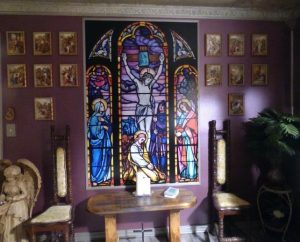
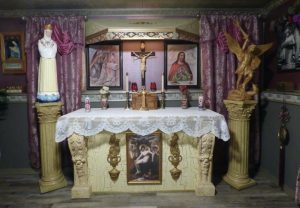
Larry Benns passed away on March 1, 2021. Please pray for the repose of his soul.
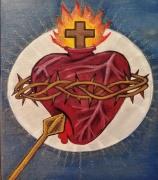
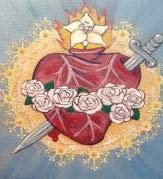
May all of us become true apostles in these trying times!
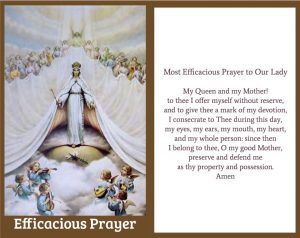
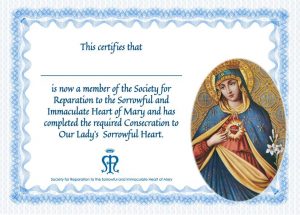
by T. Stanfill Benns | Mar 6, 2022 | New Blog
+St. Thomas Aquinas+
If you haven’t already, please join us here for the Prophet Elias prayer challenge.
Lent is a time to fast and do penance, as all Catholics know. But it is also a time to reflect and take stock of the course we are on spiritually and where it is leading us. And for us it is time to knock the dust from our sandals and move on.
What is most maddening about the current state of the Church today is the compelling need to correct so many dangerous errors in order to defend the faith. But what is sometimes lost in correcting these errors, as necessary as this is, is the simplicity of the faith itself. Heresies and broken laws take a lot of demonstration and explaining to understand, and if these laws were not being broken, and the faith was not being denied, it wouldn’t be necessary. But of course they are, and it is, and lest someone falls into the yawning chasms of disbelief they create, they must be exposed.
That being said, quite a few are understandably wearied by the constant need to deal with it all. Traditionalists and their pseudo-clergy grow more irrational and argumentative with each passing day. Witness some of the obviously nonsensical and contradictory statements in the links provided in our last blog post. The delusions they labor under are so entrenched and so strong I really do not believe it is possible to reach them. It is almost as though they function under some sort of satanic spell, and they do — the operation of error foretold by St. Paul. They have traded the true faith for a mess of Protestant pottage (thick soup or porridge) and not only do they deny it is Protestant, they think they are dining on steak and caviar, not pottage!
Generational disconnect
It would be one thing if we were dealing with the first generation of Catholics to depart following Vatican 2, but most of those who knew the Church as She once existed are no longer with us, or soon will be gone. They are the ones who initially embraced Traditionalism and refused to abandon their “priests” and now we are dealing with their children and grandchildren. They became caught up in the drama of Traditionalist life with its many scandals, dissensions and frequent hopping around from group to group, and this is now normal for these family members who went through it with them. They accept it as Catholic in these “emergency times” and with their parents’ support, continue to live the only “Catholic” life they know. Herd animals that they are, products largely of the world in which we live, they avoid at all costs anything that would separate them from their “pack” and cause them to actually think on their own. If many of them were home-schooled and this is the result, then the critical thinking homeschooling is intended to encourage certainly was lacking in their regard.
And so the initial mission to reach those who might yet understand no longer has any purpose and therefore must come to an end. Troubled Traditionalists reassessing their situation or newly-woken Novus Ordo departees are so consumed with the idea of participation and groupthink they are unable to consider any truly viable alternatives. The idea of the Latin Mass and the pageantry that always accompanied liturgical functions attracts newcomers and remains the guidepost for Traditionalists considering a different group. In a normal world this would be understandable in departing from what one considers a destructive or non-Catholic sect. But surely no one today can pretend the world we live in is anything close to normal.
Those weighing their options must understand that the Traditionalist movement is nothing new or even traditional. It is the continuation of the Jansenist, Gallicanist, Anglican, Orthodox, Theosophist and Gnostic ”tradition,” but that is certainly not Catholic tradition! One book all should read if they wish to see a mirror image of Traditionalist practice and belief is Peter Anson’s Bishops At Large. Written in 1964, it provides an amazing preview of what would soon become the Traditionalist movements and their many offspring. It is appropriate here to quote from the Introduction to Anson’s book written by Henry St. John, O.P. which aptly sums up everything we know as Traditionalism today.
Traditionalism’s true orientation explained
“[Anson’s] story is one of the strangest and most fantastic religious movements to be found in the whole range of what may be described in general terms as the erratic ‘goings-on’ of the underworld. The use of the word underworld in this context must be taken as connoting an ecclesiastical eccentricity rather than roguery or crime, though neither of the latter is wholly absent from its records. The story is closely though not exclusively connected with movements of a Catholic type, mainly arriving from dissatisfied and unstable elements in Catholicism or Anglo-Catholicism. They stand as a rule for Catholicism without the Pope but their preoccupation amounting to obsession is the recovery of Christian unity by the widespread and in effect indiscriminate propagation of valid episcopacy and priesthood.
“In almost every case, the leaders of these multiple movements have been at pains to obtain episcopal consecration from sources often remote and seldom wholly unquestionable which they hoped would be indisputable. Having obtained an episcopal character, they proceeded to found a church based upon it and their own particular version of what true Catholic orthodoxy is. In this way, so the visionary hope takes shape in the minds of these dreamers, that their church will become the center and foundation upon which the unity of Christ’s Church could be rebuilt…
“Mr. Anson’s story shows us a reductio ad absurdum of the divinely ordained hierarchical structure of the Church constituted by Apostolic succession when divorced from almost every consideration but a mechanical conception of validity… The obsession of the bishops at large and their followers with the validity of orders has brought them to the belief that such validity is a sole hallmark of the nature of the Church and its authority. Ubi ordines validi ecclesia is the principle upon which they, all of them, consistently act with a determined conviction,” (valid orders make a strong Church).
“The result of this action is that they are in effect reduced to saying get valid orders and you can choose what you believe. They are unaware that they are saying this and consequently lay great stress on the supreme importance of an orthodoxy which turns out to be no more than their own particular and sometimes variable “doxy.” What they have forgotten in their often wild and eccentric way is that even a valid Apostolic succession is of small value unless it is possessed by a believing community that is a visible organic society divinely preserved from the loss of its structural unity. This unity preserves and is preserved by its sensus fidelium and by the teaching authority of its united episcopate. This is the essential nature of the Church as taught by the Eastern Orthodox Church and the Roman Catholic Church in common, in accordance with historic tradition from the earliest times” but in the Catholic Church, of course, the Roman Pontiff alone is the guarantee of this undivided unity as the head member of that “united episcopate.”
The disturbing truth
And so we see that Traditionalists are no different than those schismatic sects who preceded them in pretending that one can have a Church without a pope. The underworld has now become their norm, and far from striving for any sort of Catholic unity, which necessarily requires a true pope, they seem to glory in their diversity. Anson goes into great detail to describe the occult connections of these groups, also their interests in ancient heresies, which so many have now resurrected and even perfected. Catholic writer Mary Lejeune warned those joining Traditionalist sects that they were occult-based and Masonic in origin in the 1970s, but to no avail. Author Craig Heimbichner, in his Blood on the Altar (2005) notes that many of those initially singing the praises of the Latin Tridentine Mass in the late 1960s, early 1970s were practicing theosophists, who succeeded in luring traditionalists into “Latin Mass” groups.
He links the awe for the old Mass to C.W. Leadbetter, founder of the Liberal Catholic (Theosophical) church in Sydney, Australia in 1917, citing several quotes proving theosophic occultism later was introduced into Traditional circles. He quotes Wasserman as stating that “Persons of Gnostic-hermetic interests have more in common with traditionalist Catholics than with either modernist Vatican II Catholics or with Protestants…The Right-wing exploits a superstition among some Catholics who hold to a kind of unspoken “magic sacramentalism,” [condemned by Pope St. Pius X in his encyclical Pascendi dominici gregis against Modernism], i.e, the notion that being present at the Holy Mass itself, with its awe-inspiring solemnity and its bells, incense and candles — not one’s state of grace, fidelity to the Commandments of God or relationship with Jesus Christ — becomes the individual’s guarantor of sanctity.” Heimbichner calls this a “Satanic perversion” of Catholicism, mixing pagan elements with the true, much as is done in the Satanic rituals connected to Voodoo and Santeria. And if this is what those investigating Traditionalism really wish to expose themselves to, they definitely are not looking for the true faith as taught by St. Peter through Pius XII.
Traditionalists’ intense focus on perpetuating their shady lineages and defending their legitimacy occupies the time that, were they anything but pseudo-clerics, should be devoted to developing a true understanding of the entirety of Catholic existence, not just its exterior aspect. They all have developed their own ideas of orthodoxy, as St. John notes above, and this is illustrated by the recent controversies among themselves regarding una cum and the material formal hypothesis. Also as noted above, their theory regarding the episcopacy reduces the Church’s establishment of a hierarchy based on true apostolic succession headed by a canonically elected pope to an absurdity. The only difference between those sects described above and Traditionalists is that Traditionalists have succeeded in convincing their ignorant followers that they are the true Church, and the “True Restoration” crowd pretends to be able to unite all these scraggly sects to present the appearance of a unity they can never possess without a true pope.
Anson’s book is filled with photos of incredible pseudo-Catholic pageantry, clerical ostentation and simulated piety, found reproduced on nearly every Traditional “Catholic” website in existence. These sites feature full-color photos of alleged consecrations and ordinations, wide-eyed “seminarians” being ordained as “priests,” and pious congregations attending ”high masses” offered in vain. Such pretension is an insult to any true Catholic and should be recognized by all for what it truly is — the continuation of a long line of heretics and schismatics who wish to dethrone the pope forever and usurp his authority. Apostolicity of origin, doctrine and mission must all be one, and they have none of these, as has been proven by the Church herself on the pages of this site and elsewhere time and time again. But the followers of these imposters are concerned only with appearances, not reality. And here we must leave them in their fantasy world to fend for themselves as best they can.
The sad neglect of true Catholic spirituality
The primary thing that is needed today is not religious externals and a renewal of Catholic social life, possible only when the Church possesses a true pope and hierarchy. What is really needed is true Catholic spirituality, and the reason the Church was taken away was precisely because Her interior life atrophied to the point it could no longer nourish Her very soul. That life is the knowledge and contemplation of Her truths, obedience to Her laws, conformity to God’s will, performance of daily duties and the offering up of oneself as a spiritual sacrifice. Already prior to the false Vatican 2 council many Catholics were largely engaged in only a mechanical performance of their spiritual duties and had become absorbed in the rampant materialism of the day. They forgot, if they ever knew, their true role as Catholics, best explained in this paragraph below.
Catechism of the Council of Trent — (Subhead, The Internal Priesthood, under Orders):
“All the faithful are said to be priests once they have been washed in the saving waters of baptism. Especially is this name given to the just who have the spirit of God and who by the help of divine grace had been made living members of the great high priest Jesus Christ. For enlightened by faith which is inflamed by charity, they offer up spiritual sacrifices to God on the altar of their hearts. Among such sacrifices must be reckoned every good and virtuous action done for the glory of God. Hence we read in the Apocalypse 1: 5,6: ‘Christ has washed us from our sins in His own blood and has made us a kingdom and priests to God and His Father.’ In like manner was it said by the Prince of the Apostles: ‘Be you also as living stones built up, a spiritual house, a holy priesthood offering up spiritual sacrifices acceptable to God by Jesus Christ’ (I Peter 2:5); while the apostle exhorts us ‘to present our bodies a living sacrifice, holy pleasing unto God, your reasonable service’ (Rom. 12:1). And long before this David had said, ‘A sacrifice to God is an afflicted spirit a contrite and humble heart O God thou wilt not despise’ (Ps. 1:19). All this clearly regards the internal priesthood.”
Statement of Belief
It may be useful here for those who are not clear on all that involves praying at home and not attending services of non-Catholics to list the following core beliefs held by true Catholics.
+ We live in the last times; the Church has entered upon a period that will end either in the Final Judgment or a brief peace that will see Her restoration.
+ Pope Pius XII was the last true pope. We are bound to obey all the teachings of the popes from St. Peter to Pius XII — the continual magisterium — even though we have no sitting pope today. This because their teachings are the authentic expression of the Deposit of Faith, revealed truth found in the Scriptures and Tradition as interpreted and taught by the Roman Catholic Church for the belief of faithful Catholics till the end of time.
+ Therefore, the authority, infallibility and indefectibility of the Church remains, expressed in the Deposit of Faith as explained by all true popes throughout the ages.
+ Pope Pius XII was the last true pope because John 23, as a public heretic, was ineligible for election in 1958 and never became pope.
+ Doubts raised about the 1958 election in many quarters prove St. Robert Bellarmine’s axiom, that “a doubtful pope is no pope” applies to his “election.”
+ Bishops consecrated under Pope Pius XII and any remaining faithful cardinals were obligated to gather and elect a true pope once it became clear that John 23/Paul 6 were heretics. St. Robert Bellarmine in his de Conciliis, Pope Pius XII in his 1945 election constitution, also Pope Paul IV in his Cum ex Apostolatus Officio, made allowances for this. It is now impossible, however, to hold a papal election, because all those bishops consecrated under Pope Pius XII have passed away.
+ Pope Paul IV ‘s infallible bull Cum ex Apostolatus Officio (Cum ex…) and Pope Pius XII’s infallible constitution Vacantis Apostolicae Sedis (VAS) are the governing documents for these times. Cum ex… is the annotated source of the Canons regarding heresy, canons which have been called into doubt for decades. Under Can. 6 §4 this old law is to be used as the prevailing law in dealing with heresy, apostasy and schism, especially in regard to papal elections and the appointment of cardinals and bishops. VAS determines what can and cannot be done during an interregnum.
+ According to VAS, not even the college of cardinals may exercise papal jurisdiction during an interregnum. This law has been observed since the early Middle Ages. All is to be left to the future pope.
+ This would include, then, the issuance of the apostolic letters and papal mandate, necessary for episcopal consecration. For VAS clearly states that if anyone attempts to exercise papal jurisdiction during an interregnum, such acts are null and void. Therefore, Traditionalist consecrations and ordinations are null and void, since ordinations may take place only by a bishop who has presented the papal mandate, been validly consecrated, been assigned a diocese and has received papal permission to erect a seminary.
+ VAS also renders null and void any attempt to dispense from or alter in any way papal laws, especially those governing elections. Traditionalists have violated numerous papal laws and canon laws, which have as their source papal law and the teachings of ecumenical councils, especially Trent. Hence their invocation of epikeia for jurisdictional acts is nullified and voided.
+ Because Catholics who now pray at home are obedient to the Roman Pontiffs, they must consider Traditionalists now calling themselves bishops as doubtful at best, for two reasons:
1) They are members of a schismatic sect by definition, since they act outside the authority of the Roman Pontiff; and
2) They are declared by Pius XII to possess no office or authority whatsoever, because their ordinations and consecrations are null and void.
+ In seeking to inform their consciences on such matters, i.e., what to do when there is no pope and no certainly valid bishops or priests, those wishing to remain Catholic follow the unanimous opinion of theologians, which states: When it comes to the Sacraments, (or matters which involve the necessary means to eternal salvation), one cannot use a probable opinion regarding their validity (see Dominic Prummer’s Handbook of Moral Theology,1957).
+ This is solidly based on the teaching of Bd. Pope Innocent XI (Denz. 1151). Theologians teach it is a mortal sin of temerity not to follow the unanimous opinion of the theologians (Fr. Sixtus Cartechini, S.J., The Church’s Theologiocal Notes or Qualifications, 1951).
+ In order to obey the Roman Pontiffs and their decrees, since it is necessary to salvation to be obedient to the Roman Pontiff (Denz. 469); and in order to avoid mortal sin, certain Catholics resolved to pray at home rather than engage in the schismatic and sacrilegious services of Traditionalists, for “Obedience is better than sacrifices.”
+ This can be best summed up by the following, taken from Life of the Blessed Virgin, by Rev. B. Rohner, O.S.B, Benziger Bros., 1897: “If you are deprived of the presence of your lawfully appointed teachers, then pray privately in your own house or in company of other faithful laity, to your divine Redeemer and ever Blessed Mother. In patience persevere in the faithful discharge of your duties till the dawn of better days in your Church affairs.”
+ This has been the practice of Catholics down through the ages, including the English during the persecutions following the Reformation, the Japanese in the 1600s, The French during the French Revolution, Americans without priests on the American frontier and those forbidden to practice their faith behind the Iron Curtain. It is not a novelty nor can it be condemned as forbidden by Traditionalists, who have no authority to command anyone to do anything.
+ Those who pray at home believe that the Head of their Church is Christ joined to all the popes and bishops in Heaven, and that they are members of His Mystical Body, as Catholics have always believed. They do NOT believe the Church Herself has ceased to exist since Pope Pius XII taught infallibly that She IS the Mystical Body. They accept the undeniable fact that we are without the visible hierarchy, at least for now. They believe the Church is still visible in Her physical (lay) members, is one in Her belief, is universal or Catholic in nature, (since there are those praying at home all over the world); is holy in her doctrines and Her saints, and is apostolic in origin, doctrine, and mission.
Those praying at home perform their daily duties, have a daily prayer routine, practice mental prayer and engage in spiritual reading. They recite the Mass of St. John or the Spiritual Mass daily as well as on Sundays and holydays, they are usually involved in some service to the Church and in helping others to understand the faith, and they pray together for others. It is a very simple and peaceful life, undisturbed by the inevitable and perpetual strife that plagues those in the Novus Ordo and Traditional sects. Even when in the catacombs the early Christians had to be witnesses to their faith in performing their daily duties in the world; they worshipped in the catacombs but did not live there. So it is with those of us living in the virtual catacombs.
We wish only for others what we have experienced ourselves, that blessed peace which surpasseth all understanding. And we pray for the conversion of all sinners, Traditionalists and Novus Ordo members included.
What in the world…
This is a new feature where we will try to comment briefly on the latest developments in Traddie land and the world in general. This time around we will address the sudden clamor for the Consecration of Russia to the Immaculate Heart of Mary.
But didn’t we already do that in the 1950s, you might ask? Well some say yes, some say no. It was never done by Pope Pius XII as Sr. Lucia requested per Our Lady, or by the bishops of the whole world. On June 6, 1930, Sr. Lucia wrote to Rev. Jose Bernardo Gonzalves: “If I am not mistaken, the good Lord promises to end the persecution in Russia if the Holy Father will himself make a solemn act of reparation and consecration of Russia to the Sacred Hearts of Jesus and Mary as well as ordering all the bishops of the Catholic world to do the same. The Holy Father must then promise that upon the ending of this persecution he will approve and recommend the practice of the reparatory devotion already described” (the Five First Saturdays). Pope Pius XII himself did consecrate Russia specifically to the Immaculate Heart of Mary in 1952, but even before it was done, Lucia had said to Fr. Gonzalves “He will do it, but it will be too late.” Yet some of the renditions of her letter read only: “It will be late.” So which is it?
Obviously it is the former, as we are seeing today. Our Lord also told Sr. Lucia that if the consecration was not done as requested, His ministers would suffer the same fate as the Kings of France — the last of those kings, Louis XVI was tortured and met his fate on the guillotine. Some believe Pope Pius XI died from poisoning by one of Mussolini’s agents, shortly before issuing a most important encyclical. It is our firm belief that Pope Pius XII also was tortured in various ways and was poisoned, not once, but twice. And after his death, just as in France, the papal monarchy fell. Sr. Lucy warned in a 1940 draft of a letter to Pope Pius XII that if the consecration was not performed, Our Lady announced that Russia “…would spread her errors throughout the world, and there would be wars, persecutions, of the holy Church, martyrdom of many Christians, several persecutions and sufferings reserved for your Holiness, and the annihilation of several nations,” all duly fulfilled. Now we see Russia threatening the world, and we wonder why.
Was the consecration done as required? The real Sr. Lucy reportedly died in 1949 (https://diesilli.com/some-questions/), so we will never know. Was prayer and penance, also sacrifices for sinners accomplished? Sr. Lucy replies in the negative. In an August 18, 1940 letter to Rev. Jose Bernardo Gonzalves Sr. Lucia wrote: “More than ever He needs souls that will give themselves to Him without reserve; and how small this number is!” In another letter she notes that “The number of souls He meets through sacrifice and intimate life of love is extremely small and limited.” As Joseph A. Pelletier writes in his The Sun Danced at Fatima, “We have known since 1917 the part of the Fatima message that needs to be known by everyone, namely that we should amend our lives and stop offending God, Who is already greatly offended. This is what we need to do to hasten the conversion of Russia and …eliminate the threat of atomic war.” And we know where the world has headed since then.
One thing no one seems to have considered here is a little-known message given to a holy woman by Our Lord at the same time the Fatima apparitions were taking place. This woman, a victim soul named Berthe Petit, was known to Pope St. Pius X. She had forwarded to him in 1914 the warning that Archduke Ferdinand would be assassinated, and that his assassination would ignite World War I. In a series of revelations once the war had begun, the Sacred Heart of Jesus guides Berthe, a Franciscan Tertiary, to petition Cardinal Bourne of England to consecrate his country to the Sorrowful and Immaculate Heart of Mary to end the war. Cardinal Bourne cooperated with Berthe’s request, with astonishing results. The same prayer was recited during World War II, and it halted the air attacks on Britain by the Germans, also marking the turn of the war in favor of the Allies. Our Lord told Berthe: “
“The calamities which I foretold are come to pass (World Wars I and II). Therefore it is time and it is my wish that the nations should turn to the Sorrowful and Immaculate Heart of my mother… Recourse to my mother under the title I wish for her UNIVERSALLY is the last help I shall give before the end of time… It is as a Son that I have conceived this devotion for my mother; it is as God that I impose it.” During the Miracle of the Sun at Fatima, Our Lady appeared as the Sorrowful Virgin. This was confirmed in a conversation the author John Haffert had with Sr. Lucy in 1946 (Russia Will Be Converted, p. 182). And yet there was never any discussion among the hierarchy — to the best of our knowledge — to add Our Lady’s title of Sorrowful to the Consecration of Russia to the Immaculate Heart. (Pope Pius XII, however, did issue a consecration prayer to the Immaculate Heart of Mary making three specific mentions of Our Lady’s Sorrowful Heart.)
And now, at the last hour, with Our Lady’s requests for prayer and sacrifices unfulfilled — in the absence of universal devotion to her Sorrowful and Immaculate Heart — everyone wonders why Russia never converted?! Our Lady came to La Salette weeping to warn us that Rome would become the seat of Antichrist, and that prophecy was ridiculed and suppressed. Today even Traditionalists are appealing to Rome and expect Antichrist to consecrate Russia to Our Lady and save us? More insanity! But then what else can we expect? As the prophet Isaias foretold:
“Behold the Lord shall lay waste the earth, and shall strip it, and shall afflict the face thereof, and scatter abroad the inhabitants thereof. And it shall be as with the people, so with the priest; and as with the servant, so with the master… With desolation shall the earth be laid waste and it shall be utterly spoiled: for the Lord hath spoken this word. The earth mourned, and faded away, and is weakened: the world faded away, the height of the people of the earth is weakened. And the earth is infected by the inhabitants thereof: because they have transgressed the laws, they have changed the ordinance, they have broken the everlasting covenant. Therefore shall a curse devour the earth, and the inhabitants thereof shall sin; and therefore they that dwell therein shall be mad, and few men shall be left,” (Isa. 24: 1-6).