by T. Stanfill Benns | Mar 24, 2026 | New Blog
+St. Gabriel the Archangel+
Introduction
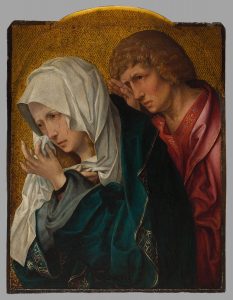
The following meditations on the sorrows of the Blessed Virgin Mary on Christ’s Passion and Death been taken from The Seven Sorrows of Mary by St Alphonsus de Ligouri (1696-1787) It is found in The Glories of Mary, a book all Catholics should have in their libraries. This excerpt can be downloaded from the Internet HERE.
The Meeting of Mary with Jesus When He was Going to Death
St. Bernardine says that to form an idea of the grief of Mary in losing her Jesus by death, it is necessary to consider the love that this mother bore to this her Son. All mothers feel the sufferings of their children as their own. Hence the woman of Canaan, when she pleaded to the Savior to deliver her daughter from the devil that tormented her, said to him, that he should have pity on the mother rather than on the daughter: “Have mercy on me, oh Lord, you son of David, my daughter is grievously troubled by a devil.” But what mother ever loved a child so much as Mary loved Jesus? He was her only child, reared amidst so many troubles and pains; a most amiable child, and most loving to his mother; a Son, who was at the same time her Son and her God; who came on earth to kindle in the hearts of all the holy fire of divine love, as he himself declared: “I have come to cast fire on the earth, and what do I will but that it be kindled?” Let us consider how he must have inflamed that pure heart of his holy mother, so free from every earthly affection.
In a word, the Blessed Virgin herself said to St. Bridget, that through love her heart and the heart of her Son was one: “Unum erat cor meum, et cor filii mei.” That blending of handmaid and mother, of Son and God, kindled in the heart of Mary a fire composed of a thousand flames. But afterwards, at the time of the passion, this flame of love was changed into a sea of sorrow. Hence St. Bernardine says: All the sorrows of the world united would not be equal to the sorrow of the glorious Mary. Yes, because this mother, as St. Lawrence Justinian writes: The more tenderly she loved, was the more deeply wounded. The greater the tenderness with which she loved him, the greater was her grief at the sight of his sufferings, especially when she met her Son, after he had already been condemned, going to death at the place of punishment, bearing the cross. And this is the fourth sword of sorrow which today we have to consider.
The Blessed Virgin revealed to St. Bridget that at the time when the passion of our Lord was drawing near, her eyes were always filled with tears, as she thought of her beloved Son whom she was about to lose on this earth. Therefore, as she also said, a cold sweat covered her body from the fear that seized her at that prospect of approaching suffering.1 Behold, the appointed day at length arrived, and Jesus came in tears to take leave of his mother before he went to death. St. Bonaventure, contemplating Mary on that night, says: You did spend it without sleep, and while others slept, you kept vigil. Morning having arrived the disciples of Jesus Christ came to this afflicted mother, one, to bring her these tidings, another, that; but all tidings of sorrow, for in her were then verified the words of Jeremiah: “Weeping, she has wept in the night, and her tears are on her cheeks; there is none to comfort her of all them that were dear to her.” One came to relate to her the cruel treatment of her Son in the house of Caiphas; another, the insults received by him from Herod. Finally, for I omit the rest to come to my point, St. John came and announced to Mary that the most unjust Pilate had already condemned him to death upon the cross. I say the most unjust, for, as St. Leo remarks, this unjust judge condemned him to death with the same lips with which he had pronounced him innocent.
Oh sorrowful mother; said St. John to her, your Son has already been condemned to death, he is already on his way, bearing himself his cross on his way to Calvary, as he afterwards related in his Gospel: “And bearing his own cross he went forth to that place which is called Calvary.” Come, if you desire to see him and bid him a last farewell in some of the streets through which he is to pass. Mary goes with St. John, and she perceives by the blood with which the way was sprinkled, that her Son had already passed there. This she revealed to St. Bridget: “By the footsteps of my Son I traced his course, for along the way by which he had passed, the ground was sprinkled with blood.”
St. Bonaventure imagines the afflicted mother taking a shorter way, and placing herself at the corner of the street to meet her afflicted Son as he passed by. This most afflicted mother met her most afflicted Son: Moestissima mater moestissimo filio occurrit, said St. Bernard. While Mary stopped in that place how much she must have heard said against her Son by the Jews who knew her, and perhaps also words in mockery of herself! Alas! what a commencement of sorrows was then before her eyes, when she saw the nails, the hammers, the cords, the fatal instruments of the death of her Son borne before him! And what a sword pierced her heart when she heard the trumpet proclaiming along the way the sentence pronounced against her Son!
But behold, now, after the instruments, the trumpet, and the ministers of justice had passed, she raises her eyes and sees; she sees, oh God, a young man covered with blood and wounds from head to foot, with a crown of thorns on his head, and two heavy beams on his shoulders; she looks at him and hardly knows him, saying, then, with Isaiah: “And we have seen him, and there was no sightliness.” Yes, for the wounds, the bruises, and clotted blood, made him look like a leper; “We have thought him, as it were, a leper;” so that he could no longer be recognized. “And his look was, as it were, hidden and despised, whereupon we esteemed him not.”3 But at length love recognizes him, and as soon as she knows him, ah, what was then, as St. Peter of Alcantara says in his meditations, the love and fear of the heart of Mary! On the one hand, she desired to see him; on the other, she could not endure to look upon so pitiable a sight. But at length they look at each other. The Son wipes from his eyes the clotted blood, which prevented him from seeing (as was revealed to St. Bridget), and looks upon the mother; the mother looks upon the Son.
Oh, the looks of sorrow, which pierced, as with so many arrows, those two holy and loving souls. When Margaret, the daughter of Sir Thomas More, met her father on his way to the scaffold, she could utter only two words, oh, father! oh, father! and fell fainting at his feet. At the sight of her Son going to Calvary, Mary fainted not; no, because it was not fitting that his mother should lose the use of her reason, as Father Suarez remarks, neither did she die, for God reserved her for a greater grief; but if she did not die, she suffered sorrow enough to cause her a thousand deaths. The mother wished to embrace him, as St. Anselm says, but the officers of justice thrust her aside, loading her with insults, and urge onward our afflicted Lord. Mary follows. Oh holy Virgin, where are you going? To Calvary! And can you trust yourself to see him who is your life hanging from a cross? And your life shall be as it were hanging before you: “Et erit vita tua quasi pendens ante te.”
Oh! my mother, stop, says St. Lawrence Justinian, as if the Son himself had then spoken to her; where do you hasten? Where are you going? If you come where I go, you will be tortured with my sufferings, and I with yours.2 But although the sight of her dying Jesus must cost her such cruel anguish, the loving Mary will not leave him. The Son goes before, and the mother follows, that she may be crucified with her Son, as William the Abbot says: The mother took up her cross, and followed him, that she might be crucified with him.1 We even pity the wild beasts: “Ferarum etiam miseremur;” as St. John Chrysostom has said. If we should see a lioness following her whelp as he was led to death, even this wild beast would call forth our compassion. And shall we not feel compassion to see Mary following her immaculate Lamb, as they are leading him to death? Let us then pity her, and endeavor also ourselves to accompany her Son and herself, bearing with patience the cross which the Lord imposes upon us. Why did Jesus Christ, asks St. John Chrysostom, desire to be alone in his other sufferings, but in bearing the cross wished to be helped by the Cyrenean? And he answers: That you may understand that the cross of Christ is not sufficient without yours. The cross alone of Jesus is not enough to save us, if we do not bear with resignation also our own, even unto death.
EXAMPLE
The Saviour appeared one day to sister Diomira, a nun, in Florence, and saidto her: “Think of me, and love me, and I will think of you, and love you: “and at the same time he presented her with a bunch of flowers and a cross, signifying to her by this, that the consolations of the saints on this earth are always to be accompanied by the cross. The cross unites souls to God. [St.] Jerome Emiliani, when he was a soldier, and leading a very sinful life, was shut up by his enemies in a tower. There, feeling deeply his misfortune, and enlightened by God to amend his life, he had recourse to the most holy Mary, and then with the help of this blessed mother, he began to live the life of a saint. By this he merited to see once in heaven the high place which God had prepared for him. He became founder of the order of Sommaschi, died a saint, and has been [canonized a saint] by the holy Church.
PRAYER
My sorrowful mother, by the merit of that grief which you did feel at seeing your beloved Jesus led to death, obtain for me the grace also to bear with patience those crosses which God sends me. Happy me, if I also shall know how to accompany you with my cross until death. You and Jesus, both innocent, have borne a heavy cross; and shall I a sinner, who have merited hell, refuse mine? Oh immaculate Virgin, I hope that you will help me to bear my crosses with patience. Amen.
The Death of Jesus
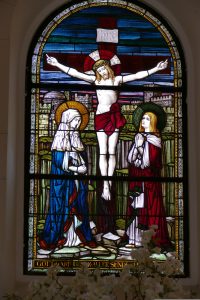
And now we have to admire a new sort of martyrdom, a mother condemned to see an innocent son, whom she loved with all the affection of her heart, put to death before her eyes, by the most barbarous tortures. There stood by the cross of Jesus his mother: “Stabat autem juxta crucem mater ejus.” There is nothing more to be said, says St. John, of the martyrdom of Mary: behold her at the foot of the cross, looking on her dying Son, and then see if there is grief like her grief. Let us stop then also today on Calvary, to consider this fifth sword that pierced the heart of Mary, namely, the death of Jesus.
As soon as our afflicted Redeemer had ascended the hill of Calvary, the executioners stripped him of his garments, and piercing his sacred hands and feet with nails, not sharp, but blunt: “Non acutis, sed obtuse,” as St. Bernard says, and to torture him more, they fastened him to the cross. When they had crucified him, they planted the cross, and thus left him to die. The executioners abandon him, but Mary does not abandon him. She then draws nearer to the cross, in order to assist at his death. “I did not leave him,” thus the Blessed Virgin revealed to St. Bridget, “and stood nearer to his cross.” But what did it avail, oh Lady, says St. Bonaventure, to go to Calvary to witness there the death of his Son? Shame should have prevented you, for his disgrace was also yours, because you were his mother; or, at least, the horror of such a crime as that of seeing a God crucified by his own creatures, should have prevented you. But the saint himself answers: Your heart did not consider the horror, but the suffering: “Non considerabat cor tuum horrorem, sed dolorem.”
Oh, your heart did not then care for its own sorrow, but for the suffering and death of your dear Son; and therefore you yourself did wish to be near him, at least to suffer with him. Oh, true mother! says William the Abbot, loving mother! For not even the terror of death could separate you from your beloved Son. But, oh God, what a spectacle of sorrow, to see this Son then in agony upon the cross, and under the cross this mother in agony, who was suffering all the pain that her Son was suffering! Behold the words in which Mary revealed to St. Bridget the pitiable state of her dying Son, as she saw him on the cross: “My dear Jesus was on the cross in grief and in agony; his eyes were sunken, half closed, and lifeless; the lips hanging, and the mouth open; the cheeks hollow, and attached to the teeth; the face lengthened, the nose sharp, the countenance sad; the head had fallen upon his breast, the hair black with blood, the stomach collapsed, the arms and legs stiff, and the whole body covered with wounds and blood.”
Mary also suffered all these pains of Jesus. Every torture inflicted on the body of Jesus, says St. Jerome, was a wound in the heart of the mother. Any one of us who should then have been on Mount Calvary, would have seen two altars, says St. John Chrysostom, on which two great sacrifices were consummating, one in the body of Jesus, the other in the heart of Mary. But rather would I see there, with St. Bonaventure, one altar only, namely, the cross alone of the Son, on which, with the victim, this divine Lamb, the mother also was sacrificed. Therefore the saint interrogates her in these words: Oh Lady, where are you? Near the cross? No, on the cross, you are crucified with your Son. St. Augustine also says the same thing: The cross and nails of the Son were also the cross and nails of the mother; Christ being crucified, the mother was also crucified. Yes, because, as St. Bernard says, love inflicted on the heart of Mary the same suffering that the nails caused in the body of Jesus. Therefore, at the same time that the Son was sacrificing his body, the mother, as St. Bernardine says, was sacrificing her soul.
Mothers fly from the presence of their dying children; but if a mother is ever obliged to witness the death of a child, she procures for him all possible relief; she arranges the bed, that his posture may be more easy; she administers refreshments to him; and thus the poor mother relieves her own sorrows. Oh mother, the most afflicted of all mothers! oh Mary, it was decreed that you should be present at the death of Jesus, but it was not given to you to afford him any relief. Mary heard her Son say: I thirst: “Sitio;” but it was not permitted her to give him a little water to quench his great thirst. She could only say to him, as St. Vincent Ferrer remarks; My Son, I have only the water of my tears: “Fili, non habeo nisi aquara lacrymarum.”
She saw that her Son, suspended by three nails to that bed of sorrow, could find no rest. She wished to clasp him to her heart, that she might give him relief, or at least that he might expire in her arms, but seeking one who could console him as he had predicted by the mouth of the prophet: “I have trodden the winepress alone; I looked about and there was none to help; I sought and there was none to give aid.” But who was there among men to console him, if all were his enemies? Even on the cross they cursed and mocked him on every side: “And they that passed by blasphemed him, wagging their heads.” Some said to him: “If you be the Son of God, come down from the cross.” Some exclaimed: “He saved others, himself he cannot save.” Others said: “If he be the King of Israel, let him come down from the cross.” The Blessed Virgin herself said to St. Bridget: “I heard some call my Son a thief; I heard others call him an impostor; others said that no one deserved death more than he; and every word was to me a new sword of sorrow.”
But what increased most the sorrows which Mary suffered through compassion for her Son, was to hear him complain on the cross that even the eternal Father had abandoned him: “My God, my God, why have you forsaken me?” Words which, as the heavenly mother herself said to St. Bridget, could never depart from her mind during her whole life. Thus the afflicted mother saw her Jesus suffering on every side; she desired to comfort him, but could not. And what caused her the greatest sorrow was to see that, by her presence and her grief, she increased the sufferings of her Son. The sorrow itself, says St. Bernard, that filled the heart of Mary, increased the bitterness of sorrow in the heart of Jesus.
St. Bernard also says that Jesus on the cross suffered more from compassion for his mother than from his own pains: he thus speaks in the name of the Virgin: I stood and looked upon him, and he looked upon me; and he suffered more for me than for himself. The same saint also, speaking of Mary beside her dying Son, says that she lived dying without being able to die: Near the cross stood his mother, speechless; living she died, dying she lived; neither could she die, because she was dead, being yet alive. Passino writes that Jesus Christ himself, speaking one day to the blessed Baptista Varana of Camerino, said to her that he was so afflicted on the cross at the sight of his mother in such anguish at his feet, that compassion for his mother caused him to die without consolation. So that the blessed Baptista, being enlightened to know this suffering of Jesus, exclaimed: Oh my Lord, tell me no more of this your sorrow, for I cannot bear it! Men were astonished, says Simon of Cassia, when they saw this mother then keep silence, without uttering a complaint in this great suffering.
But if the lips of Mary were silent, her heart was not so; for she did not cease offering to divine justice the life of her Son for our salvation. Therefore we know that by the merits of her sorrows she cooperated with Christ in bringing us forth to the life of grace, and therefore we are children of her sorrows: Christ, says Lanspergius, wished her whom he had appointed for our mother to cooperate with him in our redemption; for she herself at the foot of the cross was to bring us forth as her children. And if ever any consolation entered into that sea of bitterness, namely, the heart of Mary, it was this only one; namely, the knowledge that by means of her sorrows, she was bringing us to eternal salvation; as Jesus himself revealed to St. Bridget: “My mother Mary, on account of her compassion and love, was made mother of all in heaven and on earth.”
And, indeed, these were the last words with which Jesus took leave of her before his death; this was his last remembrance, leaving us to her for her children in the person of John, when he said to her: Woman, behold your Son: “Mulier ecce filius tuus.”1 And from that time Mary began to perform for us this office of a good mother; for, as St. Peter Damian declares, the penitent thief, through the prayers of Mary, was then converted and saved: Therefore the good thief repented, because the Blessed Virgin, standing between the cross of her Son and that of the thief, prayed to her Son for him; thus rewarding, by this favor, his former service.2 For as other authors also relate, this thief, in the journey to Egypt with the infant Jesus, showed them kindness; and this same office the Blessed Virgin has ever continued, and still continues to perform.
EXAMPLE
A young man in Perugia once promised the devil that if he would help him to commit a sinful act which he desired to do, he would give him his soul; and he gave him a writing to that effect, signed with his blood. The evil deed was committed, and the devil demanded the performance of the promise. He led the young man to a well, and threatened to take him body and soul to hell if he would not cast himself into it. The wretched youth, thinking that it would be impossible for him to escape from his enemy, climbed the well-side in order to cast himself into it, but terrified at the thought of death, he said to the devil that he had not the courage to throw himself in, and that, if he wished to see him dead, he himself should thrust him in. The young man wore about his neck the scapular of the sorrowing Mary; and the devil said to him: “Take off that scapular, and I will thrust you in.” But the youth, seeing the protection which the Mother of God still gave him through that scapular, refused to take it off, and after a great deal of altercation, the devil departed in confusion. The sinner repented, and grateful to his sorrowful mother, went to thank her, and presented a picture of this case, as an offering, at her altar in the new church of Santa Maria, in Perugia.
PRAYER
Oh mother, the most afflicted of all mothers, your Son, then, is dead; your Son so amiable, and who loved you so much! Weep, for you have reason to weep. Who can ever console you? Nothing can console you but the thought that Jesus, by his death, has conquered hell, has opened paradise which was closed to men, and has gained so many souls. From that throne of the cross he was to reign over so many hearts, which, conquered by his love, would serve him with love. Do not disdain, oh my mother, to keep me near to weep with you, for I have more reason than you to weep for the offences that I have committed against your Son. Oh mother of mercy, I hope for pardon and my eternal salvation, first through the death of my Redeemer, and then through the merits of your sorrows. Amen.
by T. Stanfill Benns | Mar 11, 2026 | New Blog
+Forty Holy Martyrs+
End times update
Four years ago I posted an article to the Catacombs section of betrayedcatholics entitled Spiritual TEOTWAWKI. The article explains the many links between the coming of Antichrist, the three days of darkness, an impending pole shift or EMP strike and the battle of Armageddon. For the battle of Armageddon to take place, the Euphrates River would first need to dry up, which over the past several years has indeed happened. This event would first need to take place so that armed calvary and military vehicles could cross through the dried (or nearly dried) riverbed, as prophesied in Apoc., Ch. 16. Now we see that American troops are being told that Pres. Trump reportedly claims he has been sent by God to fulfill prophecy and instigate the Battle of Armageddon. While this may or may not be true, it is interesting that all the indicators seem to be in place.
According to Apoc. 9:14, evil angels “bound in the great river Euphrates,” were loosed sometime in the past; Rev. E. S. Berry, in his The Apocalypse of St. John, surmises that this verse refers to the release of these angels at the end of the 1,000 years of binding, during the “pretended Reformation and the wars that followed it.” These captive or fallen angels are used as instruments of God’s judgment to punish earth’s inhabitants. According to Internet accounts, ancient cities have been discovered in the dry riverbed that were once buried beneath the waters. From one particular cave leading to tunnels beneath these cities some claim they hear cries and moans. But are the angels still bound, or could it be that they favor this location as a haunt and are anticipating the great battle? After all, they have not yet wreaked all the havoc they were assigned to create. Their most devastating blow is yet to be delivered in the final battle.
“The kings of the whole earth” are being summoned to participate in this battle (Apoc. 16:14). The forces of Antichrist and his system are summoning them, (Apoc. 16: 13). Those who will fight this war are all linked to the beast, false prophet and Satan himself, i.e., the continuation of the system begun by Roncalli and Montini even before the death of Pope Pius XII, an evil partnership with the Zionists, Masonry, spy ops worldwide and the money kings. The battle will trigger a great earthquake (man generated, a pole shift or possibly in conjunction with an EMP) and this most likely will result in the three days darkness. Anywhere from one-third to two-thirds of mankind will perish (Apoc. 9: 15, Zach. 13: 8). Antichrist and his followers will be destroyed. Rome will fall and Jerusalem will be divided into three different sections., (Rev. E. S. Berry). A certain time will be granted for penance before Christ comes for the Final Judgment.
Could it happen? Certainly. God often uses evil men to accomplish His designs. When will it happen? It is possible we could see this battle erupt during Holy Week. Christ announces through St. John In Apoc. 16:15: “Behold, I come as a thief. Blessed is he that watcheth, and keepeth his garments, lest he walk naked, and they see his shame.” Rev. Berry explains that this is a “…warning to the faithful to be prepared for the great conflict. They must guard well their garments of good works lest they be found without God’s grace in that evil day. Our Lord gave a similar warning when He foretold the destruction of Jerusalem: ‘Watch ye therefore, because you know not what hour your Lord will come’” (Matt. 24: 42).
But the battle could be postponed once again, and erupt at a later date as well. The goal of the Jews is to destroy the Dome of the Rock, held by the Muslims — the old site of Solomon’s temple — so that they may build a third temple and welcome their messiah. Yet several previous attempts to rebuild the Temple met with disaster and failed in the past. How does this fit in with today’s war on Iran? One missile already has landed very near the Dome, and “Christian” Zionist evangelists claim that the Dome must be destroyed so the third temple can be rebuilt. As one podcaster noted, all this because no one understands that Holy Scripture clearly states the promises made to the Jews have passed to the new Chosen People, the Catholic Church. But to understand where we stand in the light of prophecy today, we must first learn who the Jews really are and were and who true Catholics today truly are. Laura Wood’s Thinking Housewife site featured a good description of who the Jews were before Christ’s time and who they are today HERE. While the video does an excellent job of firmly separating the Chosen People as a group apart from Rabbinic Judaism, it is advised that everyone stop listening to this video the minute it launches into Vatican 2 teaching. And because it concludes with the false assumption that the church in Rome is the true Church, it misses several important points and fails to arrive at the proper conclusions regarding the true state of Judaism and Catholicism today.
What Is a Jew?
The word Jew first occurs in the book of 3 Kings. It later is mentioned in the books of Esther, Ezra and Jeremiah. It’s meaning is “men of Judah.” In Genesis, Judah is identified as the fourth son of Jacob and founder of the tribe of Judah and the Israelites. Judah and Tamar (his daughter-in-law and father of his two children) are the ancestors of the royal Davidic line from which Christ descended through His Blessed Mother.
The famous preacher and Bishop of Meaux, France, Jacques-Bénigne Bossuet, wrote in the 1600s: “There is among [the Jewish people] a type of drought which is unique to the Israelites, a drought which has been kept secret, and resisted for a long time, but which is no longer unspoken today and—what is even more serious—which no one is resisting anymore. In speaking of this drought, we mean to designate the disappearance—which is already very far advanced—of the traditions, customs and practices which essentially make up Jewish life… , just as initially, after the fall of Jerusalem, Mosaism had degenerated into Talmudism, so now Talmudism itself, with its remnants of Mosaism, is degenerating into rationalism or indifference—that is to say, into nihilism …”
In evaluating Bossuet’s observations, the twin brother priests who converted from Judaism, Joseph and Augustin Lemann, noted the following trends among the Jews of the 19th century:
- “a rejection of the supernatural generally;
- a denial of the divine inspiration of the Jewish Scriptures;
- calls for “free inquiry” in theological questions;
- taking pride in having no altar and no sacrifices;
- a refusal to acknowledge the traditional priesthood;
- contempt for the teachings of the Talmud;
- a refusal to engage in proselytizing or seeking converts to Judaism;
- a lack of respect for the kosher food laws;
- forgetfulness of the obligation to observe Shabbat;
- re-writing (“mutilating”) traditional Jewish prayers, to remove references to the Messiah, to Jerusalem, and to any type of national Jewish hopes.”
This is in perfect accord with a Pew research poll which shows that today: “…the majority of Jews consider themselves such in ethnicity, but not primarily in religion.” This releases the average Jew identifying as such merely by ancestry from any blame for the current situation and places it squarely on the Zionists. Seeing the above, is it any wonder, then, that a Holocaust had to be arranged and a Jewish state established in 1948 to stoke up the flagging spiritual coals among lax Jews? And given the Pew poll, is there any real evidence it has succeeded on a mass scale? Protestant evangelists have probably played a greater role in reigniting Jewish fervor than even Orthodox Jews. And the above only evaluates the spiritual state of the Jews; it does not question their identity as true Semites. Even if the Khazar/Ashkenazi controversy is laid aside and considered to be incorrect historically (which has not been proven, despite the feverish cries of the crusaders against antisemitism), the Jews today are at the very least a much watered-down version, blood-wise, of their Jewish ancestors.
Race or religion?
But racially pure Jews was not the main consideration. For God’s promises to the Jews to be kept, they were not to intermarry with anyone but their own within the boundaries of Israel, keeping their faith free from idolatry. This is not gone into in any detail in the video; the racial issue is generally ignored. And yet that is what is being stressed by the rabid antisemites predominating in the media, inordinately ignoring any real emphasis on what today’s Jews really believe. It is important to note that those Jewish religious officials objecting to establishing Israel as a state in 1948 did so on the premise that it emphasized the Jews as a race and a nation, not a religion. Interesting. As the video correctly notes, their religion is not the same today as in Christ’s time. And the Zionists are the modern-day Pharisees Christ condemned as liars and sons of the devil. In other words, the Pharisees were claiming to be Jews, but were not, since Christ sanctions them for perverting Jewish teaching.
The video is silent on the mention of the Jews in Apocalypse. But obviously, since all know we are living in the end times, this mention is what applies to us most specifically. Twice we read that there will be, in the last days, “those who say they are Jews and are not but do lie… but are the Synagogue of Satan” (Apoc. 2: 9 and 3: 9). We have observed before that Pope Pius IX called secret societies the Synagogue of Satan. (Now Protestant ministers on YouTube are identifying Freemasonry as the Synagogue of Satan and accrediting it to themselves as an interpretation of this verse, when it was Protestants in league with the B’nai B’rith and Jewish bankers who established Freemasonry in 1717). Even in the early Church we know there were “ungodly men” who had “secretly entered in,” (Jude 1:3). So we should not be surprised that they are yet with us, and that their numbers have grown exponentially. Today’s Zionists are the Pharisees of Jesus’ time and their synagogues are the dens of Satan found in all secret societies and satanic sects.
The objection to erasing the Semitic descendance of today’s Jews is that if it is indeed erased, then there would be no reason not to persecute those identifying only as ethnic or religious Jews. But this is nonsense. Christians are not allowed to persecute anyone for their religion, either, or for their ethnic origin. Muslims, on the other hand, have historically hated the Jews for their religion and exiled them from their countries. And based on that fact, it is not a stretch to assume that if they did develop nuclear weapons, Israel would be a target. Zionism has distorted passages of the Torah that both religions once claimed as a basis for belief and have also taken over predominantly Muslim territories. Zionists insist their brand of Judaism be recognized as the dominant religion in the Middle East, with no intent of co-existing with their neighbors, be it Palestine or Iran. They insist on recovering and ruling over the lands they believe God promised to them. They also have interfered with the hierarchy of Islamic religion. Iran and other Islamic nations are just as pagan and war-minded as the Zionists, but currently it is Zionism that is prevailing. So unless and until Zionists and their supporters are exposed for their satanic practices and beliefs, their war-mongering for centuries, their hatred of Christianity and the worldwide money cabal in which we are entrapped, there is no hope of any so-called “peace” in the Middle East or the world. Christ alone is the arbitrator of that peace and He will avenge His people in the end.
Vatican 2 and the Jews
Instead of using Vatican 2 to emphasize the fact that the Jews must not be persecuted, since the false council and false popes removed any suggestion of blame for Jesus’ death from the liturgy, those watching this video should instead be advised of how the birth of the Novus Ordo church is the mirror image of the reconstruction of Judaism following the destruction of the Temple in 70 A.D. Oh they still have the buildings in Rome; the exterior has survived so far. But the doctrinal content of the faith has been destroyed and apostolicity decimated. The observations made by the Lemann brothers about the Jews could just as easily apply to the Novus Ordo.
The church of the Old Testament and the promises made to the Chosen People ended with the coming of Christ as the true Messiah, and the transference of those promises to true Catholics throughout the ages. These promises now apply to those who profess belief in the Church as she existed prior to the death of Pope Pius XII. No better evidence of this transfer of these promises can be found than the following from Matt. 21: 42-45: “Jesus saith to them: Have you never read in the Scriptures: The stone which the builders rejected, the same is become the head of the corner? By the Lord this has been done; and it is wonderful in our eyes. Therefore I say to you, that the kingdom of God shall be taken from you, and shall be given to a nation yielding the fruits thereof. And whosoever shall fall on this stone, shall be broken: but on whomsoever it shall fall, it shall grind him to powder. And when the chief priests and Pharisees had heard his parables, they knew that he spoke of them.”
Conclusion
The age of the Catholic Church as an external, visible body ended with the coming of Antichrist, just as the Jewish religion ended with Christ’s coming. When the Jews seated one of their own on the throne of Peter as king, the Zionists who helped write the false V2 council documents and all of Judaeo-Masonry triumphed. Their high priest Paul 6, wearing ephod and teraphim reigned from the seat of their vanquished enemy. They called their new church Catholic just as the Jews called their Talmudic pagan religion Jewish. They boast of their continuing existence as prophesied: “I sit a queen and am no widow, sorrow I shall never see” (Apoc. 18:7). But the day is coming for their destruction as well, just as it came to the Jewish temple. Babylon the great, the very Babylon referred to by St. Peter (1Peter 5:13) is destined for the fall. It may well be that at the very time that Armageddon takes place, the seat of the great harlot riding the beast will be destroyed. It is the unanimous opinion of the Fathers and theologians, Henry Cardinal Manning tells us, that this shall occur.
We pray and watch. Please hasten Thy coming, dear Lord, and do not delay.
by T. Stanfill Benns | Mar 1, 2026 | New Blog
+Second Sunday in Lent+
+Prayer Society Intentions for March, Month of St. Joseph+
“Glorious Saint Joseph, pattern of all who are devoted to toil, obtain for me the grace to toil in the spirit of penance, in order thereby to atone for my many sins.” — Raccolta
Introduction
We are pleased to be able to present a set of meditations for every day in Lent from the great St. Thomas Aquinas, and regret only that we were not able to find them sooner, so they could be read from the beginning. We have selected a few excerpts below from the earlier weeks, and the meditations themselves can be found at: https://ia800201.us.archive.org/0/items/meditationsforle00aquiuoft/meditationsforle00aquiuoft.pdf
May all enjoy a peaceful and profitable Lent.
MEDITATIONS AND READINGS FOR LENT
FASTING
- We fast for three reasons. (i) To check the desires of the flesh. So St. Paul says in fastings, in chastity (2 Cor. vi. 5), meaning that fasting is a safeguard for chastity. As St. Jerome says, ” Without Ceres, and Bacchus, Venus would freeze,” as much as to say that lust loses its heat through spareness of food and drink. (ii) That the mind may more freely raise itself to contemplation of the heights. We read in the book of Daniel that it was after a fast of three weeks that he received the revelation from God (Dan. x. 2-4). (iii) To make satisfaction for sin. This is the reason given by the prophet Joel, Be converted to me with all your heart, in fasting and in weeping and in mourning (Joel ii. 12). And’ here is what St. Augustine writes on the matter. ” Fasting purifies the soul. It lifts up the mind, and it brings the body into subjection to the spirit. It makes the heart contrite and humble, scatters the clouds of desire, puts out the flames of lust and the true light of chastity.”
- There is commandment laid on us to fast. For fasting helps to destroy sin, and to raise the mind to thoughts of the spiritual world. Each man is then bound, by the natural law of the matter, to fast just as much as is necessary to help him in these matters. Which is to say that fasting in general is a matter of natural law. To determine, however, when we shall fast and how, according to what suits and is of use to the Catholic body, is a matter of positive law. To state the positive law is the business of the bishops, and what is thus stated by them is called ecclesiastical fasting, in contradistinction with the natural fasting previously mentioned.
- The times fixed for fasting by the Church are well chosen. Fasting has two objects in view: (i) The destruction of sin, and (ii) the lifting of the mind to higher things. The times self-indicated for fasting are then those in which men are especially bound to free themselves from sin and to raise their minds to God in devotion. Such a time especially is that which precedes that solemnity of Easter in which baptism is administered and sin thereby destroyed, and when the burial of Our Lord is recalled, for we are buried together with Christ by baptism into death (Rom. vi. 4). Then, too, at Easter most of all, men’s minds should be lifted, through devotion to the glory of that eternity which Christ in His resurrection inaugurated. Wherefore the Church has decreed that immediately before the solemnity of Easter we must fast, and, for a similar reason, that we must fast on the eves of the principal feasts, setting apart those days as opportune to prepare ourselves the devout celebration of the feasts themselves.
ON REFORMING OURSELVES
“Be not conformed to this world, but be reformed in the newness of your mind, that you may prove what is the good, and the acceptable, and the perfect will of God” — Romans xii. 2.
- What is forbidden is the forming of one self after the pattern of the world. Be not conformed to this world, that is, to the things which pass away with time. For this present world is a kind of measure of those things which pass away with time. A man forms himself after the pattern of things transitory when, willingly and lovingly, he gives himself to serve them. Those also form themselves after that pattern who imitate the lives of the worldly, This then I say and testify in the Lord : That henceforward you walk not as also the Gentiles walk in the vanity of their mind (Eph. iv. 17).
- We are bidden to undertake a reformation of the interior man when it is said, But be reformed in the newness of your mind. By mind is here meant the reason, considered as the faculty by which man makes judgments about what he ought to do. In man, as God first created him, this faculty existed in all the completeness and vigour it could need. Holy Scripture tells us of our first parents that God “filled their hearts with wisdom” and shewed them both good and evil (Ecclus. xvii. 6). But through sin this faculty declined in power and, as it were, grew old, losing its beauty and its brilliance. The Apostle warns us to form ourselves again, that is, to recover that completeness and distinction of mind that once was ours. This can indeed be regained by the grace of the Holy Ghost, and we should therefore use every endeavour to share in that grace — those who lack that grace that they may obtain it, and those who already have gained it faithfully to progress and persevere. Be renewed in the spirit of your mind, says St. Paul (Eph. iv. 23). Or again, in another sense, be renewed in your external actions, that is to say, in the newness of your mind i.e., according to the new thing, grace, which you have internally received.
- The reason for this warning is that you may prove what is the will of God. We know what befalls a man whose sense of taste suffers in an illness, how he ceases to have a true judgment of flavours and begins to loathe pleasantly-tasting things and to crave for what is loathsome. So it is with the man whose inclinations are corrupted from his conforming himself to the things of this world. He has no longer a true judgment where what is good for him is concerned. It is only the man whose inclinations are healthy and well directed, whose mind is made new again by grace, who can truly judge what is good and what is not. Therefore on this account is it written, Be not conformed to this world, but be reformed in the newness of jour mind that you may prove, that is, that you may know by experience. As again it says in the Psalm, ‘Taste and see that the Lord is sweet (Ps. xxxiii. 9). What is the will of God: that is, to say the will by which he wills us to be saved. This is the will of God, your sanctification (i Thess. iv. 3). The will of God is good, because God wills that we should will to do what is good, and He leads us to this through His commandments. “I will shew thee, O man, what is good, and what the Lord requireth of thee” (Micheas vi. 8). The will of God is agreeable in as much as to him who is rightly ordered it is a pleasure to do what God wills us to do.
Nor is the will of God merely useful as a means to achieve our destiny, it is a link joining us with our destiny and in that respect it is perfect. Such then is the will of God as those experience it who are not formed after the pattern of this world, but are formed over again in the “newness of their minds.” As to those who remain in the old staleness, fashioned after the world, they judge the will of God not to be a good but a burden and useless.
THE CROWN OF THORNS
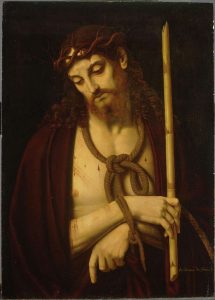
“Go forth, ye daughters of Sion, and see king Solomon in the diadem, wherewith his mother crowned him in the day of his espousals, and in the day of the joy of his heart.”— Cant. iii. n. This is the voice of the Church inviting the souls of the faithful to behold the marvelous beauty of her spouse. For the daughters of Sion, who are they but the daughters of Jerusalem, holy souls, the citizens of that city which is above, who with the angels enjoy the peace that knows no end, and, in consequence, look upon the glory of the Lord ? i. e., ‘Go forth ‘, shake off the disturbing commerce of this world so that, with minds set free, you may be able to contemplate him whom you love. And see king Solomon, the true peacemaker, that is to say, Christ Our Lord.
In the diadem wherewith his mother crowned him, as though the Church said, ” Look on Christ garbed with flesh for us, the flesh He took from the flesh of his mother.” For it is his flesh that is here called a diadem, the flesh which Christ assumed for us, the flesh in which He died and destroyed the reign of death, the flesh in which, rising once again, he brought to us the hope of resurrection. This is the diadem of which St. Paul speaks, We see Jesus for the suffering of death crowned with glory and honour (Heb. ii. 9). His mother is spoken of as crowning him because Mary the Virgin it was who from her own flesh gave him flesh. In the day of his espousals, that is, in the hour of his Incarnation, when He took to himself the Church not having spot or wrinkle (Eph. v. 27), the hour again when God was joined with man. And in the day of the joy of his heart. For the joy and the gaiety of Christ is for the human race salvation and redemption. And coming home, he calls together his friends and neighbours saying to them, Rejoice with me, because I have found my sheep that was lost (Luke xv. 6).
- We can however refer the whole of this text simply and literally to the Passion of Christ. For Solomon, foreseeing through the centuries the Passion of Christ, was uttering a warning for the daughters of Sion, that is, for the Jewish people. Go forth and see King Solomon, that is, Christ, in His diadem, that is to say, the crown of thorns with which His mother the Synagogue has crowned Him; in the day of his espousals, the day when He joined to himself the Church; and in the day of the joy of His heart, the day in which He rejoiced that by His Passion He was delivering the world from the power of the devil. Go forth, therefore, and leave behind the darkness of unbelief, and see, understand with your minds that He who suffers as man is really God.Go forth, beyond the gates of your city, that you may see Him, on Mount Calvary, crucified. (In Cant. 3 .)
HOW GREAT WAS THE SORROW OF OUR LORD IN His PASSION?
Attend and see if there be any sorrow like unto my sorrow. — Lam. i. 12. Our Lord as He suffered felt really, and in His senses, that pain which is caused by some harmful bodily thing. He also felt that interior pain which is caused by the fear of something harmful and which we call sadness. In both these respects the pain suffered by Our Lord was the greatest pain possible in this present life. There are four reasons why this was so.
- The causes of the pain. The cause of the pain in the senses was the breaking up of the body, a pain whose bitterness derived partly from the fact that the sufferings attacked every part of His body, and partly from the fact that of all species of torture death by crucifixion is undoubtedly the most bitter. The nails are driven through the most sensitive of all places, the hands and the feet, the weight of the body itself increases the pain every moment. Add to this the long drawn-out agony, for the crucified do not die immediately as do those who are beheaded. The cause of the internal pain was:
(i) All the sins of all mankind for which, by suffering, He was making satisfaction, so that, in a sense, he took them to him as though they were His own. The words of my sins, it says in the Psalms (Ps. xxi. 2). 60
(ii) The special case of the Jews and the others who had had a share in the sin of His death, and especially the case of His disciples for whom His death had been a thing to be ashamed of.
(iii) The loss of His bodily life, which, by the nature of things, is something from which human nature turns away in horror.
- We may consider the greatness of the pain according to the capacity, bodily and spiritual, for suffering of Him who suffered. In His body He was most admirably formed, for it was formed by the miraculous operation of the Holy Ghost, and therefore its sense of touch — that sense through which we experience pain — was of the keenest. His soul likewise, from its interior powers, had a knowledge as from experience of all the causes of sorrow.
- The greatness of Our Lord’s suffering can be considered in regard to this that the pain and sadness were without any alleviation. For in the case of no matter what other sufferer the sadness of mind, and even the bodily pain, is lessened through a certain kind of reasoning, by means of which there is brought about a distraction of the sorrow from the higher powers to the lower. But when Our Lord suffered this did not happen, for he allowed each of His powers to act and suffer to the fullness of its special capacity.
- We may consider the greatness of the suffering of Christ in the Passion in relation to this fact that the Passion and the pain it brought with it were deliberately undertaken by Christ with the object of freeing man from sin. And therefore he undertook to suffer an amount of pain proportionately equal to the extent of the fruit that was to follow from the Passion. From all these causes, if we consider them together, it will be evident that the pain suffered by Christ was the greatest pain ever suffered.