
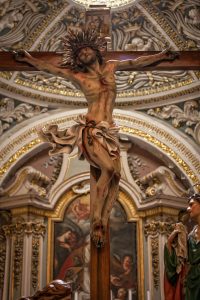
+Season of Lent+
(My apologies for a late start on Lent, and I give as excuse computer difficulties and family duties that have taken up much of my time recently. I chalk them all up to “the sacrament of the moment,” to be explained below.)
Introduction
Since childhood, we have cultivated the habit of giving something up every year for Lent. As children we often took an old glass jar discarded by our mothers and put every piece of candy that was given to us in that jar until after Lent. Or we would do the chores that we didn’t like and let our brothers and sisters do the other chores. Or we would try and give up things that meant something to us like playing baseball or watching television. As adults, we gave up cigarettes, swore off swear words, occasional gambling, or drinking, movies, sports, going out to dinner — anything pleasurable during that time period.
But one thing that very few people have ever thought about is giving up is their own will for Lent. And that is probably one of the things most pleasing to God. The art of giving up one’s will has been well developed by saints such as St. Francis de Sales, Rev. Jean-Pierre de Caussade, S.J. and authors such as Rev. Jean-Nicholas Grou, S.J. But having said that, it demands that we meditate on that process and it is a very difficult process to learn to practice because we have been so used — in this country especially — to doing our own will in all things, not God’s will. If we don’t obey God’s will we can’t reach heaven. So giving up our own will and trading it for God’s will is probably one of the most important things we could ever do in our entire life.
Lent is the perfect time to do it. And it may come a little easier for those who are pray-at-home Catholics for the simple reason that we have already given up a lot in the way of our own will in refusing to disobey God’s law by following Traditionalists. we want to do everything that Christ commanded us to do when He was on earth whether it was when He spoke to the crowds in His lifetime or later through the mouths of St. Peter’s successors. The more we know about what the popes teach and what Christ taught on earth, the better we understand what it is that He wishes us to do in order to be able to make a gift of our own will. Below I’m going to include some quotes from the three authors just mentioned that will help better define, I hope, the process involved in the gift of our own will to God.
St. Francis de Sales
St. Francis de Sales tells us the laws of the Church are God’s signified will: “Obedience to the Commandments, both divine and ecclesiastical, is of obligation for all, because there is question here of THE ABSOLUTE WILL OF GOD WHO HAS MADE SUBMISSION TO THESE ORDINANCES A CONDITION OF SALVATION,” (Holy Abandonment, Rt. Rev. Dom Vital Lehody, O.C.R., 1948). St. Francis mentions in this passage along with the commandments of God and of His Church, “divine inspiration, and those duties peculiar to our chosen vocation.” I desire that your crosses and mine be entirely crosses from Jesus Christ. And as to the imposition of them and the choice, the good God knows what He does and why He does it, for our good, no doubt. Our Lord gave to David the choice of the rod with which he would be scourged, blessed be God for this. But I think I would not have chosen, I would have let his divine majesty do all. The more a cross is from God, the more we should love it. Practice the mortifications that most often present themselves to you, for this is the thing we must do first. After that, we will do others… Be assured that we shall obtain more grace and merit in one day by suffering patiently the afflictions which come to us from God or from our neighbor than we could acquire in ten years by mortifications and other exercises which are of our own choice.” (Introduction to the Devout Life). And so to mortify ourselves this Lent, giving up our own will in all things can be the best of sacrifices.
Rev. Jean-Pierre de Caussade
Rev. Caussade sums up our manner of existence quite well when he writes that we must carry on “without thinking and concerned with no models or examples or any particular mode of spirituality. You must act when it is time for action and stop when it is time to stop. In this self-abandonment you read or put books aside, talk to people or keep silent, write or drop your pen, and never know what will follow.” How often we find it to be exactly as he says. We who are forced to proceed on nothing but faith alone can also understand his meaning in these words: “Let us acknowledge that we are incapable of becoming holy by our own efforts and put our trust in God, who would not have taken away our ability to walk unless He was to carry us in His arms…The light of reason can only deepen the darkness of faith…No matter what troubles, unhappiness, worries, upsets, doubts and needs harass souls who have lost all confidence in their own powers, they can all be overcome by the marvelous hidden and unknown power of the divine action. The more perplexing the situation, the more we can hope for a happy solution. The heart says, ‘All will be well. God has the matter in hand. We need fear nothing.’”
In this Marian age, it seems all the more fitting to find ourselves without directors, and therefore closer to the method of spirituality used by Our Lady herself. Caussade tells us that this consisted in “the sacrament of the moment,” accepting everything in our daily lives as God sends it, and at the time and in the manner in which He sends it. He says that God compelled him to write to help those “who seek to be holy and are discouraged by what you have read in the lives of the saints and some books dealing with spiritual matters.” How well this describes us today, who find so little of our own lives comparable to the lives of the saints. Caussade encourages his readers to faithfully follow inspirations of grace, a very important component of God’s will, but to follow these inspirations only as long as they also are in compliance with God’s will of signification (the natural law and the laws and teachings of the Church), His will of good pleasure (what happens in our daily lives) and our daily duties. He notes, however, that some are called to the practice of “extraordinary activities” and that some are required to fulfill both their ordinary duties in addition to these persistent and compelling inspirations. “Do you want to think, write and live like prophets and saints?” Caussade queries. “Then you must surrender, as they did, to the inspirations of God…Everything guides you to perfection except what is sinful or not a duty.”
What he describes here is nothing more than our offering of our own will to God, allowing the dictates of each moment of the day to guide us in all we do, whether it seems reasonable to us, is trying or is even painful or repugnant. Caussade continues: “The great and firm foundation of the spiritual life is the offering of ourselves to God and being subject to His will in all things.” In this manner, we ourselves become one with the eternal sacrifice Christ renews by His very presence on the heavenly altar. This today is our “Mass,” and therefore as long as we unite all that we do to this eternal sacrifice with our spiritual communions and morning offerings, while accepting all God sends as Christ accepted His own death, then we lack nothing in this world, not even the Holy Sacrifice.
In his work The Holy Eucharist, St. Alphonsus Liguori explains that in reality, the Sacrifice and priesthood never will cease, since “the Son of God, Eternal Priest, will always continue to offer Himself to God, the Father, in Heaven as an Eternal Sacrifice.” St. Thomas Aquinas says, that until the consummation we “must enter into spiritual things with sensible signs.” For only “in the state of glory…will [there] be no more sacraments.” Pope Pius XII wrote in Mediator Dei: “The people must offer themselves as victims… This offering is not in fact confined merely to the liturgical Sacrifice. For the Prince of the Apostles wishes us, as Living Stones built upon Christ the cornerstone, to be able ‘as a holy priesthood, to offer up spiritual sacrifices, acceptable to God by Jesus Christ,’” (I Peter 2: 5). This offering for us is the sacrament of the present moment God now requires, in His signified will especially, but also by inspiration and performance of daily duties. We are victims to our circumstances, which often seem chaotic; to the very uncertainty every moment brings to our day. (The above is quoted from Abandonment to Divine Providence, a compilation of letters of spiritual direction written by Caussade for the Visitation nuns in France in the early 1700s.).
Rev. Jean-Nicholas Grou
“God’s intention is that all Christians should, as soon as they have arrived at the age of reason, give themselves to Him and devote and consecrate themselves to His service, with their whole heart, thus ratifying the offering that was made on their behalf at their baptism. Yet few, when they are in a position to know themselves and begin to reflect, make this entire donation of themselves to God. The greater number, even among those who claim to be religious, remain in ignorance all their life of what this donation signifies. When anyone mentions it or suggests that they should make the trial as being essential for all Christians, they simply do not understand and cannot make up their minds to so great a sacrifice, which includes all other sacrifices.
“They are willing to adopt a system of devotion, but according to their own ideas, not God’s, in which they are prepared to submit to grace up to a point, but not absolutely and in everything. In all that is not expressly commanded by God or in which they have not made a voluntary act of submission, they believe that they have the right to dispose of themselves, and they maintain that God never intended to constrain them to the point that they should depend upon Him in every detail of their conduct. Few make this entire donation of themselves, and fewer still persevere in it… That is how so many souls are lost, whilst others only enter Heaven after a long and painful purgatory. That is also why there are so few saints. By saints I mean those who, whatever their age, whether they have persevered in their innocence or having lost it have lived for some time in sin, have at last given themselves to God in all earnestness and have thus fulfilled His designs for their perfection to the best of their endeavor” (The Gift of Self to God, 1867).
We close with this prayer written by St. Francis de Sales and an invitation to read the works cited above, for those wishing to give themselves to Our Lord this Lent as the ultimate sacrifice:
“Yes, Lord, Thy will be done, on earth, where we have no pleasure without a mixture of some pain, no roses without thorns, no day without a night to follow, no spring without a winter that went before. On earth, Lord, where consolations are rare and trials are countless. Still, O God, Thy will be done, not only in the fulfillment of Thy commandments, counsels, and inspirations, which must be done by us, but also in the suffering of afflictions and punishments, which must be accepted by us to the end; that by us, for us, in us, and with us, Thy will may do all that is pleasing to it” (Finding God’s Will For You).

When our own will does not correspond, it is “alienated” from, not “identified” with, (identical to), God’s will. When we do not do God’s will, we are simply sinning, in Lent or outside Lent.
There are not “neutral” facts: we follow God’s will or we follow our (different) will. This second option is the definition of sin.And the ones who never did anything different from the Father’s will were Jesus Christ and his Holy Mother (the slave of God): they never sinned.
So, giving up our own will is not an option, an additional good action. It is the basis of sanctity, the basis of salvation.
Yes, this is an important observation. That is why Rev. Grou points out that rather than do God’s holy will, people seem to prefer to suffer in Purgatory. What is not said here, but what he is referring to, is that Catholics do not work to eliminate deliberate venial sin from their lives. They do not eradicate bad habits and pet sins.
Lent is a time we are supposed to re-examine our lives in light of Christ’s Passion. So all I am asking, really, is that they make the extra effort to address those lesser deviations from His holy will and correct them, as an offering to God, since so few seem to do this.
Mrs Benns, please make your crisis catechism quickly as I fear my parents may not live long and I want something to put into their hands, being unlearned and incapable of long polemics
Michael, I will do my best. Please pray for me.