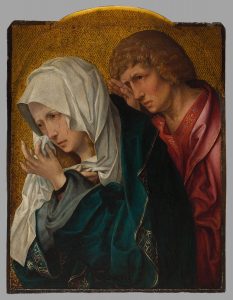
+St. Gabriel the Archangel+
Introduction
The following meditations on the sorrows of the Blessed Virgin Mary on Christ’s Passion and Death been taken from The Seven Sorrows of Mary by St Alphonsus de Ligouri (1696-1787) It is found in The Glories of Mary, a book all Catholics should have in their libraries. This excerpt can be downloaded from the Internet HERE.
The Meeting of Mary with Jesus When He was Going to Death
St. Bernardine says that to form an idea of the grief of Mary in losing her Jesus by death, it is necessary to consider the love that this mother bore to this her Son. All mothers feel the sufferings of their children as their own. Hence the woman of Canaan, when she pleaded to the Savior to deliver her daughter from the devil that tormented her, said to him, that he should have pity on the mother rather than on the daughter: “Have mercy on me, oh Lord, you son of David, my daughter is grievously troubled by a devil.” But what mother ever loved a child so much as Mary loved Jesus? He was her only child, reared amidst so many troubles and pains; a most amiable child, and most loving to his mother; a Son, who was at the same time her Son and her God; who came on earth to kindle in the hearts of all the holy fire of divine love, as he himself declared: “I have come to cast fire on the earth, and what do I will but that it be kindled?” Let us consider how he must have inflamed that pure heart of his holy mother, so free from every earthly affection.
In a word, the Blessed Virgin herself said to St. Bridget, that through love her heart and the heart of her Son was one: “Unum erat cor meum, et cor filii mei.” That blending of handmaid and mother, of Son and God, kindled in the heart of Mary a fire composed of a thousand flames. But afterwards, at the time of the passion, this flame of love was changed into a sea of sorrow. Hence St. Bernardine says: All the sorrows of the world united would not be equal to the sorrow of the glorious Mary. Yes, because this mother, as St. Lawrence Justinian writes: The more tenderly she loved, was the more deeply wounded. The greater the tenderness with which she loved him, the greater was her grief at the sight of his sufferings, especially when she met her Son, after he had already been condemned, going to death at the place of punishment, bearing the cross. And this is the fourth sword of sorrow which today we have to consider.
The Blessed Virgin revealed to St. Bridget that at the time when the passion of our Lord was drawing near, her eyes were always filled with tears, as she thought of her beloved Son whom she was about to lose on this earth. Therefore, as she also said, a cold sweat covered her body from the fear that seized her at that prospect of approaching suffering.1 Behold, the appointed day at length arrived, and Jesus came in tears to take leave of his mother before he went to death. St. Bonaventure, contemplating Mary on that night, says: You did spend it without sleep, and while others slept, you kept vigil. Morning having arrived the disciples of Jesus Christ came to this afflicted mother, one, to bring her these tidings, another, that; but all tidings of sorrow, for in her were then verified the words of Jeremiah: “Weeping, she has wept in the night, and her tears are on her cheeks; there is none to comfort her of all them that were dear to her.” One came to relate to her the cruel treatment of her Son in the house of Caiphas; another, the insults received by him from Herod. Finally, for I omit the rest to come to my point, St. John came and announced to Mary that the most unjust Pilate had already condemned him to death upon the cross. I say the most unjust, for, as St. Leo remarks, this unjust judge condemned him to death with the same lips with which he had pronounced him innocent.
Oh sorrowful mother; said St. John to her, your Son has already been condemned to death, he is already on his way, bearing himself his cross on his way to Calvary, as he afterwards related in his Gospel: “And bearing his own cross he went forth to that place which is called Calvary.” Come, if you desire to see him and bid him a last farewell in some of the streets through which he is to pass. Mary goes with St. John, and she perceives by the blood with which the way was sprinkled, that her Son had already passed there. This she revealed to St. Bridget: “By the footsteps of my Son I traced his course, for along the way by which he had passed, the ground was sprinkled with blood.”
St. Bonaventure imagines the afflicted mother taking a shorter way, and placing herself at the corner of the street to meet her afflicted Son as he passed by. This most afflicted mother met her most afflicted Son: Moestissima mater moestissimo filio occurrit, said St. Bernard. While Mary stopped in that place how much she must have heard said against her Son by the Jews who knew her, and perhaps also words in mockery of herself! Alas! what a commencement of sorrows was then before her eyes, when she saw the nails, the hammers, the cords, the fatal instruments of the death of her Son borne before him! And what a sword pierced her heart when she heard the trumpet proclaiming along the way the sentence pronounced against her Son!
But behold, now, after the instruments, the trumpet, and the ministers of justice had passed, she raises her eyes and sees; she sees, oh God, a young man covered with blood and wounds from head to foot, with a crown of thorns on his head, and two heavy beams on his shoulders; she looks at him and hardly knows him, saying, then, with Isaiah: “And we have seen him, and there was no sightliness.” Yes, for the wounds, the bruises, and clotted blood, made him look like a leper; “We have thought him, as it were, a leper;” so that he could no longer be recognized. “And his look was, as it were, hidden and despised, whereupon we esteemed him not.”3 But at length love recognizes him, and as soon as she knows him, ah, what was then, as St. Peter of Alcantara says in his meditations, the love and fear of the heart of Mary! On the one hand, she desired to see him; on the other, she could not endure to look upon so pitiable a sight. But at length they look at each other. The Son wipes from his eyes the clotted blood, which prevented him from seeing (as was revealed to St. Bridget), and looks upon the mother; the mother looks upon the Son.
Oh, the looks of sorrow, which pierced, as with so many arrows, those two holy and loving souls. When Margaret, the daughter of Sir Thomas More, met her father on his way to the scaffold, she could utter only two words, oh, father! oh, father! and fell fainting at his feet. At the sight of her Son going to Calvary, Mary fainted not; no, because it was not fitting that his mother should lose the use of her reason, as Father Suarez remarks, neither did she die, for God reserved her for a greater grief; but if she did not die, she suffered sorrow enough to cause her a thousand deaths. The mother wished to embrace him, as St. Anselm says, but the officers of justice thrust her aside, loading her with insults, and urge onward our afflicted Lord. Mary follows. Oh holy Virgin, where are you going? To Calvary! And can you trust yourself to see him who is your life hanging from a cross? And your life shall be as it were hanging before you: “Et erit vita tua quasi pendens ante te.”
Oh! my mother, stop, says St. Lawrence Justinian, as if the Son himself had then spoken to her; where do you hasten? Where are you going? If you come where I go, you will be tortured with my sufferings, and I with yours.2 But although the sight of her dying Jesus must cost her such cruel anguish, the loving Mary will not leave him. The Son goes before, and the mother follows, that she may be crucified with her Son, as William the Abbot says: The mother took up her cross, and followed him, that she might be crucified with him.1 We even pity the wild beasts: “Ferarum etiam miseremur;” as St. John Chrysostom has said. If we should see a lioness following her whelp as he was led to death, even this wild beast would call forth our compassion. And shall we not feel compassion to see Mary following her immaculate Lamb, as they are leading him to death? Let us then pity her, and endeavor also ourselves to accompany her Son and herself, bearing with patience the cross which the Lord imposes upon us. Why did Jesus Christ, asks St. John Chrysostom, desire to be alone in his other sufferings, but in bearing the cross wished to be helped by the Cyrenean? And he answers: That you may understand that the cross of Christ is not sufficient without yours. The cross alone of Jesus is not enough to save us, if we do not bear with resignation also our own, even unto death.
EXAMPLE
The Saviour appeared one day to sister Diomira, a nun, in Florence, and saidto her: “Think of me, and love me, and I will think of you, and love you: “and at the same time he presented her with a bunch of flowers and a cross, signifying to her by this, that the consolations of the saints on this earth are always to be accompanied by the cross. The cross unites souls to God. [St.] Jerome Emiliani, when he was a soldier, and leading a very sinful life, was shut up by his enemies in a tower. There, feeling deeply his misfortune, and enlightened by God to amend his life, he had recourse to the most holy Mary, and then with the help of this blessed mother, he began to live the life of a saint. By this he merited to see once in heaven the high place which God had prepared for him. He became founder of the order of Sommaschi, died a saint, and has been [canonized a saint] by the holy Church.
PRAYER
My sorrowful mother, by the merit of that grief which you did feel at seeing your beloved Jesus led to death, obtain for me the grace also to bear with patience those crosses which God sends me. Happy me, if I also shall know how to accompany you with my cross until death. You and Jesus, both innocent, have borne a heavy cross; and shall I a sinner, who have merited hell, refuse mine? Oh immaculate Virgin, I hope that you will help me to bear my crosses with patience. Amen.
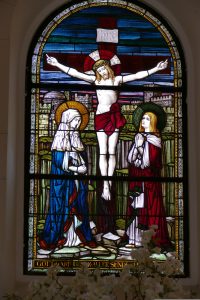
The Death of Jesus
And now we have to admire a new sort of martyrdom, a mother condemned to see an innocent son, whom she loved with all the affection of her heart, put to death before her eyes, by the most barbarous tortures. There stood by the cross of Jesus his mother: “Stabat autem juxta crucem mater ejus.” There is nothing more to be said, says St. John, of the martyrdom of Mary: behold her at the foot of the cross, looking on her dying Son, and then see if there is grief like her grief. Let us stop then also today on Calvary, to consider this fifth sword that pierced the heart of Mary, namely, the death of Jesus.
As soon as our afflicted Redeemer had ascended the hill of Calvary, the executioners stripped him of his garments, and piercing his sacred hands and feet with nails, not sharp, but blunt: “Non acutis, sed obtuse,” as St. Bernard says, and to torture him more, they fastened him to the cross. When they had crucified him, they planted the cross, and thus left him to die. The executioners abandon him, but Mary does not abandon him. She then draws nearer to the cross, in order to assist at his death. “I did not leave him,” thus the Blessed Virgin revealed to St. Bridget, “and stood nearer to his cross.” But what did it avail, oh Lady, says St. Bonaventure, to go to Calvary to witness there the death of his Son? Shame should have prevented you, for his disgrace was also yours, because you were his mother; or, at least, the horror of such a crime as that of seeing a God crucified by his own creatures, should have prevented you. But the saint himself answers: Your heart did not consider the horror, but the suffering: “Non considerabat cor tuum horrorem, sed dolorem.”
Oh, your heart did not then care for its own sorrow, but for the suffering and death of your dear Son; and therefore you yourself did wish to be near him, at least to suffer with him. Oh, true mother! says William the Abbot, loving mother! For not even the terror of death could separate you from your beloved Son. But, oh God, what a spectacle of sorrow, to see this Son then in agony upon the cross, and under the cross this mother in agony, who was suffering all the pain that her Son was suffering! Behold the words in which Mary revealed to St. Bridget the pitiable state of her dying Son, as she saw him on the cross: “My dear Jesus was on the cross in grief and in agony; his eyes were sunken, half closed, and lifeless; the lips hanging, and the mouth open; the cheeks hollow, and attached to the teeth; the face lengthened, the nose sharp, the countenance sad; the head had fallen upon his breast, the hair black with blood, the stomach collapsed, the arms and legs stiff, and the whole body covered with wounds and blood.”
Mary also suffered all these pains of Jesus. Every torture inflicted on the body of Jesus, says St. Jerome, was a wound in the heart of the mother. Any one of us who should then have been on Mount Calvary, would have seen two altars, says St. John Chrysostom, on which two great sacrifices were consummating, one in the body of Jesus, the other in the heart of Mary. But rather would I see there, with St. Bonaventure, one altar only, namely, the cross alone of the Son, on which, with the victim, this divine Lamb, the mother also was sacrificed. Therefore the saint interrogates her in these words: Oh Lady, where are you? Near the cross? No, on the cross, you are crucified with your Son. St. Augustine also says the same thing: The cross and nails of the Son were also the cross and nails of the mother; Christ being crucified, the mother was also crucified. Yes, because, as St. Bernard says, love inflicted on the heart of Mary the same suffering that the nails caused in the body of Jesus. Therefore, at the same time that the Son was sacrificing his body, the mother, as St. Bernardine says, was sacrificing her soul.
Mothers fly from the presence of their dying children; but if a mother is ever obliged to witness the death of a child, she procures for him all possible relief; she arranges the bed, that his posture may be more easy; she administers refreshments to him; and thus the poor mother relieves her own sorrows. Oh mother, the most afflicted of all mothers! oh Mary, it was decreed that you should be present at the death of Jesus, but it was not given to you to afford him any relief. Mary heard her Son say: I thirst: “Sitio;” but it was not permitted her to give him a little water to quench his great thirst. She could only say to him, as St. Vincent Ferrer remarks; My Son, I have only the water of my tears: “Fili, non habeo nisi aquara lacrymarum.”
She saw that her Son, suspended by three nails to that bed of sorrow, could find no rest. She wished to clasp him to her heart, that she might give him relief, or at least that he might expire in her arms, but seeking one who could console him as he had predicted by the mouth of the prophet: “I have trodden the winepress alone; I looked about and there was none to help; I sought and there was none to give aid.” But who was there among men to console him, if all were his enemies? Even on the cross they cursed and mocked him on every side: “And they that passed by blasphemed him, wagging their heads.” Some said to him: “If you be the Son of God, come down from the cross.” Some exclaimed: “He saved others, himself he cannot save.” Others said: “If he be the King of Israel, let him come down from the cross.” The Blessed Virgin herself said to St. Bridget: “I heard some call my Son a thief; I heard others call him an impostor; others said that no one deserved death more than he; and every word was to me a new sword of sorrow.”
But what increased most the sorrows which Mary suffered through compassion for her Son, was to hear him complain on the cross that even the eternal Father had abandoned him: “My God, my God, why have you forsaken me?” Words which, as the heavenly mother herself said to St. Bridget, could never depart from her mind during her whole life. Thus the afflicted mother saw her Jesus suffering on every side; she desired to comfort him, but could not. And what caused her the greatest sorrow was to see that, by her presence and her grief, she increased the sufferings of her Son. The sorrow itself, says St. Bernard, that filled the heart of Mary, increased the bitterness of sorrow in the heart of Jesus.
St. Bernard also says that Jesus on the cross suffered more from compassion for his mother than from his own pains: he thus speaks in the name of the Virgin: I stood and looked upon him, and he looked upon me; and he suffered more for me than for himself. The same saint also, speaking of Mary beside her dying Son, says that she lived dying without being able to die: Near the cross stood his mother, speechless; living she died, dying she lived; neither could she die, because she was dead, being yet alive. Passino writes that Jesus Christ himself, speaking one day to the blessed Baptista Varana of Camerino, said to her that he was so afflicted on the cross at the sight of his mother in such anguish at his feet, that compassion for his mother caused him to die without consolation. So that the blessed Baptista, being enlightened to know this suffering of Jesus, exclaimed: Oh my Lord, tell me no more of this your sorrow, for I cannot bear it! Men were astonished, says Simon of Cassia, when they saw this mother then keep silence, without uttering a complaint in this great suffering.
But if the lips of Mary were silent, her heart was not so; for she did not cease offering to divine justice the life of her Son for our salvation. Therefore we know that by the merits of her sorrows she cooperated with Christ in bringing us forth to the life of grace, and therefore we are children of her sorrows: Christ, says Lanspergius, wished her whom he had appointed for our mother to cooperate with him in our redemption; for she herself at the foot of the cross was to bring us forth as her children. And if ever any consolation entered into that sea of bitterness, namely, the heart of Mary, it was this only one; namely, the knowledge that by means of her sorrows, she was bringing us to eternal salvation; as Jesus himself revealed to St. Bridget: “My mother Mary, on account of her compassion and love, was made mother of all in heaven and on earth.”
And, indeed, these were the last words with which Jesus took leave of her before his death; this was his last remembrance, leaving us to her for her children in the person of John, when he said to her: Woman, behold your Son: “Mulier ecce filius tuus.”1 And from that time Mary began to perform for us this office of a good mother; for, as St. Peter Damian declares, the penitent thief, through the prayers of Mary, was then converted and saved: Therefore the good thief repented, because the Blessed Virgin, standing between the cross of her Son and that of the thief, prayed to her Son for him; thus rewarding, by this favor, his former service.2 For as other authors also relate, this thief, in the journey to Egypt with the infant Jesus, showed them kindness; and this same office the Blessed Virgin has ever continued, and still continues to perform.
EXAMPLE
A young man in Perugia once promised the devil that if he would help him to commit a sinful act which he desired to do, he would give him his soul; and he gave him a writing to that effect, signed with his blood. The evil deed was committed, and the devil demanded the performance of the promise. He led the young man to a well, and threatened to take him body and soul to hell if he would not cast himself into it. The wretched youth, thinking that it would be impossible for him to escape from his enemy, climbed the well-side in order to cast himself into it, but terrified at the thought of death, he said to the devil that he had not the courage to throw himself in, and that, if he wished to see him dead, he himself should thrust him in. The young man wore about his neck the scapular of the sorrowing Mary; and the devil said to him: “Take off that scapular, and I will thrust you in.” But the youth, seeing the protection which the Mother of God still gave him through that scapular, refused to take it off, and after a great deal of altercation, the devil departed in confusion. The sinner repented, and grateful to his sorrowful mother, went to thank her, and presented a picture of this case, as an offering, at her altar in the new church of Santa Maria, in Perugia.
PRAYER
Oh mother, the most afflicted of all mothers, your Son, then, is dead; your Son so amiable, and who loved you so much! Weep, for you have reason to weep. Who can ever console you? Nothing can console you but the thought that Jesus, by his death, has conquered hell, has opened paradise which was closed to men, and has gained so many souls. From that throne of the cross he was to reign over so many hearts, which, conquered by his love, would serve him with love. Do not disdain, oh my mother, to keep me near to weep with you, for I have more reason than you to weep for the offences that I have committed against your Son. Oh mother of mercy, I hope for pardon and my eternal salvation, first through the death of my Redeemer, and then through the merits of your sorrows. Amen.