by T. Stanfill Benns | Dec 31, 2022 | New Blog
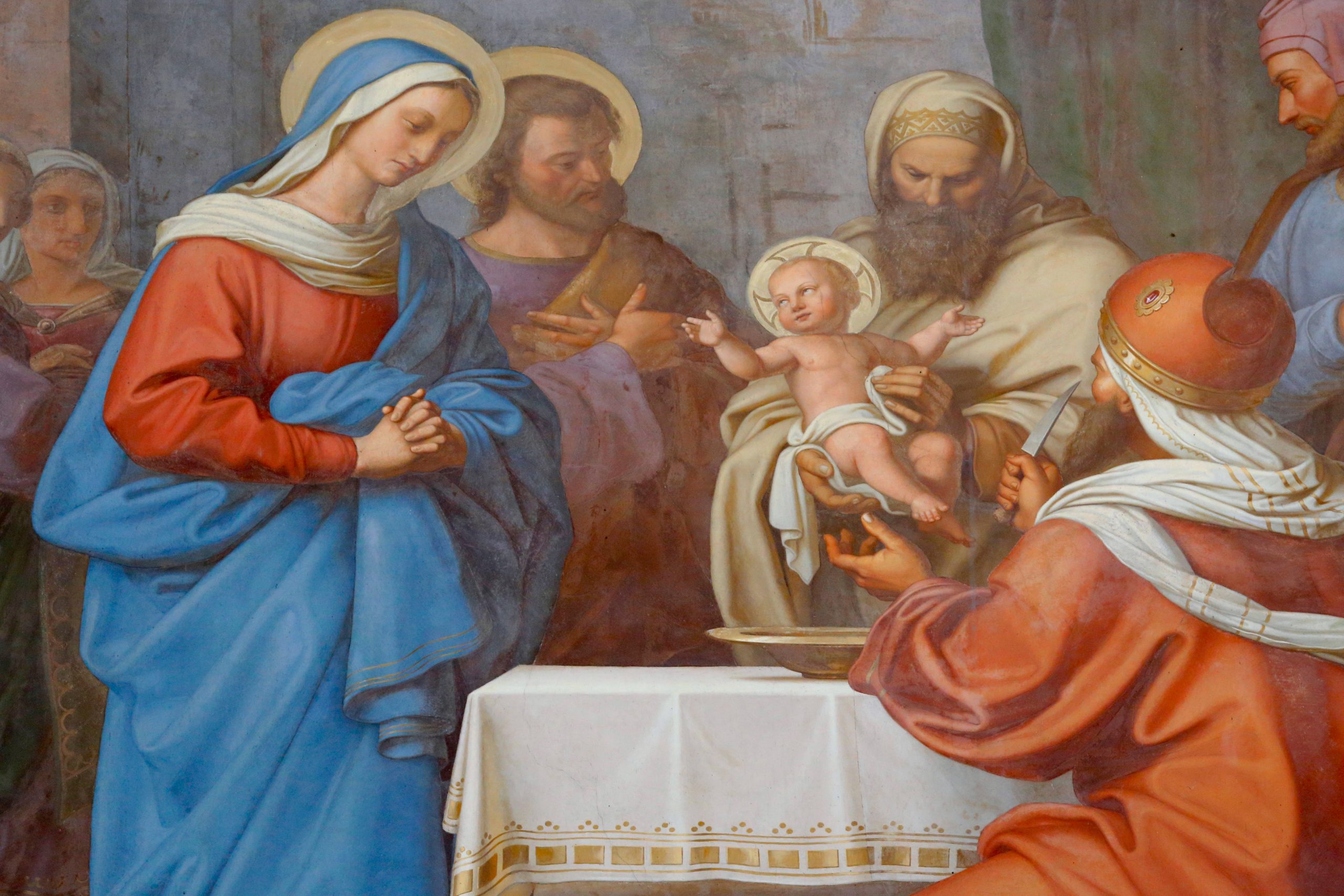
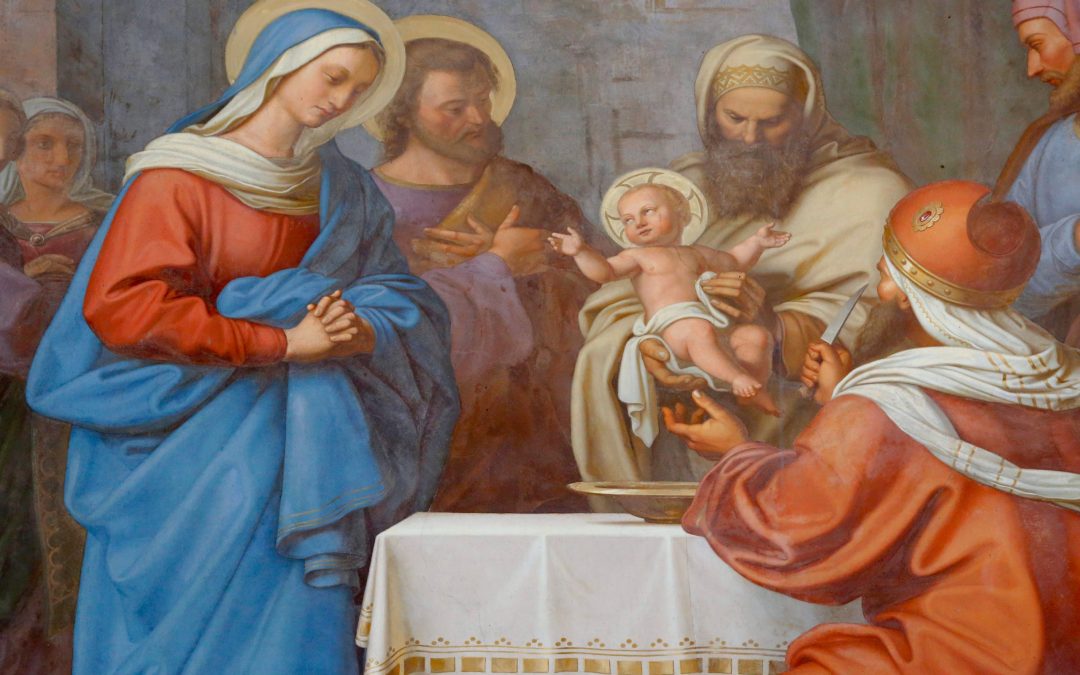
+Feast of the Circumcision+
JANUARY, MONTH OF THE HOLY NAME OF JESUS
“Thou shalt call His Name Jesus. For He shall save His people from their sins.” — Matt.1:21
Prayer Society Intention for January:
Dearest Jesus, by the invocation of Thy Holy Name, deliver this country and the whole world from impending ruin! Jesus, Jesus, Jesus!
First Friday Jan. 6 and First Saturday Jan. 7
Mystical Body, Pt. 3
Before leaving the subject of the Mystical Body of Christ it seems fitting to note that during the entire course of the infallible encyclical Mystici Corporis Christi, written by Pope Pius XII in 1943, emphasis placed by the Pope on Christ as the Head of His Body can be found prolifically throughout this encyclical. It is significant that Pope Pius XII addressed the matter of the Mystical Body as he did, seeing that it could not be addressed by the Vatican Council in its 1869-1870 sessions. This was owing to the early suspension of this council because civil war had broken out in Rome. There is reason to believe, as we’ve noted in other articles, that because the Church itself was not specifically addressed by the Vatican Council, Pope Pius XII intended to widen the scope of its definition by writing his encyclical. He had wished to call a council, as had Pope Pius XI, but, like his predecessor, had been warned by his advisors that it would likely be hijacked by modernists already exercising majority control in the Church, even in the 1950s.
Several important issues are addressed by the pope in this encyclical that would later become major factors in the Church following the false Vatican 2 council, and I do not believe that this was a coincidence. They would be further addressed in the infallible decrees Vacantis Apostolicae Sedis, Mediator dei and Humani generis, also in Ad sinarum gentum and the letter of excommunication regarding Leonard Feeney — Suprema haec sacra. This is explained in what follows below.
Mystici Corporis Christi — salient points
- Christ is the founder, supreme Head, support and Savior of the Mystical Body, the true dispenser of all the Sacraments. “In virtue of the juridical mission by which our divine Redeemer sent His apostles into the world, as He had been sent by the Father, it is He who through the Church baptizes, teaches, rules, looses, binds, offers sacrifices. Christ our Lord wills the Church to live His own supernatural life and by His divine power permeates His whole body and nourishes and sustains each of the members… Christ so sustains the Church and in a certain sense lives in the Church, that She is, as it were another Christ.”
- “Although the juridical principles on which the Church rests and is established derive from the divine constitution given to it by Christ and contribute to the attaining of its supernatural end, nevertheless that which lifts the Society of Christians far above the whole natural order is the spirit of our Redeemer who penetrates and fills every part of the Church’s being and is active within it until the end of time as the source of every grace and every gift and every miraculous power.”
- The Vicar of Christ is the ordinary head of the Mystical Body reigning on earth and all must adhere to him loyally to be counted as a member of that Body. But Christ alone, reigning invisibly, is chief Head.
- Bishops are the pastors of their own dioceses, but are subordinate to the lawful authority of the Roman Pontiff, from whom they receive directly their ordinary jurisdiction. This is stated in the encyclicals Ad sinarum gentum and Ad apostolorum principis as well. It is an article of faith binding on Catholics for belief.
- The laity are active members of the Mystical Body, especially those in the married state and those who are involved in Catholic Action. Christ has need of His members, and He wills that He receive help from these members to carry out the work of redemption.
- “…Far from the truth is the dangerous error of those who endeavor to deduce from the mysterious union of us all on this Christ a certain unhealthy quietism. They would attribute the whole spiritual life of Christians and their progress in virtue exclusively to the action of the divine spirit, setting aside and neglecting the collaboration which is due from us… Those who strive earnestly to reach the height of Christian perfection at the same time to the best of their power should stimulate others to attain the same goal. All this the heavenly spirit does not will to affect unless they contribute their daily share of zealous activity… and so we desire that all who claim the churches their mother should seriously consider that not only the clergy and those who have consecrated themselves to God and the religious life but the other members of the mystical body of Jesus Christ as well have each in his degree the obligation of working hard and constantly for the building up and the increase of this Body… Energetic zeal is of the highest importance and of the greatest weight especially in the present circumstances.”
- “Now since its founder willed the social body of Christ to be visible, the cooperation of all its members must also be externally manifest through their profession of the same faith and their sharing of the same sacred rites, through participation in the same Sacrifice and the practical observance of the same laws. Above all it is absolutely necessary that the supreme head, that is the vicar of Jesus Christ on earth, be visible to the eyes of all…” This is reiterated in Pius XII’s Vacantis Apostolicae Sedis in 1945, to be observed specifically during an interregnum. This ages-old definition of the Church, as defined by St. Robert Bellarmine, differs from St. Bellarmine’s original definition in two aspects. One, as Msgr. Joseph C. Fenton notes, is that it does not admit those putatively baptized as true members of Christ’s Mystical Body and two, in St. Bellarmine’s definition there is no mention of obedience to Church laws.
- “Actually only those are to be included as members of the Church who have been baptized and profess the true faith, and who have not been so unfortunate as to separate themselves from the unity of the Body, or been excluded by legitimate authority for grave faults committed… It follows that those who are divided in faith or government cannot be living in the unity of such a Body, nor can they be living the life of its one Divine Spirit… For not every sin, however grave it may be, is such as of its own nature to sever a man from the Body of the Church, as does schism or heresy or apostasy. Men may lose charity and divine grace through sin, thus becoming incapable of supernatural merit, and yet not be deprived of all life if they hold fast to faith and Christian hope, and if, illumined from above, they are spurred on by the interior promptings of the Holy Spirit to salutary fear and are moved to prayer and penance for their sins…”
- “If anyone unhappily falls and his obstinacy has not made him unworthy of communion with the faithful, let him be received with great love, and let eager charity see in him a weak member of Jesus Christ. For, as the Bishop of Hippo remarks, ‘it is better to be cured within the Church’s community than to be cut off from its body as incurable members.’ As long as a member still forms part of the body there is no reason to despair of its cure; ‘once it has been cut off, it can be neither cured nor healed.”
- “Likewise, We must earnestly desire that this united prayer may embrace in the same ardent charity both those who, not yet enlightened by the truth of the Gospel, are still outside the fold of the Church, and those who, on account of regrettable schism, are separated from Us… For even though by an unconscious desire and longing they have a certain relationship with the Mystical Body of the Redeemer, they still remain deprived of those many heavenly gifts and helps which can only be enjoyed in the Catholic Church. Therefore may they enter into Catholic unity and, joined with Us in the one, organic Body of Jesus Christ, may they together with us run on to the one Head in the Society of glorious love.”
- Emphasis is placed on the interior life versus the exterior organization of the Mystical Body: “Our divine Savior governs and guides the society which He founded directly and personally. For it is He who reigns within the minds and hearts of men and bends and subjects their wills to His good pleasure, even when rebellious… By this interior guidance He, ‘the shepherd and Bishop of our souls’ not only watches over individuals but exercises His Providence over the universal Church, whether by enlightening and giving courage to the Church’s rulers for the loyal and effective performance of their respective duties or by singling out from the body of the Church, especially when times are grave, men and women of conspicuous holiness who may point the way for the rest of Christendom to the perfecting of His Mystical Body. Moreover, from heaven Christ never ceases to look down with a special love on His spotless spouse, so sorely tried in Her earthly exile and when He sees Her in danger saves Her from the tempestuous sea, either Himself or through the ministry of His angels or through [Mary], help of Christians…”
- “The Church, a perfect Society of its kind, is not made up of merely moral and juridical elements and principles. It is far superior to all other human societies. It surpasses them as grace surpasses nature, as things immortal are above all those that perish. Such human societies, and in the first place, civil society, are by no means to be despised or belittled; but the Church in its entirety is not found within this natural order any more than the whole of man is encompassed within the organism of our mortal body. Although the juridical principles on which the Church rests and is established derive from the divine constitution given it to it by Christ and contribute to the attaining of its supernatural end, nevertheless that which lifts the Society of Christians far above the whole natural order is the spirit of our Redeemer, who penetrates and fills every part of the Church’s being AND IS ACTIVE WITHIN IT UNTIL THE END OF TIME AS THE SOURCE OF EVERY GRACE AND EVERY GIFT AND EVERY MIRACULOUS POWER.” And yet Catholics cannot entirely comprehend the enormity of the workings of this spirit.
- “For indeed we are not ignorant of the fact that this profound truth of our union with the divine Redeemer and in particular of the indwelling of the Holy Ghost and ourselves, is shrouded in darkness by many a veil that impedes our power to understand and explain it both because of the hidden nature of the doctrine itself and of the limitations our human intellect… requires of us… There is question here of a hidden mystery, which during this earthly exile can only be dimly seen through a veil, and which no human words can express. The Divine Persons are said to indwell inasmuch as they are present to beings endowed with intelligence in a way that lies beyond human comprehension, and in a unique and very intimate manner which transcends all created nature, these creatures enter into relationship with Them through knowledge and love.”
- “Before concluding, We cannot refrain from again and again exhorting all to love holy Mother Church with a devoted and active love. If we have really at heart the salvation of the whole human family, purchased by the precious Blood, we must offer every day to the Eternal Father our prayers, works and sufferings, for her safety and for her continued and ever more fruitful increase. And while the skies are heavy with storm clouds, and exceeding great dangers threaten the whole of human Society and the Church herself, let us commit ourselves and all that we have to the Father of Mercies, crying out: ‘Look down, we beseech Thee, Lord, on this Thy family, for which our Lord Jesus Christ did not hesitate to be betrayed into the hands of evil men and to undergo the torment of the Cross’” (Office for Holy Week; end of Mystici Corporis Christi quotes).
Church membership today
Reading the above, it might be thought that one cannot regain Church membership after returning from material heresy and/or schism. But here we have to consult our catechism to learn that while we indeed did commit heresy and schism as participating members of the Novus Ordo and Traditional sects, we never intended to commit mortal sin or even realized we were sinning at all. In fact we intended to honor God by adhering to what we believed to be left of His Church. It is only by refusing to investigate the pray at home “option” that one sins mortally, because then the truth has been revealed. Yes, one can still be invincibly ignorant, but it is very difficult in this day and age. As stated before, Canon 2200 says we must observe the censure for heresy and schism until cases can be heard and decided, if this is ever possible.
And yet we need not consider ourselves formally expelled from the Church for many different reasons, from a Canon Law perspective. We were the victims of fraud and there were many other mitigating circumstances. If we are truly sorry for incurring these censures and have spent time doing penance and making reparation, the sections of Canon Law governing censures says we must be absolved. Because it is doubtful that all the conditions necessary for incurring censure existed in these cases, this likely means that, as with all other canon laws, a doubt of facts in these cases means the censure was not incurred. Above, Pope Pius XII talks about those who are not baptized members and baptized members who have separated themselves from the Church by schism.
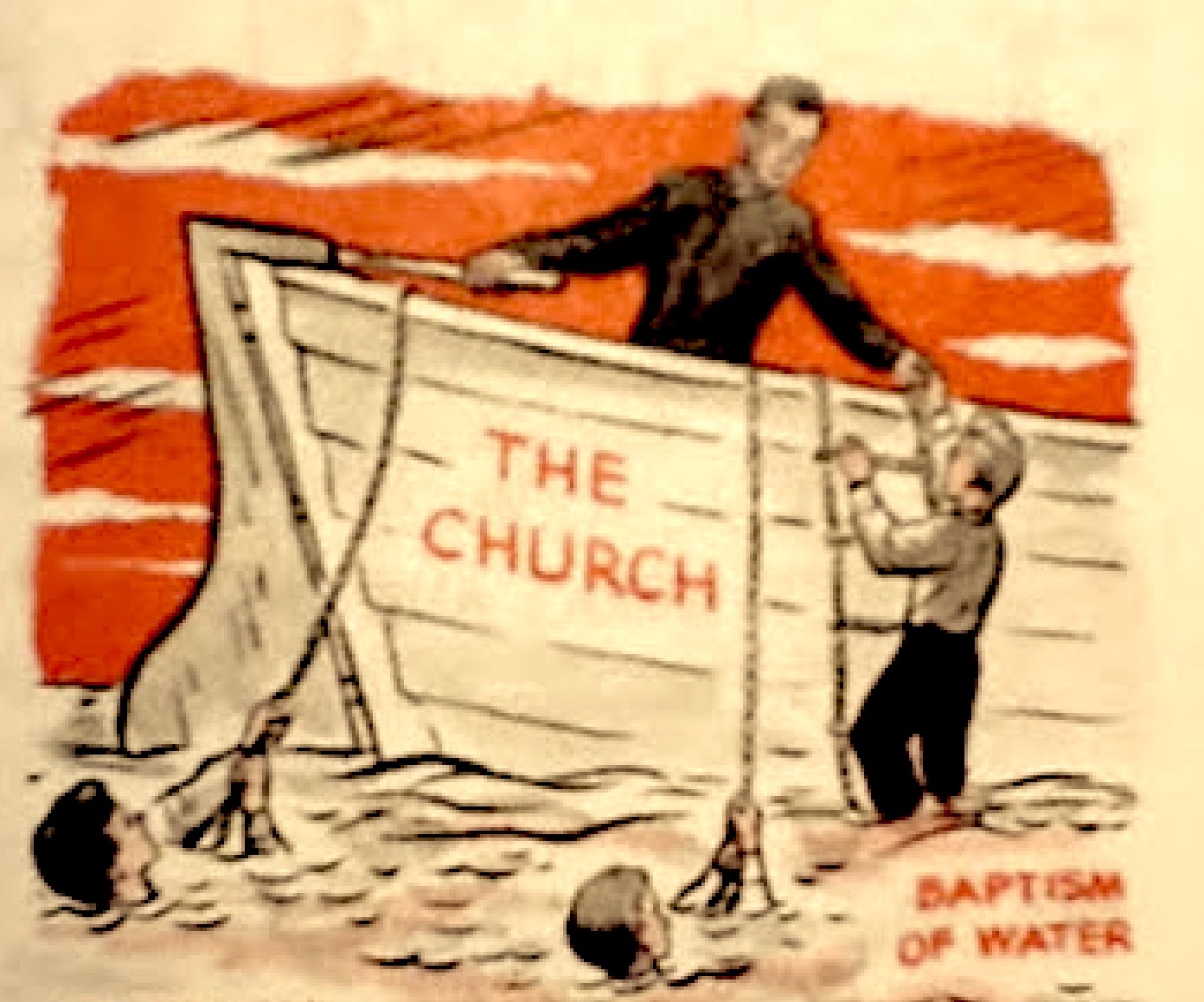 Here we see an illustration taken from an old Baltimore Catechism that best demonstrates the predicament in which those involved in non-Catholic sects find themselves today. Only valid water Baptism, public abjuration of all errors and three years of penance qualifies us to be actual members of the Mystical Body and securely aboard the Barque of St. Peter. One cannot return to something they never belonged to.in the first place. There is a notable difference in desiring “unconsciously,” as Pope Pius XII states above, to be a member when not baptized or separated from the Church by schism (those shown with leads but not a ladder to the boat), and to explicitly desire to rejoin a society to which one once belonged, according to the very laws laid down by that same society which must be obeyed to fulfill conditions of membership. Those who are members by desire alone, although not actually IN the Mystical Body, can still be saved, but they are not able to participate in the many graces available to those who are actual members of Christ’s Mystical Body.
This is why Pope Pius XII says above that they are thereby deprived of many special gifts. Pope Pius IX taught that no one is able to pretend to know who is or is not saved by and implicit desire for Baptism or Church membership because this is something God alone can determine. “Only those who have been baptized, who profess the true faith, who have not miserably separated themselves from the fabric of the Body and who have not, by reason of very serious crimes, been expelled by legitimate authority, ARE ACTUALLY TO BE COUNTED AS MEMBERS OF THE CHURCH,” (Pope Pius XII, Mystici Corporis). And in The American Ecclesiastical Review, “Questions and Answers,” January 1958, Rev. Francis J. Connell wrote: “Those who are not actual members of the Church can be sanctified and saved if they are invincibly ignorant of their obligation to join the Church and are in the state of sanctifying grace, since such persons have an implicit desire of membership in the Church. But they are not to be reckoned as members of the Church — not even invisible members.” (Rev. Connell was Msgr. Fenton’s teacher.) Msgr. J. C. Fenton: “That one may obtain eternal salvation, it is not always required that he be incorporated into the Church ACTUALLY AS A MEMBER, but it is necessary that at least he be united to her by desire and longing,” (“Pope Pius XII and the Theological Treatise on the Church,” The American Ecclesiastical Review, December 1958).
This teaching then, later elaborated upon at great length in the condemnation of Fr. Leonard Feeney, Suprema haec sacra, was never intended to be the prelude to ecumenism as some calling themselves Traditionalists have falsely stated. Rather it upholds a centuries-old teaching of the Church and gives no blank check whatsoever to those who wish to be saved in this manner. In fact this condemnation lays out specifically the conditions that must be fulfilled to attain to salvation in such circumstances, and they cannot be and are not applicable to those who simply profess to be Christian and do not exhibit a heroic act of love for Our Lord and whatever may constitute His true Church. Outside the Church, Christ’s Mystical Body, there can be no salvation except in certain instances where exceptions are made by the Church Herself. And God alone can be the judge of when those instances occur.
Conclusion
We can only reiterate here the prayer Pope Pius XII quoted in ending his encyclical. Christ did not hesitate to be betrayed for us. And while we are obligated to protest the betrayal of His Church lest others be deceived, we must never see ourselves as anything but resigned and willing victims in this betrayal by our own. As loyal members of His Mystical Body, we must count ourselves as privileged to undergo whatever is wanting to His Passion and gladly endure the rejection and opprobrium, reserved for those who refuse to dishonor the Sacrifice and the Sacraments He left us as proof of His love.
What in the World…
An emergency case is scheduled to be heard before the U.S. Supreme Court on Jan. 6 that could entirely change the course of American history, although SCOTUS is not likely to rule in favor of the Plaintiff, Raland Brunson, one of four brothers supporting the suit. Brunson is asking the Justices to overturn the 2020 elections and declare that representatives who voted to confirm the election are ineligible to hold office, now or in the future. Brunson v. Alma S. Adams: et al, sues those members of Congress who voted down a proposed 10-day audit of the 2020 elections Jan. 6, 2021. Brunson contends that by doing so, they violated their collective oaths of office to “preserve, protect and defend the Constitution from enemies both foreign and domestic” and thereby committed treason. Should the Supreme Court rule that Congress was at fault, all the members of Congress involved, as well as a sitting president and vice-president, could presumably be removed from office and forbidden to hold any U.S. government position again. Former vice-president Michael Pence also would be barred from holding office again. Some 388 members of Congress could be affected.
Consequentially, it is alleged that the Supreme Court then could facilitate the swearing-in of the rightful president and vice president. At least this is what Brunson is requesting. Brunson alleges that members of Congress, despite being “properly warned” that a credible threat had been advanced by enemies of the Constitution, violated their oaths and, essentially, “unilaterally violated the rights of every citizen of the U.S.A. and perhaps the rights of every person living, and all courts of law.” He claims that failure to investigate evidence already collected proving the 2020 election was highly irregular constitutes “fraud on a scale like never before seen, adding, “Fraud vitiates whatever it touches.” This isn’t about a rigged election – it is about failure to investigate the possibility of election fraud. As we have seen in the examination of Canons 103-104, fraud changes everything. Not to consider the possibility that it has been perpetrated — to fail to investigate credible proofs that it exists — is an act of treason, whether it involves Church or state. Remember that the subversion of the Church began with an act of election fraud. Declassified documents show that psychological warfare was waged against the Church for over a decade before the elections of John 23 and Paul 6 were engineered by CIA operatives. Same game, different day. Sadly no one is the wiser.
If the Supreme Court decides in favor of this case, it could save what is left of the republic, if that is possible. The odds are not good, but stranger things have happened. Deciding against Brunson would effectively close the doors on admitting any possibility that election fraud actually exists or the election system in this country is in dire need of reform. And it would effectively deny the fact that the United States has successfully been subverted from within for decades, just as the Communists themselves predicted long ago it would be. SCOTUS can either play the role of hero or villain — their choice. But God is in control and whatever comes of this fits somehow into His plan for our redemption.
by T. Stanfill Benns | Dec 24, 2022 | New Blog

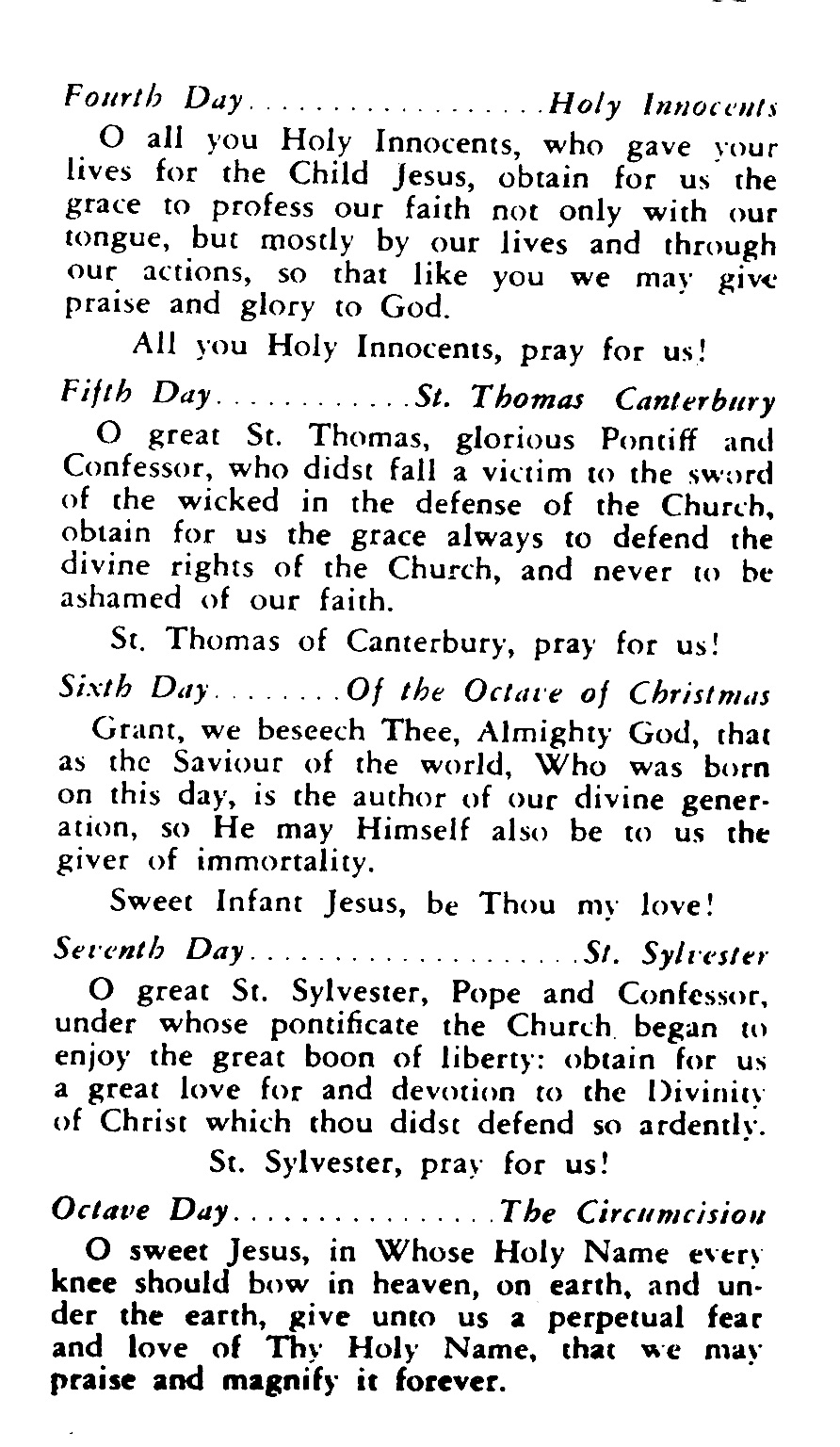
This is my ChristMass gift to the Infant Jesus and all of you who love Him. May He grant you countless graces and blessings in the coming New Year!



by T. Stanfill Benns | Dec 18, 2022 | New Blog
+Fourth Sunday in Advent+
In Part I, Revs. Mersch and Gruden define the functions of Christ’s Mystical Body among its members. For ease of reference, a summary of these points is presented below.
“First [Christ’s Mystical Body] will be an empirical, concrete, visible, tangible thing… for it is a human institution, a human society. And it is a society quite visibly and tangibly. Its sociology and Canon Law can be written down, it has its clearly defined members and its definite seat. Secondly the Church will be an invisible reality; a life of thought, love and grace that is infused into souls… THE EXPRESSION ‘MYSTICAL BODY’ DESIGNATES THE MYSTERIOUS AND INTERIOR ELEMENT OF THE CHURCH… it does not designate the external aspect of body except so far as it is the outward manifestation of the interior soul which consists in such a mystery… It is a union… primarily internal and supernatural. It is the supernatural union of the sanctified soul with Christ and with all other sanctified souls in Christ… The bonds that unite Christians to Christ and to one another are organic, physical, sacramental, although supernatural and invisible…
“The communion of saints is an invisible society, a “Church” or “ecclesia” in the broad sense, a moral body. Its invisible, moral, or juridical head is the glorified or exalted Christ.
Besides the many or multiple external visible elements, clergy and laity, hierarchical structure, sacraments, sacramentals, etc., the Church must possess an inner element which, intimately united to the visible elements, must be the formal cause of the unity and identity of the organism, formal cause, too, of its own peculiar life which is supernatural and divine… The invisible elements which, figuratively speaking, we call the soul of the Church, form together with the visible elements, its body, one undivided and indivisible whole, informed and vivified by the Spirit of Christ, the Holy Spirit. This living visible organism, of which the Holy Spirit is the soul in the real but mystical sense, is the Mystical Body of Christ, or the mystical Christ…” (end of Gruden/Mersch quotes).
What this tells us is that independent of the juridical, external aspect of the Church, it is Her inner life and the union and cooperation of Her members that is the formal cause of her unity and identity, NOT Her external attributes. This means that the Church, which IS Christ’s Mystical Body, survives in all Her essentials even without Her visible head on earth, the Pope, or the hierarchy, (although of course at all other times these elements are strictly required in the Church unless God wills otherwise, which He apparently does in these times). That She can and does so survive is Christ’s promise to us that the Church, HIS BODY, as defined by Pope Pius XII, will last into the consummation and that He will be with us until the earth is destroyed by fire and all the faithful are gathered up to Him. That the functionality of this super-naturalized state of the Church was reserved until the end times is clear from Holy Scripture, which tells us that the papacy, the Mass and hence the Sacraments will be taken way. Further proofs of this are provided below as well as a commentary on the role of the laity as apostles today.
The Formation of a Lay Apostle, Francis N. Wendell, O.P., 1954
I am the Church
“Lay people generally think of themselves as belonging to the Church. When they begin to get the concept that they are the Church they begin to be lay apostles. The doctrine of the Mystical Body of Christ is at the very heart of the lay apostolate. Christ is still living in the world in another body, it is true, a mystical, a mysterious body. The Catholic Church is not just an organization but an organism, a living body, a body with life that is Divine. ‘I am the vine, you are the branches.’ . . . ‘I came that you might have life, and have it more abundantly.’ ‘I am . . . the Life.’ The impact of these ideas is tremendous. Christ lives in me, a layman, an ordinary worker, or as a man said to me just recently, ‘Just imagine, someone asked my advice and I am only a taxicab driver.’ There is revolution here, revolution in the sense that one’s life begins to be important. Christ living in me, this is revolution. ‘We need not fear the revolution, we are the revolution.’
“With all this there come two clear, distinct revelations. First, I am related to Christ, He is the Head of the Body and I am a member of His Body, the Church. He is my friend, I walk and talk with Him as Adam walked and talked with God in the cool and shade of the evening, as a friend. The doctrine of grace. Friendship with God — playing, as someone has said, in a league that is over one’s head. The second realization for the layman is almost as important. I am related to all the other members of the body… either actually or potentially, the good and the bad. We are all one in Christ Jesus our Head. I must love them all. The good I must love for their goodness which they get from Christ. The bad I must love for their need. The Jew I must love because God made him and he might someday enjoy membership in the Body. There is no color in the Mystical Body, the yellow, the red, the black and the white are all one in Christ.
“The discovery of this doctrine opens up a tremendous field for the lay apostle. He begins to see — I am responsible for others because I am related to them. I have the greatest gift in the world, actual membership in Christ’s Body, but that Body must grow and I must help it to grow. Therein lies my apostolate… I must exercise my apostolate as a layman, doing all the things that I am required to do as a layman. Yet it is not my apostolate but His…
“’What is needed,” said His Holiness Pope Pius XII in 1949, in speaking of the Young Christian Workers, ‘is the active presence in factories and work places, of pioneers who are fully conscious of their double vocation — as Christians and workers — and who are bent on assuming their responsibilities to the full, knowing neither peace nor rest until they have transformed the environment of their lives to the demands of the Gospel. The Church, by this positive, constructive work, will be able to extend her life-giving action to the millions of souls for whom she has a maternal and ardent solicitude.’ The lay person must be apprised of the fact that it is in the very accomplishing of the ordinary things of life that he becomes holy. The traveling to work, the making of the baby’s formula, the rendering of an honest day’s work, all these are the warp and woof out of which lay sanctity is woven.
“Mary [is the] Mediatrix of All Graces… All graces come into the world through her as through a channel. He ties this up with his knowledge, also growing, of the Mystical Body and he suddenly realizes that she also plays a part in that Body. Christ is the Head, we the members, and she, as one of the Fathers of the Church pointed out, is the neck uniting the Head to the members.”
The Path of Mary, Mother Mary Potter, 1878
“In a remarkable French work, a beautiful explanation of [the Mystical Body] may be found…: “According to the explanation of some of the Fathers, the first man that is born in Mary is the man-God Jesus Christ; the second is a mere man, the child of God and Mary by adoption. If Jesus Christ, the Head of men, is born in her, the predestinate who are the members of that head ought also to be born in her by a necessary consequence. One and the same mother does not bring forth into the world the head without the members nor the members without the head, for this would be a monster of nature. So in like manner, in the order of grace, the head and the members are born of one and the same mother; and if a member of the Mystical Body of Jesus Christ, that is to say one of the predestinate, was born of any other mother than Mary, who has produced the Head, he would be simply a monster in the order of grace. Saint Augustine affirms that all the predestinate, in order to be conformed to the image of the son of God, are, in the world, hidden in the womb of the most holy Virgin where they are guarded, nourished, brought up and made to grow by that great Mother until she has brought them forth to glory after death. God the Son wishes to form Himself, and, so to speak, to Incarnate Himself every day by His dear Mother in His members.”
The Theology of the Mystical Body by Emile Mersch S.J., 1951
“We do not say that explicit submission to the external teaching authority is the only condition that makes an act of supernatural faith possible. If this were so, the souls of good will that are outside the Catholic Church could have no faith. Nor do we say that attachment to the bishops and the Pope regarded as persons who exercise an external office is enough to establish us formally on the immovable rock of truth. What we are trying to bring out is that this point of view is not adequate. The Church is Christ and Christ is God. When the Church as such speaks, we need not pursue our investigations further. All we have to do is believe, and the one we believe is God. Since the time of the Incarnation, God is not other than Christ and since Pentecost Christ is not other than the Church; on the one side hypostatic unity, on the other side mystic unity. But in both cases the unity is real… We should think with Christ, in Him and in dependence on Him. He stands before us very near, real and attentive in the magisterium of the Church. He is there to deliver to us the data of our undertaking to sustain our effort to correct our wanderings if the need should arise and to approve the result. What more could we desire? If we approach the work with a craven or irresolute spirit, the fault is none of His, for we ought to perform the task in Him.
“The part played by man in the vitality of Christian teaching is very great and we do well to assure ourselves on that point. To appreciate the fact better, have we noticed how important it was in the very founding of the Church? Jesus came to establish the Catholic Church on earth, but the ones who actually established it were men. Christ himself hardly preached to anyone except the lost sheep of the House of Israel and during His mortal life He sent his disciples nowhere except to the villages of Palestine, directing them not to travel the roads of Samaria or to cross over to the pagan districts. He himself apparently wished to do no more than train the apostles and to make ready to see that later, under His hidden action and His bidding, would [the seed be sown] to spread the gospel over all the earth. In point of fact, truly Catholic preaching, the diffusion of the true doctrine, is the work of the Church, not of Christ. Or better it is the work of Christ in the Church. The body of Christ has built itself up; as Saint Paul says it has achieved its own construction and growth. But it was able to do so because it was attached to the Head and possesses the real, though invisible, power of the Head.
“A Christian is a member of the Mystical Body not by his own effort but through Christ. On the other hand the act of knowing, which is a function of being, is construed as the being that knows. Consequently, although the Christian truly knows, he knows not of himself but through Christ. But Christ who lives in souls by His anointing and His living truth does not express Himself outwardly and authentically except in the teaching authority of the Church. Therefore this anointing, this living truth, in a word this Christian life, appeals to the teaching authority when it appeals to Christ and its voice is lifted up in the councils: ‘Peter, teach us; you have the words of eternal life and you have them for me’” (end of Mersch quotes).
The Mystical Christ, Rev. John C. Gruden, S.T.L., 1938
“The supreme visible pastor of the Church is the successor of St. Peter, the bishop of Rome. He is head of the episcopal body just as St. Peter was head of the apostolic college, and, being head of the hierarchy of jurisdiction, he is also juridic head of the Church. This honor and dignity belongs to him because he is bishop of the see which St. Peter had chosen as his own and occupied at the time of his death.
“The bishop of Rome is vicar of Christ and as such possesses primacy of jurisdiction, that is, he has supreme and immediate jurisdiction over the universal Church. It is his right and privilege to feed and to shepherd, to teach and to rule, Christ’s whole flock. This position of the pope as visible, juridic head of the Church is in no way derogatory to the honor of Christ as invisible head of his visible Mystical Body. Christ is head of the Church in the full and proper sense (sensu pleno et proprio) because he is head as both priest and pastor. The pope, on the other hand, is head of the Church, the Mystical Body, not because he is visible high priest but because he is supreme visible shepherd. The bishop of Rome possesses no more of Christ’s priesthood than other validly consecrated bishops of the Christian world. In fact, the pope in his capacity as supreme visible pastor need not be a priest at all.
“The immediate or proximate purpose of the priesthood and the pastorate is the sanctification of the members of the Mystical Body. The ultimate or remote purpose is the same as that of the mystical organism of which they are constituent elements and of all creation, namely, to give honor and glory to God by leading men from a life of grace here below into a life of glory in the kingdom of God in the world to come. When this purpose will have been realized, when this present order will have passed away and the destinies of men will have been forever sealed for weal or for woe, THE PRIESTHOOD AND THE PASTORATE OF THE CHURCH WILL ALSO PASS. THE MYSTICAL BODY OF CHRIST IS NOT AN ETERNAL FOUNDATION; IT WILL LAST ONLY UNTIL THE WORK WHICH IT HAS BEEN FASHIONED TO PERFORM HAS BEEN ACCOMPLISHED. When the created grace of Christ the head, measured out by the hand of the heavenly Father, will, as it were, have been exhausted, when the pleroma of Christ of which the apostle speaks will have been achieved, THEN THE KINGDOM OF GOD ON EARTH WILL CEASE TO EXIST. Then will the kingdom of God on earth — the mystical, visible, body of Christ, the Church — with its multiple functions and its variously articulated offices cede to a new order, the kingdom of God in the world to come.
“Multiplicity will give way to simplicity. The various visible sacramental accommodations by which men were brought into the pure vision of an all-holy God, will disappear. Of sacraments and of the Eucharistic sacrifice there will no longer be any need, for grace will have been brought to full, verdant fruition in the light of glory. For a complicated hierarchy of jurisdiction with its twofold authority of magisterium and imperium there will likewise be no more need, for men will see the Light, the heavenly magnetism of which will prevent them from ever wandering from its thrall; they will see God ‘even as He is.’ ‘Then shall the just,’ says our Lord, ‘shine forth as the sun in the kingdom of their Father.’
“The kingdom of God will enter upon its final phase on the day of judgment when in the sight of all men the good will be separated from the bad, the just from the wicked, as men separate wheat from darnel, sheep from goats. The final judgment is certain although no one knows the day and the hour, ‘but the Father alone’; it will come at an unexpected time as a thief in the night. The day of the judgment will see the inauguration of the new kingdom of God in the world to come. The New Jerusalem will then have sprung into being. The old Jerusalem, the city built of living stones, the Church, the mystical Christ, will have done perfectly the work appointed; redemption will have been fully accomplished even to the resurrection of the flesh, and God will be all in all” (end of Gruden quotes).
And Henry Cardinal Manning says much the same. He writes in his Temporal Power of the Vicar of Jesus Christ, written in the late 1800s: “Yet the event may come to pass that as our divine Lord after His three years of public ministry were ended, delivered Himself of His own free will into the hands of men and thereby permitted them to do that which was before impossible; so, in His inscrutable wisdom, He may deliver over His Vicar upon earth as He delivered Himself, and that the providential support of the temporal power of the Holy See may be withdrawn when its work is done. What that work is we know from Holy Scripture: it is the support and maintenance of the present Christian order of the world during such time as the grace of God is gathering out His people until the whole number of those whom He have chosen to the eternal life is filled up. It may be that when that is done and when the times of Antichrist are come that He will give over His Vicar upon earth and his Mystical Body at large” (for a certain time).
St. Thomas Aquinas tells us: “The state of the New Law is intermediate between the state of the Old Law… and the state of glory, in which all truth will be fully and perfectly manifested. Then there will be no more sacraments; but now, inasmuch as we see only through a glass darkly, we have to enter into spiritual things through sensible signs” (Summa Theologica, Part 3, Q. 61, Art. 4; Necessity of the Sacraments after Christ’s Coming). We must learn to love and adore God in these times without the sacred means He provided us for nearly two millennia, the Mass and the Sacraments. It is not a deprivation and should never be interpreted as such, although we believe the cessation of the continual magisterium and the continual Sacrifice was in part a punishment for the sins of those who neglected to take advantage of the rich treasury of Eucharistic graces and properly thank God for the ability to do so.
St. Thomas enlightens us further on this subject by explaining that there are five reasons why God sends us chastisements: “To try and to test, to preserve humility, to purify, to give glory to God and to punish the wicked,” (H. B. Kramer’s The Book of Destiny, pg. 109). If we have been wicked, (and through the sin of communicatio in sacris, this can be said to be true of all of us), yes, it is a punishment. But it was also a trial and a test, to see if we would repent and remain faithful to Our Lord. And it was sent to help us arrive at humility by admitting our mistakes and sins; to purify us and give glory to God by accepting and promoting the truth. Only in Heaven will the truth be fully known, but we must use the gifts and graces God has provided us to determine it as far as we are able on this earth, according to the teachings of His Vicars.
Either we are being offered a foretaste of life in our Eternal Home, and the Church will eventually be restored, (although the prospects of this appear dim); or we are being prepared for the end of the world proper and the commencement of the life to come in a very intimate way. The latter could very well be true since St. Thomas Aquinas also says: “Although men be terrified by the signs appearing about the judgment day, yet before those signs begin to appear the wicked will think themselves to be in peace and security after the death of Antichrist and before the coming of Christ, seeing that the world is not at once destroyed as they thought hitherto” (Summa Theologica, Supplement, 73: 1). If it is true that Paul 6 was the Antichrist, the Man of Sin, and we cannot see how it could be otherwise, then it is very likely that we live in this time-period St. Thomas describes.
Conclusion
So in summary, if the assessment of Rev. Gruden is taken seriously, at any time Christ can decide that the time allotted to the Church He established on earth has come to an end and its work on earth is completed. And that time could only naturally coincide with the coming of Antichrist, because this is the only time in Holy Scripture when the saints are said to be utterly crushed and overcome. In Matt. 24:21, Christ warns us these times would be like no other in history. Despite what Traditionalists say, there can be no comparison of this interregnum to the Western Schism, because a true pope reigned all along in those times, although his identity was unknown to the faithful. Only by ignoring Christ’s warning, the prophecies found in Holy Scripture and the teachings of the Church can Catholics dismiss the clear signs that we are living in the end times. That they cannot dismiss their prejudices, fueled by the deliberate diffusion of disinformation and overreliance on private revelations, fulfills the predictions involving the operation of error.
One Vatican Council teaching often cited as proof this could not be the case is that regarding the Church’s perpetuity. The Vatican Council in 1870 taught that “…Blessed Peter has (not “will have”) perpetual successors in the primacy over the universal Church — Si quis ergo dixerit, non esse ex ipsius Christi Domini institutione seu iure divino, ut beatus Petrus in primatu super universain Ecclesiam habeat perpetuos successores; aut Romanum Pontificem non esse beati Petri hi eodem primatu successorem; anathema sit.” (DZ 1825). Habeat = he has (present tense — subjunctive because it follows dixerit according to sequence of tenses). Future tense (he will have) = habebit. He must have = debeat habere. (This was first pointed out by Hutton Gibson in his The War is Now.) Gibson observed: “The Church can oblige us only to Scriptural prophecy (such as St. Paul’s revolt).” The Church WILL last until the very end; precisely HOW She will last has never been specifically defined by the Church.
And Henry Cardinal Manning’s translation of the Vatican Council documents found in the appendix to his work The Vatican Council Definitions is even less clear: “If then, any should deny that it is by the institution of Christ the Lord, or by divine right, that Blessed Peter should have a perpetual line of successors in the Primacy over the Universal Church, or that the Roman Pontiff is the successor of Blessed Peter in this primacy; let him be anathema.” Should, as found in Webster’s 7th Collegiate Dictionary, is defined as “owed or obliged to; used in auxiliary function to express a condition, “if he shall” (1), or what is probable or expected (4). Again, why is this not clearly expressed as “will have”? Msgr. Joseph C. Fenton also wrote: “This Church is meant… to endure until the end of the world” (Laying the Foundations, A Handbook of Catholic Apologetics and Fundamental Theology, 1942). It will endure as a spiritual entity, but in God’s way, not ours.
This has to do with the dogma regarding free will. How could this dogma ever be upheld if it was once granted we could always be assured that a Church left dependent by Our Lord on the good will of men for its continuance would never betray Her? Was not He Himself betrayed? And even aside from this, how could the Scriptures regarding the cessation of the Sacrifice, the taking away of he who withholdeth and the overcoming of the saints during Antichrist’s reign ever be fulfilled unless the Church was “taken way,” as St. Victorinus says? Prejudices regarding the fulfillment of these prophecies is what keeps Catholics from realizing their fulfillment, as Rev. Goffine explains below.
Rev. Leonard Goffine, Quinquagesima Sunday
(Gospel commentary on Luke 18: 31-43)
Why did Our Saviour so often predict His sufferings to His apostles?
- To show that He already knew of them, thereby indicating His omniscience; and that,
- He desired to suffer.
- In order that His disciples should not be scandalized at His humiliation, nor think evil of Him as if He had deceived them, but, by remembering His words, be rather confirmed in their belief in Him as the Son of God and Redeemer of the world.
Did not the apostles understand anything of what He thus predicted in regard to His sufferings?
They may have known that He was to suffer, for St. Peter undertook to dissuade Him from it (Matt. xvi. 22), but they could not reconcile these predictions with their expectation of a future glorious kingdom. Nor would we be able to cast off our prejudices, and understand the truths of the faith, however plainly taught, were we not enlightened by the Holy Ghost.”
All this is also explained in Matt. 26 and John 18-19, regarding Christ’s arrest, Passion and death. Scripture must be fulfilled, and all that is now being done on this earth must fulfill it — this is the passion of Christ’s Mystical Body. And yet the anticipation of a glorious rebirth of the Church has blinded many to the reality of Antichrist’s reign, and all the signs that the Second Coming is undeniably near. In celebrating Christ’s birth this 2,022nd year of our Lord, let us not forget that He must first be born anew in our hearts in order that, joined to His Mystical Body, we may be gathered up, (Matthew 24:26-31; Luke 21:25-28): “But in those days, after that tribulation, the sun shall be darkened, and the moon shall not give her light. And the stars of heaven shall be falling down, and the powers that are in heaven, shall be moved. And then shall they see the Son of Man coming in the clouds, with great power and glory. And then shall he send his angels and shall gather together his elect from the four winds, from the uttermost part of the earth to the uttermost part of heaven.”
by T. Stanfill Benns | Dec 1, 2022 | New Blog
Prayer Intention for the Month of December:
“For you are bought with a great price… you are a purchased people… Offer up spiritual sacrifices, acceptable to God by Jesus Christ.”
Remember
First Friday and Saturday this week
+St. Eligius+
As we enter the season of Advent, we should meditate on the fact that nearly 2,000 years ago God the Father sent us the inestimable gift of His only-begotten Son on ChristMass day — Truth and love Himself. Born in a crude stable in Bethlehem illuminated by a brilliant star, this light of the world was destined to dispel the darkness of paganism, a darkness that is now engulfing us once again. Our Lord and His Blessed Mother warned us many times of this impending disaster, through various saints and holy people. Holy Scripture itself predicts a time like no other when Truth will be cast to the ground (Dan. 8:12). Those captured in the nets of the operation of error today have forsaken that precious first gift of ChristMass — Truth — to believe lies, lies that others tell them and which they tell themselves. What may prevent some of them from admitting they have erred is the great fear that they have been excommunicated for involvement in a non-Catholic sect and, in the case of Traditionalists, and are guilty of innumerable sacrileges for attending masses and receiving the sacraments from men not certainly ordained.
While no one can deny that technically we are all material heretics for our participation in these sects, those given the grace to see their errors can at least depart from them, denounce them, and spend the rest of their lives doing penance and amending any evil done. God tells us many times in both the Old and New Testaments that if we shall only return to Him and convert, He will forgive us and return to us. Although grave sacrileges may have been committed in some cases, most of those availing themselves of Thuc and Lefebvre pseudo-clergy were victims of fraud according to Can. 104 and if they leave these sects, this would work to their favor according to Canon Law. The specifics of this topic are discussed at length here: https://www.betrayedcatholics.com/begin-the-probationary-period/Below we will see why no one should believe they are ever beyond God’s forgiveness nor ever despair of His mercy. For this is the very age when the Divine mercy has been extended to the least of God’s creatures – those of us who have been deceived by these destructive sects and now keep the faith at home.
Why God has chosen us despite our many sins
In his work The Way of Divine Love, by H. Monier Vinard, S.J., chronicling the messages received from Our Lord by the victim soul Sr. Josefa Menendez, we learn something of why God may have chosen us to live in these times. Many have characterized the emphasis on the Divine mercy by certain theologians, beginning in the 19th century, as a manifestation of liberalism. Yet we believe it must now be seen through new eyes. No one could have known then that the juridic Church would be taken from us, that we would be forced to live without Christ’s Vicar all these many years. Not even the Catholics of France or Japan left without clergy in the 17th and 18th centuries experienced such a devastating loss, for at least they could be assured a true pope yet existed despite their sufferings. These teachings on Divine mercy and love were the legacy Our Lord and His Blessed Mother left us as a consolation in these times. And we are the ones the servants in the parable of the wedding feast were sent out to gather up on the highways, both good and bad, for the others were not worthy (Matt. 22).
In the introduction to Fr. Monier’s book on Sr. Josefa, we read words that echo what was just written in our two previous blogs on higher education. “His ways are not our ways nor his thoughts our thoughts. And that there may be no doubt that the communications come from Him and no other, He chooses weak instruments — humanly speaking, unfitted for the task in view — so His strength shines forth in their infirmity. He did not choose the learned and the great in the world’s eyes to found His Church; St. Paul expressly tells us otherwise. The rapid spread of Christianity could have been attributed to their talents and prestige, but He chose the poor and the ignorant and of these he made vessels of election. And that the greatness of their mission might not dazzle them and lead to vainglory, He again and again reminded them of their nothingness, their innate misery and their weakness. His gifts are only secure when bestowed on the truly humble of heart.
“His Providence has always worked in this way; His glory is manifest in man’s nothingness. ‘If I had been able to find a creature more miserable than you,’ he said to Saint Margaret Mary Alacoque, ‘I should have chosen her.’ And Sr. Josefa repeatedly heard the same declaration: ‘If I could have found a more wretched creature, I should have chosen her for My special love and through her reveal the longings of My heart. But I have not found one and so I have chosen you.’ Soon after we hear Him say: ‘I have selected you as one utterly useless and destitute that none may attribute to any but Myself what I say, ask and do’ … Our Lord’s aim was never to set her as an example to be imitated. He did not speak so much to her in order to draw down upon her the admiring gaze of the world. She was a voice; nothing more. She existed for the message, the message should not exist for her. Christ our Lord willed that she should be a mere nothing. He never drew her out of her littleness. In fact he continually and purposely laid stress on her nothingness and that even when He showed himself with the greatest radiance.
“To be a victim necessarily implies immolation and as a rule atonement for another. Although strictly speaking one can offer oneself as a victim to give God joy and glory by voluntary sacrifice, yet for the most part God lead souls by that path only when He intends them to act as mediators. They have to suffer and expiate for those for whom their immolation will be profitable either by drawing down graces or forgiveness on them, or by acting as a cloak to cover their sins in the face of divine justice. It stands to reason that no one will, on his own initiative, take such a role on himself. Divine consent is required before a soul dares to intervene between God and his creature. There would be no value in such an offering if God refused to hear the prayer. He himself chooses these persons and because they are free, He asks them for their voluntary cooperation.
“Those who accept put themselves at His mercy and He then makes use of them as by sovereign right. Assimilated and transformed into Christ, the victim soul expresses the sentiments of Christ Jesus to God the Father and to Christ himself. Her attitude is one of humiliation, penance and expiation, sentiments which ought to animate the souls she represents. And because of this identification with Christ, the victim soul shares in his dolorous Passion and undergoes, to a greater or lesser degree and in various but generally superhuman ways, the torments and agonies that were His. The Passion of Christ being our sole salvation, if we are to be purified and saved, we must, of necessity, come into contact with the blood shed by the Lamb. The great cry of the dying Christ is a pressing invitation to the whole human race to hasten to the Saviour’s fountains from which all graces flow.
“This contact with Christ’s blood is immediately secured by souls that answer His appeal. Others, and alas there are many, voluntarily keep aloof. It is these things that Christ will seek to reach through other souls whom He makes use of as a channel of His mercies. They are the most fruitful of all the branches of the mystic vine loaded with the sap flowing from Christ Himself and completely won with Him, by their solidarity with the sinner they stand liable for his sins; so being one with Him and one with Christ in them and by them, grace is communicated. They are victim souls.
“How intimate must be their identification with the Crucified if they are to carry out their part of the contract fully! Full union with Him is implied whilst He on His part imprints on their souls, hearts and bodies the living image of His sorrowful Passion. All His sufferings are renewed in them: they will be contradicted persecuted, humbled, scourged and crucified and what man fails to inflict that God himself will supply by mysterious pains [and] agonies, which will make of them living crucifixes. They are thus co-redeemers in the full sense of the word. Love for their neighbor urges them on; their mission is different from that of others.
“For whereas God is pleased to allow those other souls of whom He spoke to remain in contemplation of Him, giving glory to His infinite perfections, by their love it is otherwise with victim souls. When they contemplate Him, He unveils the immensity of His love for souls and the grief with which the loss of sinners fills Him. The sight of this breaks their hearts, and their longing to console Christ is not satisfied with mere words of love; it stirs up their zeal. At whatever price they will win souls to Him, and He kindles this zeal still more. It is the love of the Sacred Heart itself communicated to them with which they loved sinners, love which gives them a superhuman endurance well described by Josefa’s own words.” And yet neither Sr. Josefa, nor even St. Margaret Mary Alocoque, were the first heralds of this tender devotion to Jesus’ Sacred Heart.
St. Gertrude the Great
“The secrets of the divine heart of Jesus have been called the treasure which is reserved for latter times. But with regard to his spouse it seems our Divine Saviour could not wait the time decreed by his infinite wisdom for the revelation of his Sacred Heart to the world at large… He made [St. Gertrude] the herald of His grace and abounding devotion which not until four centuries later was given to the world. He once told St. Gertrude: ‘I wish these revelations to be for later ages; the evidence of my love to draw souls to My heart.’ It was further revealed that this Heart is an altar upon which the sacrifices of the faithful, the homage of the elect and the worship of the angels are offered and on which Jesus the Eternal High Priest offers Himself in sacrifice.” Once Saint John the Divine appeared to Saint Gertrude and she asked him if the beating of Jesus’ heart, which so rejoiced her soul, also rejoiced his when he reposed on Jesus breast during the Last Supper. Saint John replied: “Yes, I heard them and my soul was penetrated with their sweetness, even to its very center.” Saint Gertrude then asked: “Why then hast thou spoken so little in thy gospel of the loving secrets of the heart of Jesus?” Saint John replied: “My mission was to write of the eternal word. But the language of the blissful pulsations of the Sacred Heart is reserved for latter times that the time-worn world, grown cold in the love of God, may be warmed up by hearing of such mysteries.”
“Once in answer to an inquiry on the part of St. Gertrude’s the Savior replied: ‘It would be most advantageous for mankind to know and bear constantly in mind that I, the Son of the Virgin Mary, remain ever in the presence of my Heavenly Father to whom I offer Myself continually for their salvation. Whenever through human frailty they sin in their heart, I present My most pure heart to the Eternal Father in atonement. Whenever they offend Him by their evil deeds, I show Him my transpierced hands. Thus in what way soever they sin against Him, the wrath of my Eternal Father is appeased by My merit so that they will obtain a ready pardon if they will only repent of their sins. I therefore desire that my elect, whenever they obtain pardon for their sins, offer Me their gratitude for having given them so easy a means of reconciliation” (St. Gertrude the Great, Herald of Divine Love, Benedictine publication reprinted by TAN Books).
St. Margaret Mary Alacoque
“The art of becoming holy is precisely in being able to reach the ultimate goal of life by travelling the long and bitter path of suffering.” And St. Margaret Mary Alacoque knew great suffering in her life. She suffered from ill health beginning in her childhood, various internal trials and many times she was persecuted by the demons. She also suffered intensely on the Thursdays and Fridays of the week preceding the First Friday devotions she was given by Our Lord. In his very first appearance to her, Christ made it clear that he was not pleased with humanity and how He planned to punish sinners.
“Thus she recounts the first apparition of the Redeemer, who was preparing her for subsequent revelations: “As soon as I went to pray, Jesus presented Himself to me covered with sores, asking me to look at the gash on his sacred Side: a bottomless pit dug by an enormous arrow of love…. This is the abode of all those who love Him…. But since the entrance is small, in order to enter one must become small and strip oneself of everything.” Pointing at His wounds, Jesus spoke these harsh words: “Behold at what state my chosen people have reduced me to, they whom I had destined to appease justice, but instead secretly persecute me! If they do not repent, I will punish them severely. Having preserved my just ones, I will immolate all others to the fury of my wrath.” And this message was given to St. Margaret Mary Alacoque in the 1600s!
St. Gemma Galgani
Our Lord told another victim soul, St. Gemma Galgani, who died in 1903: “What ingratitude and wickedness there is in the world! Sinners continue to live obstinately in their sins. My Father will bear with them no longer. The depraved have no strength to overcome their sins. The afflicted fall into confusion and despair. The fervent become tepid. The ministers of my sanctuary (and here Jesus was silent and only after some minutes continued) … I have entrusted to them the great work of continuing the Redemption … (again Jesus was silent). My Father will tolerate them no longer. He has continually given them light and strength and they instead? These whom I have always held in predilection, whom I have always regarded as the apple of my eye, continually I have received from creatures only ingratitude and every day their indifference increases… I have need of souls who will give Me consolation in the place of the many who give Me sorrow. I am in need of victims, strong victims, in order to appease the just wrath of my father… Speak of My desire to the Holy Father, tell him a great chastisement is threatening and that I have need of victims; that my Heavenly Father is exceedingly wrath… These are my words and the last warning that I shall give” (Gemma of Lucca, Benedict Williamson, 1932).
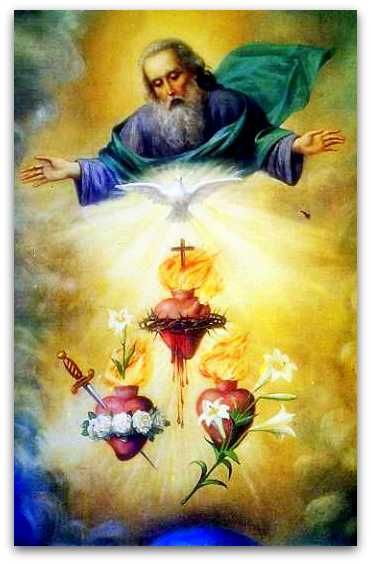
Sr. Josefa Menendez
“Obedience… binds me to all legitimate authority in which I see Thee and through whom Thou speakest to me and makes known to me Thy will. But love must go further still. I must not only obey all authority but listen to the interior voice to which I am sometimes deaf because I find it too costly to follow its behests or transmit what it tells me to transmit… No Lord,
“I will obey for love of Thee and will ask for no reasons, nor will I hesitate or complain, for it is not my will but Thine that must henceforth live in me and all I do must be for Thee…” Jesus told Josefa: “I will make it known that my work rests on nothingness and misery — such is the first link in the chain of love that I have prepared for souls from all eternity. I will use you to show that I love misery, littleness and absolute nothingness. I will reveal to souls the excess of my love and how far I will go in forgiveness and how even their faults will be used by Me with blind indulgence — yes, write — with blind indulgence. I see the very depths of souls. I see how they would please, console and glorify me… What does their helplessness matter? Cannot I supply all these deficiencies? I will show how My heart uses their very weaknesses to give life to many souls that have lost it.” And in this same work by Fr. Vinard, Our Lord also tells Sr. Josefa: “It is not sin that most grievously wounds My heart,” He said, “but what rends and lacerates it is that after sin, men do not take refuge in It once more.”
Eugenio Cardinal Pacelli, before ascending to the papal throne, said of Sr. Josefa’s writings: “I have no doubt whatever that the publication of these pages filled as they are with the great love which His grace inspired in His very humble servant Maria Josefa Menendez will be agreeable to his Sacred Heart. May they efficaciously contribute to develop in many souls a confidence ever more complete and loving and the infinite mercy of this Divine Heart towards poor sinners such as we all are.” In the conclusion to Sr. Josefa’s work, Rev. Fr. Charmot, S.J., writes: “Ah! Who would not love with a measureless love Him who has so loved mankind? How could any religious of the Sacred Heart fail to engrave on her heart the great words written large in letters of fire in the message: devotion to the Sacred Heart, charity, kindness, confidence, abandonment, total gift of self, humility, compassion, reparation, the salvation of souls and the mediation of Mary.” And are not these the very sentiments expressed in the Prayer Society statement on the Home page of this site?
Fr. Demaris
We may be victim souls of a sort by default only, for it would be almost impossible for us to even approach their holiness and we cannot be certain by way of direction from our superiors that Our Lord has even called us. Frustrated by the ingratitude of men, He has withdrawn from us all earthly support in order to force us to turn our gaze on Him alone. Jesus’ aching Heart and outstretched arms beg us to recognize Him as the sole source of truth and love. We are obligated today to choose the path that we have chosen – obligated by His laws and those of the Church, obligated, most importantly, as a matter of faith and fidelity to Him and the teachings of His Vicars. One can scarcely be credited with choosing something out of the ordinary when that very thing is strictly owed and is essential as a condition of membership in the Church.
Yet no one can deny that God has left it to our free will to accept this state of affairs as His holy will and keep our faith at home, if we wish to save our souls and avoid offending Him even more. It is an all or nothing invitation, a true calling. And no one can deny that Pope Pius XII commanded us to assume the role of the hierarchy, within certain limits, in their absence; this too, is a definite calling. Who could ever dictate to us, then, the extent of our generosity or the depth of our longing for union with Christ in His Passion, a Passion we now have been invited to share with Him if we are to be members of His Mystical Body? No one can limit our protestations of love or forbid us to limit our acts of sorrow for sin and reparation for those sins. No one can shame us into cooperating in sin by following pseudo-clerics. Fr. Demaris, in his work They Have Taken Away My Lord, written two centuries ago for those deprived of priests and Sacraments in France, tells us: “
“Abraham obeyed in immolating his son, and in not immolating him, but his obedience was greater when he took the sword in his hand than when he returned it to its scabbard.
We are obedient in going to Communion, but in holding ourselves from the sacrifice we are immolating ourselves. Quenched of the thirst of justice and depriving ourselves of the Blood of the Lamb which alone can slake it, we sacrifice our own life as much as it is in us to do. The sacrifice of Abraham was for an instant, an angel stopped the knife; ours is daily, renewing itself every day, every time that we adore with submission the Hand of God that drives us away from His altars, and this sacrifice is voluntary. It is to be advantageously deprived of the Eucharist, to raise the standard of the Cross for the cause of Christ and the glory of His Church… Let not the love of the Eucharist drive us away from the Cross… I seem to hear the Savior saying to us:
“Do not be afraid to be separated from My table for the confession of My Name: it is a grace I give you, which is very rare. Repair by this humiliating deprivation that glorifies Me, all the Communions which dishonor me… Feel this grace. You can do nothing for Me and I put into your hands a means of doing what I have done for you, and to return to Me with magnificence, that which I have given you that is the greatest. I have given you My Body, and you give it back to Me, since you are separated from it in My service. You give back to the truth what you have received from My love. I could not have given you anything greater. Your gratitude matches by that, the grace I have given you — the greatness of the gift I made to you. Console yourselves if I do not call upon you to pour out your blood like the martyrs, there is Mine to make up for it. Every time that you are prevented from drinking it, I will regard it the same as if you had spilled yours; and Mine is far more precious.”
This ChristMass season, heed the words of these wise saints and holy people. Consecrate yourselves to the Sacred Heart, pining away for the love of sinners, and to Our Lady’s Sorrowful and Immaculate Heart. Make reparation for your sins and those of your loved ones. Abandon your own will and unite it with God’s will for us in these times, — to be deprived of Mass and Sacraments that Scripture might be fulfilled. Pray for the virtues of humility, compassion, charity, kindness and confidence in God. And most importantly, make that gift of self to God to return to Him the love He sent us that ChristMass Day. A wonderful booklet for offering this gift was written by Fr. John Nicholas Grou S.J., who was forced to leave France for England during the French Revolution (and this can be ordered here: https://www.amazon.com/Gift-Self-John-Nicholas-Grou/dp/1930278829). Fr. Grou wrote at approximately the same time that Fr. Demaris wrote his little treatise, the late 1700s, and very likely wrote his work in response to the spiritual woes of those times.
As you kneel at the manger this ChristMass, kneel there with your heart and soul in your hands, and offer it to the Christ Child in union with the living Sacrifice He came to earth to offer for us.
by T. Stanfill Benns | Nov 23, 2022 | New Blog
+St. John of the Cross +
Final wrap up on mis-education
In explaining the dangers of receiving modern liberal arts degrees, those offered as such by the Church in ages past were not a consideration, for they no longer exist. For those receiving such degrees from modern colleges and universities today, the point that should have been taken away from all this is that one cannot rely on such education to reliably inform either oneself or others regarding the practice of the Catholic faith. If not infused with the Catholicity the Church requires and demanded in the days when Catholic universities were in operation, these subjects as taught today are not to be relied upon as capable of guiding one’s conscience in matters of faith or in teaching others about the faith. That is not to say that if one later converts after receiving such an education it becomes absolutely useless and cannot be applied to some extent to matters not concerning the faith. But sorting out thinking errors absorbed in such studies takes time and is often more distressing and confusing than simply starting from scratch by studying more intensely the Church’s, laws, teachings and practices in these matters.
If one’s study of the faith is limited only to the basics this becomes quite difficult, since higher learning is “unlearned” only by replacing it with those things taught by the Church on the same level. This only makes sense. And asking those not sufficiently versed in the many pitfalls that can plague the thinking process to judge how their content is contrary to Catholic teaching is ridiculous, for only the legitimately established hierarchy of the Church could undertake such a task. As Rev. Adolphe Tanquerey explains in his The Spiritual Life, “Philosophical knowledge [is] acquired by the exercise of reasoning; …theological knowledge by applying reason to the data furnished by faith.” If the exercise of reasoning is attenuated in 1,000 imperceptible ways by erroneous thought patterns learned in a secular college or university, (or a Traditionalist seminary minus approved Catholic teachers trained accordingly), how can this possibly be sorted out by lay people expected to know only the basic catechism? And how, then, can it be reliably applied to theological knowledge? One would need to study the works of St. Thomas Aquinas for years, from approved sources, to even be able to begin to undo the damage done.
In Pope Leo XIII’s encyclical, Aeterni Patris, he stresses the great importance of the study of philosophy in the Catholic Church. The Pope writes: “The Church, built upon the promises of its own divine Author, whose charity it imitated, so faithfully followed out His commands that its constant aim and chief wish was this: to teach religion and contend forever against errors. To this end assuredly have tended the incessant labors of individual bishops; to this end also the published laws and decrees of councils, and especially the constant watchfulness of the Roman Pontiffs, to whom, as successors of the blessed Peter in the primacy of the Apostles, belongs the right and office of teaching and confirming their brethren in the faith. Since, then, according to the warning of the apostle, THE MINDS OF CHRIST’S FAITHFUL ARE APT TO BE DECEIVED AND THE INTEGRITY OF THE FAITH TO BE CORRUPTED AMONG MEN BY PHILOSOPHY AND VAIN DECEIT, the supreme pastors of the Church have always thought it their duty to advance, by every means in their power, SCIENCE TRULY SO CALLED, and at the same time to provide with special care that ALL STUDIES SHOULD ACCORD WITH THE CATHOLIC FAITH, ESPECIALLY PHILOSOPHY, ON WHICH A RIGHT INTERPRETATION OF THE OTHER SCIENCES IN GREAT PART DEPENDS.
“It may be well here to speak more fully in the words of one of the wisest of Our predecessors, Sixtus V: ‘By the divine favor of Him who alone gives the spirit of science wisdom, and understanding, and who thou ages, as there may be need, enriches His Church with new blessings and strengthens it with safeguards, there was founded by Our fathers, men of eminent wisdom, the scholastic theology, which two glorious doctors in particular angelic St. Thomas and the seraphic St. Bonaventure, illustrious teachers of this faculty, . . .with surpassing genius, by unwearied diligence, and at the cost of long labors and vigils, set in order and beautified, and when skillfully arranged and clearly explained in a variety of ways, handed down to posterity.
“’And, indeed, the knowledge and use of so salutary a science, which flows from the fertilizing founts of the sacred writings, the sovereign Pontiffs, the holy Fathers and the councils, must always be of the greatest assistance to the Church, whether with the view of really and soundly understanding and interpreting the Scriptures, or more safely and to better purpose reading and explaining the Fathers, or for exposing and refuting the various errors and heresies; and in these late days, when those dangerous times described by the Apostle are already upon us, when the blasphemers, the proud, and the seducers go from bad to worse, erring themselves and causing others to err, there is surely a very great need of confirming the dogmas of Catholic faith and confuting heresies.’“
“Although these words seem to bear reference solely to Scholastic theology, nevertheless they may plainly be accepted as equally true of philosophy and its praises. For, the noble endowments which make the Scholastic theology so formidable to the enemies of truth — to wit, as the same Pontiff adds, “that ready and close coherence of cause and effect, that order and array as of a disciplined army in battle, those clear definitions and distinctions, that strength of argument and those keen discussions, by which light is distinguished from darkness, the true from the false, expose and strip naked, as it were, the falsehoods of heretics wrapped around by a cloud of subterfuges and fallacies.”
So given the clear instructions of Pope Leo XIII above, which should convince any rational Catholic that what was written in our last blog was unquestionably the truth, we need to look in another direction — to examine the possible motives of those insisting that secular credentials in philosophy can be considered legitimate and trustworthy contrary to the teachings of the Roman Pontiffs. Any truly serious student of philosophy should already have read this most important encyclical and firmly and irrevocably accepted it as the Church’s official teaching on this matter. This brings us to another topic that should be better understood in these times when it seems that every tool of the devil is being used to deceive the unwary.
After years of answering questions and accusations from various critics, it is time to apprise readers of the modus operandi of the majority of these strident objectors and the reason they make the rounds as they do. At the bottom of things their motives and arguments are all the same, and come from the same sources, even though they are very careful to make it appear they are unrelated and only pop up at random. To help explain what is really at the root of all these attacks, which issue from a familiar enemy, we have posted an article as a bookmark here exploring their origins. Whenever a new objector appears on the scene, we will simply refer to this bookmark rather than issue a lengthy response. That being said, we hope that by doing this we can avoid further distractions and move on to the many important issues Catholics are struggling with today.
The Catholic origins of Thanksgiving
Several years ago, while still a reporter, I wrote the following article. It has been amended and updated for this blog piece.
“While American school children have always learned the traditional celebration of the first Thanksgiving began with the Pilgrims on this country’s eastern seaboard in 1621, this was only one of several “thanksgivings” in America, and it was not the first.
“Some 55 years earlier, expedition leader Pedro Menéndez de Avilés, a fervent Catholic and founder of St. Augustine, Fla. accompanied by Father Francisco López, his fleet chaplain, along with their crew, celebrated a feast of thanksgiving with Native Americans there after first offering a Mass of thanksgiving for their safe journey. The meal was nothing like we celebrate with today, being ship’s fare rather than the fruits of the Pilgrim’s first harvest. It reportedly consisted of salt pork, garbanzo beans, bread and wine. But the Mass of Thanksgiving was infinitely greater than any simple a meal celebrated by non-Catholics could ever be. It placed a mark on this land for Christ as His own.
“The largest cross in the Western Hemisphere, 208 feet high, now marks the location of this first offering of thanks. Every year on September 8, the feast of Our Lady’s Nativity, Floridians commemorate the landing of Menéndez in 1565 and the Catholic Mass that followed, with dignitaries from around the world gathering in St. Augustine, the oldest city in the U.S., to reenact the event. Other thanksgivings may also have been celebrated by Coronado, as he moved throughout the Southwest, as well as Ponce de Leon and Hernando de Soto. French, Portuguese and Hispanic Catholic contributions to American culture have received little notice in the history books in decades past, even Catholic history books.
“Southwestern historian Dennis Lopez has noted that one of these later Thanksgivings was celebrated in southern Colorado when a Thanksgiving Mass was offered on Aug. 19, 1598 or 23 years before the Pilgrims. ‘It made me want to learn more because I realized that the first Thanksgiving was NOT with the Pilgrims but with the Spanish! The Spanish had been exploring the Americas for years. Without their exploration and the stories going back to Europe, Europe would have probably never gotten involved in the New World.’”
“’None of us can afford to diminish or set aside the history of another group, especially when it affects all of us. Our beginnings in the Americas are not the pilgrims, or the trappers or Jamestown. It is part of the history of Spain. [The Spanish] chronicled the Native Americans, the lands from the eastern seaboard to California. Understanding their history is like filling in several holes in our own European history. It is past time to learn, share and sometimes even agree to disagree but let us do it with tolerance, respect and understanding. So let us share the day, the family stories, the laughter and the smiles. We will all be better for it!’”
I have heard some Traditionalists remark that Thanksgiving really is only a “Protestant” invention and should not be celebrated as a national holiday by Catholics as though it was the equivalent of ChristMass or Easter. But while it may not be the equal of these two greater feasts, it is not something instituted by the Protestants after all, nor should the excellent opportunity to render thanks to so good a God be passed up on this day. Gratitude is a very important virtue and to set aside one day in a year to express it is precious little. We give thanks every day in our after meals prayer. We thank God or should in our daily prayers for every grace, every, benefit, every cross He has sent to us.
On Thanksgiving Day, we should offer a spiritual mass and communion, also our Rosary, for the countless graces and blessings we receive every day from Our Lord and His Blessed Mother; for the many blessings of yet holding dear close family members and fellow Catholics, including the faithfully departed, and for all of God’s many material blessings. Those living in this country forget that in large part, without the explorations of the Spanish and French, this continent might never have been settled as quickly and successfully as it was. God’s hand was upon this country when St. Brendan first glimpsed it and called it the “isle of the blessed.” Columbus landed on her shores, and Our Lady’s Guadalupe title graced the spot where he landed, just as it did the land of Mexico. Our country has been corrupted and co-opted by those who were determined that she never fulfill her Catholic destiny, but God alone will be the One who decides our fate. If possible at all, it would take a disastrous and devastating fall, a bloody rebirth, followed by a brief but poignant victory, but it is difficult to abandon all hope that this country could somehow convert. In our Thanksgiving prayers we must remember to pray fervently for that miraculous conversion.
My heartfelt gratitude for all the contributors and supporters to this site and may you and your families enjoy a peaceful and blessed day of thanks.
What in the World… It’s not about politics
What we have resigned ourselves to as the prevailing political system today in this country would classify everyone in various parties, but for the Catholic this classification is meaningless. The issues at hand are not political, as I told one media colleague emphatically long ago, but moral. They are moral maladies warned against by the popes for decades, even centuries, prior to Pope Pius XII’s death. They are dangers to the Catholic faith as well, since in the case of secret societies, communism and socialism, they involve the worship of false gods and culminate in atheism. There is no need here to go into the abortion issue, same-sex “marriage,” transgenderism or transhumanism, all of which are innately opposed to the natural law and everything ever taught by the Church. The principalities and powers ruling over us may have politicized all these things, but they remain issues of faith and morals long ago condemned by the popes and in Holy Scripture.
Likewise with the creation of a one world order, first advocated by Pres. Woodrow Wilson. In a hauntingly accurate description of what would result from such a system, Pope Benedict XV on July 25, 1920, in an address honoring St. Joseph as universal patron of the Church, warned of the evils inherent in such a plan and the suppression of individual freedoms which would follow if it was implemented:
“The advent of a Universal Republic, which is longed for by all the worst elements of disorder, and confidently expected by them, is an idea which is now ripe for execution. From this republic, based on the principles of absolute equality of men and community of possessions, would be banished all national distinctions, nor in it would the authority of the father over his children, or of the public power over the citizens, or of God over human society, be any longer acknowledged. If these ideas are put into practice, there will inevitably follow a reign of unheard-of terror.” And much of this has already occurred.
A young combat photographer recently returned from some of the bloodiest battles fought in the Pacific theater during World War II wrote much the same thing in the late 1940s. Having just embarked on his writing career about that time, the echoes of recent peace discussions were fresh in his mind. The realization of the horrors of war, never erased throughout his lifetime, were at their most intense, and after an unsuccessful bid for a writing position with The Baltimore Sun he wrote:
“In the event of another war, the people of the world will be faced with one of two decisions: total annihilation or a swift arbitration and consolidation of peoples, governments and cultures worldwide. Not one nation could be omitted from the list, for as long as one nation remained independent and self-governing, there would always be the temptation and high probability of aggression on the part of the major nation. This temptation would have to be eliminated, for so long as one man or one nation has something that another has not, the greed of possession will be uppermost in the mind. Thus civilization and advancement will come to a standstill, and in time, like a timepiece sitting in the weather, the functioning parts of the mechanism will become rusted and will deteriorate into a solid, immovable mass.” — William E. Stanfill, Soliloquy
We have been fighting that war now for decades, a spiritual warfare never recognized as such but one that has taken from us first our beloved Church, and now our country. There will come a time, and it may be sooner than we think, when a line will be drawn in the sand, one we cannot afford to cross. That day will divide all those who now present as Catholic or Christian and unmask them for who they truly are — the wheat will be separated from the chaff. Those who stand firm will be openly persecuted and many will eventually be martyred. The rest will be counted among the ranks of Antichrist and his system. In the coming weeks, we hope to able to present some spiritual consolations and practical helps to prepare us for those times and strengthen our faith for the fight ahead.
by T. Stanfill Benns | Nov 13, 2022 | New Blog
+St. Josaphat+
The last blog touched briefly on the dangers of secular education, dangers most Catholics today, even Traditionalists homeschooling their children, well understand. But what they don’t understand is the deficits they themselves are saddled with if they were educated in public schools or even so-called “Traditionalist” schools, many of which have been racked with controversy, scandal and frequent changes in staff, providing an unstable learning environment for young children. Those educated in secular colleges or universities will have the greatest obstacles to overcome in successfully operating a home school. For unless they do their best to deprogram themselves successfully from the indoctrination they received, much of which is so deeply lodged in the intellect it escapes identification and correction, they will not be able to competently instruct their own children. Understanding the deviant nature of such indoctrination and how to combat it is key to ridding themselves of its effects.
The best expose of public (and private) schools was written in 2001 by John Taylor Gatto, who before his retirement in the 1990s was declared Teacher of the Year by both New York City and New York State. The book is based on his 30 years of teaching experience in the public school system and his many frustrations with uncooperative school administrations who failed to put children first. His book, which is heavily documented and goes into great detail, can be downloaded at https://archive.org/details/TheUndergroundHistoryOfAmericanEducation_758 Some may be familiar with Gatto’s first book Dumbing Us Down, a bestseller ever since it was released in 1992. In this work, Gatto presents the bare outline of his 2001 book, which was the result of 10-years-worth of research. Promotional material for Dumbing Us Down reads:
“John Taylor Gatto has found that independent study, community service, large doses of solitude and 1,000 different apprenticeships with adults of all walks of life are the keys to helping children break the thrall of our conforming society. For the sake of our children in our communities, John Taylor Gatto urges all of us to get schools out of the way and find ways to re-engage children and families in actively controlling our culture, economy and society.” While Gatto, who describes himself as a lapsed Catholic, is perhaps too quick to question some Catholic educational practices and leans towards personalism, an excessive freedom of individual behavior and expression, with emphasis on love of the person as an individual. (Personalism is an error emanating from ecumenism popularized by the leftist Dorothy Day and advocated by John Paul 2.) Such leanings, however, must be understood in the light of its contrary — the total eradication of the personality and the individual talents and excellences of students in public education. In his 2001 work, Gatto is insistent that the moral and faith-based principles of education are indispensable to its success.
Public schools and colleges founded on German military principles
These criticisms aside, Gatto’s work is otherwise brilliant and thought-provoking. Some of the quotes from The Underground History of Education will give the reader an idea of what to expect from his research and observations. The major premise of his work is as follows:
“It took seven years of reading and reflection to finally figure out that mass schooling of the young by force was a creation of the four great coal powers of the 19th century. Nearly 100 years later on April 11,1933, Max Mason, president of the Rockefeller Foundation, announced to insiders that the comprehensive national program was underway to allow in Mason’s words: ‘The control of human behavior…” In 1935 at the University of Chicago’s experimental school where John Dewey had once held sway, Howard C. Hill, head of the social science department, published an inspirational textbook called The Life and Work of the Citizen. The title page clearly shows four cartoon hands symbolizing law, order, science and the trades interlocked to form a near swastika. By 1935, Prussian pattern and Prussian goals had embedded themselves so deeply into the vitals of institutional schooling the heartless soul noticed the traditional purposes of the enterprise were being abandoned…” Gatto demonstrates just how the Prussian system of education was introduced in the 1800s, a system of compulsory education intended to create: “Obedient soldiers to the army; obedient workers for mines, factories and farms; well subordinated civil servants; well subordinated clerks for industry; citizens who thought alike on most issues; national uniformity in thought, word and deed.
“Traditional American school purpose — piety, good manners, basic intellectual tools, self-reliance, etc. — was scrapped to make way for something different… the compulsion school institution was assigned the task of fixing the social order into place… Society was to reflect the needs of modern corporate organizations and the requirements of rational evolution. The best breeding stock had to be protected and displayed; the supreme challenge was to specify who was who in the new hierarchical order… At the heart of the durability of mass schooling is a brilliantly designed power fragmentation system which distributes decision making so widely among so many warring interests that large scale change is impossible without a guidebook. Few insiders understand how to steer this ship and the few who do may have lost the will to control it.”
“The great destructive myth of the 20th century was the aggressive contention that a child could not grow up correctly in the unique circumstances of his own family; forced schooling was the principal agency broadcasting this attitude… God was pitched out of our schooling on his ear after World War II and this wasn’t because of any constitutional prescription (there was none that anyone had been able to find in over a century and a half), but because the political state and corporate economy considered the western spiritual tradition too dangerous a competitor… I lived through the great transformation which turns schools from often useful places into laboratories of state experimentation with the lives of children, a form of pornography masquerading as pedagogical science… The evidence of your own eyes and ears tells you that average men and women don’t really exist except as a statistical conceit… What has happened in our schools was foreseen long ago by [Thomas] Jefferson. We have been recolonized silently in a second American Revolution. Time to take our script from the country’s revolutionary start; time to renew traditional hostility toward hierarchy and tutelage.”
Fabian socialism and Hegelianism
Gatto’s keen insights predicted long ago the exact situation in which we find ourselves today: “The direction of modern schooling for the bottom 90% of our society has followed a largely Fabian design and the puzzling security and prestige enjoyed at the moment by those who speak of globalism and multiculturalism is a direct result of heed paid earlier to Fabian prophecies that a welfare state followed by an intense focus on internationalism would be the mechanism elevating corporate society over political society and is a necessary precursor to utopia… Fabian practitioners developed principles which they taught alongside Morgan bankers and other important financial allies over the first half of the 20th century. One insightful Hegelianism was that to push ideas efficiently, it was necessary first to co-opt both political left and political right. Adversarial politics competition was a losers’ game.
“By infiltrating all major media, by continual low-intensity propaganda, by massive changes in group orientations (accomplished through principles developed in the psychological warfare bureaus of the military) and with the ability, using government intelligence agents and press contacts to induce a succession of crises, they accomplished that astonishing feat… Thus the deliberate creation of crises is an important tool of evolutionary Socialists. Does that let you understand the government school drama a little better or the well-publicized doomsday scenarios of environmentalists?” And Gatto links Darwinism and its principles to the Fabians. But it doesn’t stop there. For those who want to crow about being highly educated, consider what Gatto says here:
Schools Masonic, Rockefeller funded, and psychopathic
“The whole blueprint of school procedure is Egyptian, not Greek or Roman. It grows from the theological idea that human value is a scarce thing represented symbolically by the narrow peak of a pyramid. That idea passed into American history through the Puritans. It found its scientific presentation in the Bell Curve, along which talent supposedly apportions itself by some Iron Law of Biology. It’s a religious notion [and ]school is its church. I offer rituals to keep heresy at bay. I provide documentation to justify the heavenly pyramid. School is a religion [and] without understanding the holy mission aspect you’re certain to misperceive what takes place as a result of human stupidity or venality or even class warfare. All are present in the equation… [John] Dewey’s pedagogic creed statement of 1897 gives you a clue to the zeitgeist:
“’Every teacher should realize he is a social servant set apart for the maintenance of the proper social order and the securing of the right social growth. In this way the teacher is always the prophet of the true God and the usherer in of the true kingdom of heaven.’ and John Dewey’s patron was John D. Rockefeller. Gatto explains: “The Rockefeller foundation has been instrumental through the century just passed along with a few others in giving us the schools we have. It imported the German research model into college life, elevated service to business and government as the goal of higher education, not teaching. And Rockefeller financed University of Chicago and Columbia Teachers College have been among the most energetic actors in the lower school tragedy.”
Gatto further describes public schools, even the less offensive ones, as peddlers of psychopathology. Their bewildered and confused graduates, he claims, come away from their school experience having learned emotional and intellectual dependency, indifference, memory loss, lack of self-respect and self-confidence, lack of empathy, inability to experience true intimacy, materialistic, purposeless, shallow, superficial, indecisive, entitled and perpetually fixed in adolescent mode. Perhaps this explains Traditionalists’ insane fixation with exterior religion and dependence on Traditionalist pseudo-clergy. Seldom in touch with self, always fixated on the outside world. One wonders if perhaps the some 40 or 50 percent who left the Church following Vatican 2 were those who at least had received some Catholic schooling, while the others remaining with new church had been sent to public school and CCD classes. Many of those children who are now adults in Traditionalist groups, if they were not homeschooled, doubtlessly were forced to resort to public school once Catholic schools no longer existed. (And attendance at dysfunctional Traditional schools does not count as a Catholic school education.) This accounts for their unreachability.
So given all the above, exactly why would anyone striving to be truly Catholic attend such obviously Masonic, anti-Catholic institutions or behave as though such institutions could possibly educate them in anything other than error and immorality? Why would they brag about credentials they have received from them? It is beyond belief that those homeschooling their children, Traditionalists among them, stop at the 8th or 12th grade of schooling to send their children to so-called ”conservative” high schools and colleges, even public high schools and secular colleges. That they pay to send them to such perverse academies is communicatio in sacris, cooperation in a false religion, as Gatto so well illustrates. We are to be in this world but not of it, and even if it means we might make less money or appear to be less desirable in the world’s eyes as an employee, our faith demands we spurn such institutions as inimical to our beliefs and a clear and present danger to both Church AND state.
Self-education the only option today
Gatto sums up his observations as follows: “My purpose is only to show that the wisdom tradition of American Christianity has something huge to say about where we’ve mis-stepped in mass compulsion schooling… Americans have been substantially broken away from their own wisdom tradition by forces hostile to its continuance. No mechanism employed to do this has been more important than the agency we call public schooling. In neglecting this wisdom tie, we have gradually forgotten a powerful doctrine assembled over thousands of years by countless millions of minds hearts and spirits which addresses the important common problems of life which experience has shown to be impervious to riches intellect charm science or powerful connections.” In his Dumbing Us Down, Gatto writes: “We need to trust children from a very early age with independent study… We need to invent curricula where each kid has a chance to develop private uniqueness and reliance… As they gain self-knowledge, they also will become self-teachers, and only self-teaching has any lasting value.”
In this world today, the only kind of education available to true Catholics is self-education. This is not by choice, but by necessity. What we wouldn’t give for true bishops, priests and Catholic nuns to teach us! Traditionalists, had they followed the laws of the Church, could have helped establish Catholic communities centered not on the Mass and sacraments, which they could not convey, but on catechetics, Catholic dogma and the spiritual life, which all can attain to according to their ability. They could have used the old Catholic teachings and methods to train catechists and baptizers, to instruct those aspiring to the married state and to assist parents with training in child-rearing and home-schooling. In this way strong, largely rural Catholic communities could have been built comparable to those maintained for nearly two centuries by the Amish and Mennonites.
Regarding such teaching, Pope St. Pius X taught in Acerbo Nimis, his encyclical on catechetical instruction, in 1905:
“Now we must inquire who has the duty to safeguard minds from this pernicious ignorance and impart to them the necessary knowledge on this point. Venerable brothers, there can be no doubt this very grave obligation is incumbent on all those who are pastors of souls. They are certainly obliged by the precept of Christ to know and to nourish the sheep confided to them. NOW TO NOURISH IS FIRST OF ALL TO TEACH. ‘I will give you,’ God promises by the mouth of the prophet Jeremias, ‘pastors according to my own heart and they shall feed you with knowledge and doctrine.’ And so the apostle said: ‘Christ sent me not to baptize, but to preach the Gospel,’ indicating thus that the first office of those who are set up in any way for the government of the church is to instruct the faithful in sacred doctrine.”
This tells us volumes. First of all, had Traditionalists truly been lawful “pastors of souls,” they would have nourished the sheep by teaching them, not setting up chapels and simulating Mass and Sacraments. Secondly, they must not have been “pastors according to My own heart,” for they did not impart to the faithful “knowledge and doctrine.” And finally, we see that such knowledge must proceed the administration of the Sacraments, as Christ himself modeled to the Apostles in establishing the Church. For only after three years of preaching and educating them did he bestow on them the power to confer the Sacraments and celebrate the Holy Sacrifice. Traditionalists calling themselves clerics were never set up in any way for “the government of the Church,” or they would have nourished the flock, not thrown them to the wolves.
Conclusion
Low on priests and religious to teach the faithful, the popes, beginning with the Vatican Council in 1870, did their utmost to engage Catholics in Catholic Action to fill the gap, with little success. No one rose up to bear the standard handed them by Pope Pius XII to assume the responsibilities of the hierarchy once they had all apostatized. In a column on Communism written by author Solange Hertz for The Wanderer in the 1980s, sent by a reader, we read the following:
“Fr. François Dufay, who witnessed the battle at close quarters in China [in the 1940s], says to lose no time in preparing the Church of the Catacombs: “Take as principle that normal exterior life – liturgy, teaching, apostolate – should continue as far as possible [but only when certainly valid clergy are available — Ed.]. But, at the same time, prepare Christians to preserve their essential religious life in the absence of priests, worship and Sacraments… Prepare memory aids on the dogmas of necessary means, marriage without clergy, perfect contrition, assistance to the dying, Baptism, child education, etc., and place these leaflets in safe places…”
“It would be good if trustworthy priests of high caliber were to set themselves to living the life of the people. They need profound dogmatic and spiritual formation, especially on the theology of the Church, the meaning and value of persecution and suffering, and should be steeped in the remembrance of the great saints and martyrs of the past. Thus armed, the Christian faith will use its bad times for growth in charity,” making the most of the service Communism will render it by purifying and detaching it from all that is not God here below. And again, “Actually it’s solitaries who must be found and trained, in other words, Christians capable of living their faith all alone, amid the strongest pressures, the most painful happenings and the most forbidding of deserts.”
Gatto was looking to build those strong solitaries among his students. He knew that atheistic materialism — Communism and its forerunner Fabian socialism — had infiltrated the schools. He knew that, as we learn fromthe Catholic Encyclopedia:
“• Intellectual education must not be separated from moral and religious education. To impart knowledge or to develop mental efficiency without building up moral character is not only contrary to psychological law, which requires that all the faculties should be trained but is also fatal both to the individual and to society. No amount of intellectual attainment or culture can serve as a substitute for virtue; on the contrary, the more thorough intellectual education becomes, the greater is the need for sound moral training.
“• Religion should be an essential part of education; it should form not merely an adjunct to instruction in other subjects, but the centre about which these are grouped and the spirit by which they are permeated. The study of nature without any reference to God, or of human ideal with no mention of Jesus Christ, or of human legislation without Divine law is at best a one-sided education. The fact that religious truth finds no place in the curriculum is, of itself, and apart from any open negation of that truth, sufficient to warp the pupil’s mind in such a way and to such an extent that he will feel little concern in his school-days or later for religion in any form; and this result is the more likely to ensue when the curriculum is made to include everything that is worth knowing except the one subject which is of chief importance.
“• Sound moral instruction is impossible apart from religious education. An education which unites the intellectual, moral and religious elements is the best safeguard for the home, since it places on a secure basis the various relations which the family implies.” https://www.newadvent.org/cathen/05295b.htm
Tell that to those who would have us revere credentials received from these halls of “higher learning.” And when these same people advise us to give Traditionalists credit for their alleged accomplishments, when all that these “accomplishments” amount to is decades of skewing the truth, remind them of what Fr. Dufay said above. Ask them how it is that they have secured the salvation of souls and prepared their followers for these times with their perpetual bad example, infighting, immorality, and denial of the necessity of the papacy. They must answer to God for their sins. We are to avoid them, warn others against them and through prayer, penance and self-education, do our best to persevere until the very end.