by T. Stanfill Benns | Feb 2, 2023 | New Blog
+Feast of the Purification+
Month of February, Dedicated to the Holy Family
Prayer Society Intention
Oh Jesus, Mary and Joseph, we humbly beseech Thee to protect our families in these tempestuous times fraught with so many evils. Please keep us ever faithful and always pure in body, mind and soul. Amen.
To our readers
Owing to formatting problems resulting from a WordPress glitch, readers attempting to access site articles may have been unable to decipher some of the site content and for this we apologize. Please know that these errors, with a few exceptions, have now been corrected. Next, we will be working to update links in site articles, but this will be a slow process; please be patient. Non-working links or other issues may be reported at answers@betrayedcatholics.com
The article featured on the homepage addressing epikeia has been updated to include a part two on “necessity knows no law,” since Traditionalists continue to use this legal principle to justify their operations. It comes at the end of the epikeia article and is only five pages long. See https://www.betrayedcatholics.com/epikeia-negates-the-churchs-divine-constitution/ . This is further proof that Traditionalists, from the outset, have tried to make their followers believe that legal principles are superior to revealed truth and can rightfully replace what has been infallibly taught by the Roman Pontiffs.
The Vatican Council on interpretation of papal decrees
The headline above may seem self-evident. But if it truly was understood, there would be no need for many of the articles posted to this website. Nor any need to repeatedly refute the allegations lobbied against these articles/this author. Unfortunately, the misrepresentation and misunderstanding of this most essential dogma is so deeply rooted that it seems a special effort should be made to better explain and demystify it. The entire thrust of the Vatican Council held in 1869 was to define the primacy and the divine nature of jurisdiction entrusted by Christ to Saint Peter and his successors, to rule the Church in His name: “He who hears you, hears me.” For those so enamored of the episcopal power, close to 700 bishops and heads of religious orders, at one time or another, attended the Vatican Council, the largest gathering in Church history. A total of 533 affirmed these dogmas, with only a scant few dissenters. Sixty of those who left to avoid the final vote later accepted the definition. The infallible decrees of this council declared the following, which will be followed by my comments.
Probably the most important of these infallible Vatican Council decisions for us today is the following: “God cannot deny Himself… but a vain appearance of such a contradiction arises chiefly from this: that either the dogmas of faith have not been understood and interpreted according to the mind of the Church or deceitful opinions are considered as the determinations of reason, therefore ‘Every assertion contrary to the truth illuminated by faith we define to be altogether false’” [Lateran Council V, no. 738.]; (DZ 1797).
Comment: Since God cannot deny Himself, this means that the Vatican Council decisions regarding the dogmas of faith must issue directly from God through His Son and to His Vicars on earth, but that is not how they are received today by Traditionalists. As noted earlier on this blogspot, some wishing to oust Francis even have suggested there should be changes to the Vatican Council decisions. Yes, changes, to what God has issued through the mouths of the Apostolic College His Son established to rule in His name! Why has this happened? Because “the dogmas of faith have not been understood and INTERPRETED according to the mind of the Church.” How would this occur?Only by ignoring the laws and teachings of the Roman Pontiff, both past and prior to Pope Pius XII’s death, regarding the doctrines in question. The lawgiver himself, that is the Roman Pontiff and his predecessors, are the only ones Canon Law designates as able to determine the nature of his own laws and pronouncements. Approved theologians pre-1959 may explain them but they cannot interpret them.
Numerous “deceitful opinions… considered as the determinations of reason” have been advanced by those who are not valid clerics, and therefore unable to even explain various points, far less speculate on the intent of the lawgiver. They may appear to be reasonable, but their reasoning has been time and time again shown as consisting in logical fallacies and theological errors. Their actual deceit has been demonstrated in recent blogs on this site, a deceit that under Canons 103 and 104, nullifies and invalidates their actions. “For the doctrine of faith which God revealed has not been handed down as a philosophic invention to the human mind to be perfected.”
Comment: And that is exactly what Traditionalists have done by resorting to mere legal principles such as necessity and epikeia, which they pretend can override the Holy Ghost inspiring the pope and Christ speaking through him.
And then there is also this: “For the doctrine of faith …has been entrusted as a divine deposit to the spouse of Christ TO BE FAITHFULLY GUARDED AND INFALLIBLY INTERPRETED. Hence also that understanding of the sacred dogmas must be perpetually retained which Holy Mother Church has once declared and there must never be recession from that meaning under the specious name of a deep deeper understanding.”
Comment: God’s revelations are not to be interpreted by men. They are entrusted only to the Roman Pontiff who alone is guided by the Holy Ghost in his determinations. Anyone who dares to attempt to interpret papal documents, when the popes are quite clear in what they mean and what they teach, are usurping the papacy. This is especially true during an interregnum, when all such attempts are declared null, void, and invalid in Pope Pius XII’s 1945 election constitution, Vacantis Apostolicae Sedis (VAS). And how does one faithfully guard what God has revealed as presented in an infallible document? Certainly not by ignoring it, minimizing it, dismissing it, and disputing it!! As recently emphasized in various blogposts, those who do such things are not just disposing of the necessity of the papacy — they are denying that Christ founded His Church on Peter the Rock and that the Holy Ghost speaks through the Roman Pontiffs to us.
“But that the episcopacy itself might be one and undivided, and that the entire multitude of the faithful, through priests closely connected with one another might be preserved in the unity of faith and communion, placing the blessed Peter over the other apostles He established in him the perpetual principle and visible foundation of both unities, upon whose strength the eternal temple might be erected and the sublimity of the Church to be raised to heaven might rise in the firmness of this faith. And since the gates of hell to overthrow the Church, if this were possible, arise from all sides with ever greater hatred against this divinely established foundation,We judge it to be necessary for the protection, safety and increase of the Catholic flock, with the approbation of the council, to set forth the doctrine on the institution, perpetuity and nature of the sacred Apostolic primacy in which the strength and solidarity of the whole Church consist…” (DZ 1821).
Comment: So the pretend episcopacy of Traditionalists is one and undivided without a pope? And the unity of faith is preserved? This would be a laugh-out-loud moment if it wasn’t such a sad and serious matter. Exactly how many Traditionalist sects are there today — hundreds, maybe even thousands? Certainly neither both unities, the episcopacy nor the entire multitude of the faithful, could ever be said to be one. The Vatican Council states that the definition of infallibility was declared specifically to prevent the overthrow of the Church and for the protection and safety of the faithful. And yet that is the one thing Traditionalists failed to secure for the faithful — a true pope; and having failed at that, they do not even uphold infallibility or obey papal decrees. So can we doubt that there has indeed been an overthrow of the Church, one they helped orchestrate and perpetuate? The Vatican Council decrees that the primacy is the strength and solidarity of the whole Church, but we must fend off attacks for Pius IX’s statement that “without the pope there is no Church”? Clearly Pope Pius IX as well as the bishops was of one mind in this matter.
“So this gift of truth and never-failing faith was divinely conferred upon Peter and his successors in this chair… that with the occasion of schism removed the whole Church might be saved as one and relying on her foundation, might stay firm against the gates of hell” (DZ 1837).
Comment: So we see that without the foundation of the primacy, the Church cannot stay firm against the gates of hell. Once again, Traditionalists failed to lobby for a papal election but they have the best interests of the Church at heart? They are indeed working for “the salvation of souls” as they have claimed for decades when Pope Boniface VIII proclaimed that in order to be saved, all must obey the Roman Pontiff? Schism everywhere we look is all the proof we need that we have no true pope. What the Vatican Council tried to protect us against is exactly what happened. And now the only protection we can claim is strict adherence to everything issuing from the continual magisterium and the censuring of any and all who presume to interpret papal teachings or speak in his name. If we cannot have Christ’s Vicar at our side, we can at least gather around his throne and pray, promising to honor all the popes have ever taught and obey their commands.
Papal documents bind infallibly even when a censure is not heretical
In his Tuas libentur, addressed to German theologians, Pope Pius IX stated; “Perfect adhesion to revealed truth [cannot] be obtained if faith and obedience were given only to the dogmas expressly defined by the Church. Or even if it were a matter concerning that subjection which is to be manifested by an act of divine faith, nevertheless it would not have to be limited to those matters which have been defined by express decrees of the ecumenical councils or of the Roman Pontiffs and of the See, but would have to be extended also to those matters which are handed down as divinely revealed by the ordinary teaching power of the whole Church spread throughout the world and therefore by universal and common consent are held by Catholic theologians to belong to faith” (DZ 1683)… “[For] it is not sufficient to shun heretical iniquity unless these errors also are shunned which come more or less close to it…” (DZ 1820; Can. 1324).
Comment: So where is the obedience to those things not condemned as heretical? Certainly this belief that we owe no obedience to such things is not limited to Traditionalists. And yet it is stated by the popes in many other places as well. Why would any sincere Catholic prefer the opinion of a theologian, or even several theologians, over the teachings of a pope, especially in these uncertain times? As Revs. Pohle-Preuss write in The Sacraments, Vol. IV (1931): “It matters not what the private opinions of…theologians [are]. It is not the private opinions of theologians but the official decisions of the Church by which we must be guided.” And as Msgr. Joseph C. Fenton wrote in one of his articles for the American Ecclesiastical Review: “It is, I believe, to be presumed that the Vicar of Christ speaks to the faithful in a way they are able to understand.” Henry Cardinal Manning wrote in his work The Vatican Council and its Definitions (1887):
“To deny the infallibility of the Church in the censures less than for heresy, is held to be heretical” (and here he lists 11 approved theologians including Ferraris, De Lugo and others). “All, therefore, affirm the Church in passing such censures to be infallible. The infallibility of the Church in all censures less than heresy may be proved from the Acts of the Council of Constance. In the eleventh article of the Interrogatory proposed to the followers of Huss are included condemnations of all kinds. “In like manner, again, in the Bull Auctorem Fidei, the propositions condemned as heretical are very few, but the propositions condemned as erroneous, scandalous, offensive, schismatical, injurious, are very numerous.
“During the last three hundred years, the Pontiffs have condemned a multitude of propositions of which perhaps not twenty were censured with the note of heresy. Now in every censure the Church proposes to us some truth relating to faith or morals; and whether the matter of such truths be revealed or not revealed, it nevertheless so pertains to faith and morals that the deposit could not be guarded if the Church in such judgments were liable to error… In like manner all censures, whether for heresy or with a note less than heresy, are doctrinal definitions in faith and morals, and are included in the words in doctrina de fide vel moribus definienda…
“…The infallibility of the Church extends, as we have seen, directly to the whole matter of revealed truth, and indirectly to all truths which though not revealed are in such contact with revelation that the deposit of faith and morals cannot be guarded, expounded, and defended without an infallible discernment of such unrevealed truths, that this extension of the infallibility of the Church is, by the unanimous teaching of all theologians, at least theologically certain; and, in the judgment of the majority of theologians, certain by the certainty of faith.” He then quotes Pope Pius IX:
“Wherefore the Church, by the power committed to it by its Divine Author, has not only the right but above all the duty, of not tolerating but of proscribing and of condemning all errors, if the integrity of the faith and the salvation of souls should so require. On all philosophers who desire to remain sons of the Church, and on all philosophy, this duty lies, to assert nothing contrary to the teachings of the Church, and to retract all such things when the Church shall so admonish. The opinion which teaches contrary to this we pronounce and declare altogether erroneous, and in the highest degree injurious to the faith of the Church, and to its authority.” (Papal Letter Gravissimas Inter, Dec. 1862)
Objections by John Lewis addressed
So it is infallibility itself that is denied by those who hold that propositions not labeled as heretical may be held without incurring the penalty for heresy because there has been no “final determination,” refusing to render obedience to papal teaching. And if anyone is to be believed among the theologians, surely Henry Cardinal Manning, who took a vow before Pope Pius IX to bring the Vatican Council and its definition to fruition, is to be trusted far and away before any other theologian, especially when he quotes so many other approved theologians. Furthermore, there is an abundance of proof that what Cardinal Manning states is straight from the mouth of Pope Pius IX as seen below. To address more recent claims by John Lewis I state the following:
- As to the assertion that no one ignores VAS, this is ridiculous. Traditionalists are ignoring VAS by the simple fact that they continue to function and hold themselves validly ordained and consecrated. This is why generally no individual names are mentioned when writing these articles: all are ignoring it.
- An apostolic constitution is a papal document that deals with serious doctrinal matters regarding the definition of dogma, changes in canon law or other ecclesiastical matters (https://www.betrayedcatholics.com/vacantis-apostolicae-sedis-vindicated/). Apostolic constitutions are issued as papal bulls because of their solemn, public form. That the manner of electing a true pope would need to be modified in the present situation, were this possible (and it is not possible without unquestionably valid bishops to elect) I affirm. That the first four paragraphs of this constitution dealing with both dogmatic and canon law matters is not a matter of the primary, but the secondary object of infallibility, I deny. Even were such a thing only the secondary object of infallibility involving a disciplinary matter, Pope Pius IX teaches:
“…Discipline is often so closely related to doctrine and has such a great influence on its preservation and its purity, that the sacred councils have not hesitated to cut off from the Church by their anathema those who have infringed its discipline… Nor can the Eastern Churches preserve communion and unity of faith with Us without being subject to the Apostolic power in matters of discipline… Teaching of this kind is HERETICAL, and not just since the definition of the power and nature of the papal primacy was determined by the ecumenical Vatican Council (DZ 1827)
“… But the neo-schismatics say that it was not a case of doctrine but of discipline, so the name and prerogatives of Catholics cannot be denied to those who object. Our Constitution Reversurus, published on July 12, 1867, answers this objection. We do not doubt that you know well how vain and worthless this evasion is. For the Catholic Church has always regarded as schismatic those who obstinately oppose the lawful prelates of the Church and in particular, the chief shepherd of all. Schismatics avoid carrying out their orders and even deny their very rank. [These] are schismatics even if they had not yet been condemned as such by Apostolic authority” (Pope Pius IX, Quartus Supra, 1873).
Three years after writing Quartus Supra, we also hear the following from Pope Pius IX, in Quae in patriarchatu: “In fact, Venerable Brothers and beloved Sons, it is a question of recognizing the power (of this See), even over your churches, not merely in what pertains to faith, but also in what concerns discipline. He who would deny this is a HERETIC; he who recognizes this and obstinately refuses to obey IS WORTHY OF ANATHEMA,” (Pope Pius IX, September 1, 1876, to the clergy and faithful of the Chaldean Rite.) See also Manning above.
- I have never said bishops do not have ordinary jurisdiction and could not function during an interregnum IF they had kept the faith. In a previous response to your objections, I pointed out that I am speaking here only of this PARTICULAR CIRCUMSTANCE AND SITUATION, not the normal course of things, since it no longer exists. I have said and continue to say no valid bishops exist and that all the valid bishops attending the false Vatican 2 council became heretics, as well as most of those those not attending the false council, since they failed to rally and elect a true pope: this was the command and intention of Pope Pius XII and all those preceding him. They are now all deceased, as noted previously.
- I am well aware that there are cardinal-priests and cardinal-bishops; I wrote a book stating this in 1990, remember? But the majority of those cardinals electing John 23 were consecrated bishops, and whether cardinals or not, they hardly lost their episcopal powers just by being appointed cardinals. This is what the Apostolic College is all about. The point I was attempting to make is that they lost their office as cardinals in bowing to secular governments and determining, prior to Roncalli’s election, that he would indeed be the one elected. This invalidated the election, as VAS decrees, and these cardinals were reduced to (infamous, excommunicated) bishops; this is verified in Pope Paul IV’s Cum ex Apostolatus Officio, the (old) law which serves as the fontes for Can. 188 no. 4, cited in VAS. You are the one who does not seem to be logically following here.
- You are arguing beside the point, (hence your argument is invalid), when you state that I falsely claim Mystici Corporis teaches “without the Pope the bishops have no power.” Bishops referred to above who defected from the Church have no power ; had any bishops remained faithful, they would have retained their power. Bishops excommunicated for heresy lose all jurisdiction and incur infamy of law. Traditional pseudo-bishops and those upholding their purported power by their actions deny that the pope alone has the power to direct and supervise all they do, and that this power can come from no other source; hence they deny infallibility as explained above. (See https://www.betrayedcatholics.com/?s=Ott). The canon law defining heresy declares that it is committed by “manner of acting” (Can. 1325), among other things.
- It is obviously the will of God that we no longer have valid bishops to elect a pope, or valid priests for that matter. The failure of Traditionalists to demand that such an election be held and try to rally remaining valid bishops and senior clergy to do this is proof they never intended to obey the pope in the first place. Some will say that this effort was made; I have yet to see any proof that this was ever the case and have pointed out in several articles that such an attempt to elect someone was actually circumvented.
- You state: “Neither of these groups (Cardinals or bishops) can cease to exist in the Church.” And yet they have physically ceased to exist, because we live in the one time exempted from their existence in Holy Scripture, when “he who withholdeth will be taken out of the way” and the flock will be scattered — the time of Antichrist. If Traditionalists don’t accept this, it is not my problem. Even Protestants look around at this world and seem to think that the Second Coming is imminent. And if it is indeed imminent, it could not happen unless Antichrist proper, the Man of Sin, had already come, although his system remains.
- As to your advice on how to argue with others, I quote from the link you provided to Vermeersch: “If we were to summarise what is needed in our interactions with other Catholics in one word, it would not be “charity”. Rather, it would be the very title of the book from which this extract is taken: “Tolerance… It often is not right for us to conclude that someone is a heretic or schismatic unless we are really compelled to do so.” I wish that I could say that I consider those I am dealing with as Catholic. Sadly, I cannot. Most of the pseudo-clergy I even consider as pertinacious heretics. I prefer Rev. Felix Sarda-Salvany’s approach in Liberalism is a Sin on this subject, whose work was approved by the Holy Office. And I am obligated in these evil times to warn people against men whose practices lead them into mortal sin and eternal damnation, not to mention the obligation I owe Our Lord to defend His Church.
Fr. Sarda states: “Sovereign Catholic inflexibility is sovereign Catholic charity. This charity is practiced in relation to our neighbor when in his own interests he is crossed, humiliated, and chastised. It is practiced in relation to a third party, when he is defended from the unjust aggression of another, as when he is protected from the contagion of error by unmasking its authors and abettors and showing them in their true light as iniquitous and pervert, by holding them up to the contempt, horror and execration of all… The love due to a man inasmuch as he is our neighbor ought always to be subordinated to that which is due to our common Lord. For His love and in His service we must not hesitate to offend men. The degree of our offense toward men can only be measured by the degree of our obligation to Him. Charity is primarily the love of God, secondarily the love of our neighbor for God’s sake. Therefore to offend our neighbor for the love of God is a true act of charity. Not to offend our neighbor for the love of God is a sin.”
And on that note I will end this, with one more observation. Several years ago I wrote an article explaining the true motive and intent of this minimization of the infallibility of the Roman Pontiffs. This in a time when the only right thing we can do is defend and uphold the Deposit of Faith and condemn the actions of those who impugn it. I suggest that those who would seek a better understanding of why this is happening should read or reread this article at https://www.betrayedcatholics.com/material-formal-hypothesis-condemned-as-heresy/ . If people objecting to what is written here would pay closer attention to what has already been said for nearly 20 years — both in the books and articles on this site — there would be none of these superfluous questions.
As the Vatican Council teaches, truths of faith presented from reason are not sufficient to facilitate conversion. What is needed is grace. This we fervently beseech God to grant all those today who wander in this vast wilderness of unbelief.

by T. Stanfill Benns | Jan 26, 2023 | New Blog
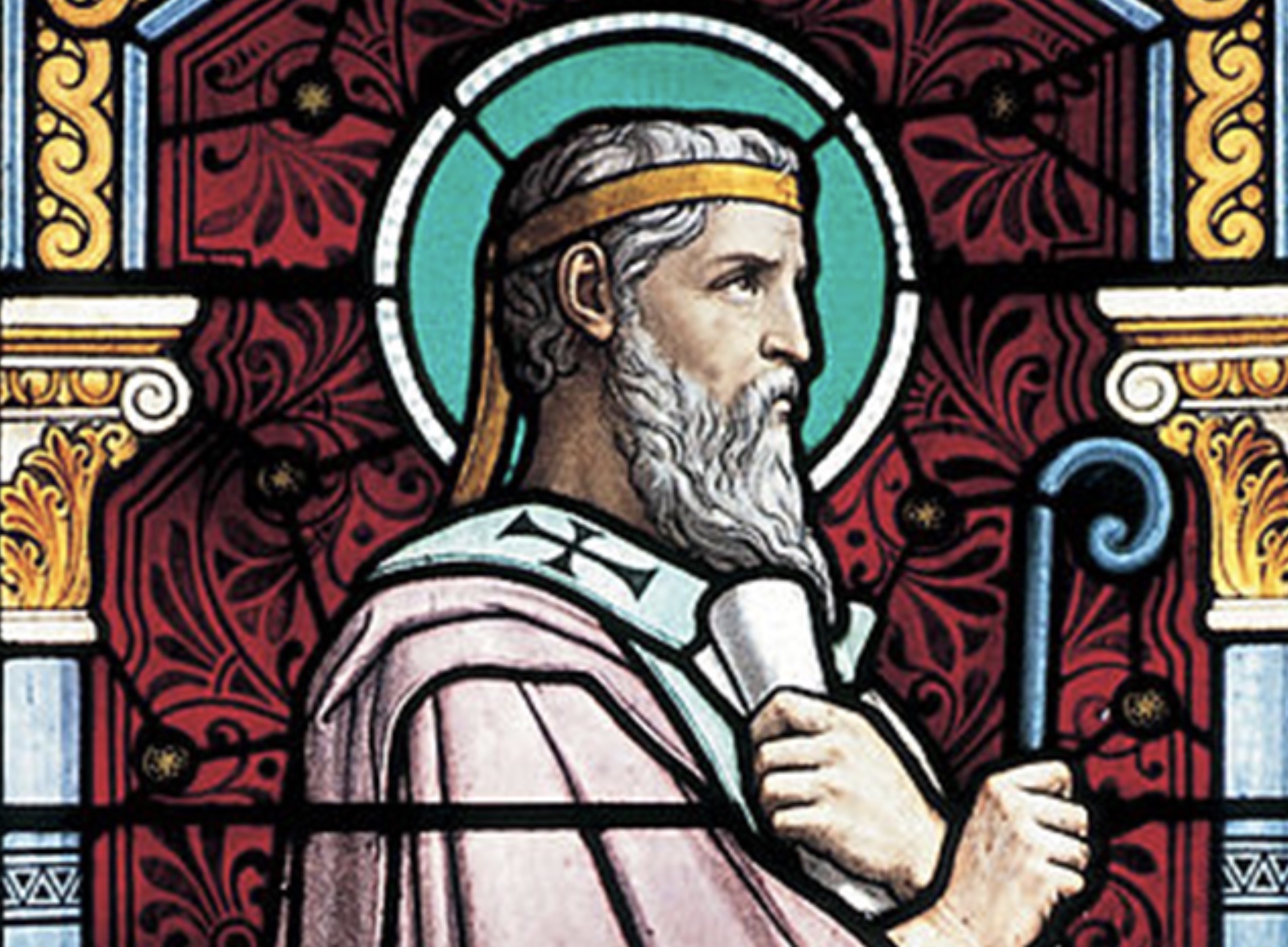
+St. Polycarp, Bishop, Martyr+
Saint Polycarp, Bishop of Smyrna (70-167) was a disciple of Saint John. He wrote to the Philippians, exhorting them to mutual love and to hatred of heresy. When the apostate Marcion met Saint Polycarp at Rome, he asked the aged Saint if he knew him. “Yes,” Saint Polycarp answered, “I know you for the first-born of Satan.” These were the words of a Saint, most loving and most charitable, and specially noted for his compassion to sinners. He abhorred heresy, because he loved God and man so well.
Introduction
We have seen here most recently that those upholding the right of Traditionalist bishops to function as valid must trample on infallible papal decrees in order to support their position. How did this come about and why is it so deeply entrenched that they cannot see their errors? It has already been pointed out that a certain element of fraud was involved in the mobilization and redirection of Catholics exiting Vatican 2, (such fraud as defined in Canons 103 and 104). But how was that fraud perpetrated? It was perpetrated because Catholics first believed those validly ordained and consecrated before the death of Pope Pius XII were still lawful pastors, when they were not. Most of them believed this because these men told them they still possessed jurisdiction, and in certain cases they may have for a time. But such jurisdiction quickly expired and when the faithful continued to believe they still possessed it, they simply never bothered to tell them they did not, and could no longer minister to them.
Next the priestly wannabes came along, those ordained under Lefebvre, Thuc and others. These men violated the laws of the Church in ordaining these unqualified aspirants to the priesthood and later consecrated some of them as bishops. According to Pope Pius XII’s Vacantis Apostolicae Sedis (VAS) this rendered these ordinations/consecrations invalid, null and void. But Lefebvre/Thuc et al never based any of their actions on papal teaching (while mouthing various papal decrees to their own benefit, especially Pope St. Pius V’s Quo Primum), nor advised the faithful of the existence of VAS, limiting what is to be done during an interregnum. They also allowed the faithful to believe these invalidly consecrated bishops had the power to rule them according to Church teaching, when Pope Pius XII’s Mystici Corporis, in this and many other parts an infallible decree, clearly states that only the pope himself can assign them this power. He restates this same teaching in several other documents which are binding on the faithful.
Then there was Pope Paul IV’s Cum ex Apostolatus Officio (1559), an infallible bull retained in multiple canons of the 1917 Code of Canon Law regarding heresy. This bull has been dismissed, ignored, misinterpreted and maligned ever since it was first discovered. A popular recognize and resist site has recently misrepresented it once again as teaching a pope validly elected could fall into heresy, when a careful reading of this bull will show that no such thing was ever taught by Pope Paul IV. In fact the opposite is taught — Paul IV explains that no one who is a heretic prior to his election could ever become pope. The teaching in question reads: “Further, if ever at any time it becomes clear that any Bishop… or likewise any Roman Pontiff before his promotion or elevation as a Cardinal or Roman Pontiff, has strayed from the Catholic Faith or fallen into some heresy, then his promotion or elevation shall be null, invalid and void.” This gives the lie to any other interpretation of this bull. And moreover, Pope St. Pius V later confirmed the bull and even strengthened it in his Intermultiplices.
These are the binding papal decisions mentioned in a previous blog as indispensable to a proper understanding of the crisis in the Church. And yet they have been obscured, misinterpreted and even blatantly ignored (VAS). Below we will attempt to explain how this happened and why it is crucial to recognize the fact that it was a concerted effort to erase the papacy as the ultimate source of dogma and guardian of Divine truth.
Distractions and gaslighting
How does someone set about to commit spiritual fraud? Well as seen played out again and again on the idiot box by those reporting on the political scene, one of the best ways to get way with something or to confuse someone is to stage something else to make them look away while it is being done in order to convince them, once it is a done deal, that it is perfectly democratic, constitutional, understandable in the circumstances, legal, forgivable or whatever, despite what the laws of the nation or the Constitution or Bill of Rights might say. And then, as we also have seen for the past several years regarding politics, even those protesting abuses who cite the obvious are categorized as conspiracy theorists, nuts, ridiculous, etc. and are censored on social media and other platforms, sued and even arrested and imprisoned. It is no different with spiritual fraud.
Those appearing on the scene following the close of Vatican 2 and the promulgation of the new sacrilegious mass in 1969 used the same method of operation. They presented the cessation of the Mass as the primary problem in the Church, ignoring the fact — already being voiced in the early 1970s — that Paul 6 was not a true pope and that both he and John 23 were Freemasons. But before we begin to explain how and why these diversion tactics were implemented to shift focus from the lack of a true pope to the cessation of the Latin Mass, the term distraction must be adequately defined. Simply put, distraction is something practiced to divert attention from other, more important issues. Most people naturally avoid concentrating for too long on serious matters and eventually seek out lighter topics and objects of interest to relieve them of serious headwork. But some shift their focus to other subjects as a way to escape figuring out problems they would rather not face.
Then there is gaslighting, which is really just a cover-up. It is often employed by those described as narcissists, (a subject we discussed not long ago and have posted an article on HERE). Gaslighting attempts to distort reality and create a new reality by eroding self-trust, self-confidence and self- esteem and especially one’s intellectual ability to correctly judge a given situation or concept. Gaslighting is usually an attempt to hide or conceal something — meaning it also can be classified as a distraction. And many have fallen prey to this tactic. Another tool used by narcissists is the creation of circular conversations, which have no end in sight, as a method to distract their targeted audience. They often simply refuse to answer questions or the answers they do give are off the real topic. This is certainly something readers of this blog are familiar with, since several opponents have been called out here for their fallacies of argument from a logical standpoint.
Deception is the ultimate hidden distraction, as one Internet psychologist notes. Peeling off the many layers to find the root cause of the deception can be painful and confusing. While certain information is withheld, other information which sounds rational but is contrary to Catholic teaching, is presented to those following Traditionalists as a must-read, or something that must be believed to remain in Traditional sects. Yet honest questions remain unanswered or are relegated to the no-need-for-the-laity-to-know basket. This only adds to the layers and complicates matters. Truth has no layers; it simply is what it is. One need only accept and obey.
As stated many times before, Catholics poorly educated in the faith were sitting ducks for these tactics. Preying on their ignorance was/is actually a logical fallacy. But none of them realized this. They followed along because they were unable to make the finer distinctions, and those who should have helped them to do this were working instead to keep their pockets lined and their bellies full. Detailed examinations of what Traditional pseudo-clergy were teaching was and is necessary to refute every erroneous point, because most of their followers did not have the resources, time or ability to conduct such research. And such studies had to be undertaken in the interests of truth and for the honor and glory of God, ignored by these pseudo-clerics, who catered only to the need for Mass and sacraments insisted on by their followers. And when Traditionalist teaching and claims are examined from a strictly magisterial and dogmatic standpoint, the resulting discrepancies become more evident and the pattern of deception begins to emerge.
The first deception: Tradition reinterpreted
Those following Traditionalists were blinded by their redirection and re-definition of the faith. This new definition effectively rendered the Church as a human institution only, governed by men who had no right and no power to profess themselves as possessing any sort of mission. As the 19th century defender of the primacy, William Allies wrote: “The contest in Church history really lay not between Ultramontane and Gallican opinions, but between the liberty, independence, and spirituality of Christ’s Church on the one hand, or on its being made a servile instrument of State government on the other: between a divine and a human Church.” The popular BLM/ANTIFA motto “erase and replace” was in use without being recognized as such long before the 21st century. The cultural war and destruction of tradition and doctrine that began with the election of John 23 and the false Vatican 2 council was continued under the banner of preserving Tradition, and those exiting the false Church rallied under that banner.
But as pointed out before, it was the use of amphibology, a false argument in logic, regarding the true Catholic meaning of Tradition that misled those followers. Because according to the Catholic Encyclopedia: “Tradition can only be defined as either doctrine itself, or the mode by which doctrine is transmitted… a magisterium, or teaching authority… Tradition, in the double meaning of the word… is Divine truth coming down to us in the mind of the Church and it is the guardianship and transmission of this Divine truth by the organ of the living magisterium, by ecclesiastical preaching, by the profession of it made by all in the Christian life. But a Church without the guidance of that living magisterium is Tradition capable of defining and transmitting Divine truth? It is doctrine capable of being transmitted without reference to the transmitter appointed by Christ, the Supreme Pontiff?
The second deception: Mass, sacraments can exist without pope
Now the authority established by God in His Church, the papacy, can only be certainly exercised by he who has the fullness of the priesthood. This supreme office is the symbol of Christ’s universal teaching authority; the Mass and the papacy are the intertwined symbols of Catholic unity. When he who withholdeth is taken out of the way; when the shepherd is struck and the sheep are scattered, no surer indication of God’s will, no greater indication of prophecy fulfilled could exist. The absence of the Mass and Sacraments must be rightly interpreted as a punishment. For in Daniel 11:31, we read that the Holy Sacrifice of the Mass will cease. Why will it cease? Daniel tells us: “And strength was given him [Antichrist] against the continual sacrifice because of sins, and truth shall be cast down on the ground…” (Dan. 8:12). Christ gave up His Body for our sins, and he gave to His Vicar on earth alone the right and the power to see that the re-enactment of His Holy sacrifice was renewed on earth in a fitting manner. He who gave can also taketh away, for we find in the book of Job,1:21: “The Lord gave, and the Lord hath taken away: as it hath pleased the Lord so is it done: blessed be the name of the Lord.” Where among Traditionalists do we find the resignation and the patience of Job, the patience of the saints prophesied for the last days?
We have already demonstrated at length on this site, and especially in the last two blogs on Vacantis Apostolicae Sedis, that Traditionalists had no hope of functioning validly or licitly during an interregnum. So why did they offer Catholics their services when they at the very least doubted, or professed to doubt, that the men succeeding Pope Pius XII were legitimate; when they had to have known — to have fabricated such elaborate theories as epikeia, necessity, material-formal and extraordinary mission jurisdiction, all ascribed to the heretics — that they had no authority to do so?? Once proscribed, without a true pope to appeal to, there was no hope of ever reviving the Continual Sacrifice. And its proscription was scarcely doubted or unknown; Henry Cardinal Manning writes in his The Present Crisis of the Holy See: “The Holy Fathers who have written upon the subject of Antichrist and the prophecies of Daniel — all of them unanimously — say that in the latter end of the world, during the reign of Antichrist, the Holy Sacrifice of the altar will cease.” And the Council of Trent determined that when the Fathers unanimously agree on a point of Holy Scripture, no one may interpret it otherwise (DZ 995; also DZ 1788).”
St. Francis de Sales and St. Alphonsus Liguori also taught that the Sacrifice would cease in the latter days. St. Francis writes: “The revolt and separation must come…the Sacrifice shall cease and…the Son of Man shall hardly find faith on earth…All these passages are understood of the affliction which Antichrist shall cause in the Church…But the Church… shall not fail, and shall be fed and preserved amidst the deserts and solitudes to which She shall retire, as the Scripture says, (Apoc. Ch. 12),” (The Catholic Controversy). In his The Holy Eucharist, St. Alphonsus stated that: “It is true [the Mass] will cease on earth at the time of Antichrist: the Sacrifice of the Mass is to be suspended…according to the prophecy of Daniel, (Dan. 12:11).” But he goes on to explain, however, that in reality the Sacrifice and priesthood never will cease since “the Son of God, Eternal Priest, will always continue to offer Himself to God, the Father, in Heaven as an Eternal Sacrifice.” And we also hear from St. Robert Bellarmine: “In the time of Antichrist, all public offices and divine sacrifices will cease on account of the vehemence of the persecution” (Antichrist, St. Robert Bellarmine, S.J., Ryan Grant translation 2015).
We can only conclude that by refusing to accept God’s will regarding the Mass, Traditionalists successfully demoted Christ as the Second Person of the Blessed Trinity, Redeemer of the world, since He would never be present on their altars. They then denied Him as the supreme source of all Divine jurisdiction in favor of those purporting to be bishops possessing valid orders without papal approval. Those claiming they received their jurisdiction directly from Christ against His express will, as made know by His Vicars, receive(d) a curse instead. Traditionalists, then, effectively transferred the center of all unity to the Mass and Sacraments outside the papacy. As Adrian Fortescue explained in the Catholic Encyclopedia under the Mass, THE CENTER OF UNITY IN BELIEF IN THE CATHOLIC CHURCH IS THE PAPACY, but the Holy Sacrifice is the expression of that unity. Yet without a true pope, how can the Holy Sacrifice by itself express unity in belief? When the Church’s teachings are overturned, this invariably results in a disintegration of the liturgy. Therefore the destruction of the symbol of unity, inextricably bound up with the doctrine of the papacy was mistaken for the thing itself. This is an echo of the manner in which the Modernists intended to represent the faith: external symbols of doctrines themselves were all that was needed to satisfy the superficial Catholic.
And there can be no pleas of ignorance by the malefactors. One of the theologians favored by some Traditionalists has expressed it well: “For authority [in the Church] comes directly from God through Christ, and from Christ to his Vicar, and from the Vicar of Christ it descends to the remaining prelates without the intervention of any other physical or moral person” (Louis Cardinal Billot, S.J., Tractatus De Ecclesia Christi – Rome: Aedes Universitatis Gregorianae -1927, Vol. 1. p. 524). It is fairly evident that all this shifting and transferring in matters related to Christ’s very divinity, without any realization by the faithful that this was even occurring, amounts to diversion and gaslighting. The machinations of Traditionalists were a quantum shift by those who knew full well what they were doing — establishing their long-awaited Gallicanist and autonomous church ruled only by putative bishops. How they arrived at the fulfillment of their fondest dreams did not matter. Christ Himself did not matter. It is no coincidence that, as Fortescue himself reports, those leaving the Church for Anglicanism proclaimed, “It is the Mass that matters.” The church of man began with the rejection of the papacy by Henry VIII and Martin Luther and the denial that it was of Divine institution. This was the “tradition” continued by Traditionalists and embraced by the Novus Ordo.
That Traditionalism is just an extension of the Novus Ordo has been suggested here, and by others, for decades. And as Dr. Cyril Andrade points out in his work, Are Papal Elections Inspired by the Holy Ghost, we should not be surprised. “In the fourth Eucharistic prayer which they have concocted for their Novus Ordo Missae (New Mass) they state categorically: ‘Father in heaven, you alone are God . . .’” (Emphases added), thus excluding the Son and the Holy Ghost from the Trinity Godhead.” Traditionalists can scream all they like that this is not the case, but without the Pope there is no voice of Christ and no Divine assistance of the Holy Ghost; without obedience to and recognition of his decrees, there is every indication Traditionalists no longer consider the pope necessary to the Church’s existence. Was this not indeed, from the beginning, a calculated effort by Traditionalists to appear as champions of orthodoxy while silently humanizing the Church and removing from it every vestige of Divinity?
The third deception: a cunning use of amphibology
Amphibology is s statement that can be taken in two different ways or whose meaning is otherwise unclear. But it is not so much that those who deal in wording Traditionalist position statements make use of ambiguous terms, although this is also a problem in many of their writings; the other technique they employ is more difficult to explain and detect than that. Rather they cite a perfectly true statement and twist it to pretend that it actually supports what they are trying to prove when in fact it proves the opposite. Case in point: One Traditionalist, trying to prove that jurisdiction can be granted bishops (and then delegated to priests} directly from Christ gave the following quotes to support this false proposition:
“The power of the Church, therefore, does not die with the death of the pope as far as jurisdiction is concerned, which is, as it were, a form in the papacy, but remains in Christ. Nor does it die as far as the choice and determination of the person is concerned, which is like something material, but it remains in the college of cardinals, BUT DIES AS FAR AS THE ACTUAL ADMINISTRATION OF THE JURISDICTION IS CONCERNED, because when the pope dies the church becomes vacant, and is deprived of administration” (St. Antoninus of Florence, Summa Theologiae, p. III, c. II.). And yet another Traditionalist quoted this in support of the same proposition:
“Jurisdiction …operates through the pope, however, as a minister and INSTRUMENT OF DIVINITY, and therefore not by authority proper to the Church, but rather by God exercising His own authority.” (Merkelbach 3: 569). In other words, jurisdiction comes directly from God, but only through the popes! This is exactly the same statement made by Louis Cardinal Billot, S.J.: “For authority [in the Church] comes directly from God through Christ, and from Christ to his Vicar, and from the Vicar of Christ it descends to the remaining prelates without the intervention of any other physical or moral person” (Tractatus De Ecclesia Christi – Rome: Aedes Universitatis Gregorianae -1927, Vol. 1. p. 524).
The above quotes state exactly how jurisdiction operates in the Church and it is exactly as Pope Pius XII describes it in Vacantis Apostolicae Sedis and his other binding decrees. The idea that is being planted here by Traditionalists, however, is that the Church can never fail, so therefore Christ is more or less forced, against His Divine will, to grant these men jurisdiction to keep His Church alive as He promised. A fine bit of blackmail, that! But here they are sadly mistaken, for it is the faith of Peter, not the Church, Herself, that can never fail. As seen above, there is a time when She will indeed seem to fail, when her visible head will be removed and Her Holy Sacrifice taken away. Nowhere in what is stated above is it said that in the absence of the pope the cardinals or bishops may hijack the Church; St. Antoninus says just the opposite. And yet they lead their readers to believe that the failure of valid bishops to elect a true pope so they could then receive the proper to jurisdiction in no way leaves them without it.
As explained in the opening paragraphs above, this same technique has been used to also discredit Pope Paul IV’s Cum ex Apostolatus Officio, which was crucial to establishing the papal vacancy and proceeding to an election. More on this topic is presented next.
The fourth deception: Cum ex… suppressed and ignored
In his speech at the Vatican Council, St. Anthony Mary Claret summed up why it was that infallibility was not properly understood. First, he said, it is because Scripture itself is not understood. And it is not understood 1) (quoting St. Teresa of Avila) because men do not truly love God. 2) They lack humility and 3) There are some who do not wish to understand Scripture simply because they do not wish the good. In his 1559 bull Cum ex…, Pope Paul IV explained the meaning of the abomination of desolation in Holy Scripture, but no one today accepts his intended definition. He said he was issuing his bull “lest it befall Us to see in the holy place the abomination of desolation spoken of by Daniel the prophet.” And the entire bull consisted of declaring deposed from offices of any kind those who possessed them and became heretics, and any Roman Pontiff who as a cardinal professed heresy before his election. Such an election, he decreed, would be “invalid, null and void.”
The fact that John 23 was a heretic pre-election was first documented in 1990, and that is only ONE thing that disqualified him; there were several other disqualifying election-related issues as proven in The Phantom Church in Rome. But no one has ever accepted the fact that, having been recognized as a pope when not one at all, he then became the abomination of desolation as Pope Paul IV defined it in his bull (see more on this term HERE). Nor has the invalid election evidence ever been analyzed and publicly discussed, to the best of my knowledge, by anyone but myself. The link just provided shows that St. Bernard, also the earlier ecumenical councils have always referred to antipopes as antichrists, so this was nothing new. What WAS indeed new was the fact that both John 23 and Paul 6 abrogated the Latin Mass of Pope St. Pius V, completing the fulfillment of the prophecies concerning Antichrist, when the faithful not willing to accept the new mass left the false church. This concluded the Great Apostasy begun by the Cardinals who “elected” John 23 and the bishops who signed the documents issuing from the false Vatican 2 council.
As pointed out on this site repeatedly, it was then the duty of any remaining validly consecrated bishops who had not attended the false Vatican 2 council to invoke Cum ex…, convene an imperfect council as suggested by St. Robert Bellarmine in such cases and elect a pope. I began advocating for this in 1987. There were others who were aware of it even before then, including Fr. Joaquin Saenz-Arriaga and others from the Mexican Union of Trent, also Daniel Dolan, who reportedly was working with one of the translators of Cum ex.., (Prof.) Benjamin Dryden. Dolan posted an article he says he and Dryden co-authored on one Traditionalist site, dated 1980, explaining Can. 188 no. 4. So why was a pope never elected?
Because that was never the plan. The plan was to act as though nothing could be done because of doubts regarding the validity of the usurpers and their elections, which was the reason Guerard des Lauriers wrote his heretical material-formal thesis. And yes, it was heretical, because he ascribes to pontiffs assisted by the Holy Ghost a dual, schizoid personality and denies the very consequences of heresy itself, not to mention contradicting Cum ex Apostolatus Officio and the history of Canon Law regarding papal elections. Now we see this thesis being aggressively questioned by CMRI adherents, but to what purpose? The damage was done long ago. In reality, this has all been God’s Holy Will. We live in the midst of Antichrist’s system following his death, as St. Thomas Aquinas said might well happen, and more likely than not, all we can hope for is God’s mercy in hastening the Second Coming.
Punishments to be expected for deceiving the faithful
Hear what Canon Arvisenet, speaking to seminarians and priests as Christ, tells those who unworthily conduct public ceremonies: “How long will you dishonor me? How long will you trample underfoot the faith and piety of my people? How long will My flock cry out in indignation: Where is their God? Can we believe that He will come down on their altar? Will He not destroy those who have violated his sanctuary…Let fire come from thy tabernacle and devour them, and let them expire before thy face. They have taken away faith by living, let them restore it by dying” (Epitome of the Priestly Life, 1921). Every Traditionalist pseudo-cleric should read about the punishment God meted out to Core, son of Levi, and his followers, (Num., Ch. 16) for rebelling against Moses and Aaron. Verses 1-4 explain how Core, Dathan, Abiron, and others, followed by 250 “leading men of the synagogue,” told Moses that he had taken too much upon himself and that his (Core’s) group had the Lord on their side. For defying Moses, “…the earth broke asunder under their feet…and opening her mouth, devoured them,” (vs. 31-32).
Rev. Leo Haydock comments on these verses in Numbers: “The crimes of these men, which were punished in so remarkable a manner, was that of schism, and REBELLION AGAINST THE AUTHORITY ESTABLISHED BY GOD IN HIS CHURCH; and their pretending to the priesthood without being lawfully called and sent; the same is the case of all modern sectaries. Let them dread a similar punishment; not only the authors of such wicked pretensions, BUT ALSO THOSE WHO CONSENT TO THEM,” (emphasis Haydock’s). “They believed in the same God, yet because they took upon themselves to sacrifice, they were forthwith punished by God, and their unlawful sacrifices to God could do them no service…If we give any encouragement to schismatics, or go to their meetings, we must expect to be involved in their sins.”
And we read again from Canon Arvisenet, speaking as Christ: “O priest, not a pastor but a seducer of My flock! An eye for an eye, a tooth for a tooth shall this most wicked man restore. O wicked [ones], through whom so many scandals have come, through whom so many people, so many nations have fallen away from the faith and from the unity of My Church, unjustly imputing your crimes to My most chaste Spouse! On account of you, on account of your evil deeds, the world is laid waste by the sword and perishes by the destroyer. Woe to you, brood of Vipers! The depths of hell will swallow you up before the rest of sinners and the mouth of the pit of torment will reach out with greater fury to receive you than others.”
Conclusion
Simplicity and humility — these are the two virtues that Traditionalist pseudo-clergy never possessed. These virtues would have enabled them to properly assist the faithful fleeing the wreckage of the Church following the false V2 council and the abrogation of the Latin Mass. Humility would have laid down any so-called orders received and explained to the faithful, hard as that might have been, that they needed to obey Church teaching, educate themselves and keep the faith at home. Humility would have inspired penance and a contrite spirit, not the scornful contempt and proud defiance displayed by Traditionalist pseudo-clergy. What is simplicity? Speaking of the virtues so necessary to priests, Canon Arvisenet tells us: “Be simple in all things; show thyself sincere and straightforward; act without dissimulation; speak without guile… Simplicity is more effective than all manner of schemes and diligence… O blessed simplicity, that proceeds from a good and perfect heart!”
Simplicity would have acknowledged the truth and faced it, no matter how difficult the task, and accepted the judgment of the Roman Pontiff regarding the observance of Canon Law and usurpation of the papacy during an interregnum. Simplicity would have radiated a childlike docility in obedience to papal decrees and confidence in the teachings of the Roman Pontiff as Christ’s will for us. Simplicity would not dare question these teachings or the dictates of Canon Law. And simplicity would certainly never resort to deceitful practices such as gaslighting and creating distractions to deceive the faithful. “Unless you be converted, and become as little children, you shall not enter into the kingdom of Heaven” (Matt. 18:3).
We must remember what St. Paul told us concerning the workings of Satan in these days: “…in all power, signs and lying wonders” (2 Thess. 2:9). Satan is the father of lies; the master of deception and illusion. And if the elect continue to remain entrapped in his snares, it will not be because no one has bothered to warn them.
by T. Stanfill Benns | Jan 18, 2023 | New Blog
+St. Peter’s Chair at Rome+
Today the Church celebrates the Chair of St. Peter at Rome, and faithful Catholics have hopefully begun the much-needed Unity Octave (https://www.betrayedcatholics.com/that-all-may-be-onepray-for-counterfeit-catholics/)
But alas, there are those who do not even recognize the popes as Supreme Head of the Church, for they would place them secondary to theologians, denying the Divine assistance promised them by Christ. And they continue to perpetuate the dissonance and DISUNITY so inimical to all who strive to be Catholic, and long to be included in the sheepfold of Christ. Even though we have no pope, we have the priceless treasury of the Deposit of Faith they left us, if only Catholics would accept and obey the contents of that Divine Deposit.
We have published lengthy comments to our last blog; this most recent comment will be answered here. Once again, it is from a “John Lewis,” who asks the following questions.
Q. “If I’m understanding you correctly you believe there are no valid sacraments during a papal interregnum?”
A. Have you read the opening paragraphs of Vacantis Apostolicae Sedis? We must ALL believe that Pope Pius XII has INFALLIBLY TAUGHT that:
- No bishops can validly be consecrated during THIS interregnum without the examination/papal mandate. Never before in the Church’s history did all the cardinals and bishops fall into heresy, schism and apostasy during an interregnum and lose all jurisdiction, making it impossible to elect a true pope.
- No one, neither the cardinals far less the bishops, can usurp papal jurisdiction during an interregnum.
- No one can change papal law or Canon Law during an interregnum.
- Any attempt to do any of the above, as infallibly defined by Pope Pius XII in Vacantis Apostolicae Sedis, is null, void and invalid.
Q. There have been interregnums in the history of the Church other than the present one. Can you cite any theologians or theological manuals that support your conclusion?
A. What theologians teach or think is entirely irrelevant; they have no right to interpret infallible papal decrees. This has been taught repeatedly by the popes themselves. It does not matter what happened with the Church in the past; Pope Pius XII’s infallible definition did not exist at that time. It exists today. We find in Pope Pius XII’s Mediator Dei, Nov. 9, 1947, also determined to be binding on the faithful:
“Clearly no sincere Catholic can refuse to accept the formulation of Christian doctrine more recently elaborated and proclaimed as dogmas by the Church, under the inspiration and guidance of the Holy Spirit with abundant fruit for souls, because it pleases him to hark back to the old formulas. NO MORE CAN ANY CATHOLIC IN HIS RIGHT SENSES REPUDIATE EXISTING LEGISLATION OF THE CHURCH TO REVERT TO PRESCRIPTIONS BASED ON THE EARLIEST SOURCES OF CANON LAW. Just as obviously unwise and mistaken is the zeal of one who in matters liturgical would go back to the rites and usage of antiquity, discarding the new patterns introduced by disposition of divine Providence to meet the changes of circumstances and situation.
“This way of acting bids fair to revive the exaggerated and senseless antiquarianism to which the illegal Council of Pistoia gave rise. It likewise attempts to reinstate a series of errors which were responsible for the calling of that meeting as well as for those resulting from it, with grievous harm to souls, and which the Church, the ever-watchful guardian of the “deposit of faith” committed to her charge by her divine Founder, had every right and reason to condemn.”
And this is repeated in Ad apostolorum principis:
“We are aware that those who belittle obedience in order to justify themselves with regard to those functions which they have unrighteously assumed defend their position by recalling a usage which prevailed in ages past. Yet everyone sees that all ecclesiastical discipline is overthrown if it is in any way lawful for one to restore arrangements which are no longer VALID because the supreme authority of the Church long ago decreed otherwise. In no sense do they excuse their way of acting by appealing to another custom, and they indisputably prove that they follow this line deliberately in order to escape from the discipline which now prevails and which they ought to be obeying…
“…The faithful are bound by the duty of hierarchical subordination and true obedience not only in matters which pertain to faith and morals, but also in those which concern the discipline and government of the Church.”
“From what We have said, it follows that no authority whatsoever, save that which is proper to the Supreme Pastor, can render void the canonical appointment granted to any bishop; that no person or group, whether of priests or of laymen, can claim the right of nominating bishops; that no one can lawfully confer episcopal consecration unless he has received the mandate of the Apostolic See.”
Q. For such a radical proposition to have even been considered a possibility, would this not have been discussed amongst Church theologians and widely debated?
A. See below.
“For the mystery of iniquity already worketh; only that he who now holdeth do hold until he be taken out of the way” (2 Thess. 2:7). This restraining power, Henry Edward Cardinal Manning says — this “he who withholdeth” — is none other than: “Christendom and its head; the Vicar of Jesus Christ.” For in that twofold authority, temporal and spiritual, the Supreme Pontiff:
“…is the direct antagonist to the principle of disorder …It was the will of God; it was the concession of the Father that Pilate had power over His Incarnate Son… In like manner with His Church. Until the hour has come when the barrier, by the Divine will, be taken out of the way, no one has power to lay a hand upon it. The gates of Hell may war against [the Church]; they may strive and wrestle, as they struggle now, with the Vicar of Our Lord; but no one has the power to move Him one step until the hour shall come when the Son of God shall permit, for a time, the powers of evil to prevail. That He will permit it for a time stands in the book of prophecy. But the imperishable Church of God…will live on still through the fires of the times of Antichrist….” (Henry Cardinal Manning, The Temporal Power of the Vicar of Jesus Christ, Burns and Lambert, 1862, London).
Louis-Edouard Cardinal Pie of Poitiers, a contemporary of Cardinal Manning’s and a drafter of the Vatican Council proclamation on infallibility, wrote:
The Church, though of course still a visible society, will be increasingly reduced to individual and domestic proportions. She who in Her young days cried out: ‘the place is strait: give me room wherein to dwell,’ will see every inch of Her territory under attack. Surrounded on all sides, as the other centuries have made Her great, so the last will strive to crush Her. And finally the Church on earth will undergo a true defeat: ‘…and it was given unto him to make war with the saints and to overcome them,’ (Apocalypse 13:7). The insolence of evil will be at its peak.
Hilaire Belloc says the same in his The Great Heresies:
The Church will not disappear, for the Church is not of mortal stuff; it is the only institution among men not subject to the universal law of mortality. Therefore we say, not that the Church may be wiped out, but that it may be reduced to asmall band almost forgotten amid the vast numbers of its opponents and their contempt of the defeated thing. One of the most intelligent of French Catholics, a converted Jew, has written a work to prove (or suggest) that the first of these two possible issues will be our fate. He envisages the last years of the Church on this earth as lived apart. He sees a Church of the future reduced to very few in numbers and left on one side in the general current of the new Paganism. [Pope Pius XII calls this resurgence of former errors “the current of Black Paganism” – Ed.] He sees a Church of the future within which there will be intensity of devotion, indeed, but that devotion practised by one small body, isolated and forgotten in the midst of its fellowmen.”
And there also is this: “We must not be too ready to pronounce on what God may permit. But we, or our successors in future generations of Christians, shall perhaps see stranger evils than have yet been experienced, even before the immediate approach of that great winding up of all things on earth that will precede the day of judgment. I am not setting up for a prophet, nor pretending to see unhappy wonders, of which I have no knowledge whatever. All I mean to convey is that contingencies regarding the Church, not excluded by the Divine promises, cannot be regarded as practically impossible, just because they would be terrible and distressing in a very high degree” (The Relations of the Church to Society — Theological Essays, Rev. Edmund James O’Reilly, S.J.).
Victorinus — (Source: Translated by Robert Ernest Wallis. From Ante-Nicene Fathers, Vol. 7. Edited by Alexander Roberts, James Donaldson, and A. Cleveland Coxe. (Buffalo, NY: Christian Literature Publishing Co.,1886) https://www.newadvent.org/fathers/0712.htm
“Ch. 6:14. “And the heaven withdrew as a scroll that is rolled up.” For the heaven to be rolled away, that is, that the Church shall be taken away.
“Ch. 15:1 And I saw another great and wonderful sign, seven angels having the seven last plagues; for in them is completed the indignation of God. For the wrath of God always strikes the obstinate people with seven plagues, that is, perfectly, as it is said in Leviticus; and these shall be in the last time, when the Church shall have gone out of the midst.”
The esteemed Catholic journalist, Juan Donoso Cortes, writing in the mid-1800s, makes this chilling prediction:
“…Christianity, humanly speaking, must necessarily succumb: It must succumb first, because it was the truth; secondly, because it had in its support marvelous miracles, eloquent testimonies and irrefragable proofs… [i] Without the Church, nothing is possible except chaos. Without the pope, there is no Church. The world will not allow…Roman demagogy to confiscate the infallibility promised to the bishop of Rome for its own benefit, or that demagogic oracles replace the oracles of the papacy. No, this cannot be. This will not be unless we have come to those frightful days of the Apocalypse in which a mammoth anti-Christian empire extends from the center to the poles of the earth. The Church of Jesus Christ will suffer a dreadful eclipse in which the Holy Sacrifice will, for the only time, be suspended, and in which, after unheard of catastrophes, to save His Church, the direct intervention of God will be required to pull down pride and hurl down the impious” (Juan Donoso Cortes, Essays on Catholicism, Liberalism and Socialism, translated from the Spanish by Rev. William McDonald, M. H. Gill and Son, Dublin, 1879, 66)
In his prefatory letter to Reverend Denis Fahey’s excellent work, The Mystical Body of Christ in the Modern World, Bishop J. Kinane, D.D., J.C.L., of Waterford and Lismore (Ireland), wrote the following:
“We know, indeed, that the divine order will survive these attacks, that the Church is indefectible and will emerge triumphant from this struggle as she has done from former ones. We have, however, no guarantee that she will not be wounded in the fight, and whether her wounds are to be serious or light will depend, under God, almost entirely on the number, zeal, and preparedness of her defenders. Now, an essential prerequisite for a proper preparation is a knowledge of the nature and extent of the menace, of the organization of the forces behind it, and of the diabolical hatred of Christianity and of everything behind it, and of the diabolical hatred of Christianity and of everything supernatural with which these forces are imbued.”
In his work Liberal Illusions, Louis Veuillot wrote in the 1800s:
“Cicero wrote: ‘A state cannot exist anymore than can a household unless the good are rewarded and the evil punished.’ This duty to uphold justice and consequently to profess the truth is of the very essence of government independently of all constitutions and political structures. God threatened his rebellious people saying: ‘I will give you a king in my fury and in my fury I will take him from you’ (Osee 13:11). All Holy Scripture is full of this wisdom but what can divine and human reason do when ignorance reigns? From the depths of the multitude comes up a strange fog which darkens even the best of minds and the wise men are legion who will only see clearly by the light of everything going up in flames. When one studies this phenomenon, it appears so strange and so terrible that one cannot help recognizing the hand of God at work. It is the wrath of God bursting forth. It bursts forth, it triumphs and it is punishing whoever persists in scorning the truth.
“In line with the faith, reason cries out to us to unite and strengthen ourselves through obedience: ‘To whom shall we go?’ Liberals and non-Liberals alike, all of us struck by the dreadful unrest of these times know only one thing for certain: that the only man who knows anything at all is that man to whom God is always present; the man who is the mind of God. We must rally together around the Supreme Pontiff, follow his directives without faltering and proclaim with him those truths that will alone save our souls and the world. We must refrain from all endeavor to make his words fit our own mindset. “When the Supreme Pontiff has made known a pastoral decision, no one has the right to add or take away the smallest letter — non addere, non minuere. What he affirms is true forever’ (Most Reverend Bericaud, Bishop of Tulle). Any other course of action will only end by dividing us further until we break up. That would be the greatest misfortune of all.”
And there you have it; Vacantis Apostolicae Sedis in a nutshell. What Veuillot urged us to do is the very thing that has been ignored, and what we are dealing with today can only be the wrath of God. For there is nothing but contempt for the papacy and disunity even among those calling themselves “homealone” Catholics. In truth they are the very same Liberals of Veuillot’s day who have led us to this intolerable impasse in the first place, and who continue to attempt to widen the gap among true Catholics. May God help us all.
Addendum on the authority of theologians
Strict doctrinal accuracy is the primary responsibility of the theologian
Revs. Pohle-Preuss write in The Sacraments, Vol. IV: “It matters not what the private opinions of…theologians [are]. It is not the private opinions of theologians but the official decisions of the Church by which we must be guided.”
“A man is a competent theologian only to the extent that his teaching, written or oral, is an accurate statement of divine public revelation…the actual teaching of the ecclesiastical magisterium,” (J.C. Fenton, J.C.L. American Ecclesiastical Review, “What are the sources available to the sacred theologian? In his “Sacred Theology,” Fenton lists these sources from the theologian Melchior Cano as follows:
- Holy Scripture, contained in the canonical books;
- The oral Traditions of Christ and the Apostles, rightly called oracles of the living voice;
- The Catholic Church, (continual magisterium);
- The General Councils specifically, but also the regional councils;
- The Roman Church, called by divine privilege Apostolic (Holy See, Sacred Congregations);
- The authority of the ancient Fathers;
- The authority of scholastic theologians, to whom the teachers of Canon Law are joined;
- Natural reason, contained in all the naturally acquired sciences.
- The authority of philosophers following the natural light of human reason and the masters of the civil law;
- The authority of human history written by trustworthy authors or expressed in serious, national tradition.
“According to Catholic doctrine, therefore, Holy Scripture and Tradition are only the remote rule of faith, while the proximate rule is the living magisterium of the Church, which resides in the Roman Pontiff and in the bishops, inasmuch as they are subject to and united with him. The Vatican Council (sess. 4, c. 4, DB, 1832) has sealed this truth by defining that the primacy of Peter and his successors is included in the supreme power of teaching, which is veritatis et fidei numquam deficientis charisma (“the chrism of never-failing truth and faith”).” Dictionary of Dogmatic Theology by Pietro Parente, Antonio Piolanti, and Salvatore Garofalo. Imprimatur, May 1, 1951, pages 170 and 171). Under loci theologici (theological sources) in this same work, Parente et al ranks the various sources as follows:
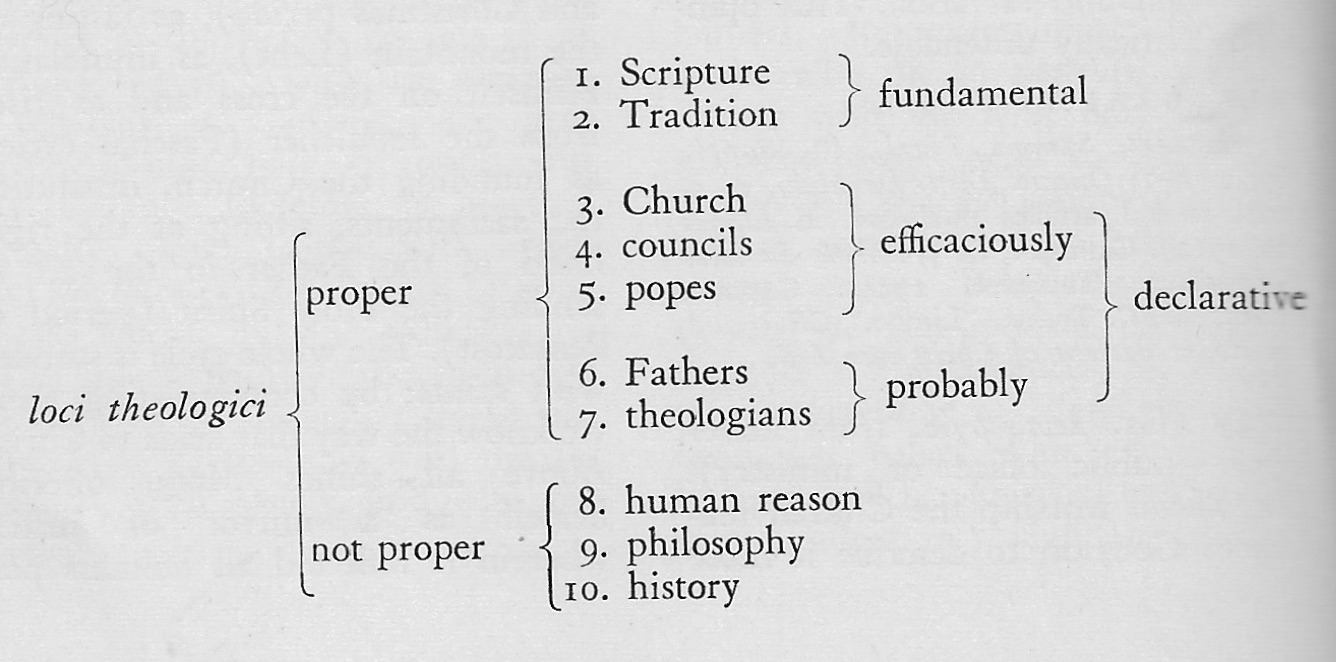
It is clear, then, that theologians, on the theological scale, are low on the list of authorities as all should know, and the Popes, the Councils, and the Church are at the top of the list. To ask anyone to prove the infallible teachings of the Roman Pontiffs by resorting to the interpretation or opinions of the theologians is totally reversing this trusted, centuries-old order employed by scholastic theologians. And to subject papal decisions and definitions to human reason, which is what is done when those in these online Traditional discussion groups dissect these teachings, is the work of human reason. This application of human reason is judged in the above diagram as “not proper;” the work of theologians is determined to be only “probably” declarative, while the magisterium in all its manifestations is efficaciously declarative, efficacious meaning it “produces the desired or intended result.” So would those truly desiring to know the truth and save their souls prefer to rely on something only probably declarative and improper or would they rather trust what is most efficacious and productive of formal certitude? Obviously many prefer the former.
by T. Stanfill Benns | Jan 14, 2023 | New Blog
+St. Hilary, Bishop+
The length of the articles on this site has been objected to from time to time by some who think there can and must be a simple answer to the problems facing us today. This of course does not stop them from reading and quoting from even lengthier articles and works on the Internet, but I digress. Presenting the answers to the crucial questions of our times has taken many years and much study, but over time the answers become much clearer than when the subject was first addressed. Hindsight is always very helpful and newer developments and research finds are the stuff that helps crystallize conclusions and dispel all doubt. As often as possible, the works of the Roman Pontiffs are used on this site, as they most certainly should be, as the final word in matters of faith and morals. And when such teachings specifically address a certain circumstance and can be applied to a particular situation, then there can be no doubt, there must be no doubt, about the answer to that question.
But of course there are always the naysayers, or those who simply will not admit that such answers are conclusive regardless of what the popes might infallibly teach. This seems to be true even when these same people teach that denying one doctrine of faith results in heresy. What is stated below has been repeated numerous times on this site, but as long as these errors continue to circulate then this same teaching will be repeated. When everything began in the 1960s early 1970s, after concerned Catholics had exited Vatican 2, the first thing that should have been done was to discover whether or not there was any kind of papal instruction that covered the situation and gave the faithful any idea of what should be done. As it turns out, there were several of these documents. And yet one, primarily, governs our case.
Four indispensable papal teachings
It took a while for many of these documents to even be uncovered and evaluated thanks to Traditionalists, who didn’t even bother to address them comprehensively or honestly in the early days. Some of them were difficult to find in English, some of them were not easy to understand. Some respected “priests” even openly declared these papal decrees were not authoritative, and therefore could not be binding. But it was the duty of anyone pretending to take the place of the Church on earth to locate and translate these important guiding documents. This would have given us some general idea of how we were to proceed and what we should do. Four documents especially stand out as essential for a basic understanding of how to proceed during the Great Apostasy — Pope Paul IV’s infallible bull Cum ex Apostolatus Officio (Cum ex…), 1559; Pope Pius XII’s infallible encyclical Mystici Corporis Christi, 1943; Pope Pius XII’s infallible constitution Vacantis Apostolicae Sedis (VAS),1945 and Pope Pius XII’s binding constitution Ad apostolorum principis, 1957. It is among these four documents that we find the answers to most of what arose following Vatican 2. These papal decrees will be examined below.
Cum ex Apostolatus Officio told us that no one who sat in the papal seat and professed heresy could possibly have been Catholic or presumed to be validly elected. This is confirmed by the Vatican Council in no uncertain terms. In Cum ex…, Pope Paul IV established the fact that anytime we see someone such as John 23rd and Paul 6 teaching error — which they most certainly did, and most Traditionalists will even acknowledge that — then we know that these men were heretics before their election and were not validly elected. And this is true of both John 23rd and Paul 6. So there was an answer to that question; it should not even have been something discussed early on in Traditional circles because it was readily able to be established. And still we have the arguments going on and on about whether a heretic can become a Pope, which is impossible unless you deny the teachings of the Vatican Council and become a heretic.
Now regarding Mystici Corporis, we have a statement that has been upheld and defended on this site for several years and there really isn’t any getting around it — you either accept what the Pope says as binding or you don’t. And if you don’t then you’re outside the Church. Because at that point in time it doesn’t become a matter of just denying the specific dogma the Pope is teaching. At that time it becomes a matter also of denying his authority to teach and the necessity of obedience to the Pope for salvation, and these are two separate things. In Mystici Corporis Pope Pius XII clearly taught that the Pope alone has power over the bishops and they do not receive their power directly from Christ; Christ alone had the power to establish the order of jurisdiction in the Church and did so establish that order. Anything they do after the fact is in direct violation of the order He established.
VAS is a document originally attributed to Pope St. Pius X and rewritten and appended by Pope Pius XII. Pope St. Pius X codified his election law from all the papal election documents that had existed since the very beginning of the Church. So that’s really a pretty important document, because it represents the entire history of papal elections in the Church. How does one dismiss that history as documented in VAS itself and still try to pretend to be a Catholic? Now one of the things specifically mentioned in this papal election constitution is how the Church is supposed to operate when there is no Roman Pontiff. It is the blueprint for our times, complete in the first four paragraphs of the document. Outside of what exists on this site, there is no open discussion of it on the Internet, but I’m sure those behind the scenes who think they are trying to run the show are well aware of it.
Invalid, null and void
Now one of the first things VAS addresses has to do directly with what Pius XII taught in Mystici corporis — that without the Pope as head Bishop the other bishops have no real power. And this is restated in the first paragraph, first chapter of VAS. This teaching is not new, although Pope Pius XII was the first to state this decisively. It was commonly held by theologians even before he wrote Mystici Corporis. What that paragraph says is that during an interregnum not even the Cardinals have the right to usurp the jurisdiction of the Roman Pontiff. “We declare INVALID AND VOID any power or jurisdiction pertaining to the Roman Pontiff in his lifetime, which the assembly of Cardinals might decide to exercise” (while the Church is without a Pope). This teaching that the cardinals can do nothing without the pope during an interregnum is not new; the footnotes to VAS list it as dating back to the 1100’s and Pope Clement III.
This also is upheld in Ad Apostolorum principis, where Pope Pius XII taught: “For it has been clearly and expressly laid down in the canons that it pertains to the one Apostolic See to judge whether a person is fit for the dignity and burden of the episcopacy, and that complete freedom in the nomination of bishops is the right of the Roman Pontiff.” So clearly that right is violated whenever the Roman Pontiff is unable to nominate such bishops. This decree falls within the pope’s ordinary magisterium; it is entered into the Acta Apostolica Sedis.
The Cardinals are basically just bishops, and Mystici corporis says that without the Pope the bishops have no power; the Cardinals have no right to do anything that would require papal jurisdiction during an interregnum. That covers a pretty wide field. And next VAS states that during an interregnum these same Cardinals cannot in any way violate the rights of the Church or laws made by the Roman Pontiff; the very right just mentioned above in the papal law laid down in Ad apostolorum principis. Because if the bishops cannot act without the Roman Pontiff, then he alone can dictate what could be done in the emergency the Church faces today. And finally it exhorts the Cardinals to defend the papacy in the event of a situation arising such as it has and did, and of course, cowards that they were, the majority violated their cardinalitial oaths, fled the scene and threw the flock to the wolves. They later commenced to invoke powers they no longer possessed and gathered to convene Vatican 2 and destroy the Sacraments.
Finally we come to the third paragraph of VAS. “The laws issued by Roman Pontiffs in no way can be corrected or changed by the assembly of Cardinals of the Roman Church while it is without a Pope, nor can anything be subtracted from them or added or dispensed in any way whatsoever with respect to said laws.” And this especially pertains to the election constitution itself which is quite lengthy and goes into the conclave process. (This is of no concern to us now because a true Pope at this time cannot be elected.) So then we come to the final and most crucial part of this whole document which states: “In truth if anything adverse to this command should by chance happen to come about or be attempted, WE DECLARE IT. BY OUR SUPREME AUTHORITY, TO BE NULL AND VOID.” Now all accept Pope Pius XII as a valid Pope, correct? And therefore if he infallibly declares that something is invalid, null and void, we must believe it is, correct? So if we deny that he has the power to infallibly declare something we deny infallibility and are excluded from Church membership.
Because in paragraph one we were already seeing that papal jurisdiction cannot be usurped during an interregnum. And if it is, then such acts are null and void. This means that nobody — not the Cardinals, far less the bishops — can claim to possess jurisdiction during an interregnum; they must elect a pope. Traditionalists usurped that jurisdiction specifically in violation of this constitution. Lefebvre, Thuc, et al, first violated Canon Law (which is predominantly papal or conciliar law) by ordaining unqualified men as priests without possessing the necessary jurisdiction. This jurisdiction they lost when founding their various schismatic sects; ergo, their acts were null and void. So no priests were ever created to consecrate as bishops, and even if they had been created, such consecration was a usurpation of papal jurisdiction. Because papal approval of episcopal candidates and the issuance of the papal mandate are required per the episcopal ordination rite itself, such usurpation rendered their consecrations null, void and invalid. All any remaining validly consecrated bishops could rightly do following Pope Pius XII’s death was to elect a true pope. And we’ve gone to great lengths to show that epikeia invoked to supposedly cover all of this mess is prohibited by VAS and cannot possibly supply for anything that these Traditionalists have done. Please read the articles here and here.
Invalid and illicit are NOT the same
Now that being the case, and given the wording of VAS, how is it that we keep finding on various blogs and websites statements to the effect that “Traditional sacraments are only illicit; no one can prove they are invalid.” Really? I thought we just read in the first paragraph of an infallible constitution written by an incontestably and unquestionably true Pope that the actions of anyone usurping papal jurisdiction or violating the law during an interregnum are null, void and invalid. Pope Leo XIII declared in Apostolica curae that “…to obtain orders nulliter means the same as by act null and void, that is invalid, as the very meaning of the word and as common parlance require.” Pope Alexander VIII, in condemning the Gallican articles, declared them “…null and void, invalid, useless” (DZ 1326). The word illicit here is nowhere mentioned in Pius XII’s constitution. In his A Catholic Dictionary, Donald Attwater wrote: “[Illicit means] Unlawful, forbidden. Illicit must be distinguished from invalid,” and invalid is here defined by the popes. A sacrament or sacramental may have its effect if illicit, as all know. However, its reception and administration is sinful, as St. Thomas Aquinas teaches. In certain cases it may have the possibility of becoming licit, but that is not what we are talking about here.
Despite the above, those who should know better insist, for some strange reason, on referring to Traditionalist sacraments as only illicit. And they are even bold enough to use it in the same context with the definition of infallibility and the nature of heresy, explaining that denying one truth of faith is enough to cast you outside the Church. What could possibly motivate this strange refusal to recognize an infallible document issued by a man Traditionalists recognize as a true pope? Several things come to mind. First, they could still believe, despite infallible teaching, that bishops receive their power directly from Christ. Secondly, they might believe that true bishops possessing certain jurisdiction still exist on this earth, something that has been shown on this blog to be impossible given our current situation. Third, they could anticipate, at some future date, that a true pope will be elected and Pope Pius XII will be declared a false pope, a collaborator with the Modernists, which has been falsely claimed by various Traditionalists. In that case they could claim VAS no longer existed, and illicit could then be declared licit. What else could it be that would prompt them to deny an infallible decree?
Why “melding” is so dangerous
This fully illustrates the problems outlined in the last blog written here, which explained why the melding of all the views of one group together indiscriminately and presenting the authors of these views as in agreement with each other is misleading, unCatholic and therefore outright dangerous from a faith standpoint. Welcome to a demonstration of The Delphi Technique, which employs the HEGELIAN dialectic, not the scholastic dialectic of St. Thomas Aquinas. For where Catholic teaching is concerned, unless each, particular term has been defined and explained sufficiently and documented as a Catholic truth, no one is going to be able to discern Catholic truth even if it exists in part in such a document. This is because premises are being built on things that have not yet been defined and proven to exist, things essential to Catholic belief. This is the fallacy of arguing beside the point also known as begging the question — assuming to be true that which has yet to be proven.
Those assuming these men are illicit would have us automatically believe them to be validly ordained and consecrated, when Pope Pius XII clearly teaches their actions during an interregnum are invalid. For no man can proceed illicitly if he is not already a validly ordained priest or validly consecrated bishop. One of the errors mentioned by Rev. Joseph B. Walsh S.J. in his 1940 work Logic under the begging the question fallacy is “…assuming a proposition implicitly contained in the one to be proved.” Failure to identify that missing presumption — that validity is required before liceity can even be considered a possibility — invalidates the argument. That is something that cannot be done and will not stand in scholastic theology.
What these authors citing a lack of liceity are trying to prove is that the faithful should not frequent the sacraments of Traditionalists because it is against the law and is mortally sinful; also because it violates the teaching of the Council of Trent which is de fide, of faith. This is something we have proven ourselves for decades, alongside the invalidity issue, but only as it pertained to priests validly ordained before the death of Pope Pius XII. However, this particular question is beside the point today as all these priests are dead. The only pseudo-clergy remaining are those issuing from Lefebvre, Thuc and a few others, ordained and consecrated during an interregnum and hence falling under the infallible provisions of VAS.
The inference here is that it is not really important whether they are valid or not, while the infallible decree of a true pope requires us to believe that they are much worse than illicit; they are not even possible pretenders to the throne but absolute interlopers who must be repelled. One can receive something illicitly and still validly receive the sacrament or sacramental. But where there is invalidity, nothing is conveyed nor can anything be conveyed. Invalidity, when specifically laid out in the terms as it is in VAS, can be nothing more and nothing less than an indicator that there is an element of fraud involved (and I’m not talking fraud in a civil, criminal aspect here; I’m talking fraud only as it is covered in Canon 103 and 104 in the Code of Canon Law). Call it spiritual fraud, if you will, but invalidity — especially when it’s so easily shown to be the case — can’t help but suggest fraud.
Conclusion
What has been going on for the past 64 years had to happen so that Scripture could be fulfilled. The Church had to be betrayed just as Her Divine Lord was betrayed; the Passion of the Church had to play out. But that doesn’t excuse those who did not insist that the laws and infallible teachings of the Church be known and observed. It has been emphasized here, over and over again, that it doesn’t matter what errant website authors or blogsters have to say regarding the teachings of the Church, the status of Traditionalists or the meaning and application of Canon Law. The popes and ecumenical councils alone must be believed, and these brazen sophists cannot gainsay them.
There is a cunning form of deception going on here and that deception is based on a shameful suppression and total dismissal of Pope Pius XII’s Vacantis Apostolicae Sedis. It would have us admit that failure to avoid Traditionalists owing to a lack of liceity is a heresy, while leaving Trad clerical egos intact and yet admitting their validity. It is nothing more than a disgusting form of human respect, and it is bought at the cost of denying an infallible teaching every bit as worthy of our obedience and irrevocable acceptance. VAS is the bull elephant in the Traditionalist living room, as we have said before. Those who continue to ignore this decree and its infallible consequences dare not count themselves as Catholics.
by T. Stanfill Benns | Jan 9, 2023 | New Blog
+St. Agatho and Bd. Gregory X, Popes+
Additional note on the Mystical Body series
A reader from Africa has forwarded a sermon from Henry Edward Cardinal Manning that I have been trying to locate for several years. It is probably the best illustration of the establishment of the visible and invisible heads of the Mystical Body, as prophesied by the prophets Isaias and Ezekiel, that could be found. Written in 1859, it unquestionably demonstrates, even before the definition of infallibility handed down by the Vatican Council, that there would be a living voice to guide the people until the very consummation of the world. But you say, “We have no pope!” We may not have a pope, yet we have very nearly all that the popes have ever written readily available to us, a virtual treasury of their teachings, including the mandate for the conduct of the Church during an interregnum infallibly delivered by Pope Pius XII. For all who wish to see that this promise was made to us by the very prophet who likewise foretold Christ’s coming and His suffering and death on the Cross, please read this sermon here very carefully. And then dare to state that we can trust the very “opinions” of any other human authority on what must be believed. More on this below.
Where does one find the truth?
Several readers have asked over the past few years for referral to like-minded sites for those who pray at home. While there are a few sites with good resource material for Traditionalists in general that are not objectionable, there are no sites I am aware of that promote the pray-at-home position and at the same time have their theology straight. For this reason I cannot in good conscience refer people to those sites where they may easily encounter errors. Even among those who pray at home and also write blogs or host websites, there is a general tendency to engage in liberal charity that cannot be ignored. This tendency over time, if imbibed often enough by readers, convinces them that one must be sympathetic and indulgent even to those who teach error and that to snub them or renounce those errors is a lack of Catholic charity.
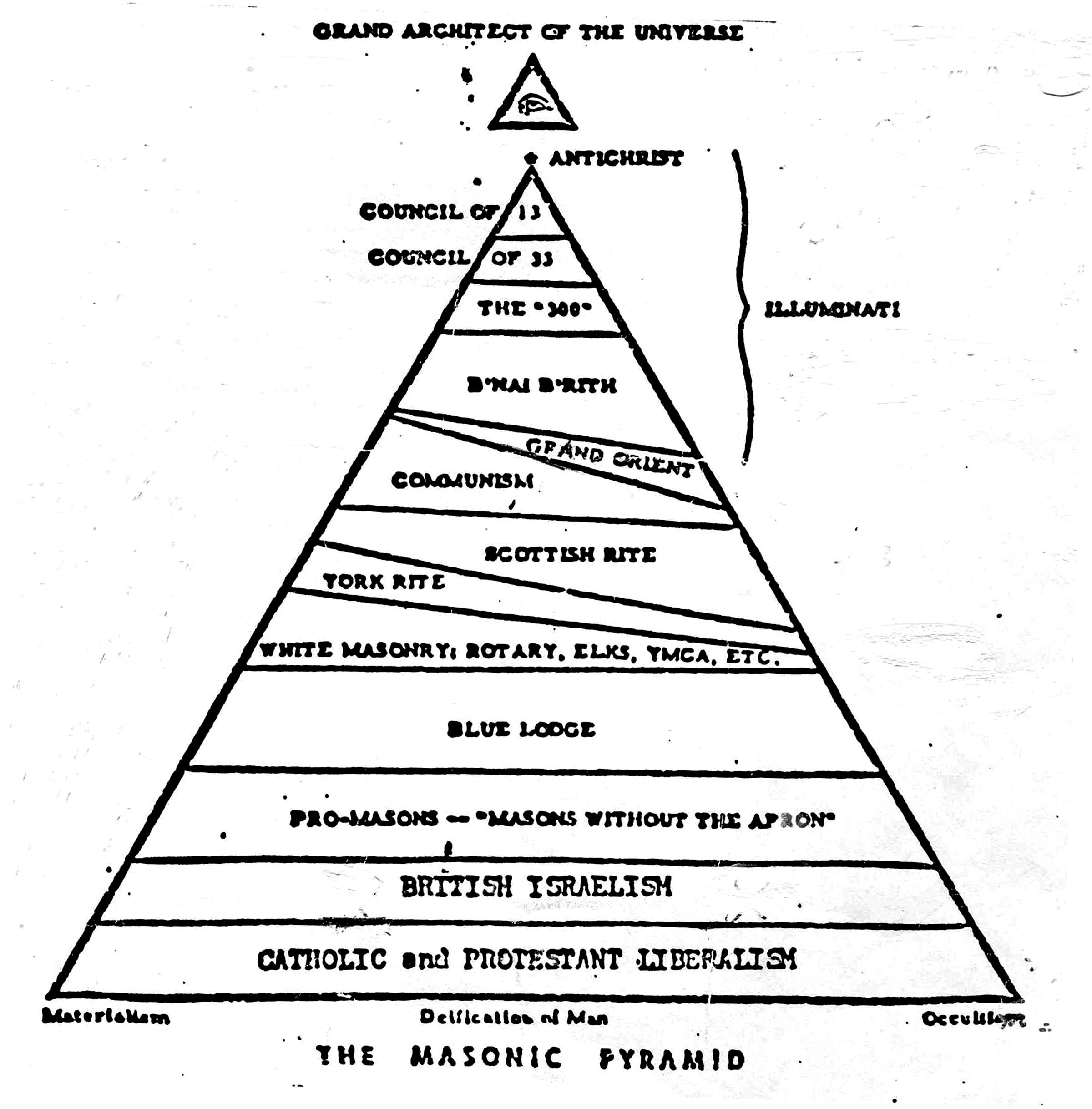 We have discussed this here before, referring readers to Fr. Felix Sarda-Salvany’s Liberalism is a Sin, which is the only known antidote to this syrupy poison that renders so many otherwise commendable articles and treatises dangerous to Catholics. What perhaps needs to be pointed out, however, is that Catholic and Protestant Liberalism is not just an error condemned by the Church; it is the first level of Freemasonry marked by Edith Star Miller, (an American who married into British royalty, Lady Queensborough) on her Masonic pyramid. Lady Queensborough was later murdered in Paris for her expose’ regarding Freemasonry. Directly above this liberalism we find British Israelism, also previously discussed on this site. This is the error that has infested so many among the Traditionalist sect, particularly those of the St. Pius X Society (SSPX) and its related organization, the Knights of St. John Jerusalem.
The idea promoted by certain Traditionalists is that the popes long ago conveyed jurisdiction to this order and therefore that they operate under that jurisdiction. This nonsense was first promoted by Fr. James F. Wathen, O.S.J., (Order of St. John, (Knights) of Jerusalem or the Shickshinny, PA “knights), among several other prominent Traditionalists. Wathen taught in his work defending the order that it was indeed an order initially sanctioned by the Holy See, and that it was specifically given power to institute its own priests and bishops by direct grant of Pope Anastasius IV in 1154. This grant by the pope, however, insists that those clerics admitted to the “order” must be verified as certainly validly ordained. And it ends by decreeing that all these clerics so admitted ultimately must be subject to the Roman Pontiff (Is the Order of St. John Masonic, TAN Books, 1973).
The Church condemns “Catholic” secret societies
Research into this order, later declared to be fraudulent in a civil court, leads one into the dark recesses of Aryanism and the White Brotherhood. Scary stuff. It also provides links to Mass centers and Traditionalist operations of various stripes and colors and even references the John Birch Society, a right-wing, purportedly anti-Communist group many Traditionalists joined in the early days of the movement. As reported elsewhere, the founder of the Knights was a man also associated with the Priory of Sion, a secret society of “Catholics” which appears to have been headed at one time by none other than Abp. Marcel Lefebvre. The idea of a “Catholic secret society” was floated for several years by many different players in the Traditional movement, including the infamous non-priest Peter Tran Van Khoat, heralded as a true priest and possible “pope-elect” by the Siri idiocy bunch. Plunging head-first into the “Catholic” secret society rabbit hole is a sure ticket to hell. And during the reign of Pope Pius XII, the following statement regarding such societies was released:
“Among the things which are springing up again with renewed vigor and not only in Italy is Freemasonry with its ever-recurring hostility to religion and to the Church. What appears to be a new feature in this Masonic renaissance is the rumors circulating in various social classes that a particular rite of Masonry might no longer be in opposition to the Church whereby even Catholics can enroll at their ease in the sect without fear of excommunication and reproach. Those responsible for propagating these rumors must surely know that nothing has been modified in the Church’s legislation relative to Freemasonry and if they continue this campaign, it can only be in order to profit from the naivete of simple folk. The bishops know that Canon 684 and especially Canon 2335 which excommunicates those who have given their names to Masonry without any distinction between rights are as full in force today as they always have been; all Catholics ought to know this and remember it so as not to fall into this snare and also so as to know how to pass due judgment on the fact that certain simpletons believe they can call themselves both Catholics and Freemasons with impunity. This, I repeat, applies to all Masonic rites, EVEN IF SOME OF THEM IN VARYING CIRCUMSTANCES DECLARED THAT THEY ARE NOT HOSTILE TO THE CHURCH” (Most Reverend Mario Cordovani, Master of the Sacred Palace; printed in Osservatore Romano, March 19, 1950, as quoted by Vicomte Leon de Poncins).
This should be the end to any speculation that such a thing as a Catholic secret society could ever exist. And it also should alert Catholics to the fact that the Church was well aware that organizations such as the Priory of Sion and St. John of Jerusalem were attempting to deceive Catholics into joining their ranks at precisely that point in time when these two organizations were first organizing. Move a little further up the pyramid from British Israelism and we find Pro-Masons “Without the apron.” In other words, Liberal Catholics favoring Masonry who are not actually members are counted by Masons AS MEMBERS. Then there is actual Communism, which most Catholics would assume they could easily avoid. But Communism relies on the process of gradualism, a slow and perhaps imperceptible conditioning process facilitated by the practice of Liberal charity and involvement with Traditional organizations, often founded, at least, by those affiliated with secret societies who believe and promote British Israelism. To make Communism more palatable, its disseminators have devised new variations that appear to be something they aranotin order to better deceive the general populace. It begins with the teachings of Georg Wilhelm Friedrich Hegel, born in Germany in 1770.
Hegelianism prepares the way
We last encountered Hegel in ours series on education. Award-winning New York state teacher and author, John Gatto, wrote regarding Fabian Socialism in Great Britain: “The puzzling security and prestige enjoyed at the moment by those who speak of globalism and multiculturalism is a direct result of heed paid earlier to Fabian prophecies that a welfare state followed by an intense focus on internationalism would be the mechanism elevating corporate society over political society and is a necessary precursor to utopia… One insightful Hegelianism was that to push ideas efficiently, it was necessary first to co-opt both political left and political right. Adversarial politics competition was a losers’ game… “By infiltrating all major media, by continual low-intensity propaganda, by massive changes in group orientations (accomplished through principles developed in the psychological warfare bureaus of the military) and with the ability, using government intelligence agents and press contacts to induce a succession of crises, they accomplished that astonishing feat… Thus the deliberate creation of crises is an important tool of evolutionary Socialists. Does that let you understand the government school drama a little better or the well-publicized doomsday scenarios of environmentalists?” (The Underground History of American Education, 2001).
So basically Hegel was an evolutionist, believing that nothing actually “is” but only is in the process of perpetually “becoming,” (primitive Modernism). He is best known for his ideas on the philosophia perennis, that “all previous systems of thought — religious, mythological, philosophical — aim at and partially unveil the same doctrine,” the teaching that a grand synthesis of opposing beliefs would culminate in unity and equality,” (What is the Hegelian Dialectic?, by Niki Raapana and Nordica Friedrich, https://nord.twu.net/acl/agenda21.html). Some believe that Hegel’s ideas are essentially Hermetic, with Hermeticism (Rosicrucianism, Alchemy, Theosophy, ESP, New Age thinking, Freemasonic beliefs) constituting a middle position between pantheism (that God, an eternal being is somehow one and the same with the world itself, which is of limited duration) and the Judeo-Christian conception of God. This is why his philosophy also is called “the Third Way.”
Hegel invented the notion of a different sort of dialectic, the term so common to evolving religious and political beliefs first taking center stage in the 1960s during the ecumenical movement. He believed that the only way to “become” was to engage in the expression of one’s thought processes, since these processes infallibly reflected a sort of ingrained wisdom passed on via man’s unconscious from generation to generation. By way of poetic discussion held through written and verbal exchange, Hegel taught that one could reconcile mythology with philosophy and religion to create a “new mythology of reason.” Thus is the perennial philosophy perpetually completed. Thought itself, in other words, “becomes” divine. This process joins all men and all disciplines, then, in a synthesis of experience that would replace the need for religious belief.
God is the world and the world is God; we all are bound up in the same absolute knowing because we are Him. (This is related to a concept some also know as secular humanism.) Hegel’s intent in implementing his dialectic was to initiate constant conflict. The conflict created in these discussions resulted in the continual melding of systems and ideas, whether right or left in origin, (syncretism). And this in turn, he believed, would accomplish the ideal spiritualization and perfection of mankind. While this background information may be difficult to digest and appear to many to be irrelevant, this is far from the truth. It is necessary to understand exactly how dialectic has been employed in the formation and perpetuation of communitarianism in order to appreciate how communitarianism relates to so much of what we see today.
In his encyclical Divini Redemptoris, Pope Pus XI places this process in perspective: “According to this doctrine, there is in the world only one reality — matter — the blind forces of which evolve into plant, animal and man. Even human society is nothing but a phenomenon and form of matter, evolving in the same way. By a law of inexorable necessity and through a perpetual conflict of forces, matter moves toward the final synthesis of a classless society…Communists claim that the conflict which carries the world towards its final synthesis can be accelerated by man. Hence they endeavor to sharpen the antagonisms which arise between the various classes of society. Thus the class struggle with its consequent violent hate and destruction takes on the aspect of a crusade for the progress of humanity.”
Communitarianism = communism
It is easy to see from what has been described so far that communitarianism tallies perfectly with Communist tactics and teaching as outlined by Pope Pius XI. Hegelian philosophy is all about evolving socially; the system engages others in a “mystical” dialectic process of discussion to initiate the conflict necessary for Communism to establish itself. These dialectics, in turn, wear those engaging in them down and confuses them until eventually they arrive at a conclusion reached through a series of surrenders and compromises. This is a Communist war of words, not battlefields. It is a hidden and deceitful form of mind control known as coercive persuasion, engineered to arrive at the desired result without shedding blood. Those who come out on top in this process go on to become the new missionaries for the cause. This is how slowly and for many decades — almost imperceptibly — the United States was absorbed into the anticipated global community governed by Community (communitarian) Law.
Members of the legal community worldwide have worked for years to revise laws of states and regions to conform to Community Law. Yet under the U.S. Constitution and U.S. Criminal Code, communitarian law is not only illegal — it is treason. Why? Because, as Prof. Francis Snyder writes in his “Institutions of the Union and the European Communities,” (Google translation): “Communitarian law…integrates extreme communism with extreme capitalism. It defends the rights of the global ‘collective’ against the rights of the greedy, selfish individuals clinging to their ‘outdated notion’ of independent nations.” In short, then, communitarianism is nothing less than global communism, implemented by dedicated volunteers who agitate ceaselessly for a “communitarian, or communist, system,” (Weekly Worker, Jan. 25, 2001). But who will stand as judge and advocate for us to ensure that the return to common law alleged by those establishing this new world order is not actually contaminated with communitarianism? Is there a way to identify this system at work? According to an article in the Nov. 1998 issue of The Education Reporter, there is.
The Delphi Technique
In her “Using the Delphi Technique to Achieve Consensus,” Lynn Stuter explains how the Hegelian dialectic of “thesis, antithesis synthesis” is set into motion. By the unethical practice of creating tension and friction, change agents or facilitators move two sides towards the middle, making one set of views appear sensible and the other set ridiculous. Eventually this results in a new “thesis,” or melding of views, and the process will be repeated as many times as necessary until the desired result is achieved. “The facilitators or change agents…are hired to direct the meeting to a preset conclusion…to encourage each person in a group to express concerns about the programs, projects, or policies in question. They listen attentively, elicit input from group members, from “task forces,” urge participants to make lists, and in going through these motions, learn about each member of a group. They are trained to identify the “leaders,” the “loud mouths,” the “weak or non-committal members,” and those who are apt to change sides frequently during an argument.
“Using the ‘divide and conquer’ principle, they manipulate one opinion against another, making those who are out of step appear ‘ridiculous, unknowledgeable, inarticulate, or dogmatic.’ They attempt to anger certain participants, thereby accelerating tensions. The facilitators are well trained in psychological manipulation. They are able to predict the reactions of each member in a group. Individuals in opposition to the desired policy or program will be shut out. In her book Educating for the New World Order, author and educator Beverly Eakman makes numerous references to the need of those in power to preserve the illusion that there is ‘community participation in decision-making processes, while in fact lay citizens are being squeezed out.’” The similarity to recent events in this country and even the use of the same language by those agitating for a new thesis are too obvious to even merit comment. Communitarianism is obviously alive and well, even among those Catholics who denounce Communism.
Truth is One
The Delphi Technique has been used repeatedly to squeeze out the common man and move ever closer to certain individuals’ dream of a global community. And its application is not limited to the political sphere — it has been used for decades among Traditionalists and even at times among those who profess to keep the faith at home. Those employing this technique fancy themselves to be clever manipulators able to achieve the melding of different opinions and positions within the Traditionalist spectrum to achieve at least a consensus if not a contrived sort of unity. In order to accomplish this, they must make it appear that all doctrinal differences amount only to a matter of opinion, when nothing could be further from the truth. And yet it takes only ONE denial of faith to lose membership in Christ’s Mystical Body. Examples of these divergences form the faith are legion and have been pointed out on this site for years. Among them are:
— the belief that the pope can become a heretic AS A LEGITIMATELY ELECTED POPE, condemned infallibly by the Vatican Council;
— that bishops can be validly consecrated without papal appointment or approval during an interregnum, condemned infallibly in Mystici Corporis Christi and Vacantis Apostolicae Sedis;
— that epikeia can “supply” jurisdiction during an interregnum, likewise condemned infallibly in Vacantis Apostolicae Sedis;
— that the Church considers the Jews the primary founders and originators of Freemasonry who are responsible for Her demise, when this has never been taught by the Church;
— that the Church, as She was constituted by Christ, can exist without the pope, when the pope is the head bishop — condemned implicitly in Vacantis Apostolicae Sedis and Pope St. Pius X’s Vacante Sedis Apostolica, a codification of all papal election laws.
And there are many others. But none of the above are up for debate, speculation, can be left to private opinion or are able to be interpreted in any way. Questions on such matters cannot be settled during an interregnum; without a pope there is nothing that can be decided. Traditionalists hate to hear this, but objective truth is one, while error is manifold. And the only source of objective truth left to us on this earth were the Roman Pontiffs. As one reader pointed out recently, there are only two cities — the City of God and the city of Satan. As St. Thomas Aquinas writes, “There are two mystical bodies in this world: The Mystical Body of Christ and the mystical body of the Devil or of the Antichrist. To one or another every man belongs.” St. Augustine writes: “They cannot be at the same time members of Christ and members of a prostitute. Many receive the Body of Christ in the Sacrament, but not in their souls. By failing to receive Christ spiritually and leading bad lives, they reduce the members of Christ, making themselves members of the Devil, so they greatly diminish the Body of Christ.”
St. Louis Grignon de Montfort, in his True Devotion to the Blessed Virgin Mary, wrote: “The Most Holy Virgin is called by the Holy Ghost the City of God (Ps. 86:3)… God has set…enmities between Mary and the Devil… between the true children and servants of Mary and the slaves of the Devil. They have no love for each other… The children of Belial have always persecuted those who belong to our Blessed Lady… [Our Lady’s] humble slaves and her poor children… shall be little and poor in the world’s eyes, abased before all, trodden underfoot and persecuted as the heel is by the other members of the body. But in return for this they shall be rich in the grace of God.” Hail-fellow-well-met may be the norm among attorneys and politicians today, but among Catholics, liberal charity can only be the beginning of that fateful principle of toleration that amounts to indifferentism. And this then leads to the ascent of the pyramid illustrated above, whether those identifying as Catholic realize it or admit it or not.
We were all born to be Soldiers of Christ, not the “woke” variety of soldiers now populating today’s military. True soldiers who believe their primary duty is to rid the earth of all that is inimical to Christ’s teaching will stop at nothing when it comes to defending their faith. As Fr. Sarda says, “Give the enemy no quarter.” We are either with Christ or against Him; we either belong to the City of God or the City of Satan. One denial of a Catholic dogma deprives Catholics of Church membership. And refusing to accept the fact that that we are forbidden, during an interregnum, to decide on matters of faith or those closely connected to it — and not accept those binding teachings and sacred Canons already governing it — is a denial of the supreme jurisdiction of the Roman Pontiff as defined at the Vatican Council. It is a denial of everything written by Henry Cardinal Manning written in the sermon mentioned in the first paragraph of this blog.
“The illumination which is diffused throughout the whole body of the Church resides imminently in the episcopate but resides pre-eminently and above all in the chief of Bishops, the Pastor of Pastors, the Vicar of the Incarnate Word himself. Here then we have the fulfillment of the prophecy for what is the Vicar of Jesus Christ but the representative of Jesus Christ — the true, special, personal witness — the very presence, so to speak, of the son of God on earth? And as the prophecy of Isaias was accomplished when the son of God was incarnate rose up in the city of Nazareth, anointed by the Holy Ghost, so His representative and Vicar now stands in the midst of the world, the true special heir of those promises and on his anointed head rest the spirit of God never to depart, and in his mouth the word of God which cannot pass away. He is the oracle, the organ and the living voice through whom the Spirit of God accomplishes to this hour the prophecy of Isaias.
“All doctrines have been disputed, cast out, disfigured in controversy and railed upon; for since Jesus withdrew Himself, and the shame which fell on Him had no longer a divine personal object in the world, never was there anything so railed at as that one, universal faith of the holy Catholic and Roman Church. It bears the shame of Jesus: ‘You shall be hated by all men for my name’s sake’ has been fulfilled in the faith which we believe. And why is it so? Because it speaks in its Master’s name; because it perpetuates His voice; because every article of the Council of Trent is an account of the voice of Jesus. Therefore men gainsay it as they gainsaid Him; but the words of the prophet stand true: ‘My spirit, which is on thee, and my word, which I put in thy mouth, shall not depart out of thy mouth, nor out of the mouth of thy seed, nor out of the mouth of thy seed’s seed, sayeth the Lord, from henceforth and forever.’
“There is also another truth and it is an awful one — a truth which follows from this so inseparably and by so strong a necessity that I dare not pass it by. If indeed God the Holy Ghost be in the midst of us and if it be God the Holy Ghost that speaks to us through the One, Holy Catholic and Roman Church, then it imposes its doctrines on the consciences of men under pain of eternal death… To disbelieve what the Holy Ghost, through the Church of God has taught, incurs the pain of eternal death for those who, with their eyes open, reject it.”