by T. Stanfill Benns | Dec 8, 2023 | New Blog
O Mary conceived without sin, pray for us who have recourse to thee!
(What follows below is taken from The Illustrated Life of the Blessed Virgin by Rev. B. Rohner, O.S.B., 1897)
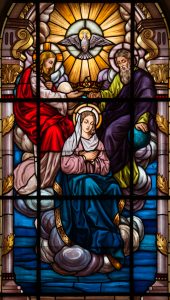
The Immaculate Conception
Now, Christian reader, gather up all the powers of your understanding and will, in order to contemplate the origin and the completion of this mystery. This miracle-mystery, so peculiar in itself, so unparalleled in the decrees of Providence, wrought in Mary’s person by the Almighty God, consists in this great truth: That she, in the first moment of her conception, by special grace and permission of Almighty God, by virtue of the merits of Jesus Christ, the Redeemer of mankind, was preserved from every stain of original sin. This is not a mere pious opinion of over-zealous votaries of the Blessed Virgin; but it is, as you know and believe, the pronounced and expressed doctrine of faith held by the infallible Catholic Church, which Church we cannot refuse our unreserved submission.
Let us, now, in the first place, Christian reader, endeavor to learn something about the nature of original sin, as defined and set forth in the Council of Trent. Adam, the chief father of the whole human race, by his transgression of the divine command, injured not only himself, but also his whole posterity. He also lost, by his sin of disobedience, the sanctity and justice bestowed upon him by God, and lost them for us all. Tainted by his sin of disobedience, he fastened upon all future sons of his family, not only death and bodily sufferings, but also sin, which is the death of the soul.
Thus, all of Adam’s children carry on their brow the brand of sin and shame. Great and disastrous is the evil that this sin produces within us. It robs us of our higher and supernatural life, it enfeebles and wounds our very nature. Frequently the very symptoms of the original grandeur and beauty of this nature become barely perceptible, while the likeness of God, which once shone forth so brilliantly from it before the eyes of angels, has been completely hidden from view. Now, from this original sin, and from all its deadly consequences, was the Blessed Virgin shielded and preserved from the moment of her Immaculate Conception. As our late Holy Father, Pope Pius IX declared in his definition of this mystery:
“It was becoming that the ever- blessed Virgin should be clothed in a garment of perfect sanctity, that she should be exempt from every stain of original sin, that she should win the most complete victory over the old serpent. For she was to be a Mother in every respect worthy of her divine Son. She was to be chosen by God to be the Mother of His only begotten Son, whom He loved as He loved Himself, and who according to His nature was to be, at one and the same time, the Son of God the Father and the Son of the Blessed Virgin. She was to be the Mother chosen by the Second Person of the Blessed Trinity. She it was from whom the Holy Ghost, by divine acts of His will and operation, was to cause Him to be born, from whom He Himself proceeds. It was becoming that He who has in heaven a Father, whom the seraphim praise as the thrice-holy God, should have on earth a mother who was not for a moment deprived of grace, innocence, or glory.”
Moreover, the teaching of the Church regarding this mystery of the Immaculate Conception is not to be understood in the sense that Mary did not need the graces of the Atonement through Jesus Christ. It is clearly and expressly affirmed that she was exempted from sin and sanctified through the merits of Christ and by virtue of grace, of grace preventing original sin, as we through the same are cleansed after our birth in holy Baptism. But it would also be a heresy to maintain or believe that the sanctification accruing to the Blessed Virgin by virtue of her Immaculate Conception is the same as is operated in us by the waters of Baptism. True, by the grace of Our Lord Jesus Christ, the guilt of original sin is remitted, and everything pertaining strictly to the true and exact nature of sin is blotted out. Yet the reliquiae of sin, the germ of sin, the concupiscence of our lower nature, remain.
This lingering concupiscence is the reason why we are so early surprised by its emotions, why we cannot through the long course of our lives save ourselves from any sin without the aid of a special grace. But Mary was preserved even from this concupiscence arising from original sin, so that she was sanctified not only in her soul, but also in her body. During her whole life upon earth she, by special aid of grace, kept herself, body and soul, intact from even the smallest sin against God. Therefore the grace of sanctification with which Mary was favored in her Immaculate Conception reached an immeasurably higher degree than our sanctification in Baptism.
Chosen to be the Mother of the Son of God, she was, even in the moment of her conception, so filled with the treasures of divine grace, that the Archangel Gabriel could with truth address her a title belonging only to herself, namely, that of “full of grace.” For the same reason, too, did she excel by far all created beings, even the seraphim and cherubim. This grace was planted in her inmost being, where it struck deep roots, and in her life put forth beauteous foliage and flowers and brought forth abundant fruit. This grace was like a fire which warmed into ardent piety her whole soul, her every thought, her will, her intellect. It was a light which cast its bright rays of heroism, beauty, and gentleness over her whole being. This fire and this light were now to burst forth upon the world, to enlighten and warm it.
Such is the mystery of the Immaculate Conception of the Blessed Virgin. Christian reader, if you meditate earnestly on this mystery, study it assiduously, you will comprehend and realize that the moment of such a conception must have been a moment of intense joy and unspeakable satisfaction both for heaven and for earth, as well as a moment of indescribable terror to the powers of hell.
Joy in Heaven
By the first sin the tender relations existing between God and man were snapped asunder. Father and child were separated from each other in anger and sorrow. ‘The glorious likeness of God imprinted on the soul of man was turned into a caricature, and became an object of horror and disgust in the eyes of the Creator. Mankind then strayed away from the paths of righteousness and violated God’s laws. At a very early period, even before the deluge, there came, so to speak, a complete break between God and man.
“And God seeing that the wickedness of men was great on the earth, and that all the thought of their heart was bent upon evil at all times, it repented Him that He had made man on the earth. And being touched inwardly with sorrow of heart, He said: I will destroy man, whom I have created, from the face of the earth, from man even to beast; . . . for it repenteth me that I have made them.” (Gen. vi. 5). Century after century sin succeeded sin, shame was heaped upon shame. With the honorable exception of a few chosen people, all men worshipped false gods.
Heaven’s gates were closed against all — that heaven which had been destined to receive into all its glory and happiness every child of earth. Of millions and millions of men who were born, who lived, and who died, not one attained to the possession of the one true God. Things were in this deplorable condition, when, as reckoned by learned and holy writers, in the memorable year of 732 after the foundation of pagan Rome, on the eighth of December, was a child conceived in the Land of Promise, in whose being reposed the fullness of the complacency and grace of God.
Here was a source of joy for the ever-adorable Trinity. But it was more. This sinless creature is destined to be the daughter of God the Father, the Mother of God the Son, and the spouse of the Holy Ghost. With the same complacent happiness that a father looks upon his daughter, a son upon his mother, a bridegroom upon his bride, did the Blessed Trinity look down on Mary, sinless and immaculate. She was the dawn of a bright, fresh, happy day, after a long and dreary night. She was the inauguration of that reign of peace, of grace, and of justice, during which men would adore the one true God in spirit and truth; during which God, in His goodness, mercy, and wisdom, would be known, served, and loved, and during which it would be His delight to dwell among the children of men. (Prov. viii. 31.)
The Immaculate Conception of Mary was a subject of extraordinary joy among the angels of heaven. It is a well-founded opinion, and one not without Scripture proof, that the most-high God placed before the angels the image of His future Mother, in order to try their humility. Here was shown to them the image of a sinless human being, of her who was to be their future queen. At this sight, the faithful angels were filled with holy joy, and seized with the utmost admiration. They were astonished at the boundless goodness of their almighty Creator, they glowed with sacred love for the virgin Mother of their God, and cheerfully recognized her as their lady and mistress.
One of the most exalted spirits, however, a cherub who shone like the morning star, was offended at this wonderful elevation of human nature above the very angels themselves, and even communicated his proud, rebellious thoughts to other spirits, to whom he said In tones of anger: ” I will ascend into [the highest ] heaven, I will exalt my throne above the stars of God, I will sit in the mountain of the covenant, in the sides of the north. I will ascend above the height of the clouds, I will be like the Most High.” (Is. xiv. 13, 14.)
On account of their humble submission, the faithful angels became more beautiful, more spiritual, more like unto God. Lucifer and his unhappy followers, on the contrary, were transformed into demons, and hurled down from the heights of heaven to the depths of everlasting degradation and suffering. The inspired Seer of Patmos, the beloved disciple St. John the Evangelist, describes this event in the following words of the Apocalypse: ” A great sign appeared in heaven: a woman clothed with the sun, and the moon under her feet, and on her head a crown of twelve stars. And there was seen another sign in heaven; and behold a great red dragon having seven heads and ten horns; and on his head seven diadems.
And the dragon stood before the woman who was ready to be delivered, that when she should be delivered, he might devour her Son. And there was a great battle in heaven; Michael and his angels fought with the dragon, and the dragon fought and his angels. And they prevailed not, neither was their place found any more in heaven. And that great dragon was cast out, that old serpent, who is called the devil and Satan. And I heard a loud voice in heaven, saying: Now is come salvation and strength, and the kingdom of our God, and the power of his Christ. ‘Therefore rejoice, O heavens, and you that dwell therein. And the dragon was angry against the woman: and went to make war with the rest of her seed” (Apoc. Chap.12).
Thus was the woman with twelve stars about her head and the moon under her feet, as she has from the earliest days of Christianity been represented in the Immaculate Conception, a source of joy for the good and of terror for the evil, even in her remote predestination. How much more heartfelt then was the shout of joy throughout the vaults of heaven and in the very souls of its happy inhabitants when this queen appeared in reality of existence! We can imaginethe angels calling to each other: ” Who is she that cometh forth as the morning rising, fair as the moon, bright as the sun, terrible as an army set in array?” (Cant. vi. g.) For the rejected and condemned spirits, this same in- nocent child was terrible as an army set in array.
Their widespread dominion, which, with falsehood and deceit, they had set up among men, was now about to crumble to ruins; for she had at last appeared who was to crush the serpent’s head.
Joy on earth
But men on earth had still greater cause to rejoice at the conception of the Redeemer’s Mother. For God so loved the world, that He sent His only begotten, His well beloved Son into the world (John iii. 16), and for Him prepared a worthy mother in the person of Mary, and for men a powerful intercessor and a sublime image and model. But alas! the world lay buried in darkness and ignorance. Men busied themselves about things of earth, and gave themselves up to pleasures, without taking time to think and remember that their almighty Father in heaven was watching over them, studying their welfare, and in His solicitude for the salvation of their immortal souls was perfecting the most astounding miracles. But two lowly hearts there were that were overflowing with holy joy — the hearts of Joachim and Anne, privileged parents of this grace-crowned child. Who can express the joy that thrilled through the maternal heart of St Anne on ascertaining this wonderful conception? Who can tell her thoughts, or describe her humble sentiments of gratitude to God? But, although this heavenly Jewel was concealed from the eyes of men and remained is yet unsuspected and unknown by the world, it was soon to appear in all its brilliancy to shed the light of joy and comfort over that world. This joy shall endure for all time. As often as the revolving year brings to us each succeeding eighth day of December, every Christian heart is lifted up in exaltation of joy and love at the remembrance of the Immaculate Conception of our Queen and Mother.
by T. Stanfill Benns | Nov 30, 2023 | New Blog
+St. Andrew, Apostle+
+Wishing All a Blessed Advent and Nativity of Our Lord+
Prayer Intention for the Month of December:
“Glory to God in the highest, and on earth peace to men of good will.” (Luke 2:14)
St. Andrew Novena
A question has been raised by one reader regarding the novena to St. Andrew which begins today, and which is popular among many calling themselves Catholic. Although it has long been promoted as a very old prayer, it is not in the Raccolta or any other novena books in my possession, and there seems to be no record of when it originated. The reader inquiring states he found one imprimatured prayerbook containing the prayer, but this is not the same as the prayer itself receiving an imprimatur. One Internet report states it came from Ireland and is over 100 years old; another that it surfaced in the 18th century. Both report its origins are not exactly known. The prayer is touted as a “miraculous prayer,” some stating one undoubtedly will receive whatever is requested.
While some many find themselves very attached to this particular devotion, it does not seem prudent to recommend its recitation. I would like to ask, however, that anyone who has any information on this prayer and whether or not the Church has approved it to please contact me.
What kind of Catholics are we?
Another comment made recently by a reader has led to some interesting research regarding what title Catholics must use to designate themselves as faithful members of the Church. As we all know ad nauseum, there are a plethora of sects in the world now claiming to be Catholic, and these include:
— sede occupantists (recognizing the usurpers since Pope Pius XII’s death as true popes),
— sedevacantists (those believing the See has been vacant since the death of either Pope Pius XII, or the usurper John 23, also referred to by some as totalists),
— sedeprivationists (the material-formal crowd, believing the usurpers are materially but not formally pope, a contradiction in terms),
— “Latin Mass” Catholics, as some call them (with no distinction made between the Mass of St. Pius V or that of the bogus John 23 missal) and
— conclavists (those who are currently calling for a papal election to unseat Francis, (when such an election is now an impossibility). See here:
There also are semi-Trads (the recognize and resist folks who are also sedeoccupantists) and now, rad-Trads, (those among Traditionalists with markedly anti-Semitc views who often embrace the British Israel heresy), also many who fall in between these designations, including “Liberal Catholics,” the “Old Catholics,” and “Old Roman Catholics,” those posing as “Anglo-Catholics,” the Orthodox, “Independent” catholics and others.
As Msgr. Joseph C. Fenton notes in his article on theological disputation, “The part of [Pope Benedict XV’s] Ad beatissimi which has been perhaps most frequently mentioned in the years since its original appearance is that in which the Sovereign Pontiff asked his people to refrain from “using distinctive names by which Catholics are marked off from Catholics… From the context there can be hardly any room for doubt that the term to which the Pope objected was ‘integralist.’” Pope Benedict XV wrote on this topic:
“It is, moreover, Our will that Catholics should abstain from certain appellations which have recently been brought into use to distinguish one group of Catholics from another. They are to be avoided not only as ‘profane novelties of words,’ out of harmony with both truth and justice, but also because they give rise to great trouble and confusion among Catholics. Such is the nature of Catholicism that it does not admit of more or less, but must be held as a whole or as a whole rejected: ‘This is the Catholic faith, which unless a man believe faithfully and firmly; he cannot be saved’ (Athanasian Creed). There is no need of adding any qualifying terms to the profession of Catholicism: it is quite enough for each one to proclaim, ‘Christian is my name and Catholic my surname,’ only let him endeavour to be in reality what he calls himself.”
In his encyclical Quartus Supra, addressed to Armenian schismatics, Pope Pius IX wrote: “The chief deceit used to conceal the new schism is the name of “Catholic.” The originators and adherents of the schism presumptuously lay claim to this name despite their condemnation by Our authority and judgment. It has always been the custom of heretics and schismatics to call themselves Catholics and to proclaim their many excellences in order to lead peoples and princes into error… But to prove that they are Catholics, the neo-schismatics appeal to what they call a declaration of faith, published by them on February 6, 1870, which they insist disagrees in no regard with the Catholic faith. However it has never been possible to prove oneself a Catholic by affirming those statements of the faith which one accepts and keeping silence on those doctrines which one decides not to profess. But without exception, all doctrines which the Church proposes must be accepted, as the history of the Church at all times bears witness… For any man to be able to prove his Catholic faith and affirm that he is truly a Catholic, he must be able to convince the Apostolic See of this.”
In his Freemasonry and the Vatican, Comte Leon de Poncins tells us the true origin of the introduction of these labels: “To put an end to religion,” the Communist Vladimir Lenin wrote, “it is much more important to introduce class war into the bosom of the Church than to attack religion directly.” And de Poncins goes on to quote a Communist sympathizer in Poland, who describes this technique as “…acting as a solvent to form cells of disunity among the faithful but especially in the ranks of the priests and religious; split the bishops into two blocks, the ‘integralists’ and the ‘progressives’; use 1,000 pretexts to align the priests against their bishops; drive a wedge into the masses by cleverly contrived distinctions between ‘reactionaries’ and ‘progressive…’
“’Never attack the Church directly, but ‘only for her own good’; attack ‘her antiquated structure’ and ‘the abuses which disfigure her.’ If necessary, appear to be more Catholic than the Pope; skillfully undermine the Church by attracting into ecclesiastical circles groups of ‘discontented’ Catholics so as to lure the former bit by bit ‘into the fertile climate of class struggle’: slowly and patiently work for this ‘adaptation’ by introducing new forms into traditional ideas. The ambiguity of certain terms such as ‘progressivism’ and ‘integralism,’ ‘open’ and ‘closed’ attitudes, democracy and socialism and so on, which have entirely different meanings in France and in Poland, help to create misunderstanding. In short it is not a question of liquidating the Church, but of putting the Church in step by enlisting her in the service of the Communist revolution.”
And so we have the blueprint for the dismantling of the Church perfectly outlined here. And it began by introducing the use of labels, creating confusion in Catholic terminology. (And the LibTrad sects have greatly added to that confusion by splintering continually into rival factions.) A much-respected Australian priest and student of Rev. Garrigou-Lagrange, Dr. Leslie Rumble — who most will remember for his co-authorship of the popular series entitled, Radio Replies — must have noted the resurgence of this tendency to apply labels. In 1961 he wrote an article on this topic for the June issue of the Homiletic and Pastoral Review, addressing one term most frequently used to designate Catholics in the media and other publications: that of “Roman Catholic.” And the title of his article may surprise many Catholics, for he called it: “Roman Catholic, A Protestant Term.” How this came to be is well detailed in Dr. Rumble’s article which is excerpted below, followed by my comments.
Roman Catholic, a Protestant Term
Dr. Rumble begins by noting: “For the purposes of our present study, what has to be noted is that the term was definitely ‘the Catholic Church,’ never ‘the Roman Catholic Church.’ Nowhere in any documents, of either East or West, does the expression ‘Roman Catholic’ occur…” (See the quotes HERE for proof of this). “It is historically certain that the combination of the word ‘Roman’ with the word Catholic and the expression ‘Roman Catholic’ was originated by English Protestants.” Rumble then quotes one Anglo-Catholic bishop who explained: “The breach with Rome was renewed under Elizabeth. It became necessary to find some name for those who, finding that they could not by the popes direction be in communion both with Rome and with the English church, elected to adhere to the former. It was a new situation and a new nomenclature was required in practice. The contemporary name soon came to be ‘recusant,’ (where it was not a mere quarrelsome nickname such as papist); i.e., a person who refuses to attend the English services. It was in Elizabethan controversy that the term ‘Roman’ was adopted as the qualifying adjective suitable to recusant Catholics.’”
Comment: And this is why I have never warmed to the term “recusants,” either, as an alternative tag to replace “Traditionalists.” It was first assigned to us by Protestants, who scarcely have any right to designate who and what we are. Nor is it any more accurate to refer to those who hold as the Church always held as “the Catholic resistance,” something William Strojie once suggested but later rejected as a proper description of who we are. That might apply to the “recognize and resist” bunch but could not possibly apply to true Catholics. Below Dr. Rumble explains how it happened that in the 19th century, certain Anglo-Catholics actually began to style themselves as Catholic.
He continues: “It was a definite shock to Anglicans in England when in the early 1830s the Oxford high church tractarians told them they should regard themselves as Catholics. These high churchmen had persuaded themselves that the Church of England was still part of the worldwide Catholic Church. They did their utmost to interpret Anglican formularies in a Catholic sense adopted much of the Catholic ritual and declare that the duty of all Anglicans to think as they did.” This resulted in “a new emphasis on the idea that Catholics were only Roman Catholics the suggestion being there were other kinds of Catholics not in union with Rome…
“The British government insisted on regarding ‘Roman Catholic’ as the official and legal title of the Catholic Church in England whatever Catholics themselves might say.” This idea would later expand to even more ridiculous lengths. “In 1950 a group of free churchmen representing Methodist Baptists and Congregationalists sent the Archbishop of Canterbury a report of their own entitled The Catholicity of Protestantism… This group argued that almost all western reformed communions used the word ‘Catholic ‘in their credal statements and would as strongly insist as the Anglicans that Christianity, as they know and practice it, is true Catholicism…”
“[So] it was among English-speaking Protestants that the expression ‘Roman Catholics’ arose and that not because they thought of themselves as Catholics, but in order to imply that ours was not the one, true Church… Protestants must not be surprised if the more insistent they become in their demands, the more determined Catholics show themselves to be in maintaining their exclusive right to the title Catholic and the more careful they are never to speak or write of themselves as ‘Roman Catholics’ but always as simply Catholics. The description of our religion as Roman Catholic… is both absurd and misleading. It is absurd, for the word ‘Catholic’ means universal and the use of the word ‘Roman,’ as a qualifying adjective with the idea of sectional limitation in mind, would be equivalent to speaking of the Not-Universal-Church! It would be misleading, implying that there can be other kinds of Catholics not in communion with the See of Rome.”
This controversy was concerning enough that it actually merited discussion at the Vatican Council. Dr. Rumble tells us that Bishop Ullathorne of England told the Vatican Council bishops: “’Protestants wish to claim for themselves the name of Catholic which occurs in the Apostles Creed and they dispute our exclusive right to it.’ He declared that every effort was being made in England to familiarize men’s minds with the name Roman Catholic. ‘They cannot bear that we call ourselves simply Catholic and that we call ourselves not a part of the Church but the entire Church,’ Ullathorne said… ‘If the Vatican Council names the Church not Catholic and Roman but Roman Catholic it will be spread abroad that overcome by the truth, we finally recognize our Church is only part of the true Church.’” An actual decision on the Church’s official title was voted in unanimously on April 24, 1870. That title reads: “Sancta, Catholica, Apostolica, Romana Ecclesia” — Holy, Catholic, Apostolic Roman Church.
Comment: Readers may be surprised that the mark of “one” (Una) is. not included in this definition. Rumble does not offer an explanation for this. But he does comment that because the word Catholic stands alone, “…it is meant to imply that no other Church is Catholic.” And he states that the word Roman means, “the one, worldwide Catholic Church is centered in Rome and is presided over by the Bishop of that Apostolic See. Thus is excluded any idea that there may be Catholics not in union with Rome as Protestants wish to suggest by their invention of the term ‘Roman Catholics.’” So Catholic unity can only mean recognition of Rome as the head bishop, ruling over all those other apostolic bishops descending “in an unbroken line from the Apostles.” And this excludes any possibility that those pretending to be bishops without the successor of St. Peter as their head bishop have any claim to the name Catholic.
Dr. Rumble continues his comments: “Thus is excluded any idea that there may be Catholics not in union with Rome, as Protestants wish to suggest by their invention of the term Roman Catholics. In keeping with this Vatican Council decision, the popes have consistently refrained from using the designation ‘Roman Catholic’ in any official documents. Moreover, Pope Benedict XV deprecated the use of such an expression [see above]… [However], if some Catholics speak of themselves as Roman Catholics in ordinary and everyday conversation… they act inadvertently, adopting the prevailing custom in a non-Catholic environment, and unthinkingly speaking of themselves in the way in which Protestants speak of them, [since] they constantly read this of themselves in secular newspapers, periodicals, novels and other literature. Even so, they intend the one, Catholic Church whose head is the Bishop of Rome, with no thought that any other churches not in union with Rome can in any truly Christian sense of the word be called Catholic.”
And so we must not refer to ourselves as Roman Catholics, especially today when this could be taken to mean that we are loyal to the usurper in Rome. But how are we to obey Pope Benedict XV and still separate ourselves from those without any claim to the name Catholic?
The LibTrad label war
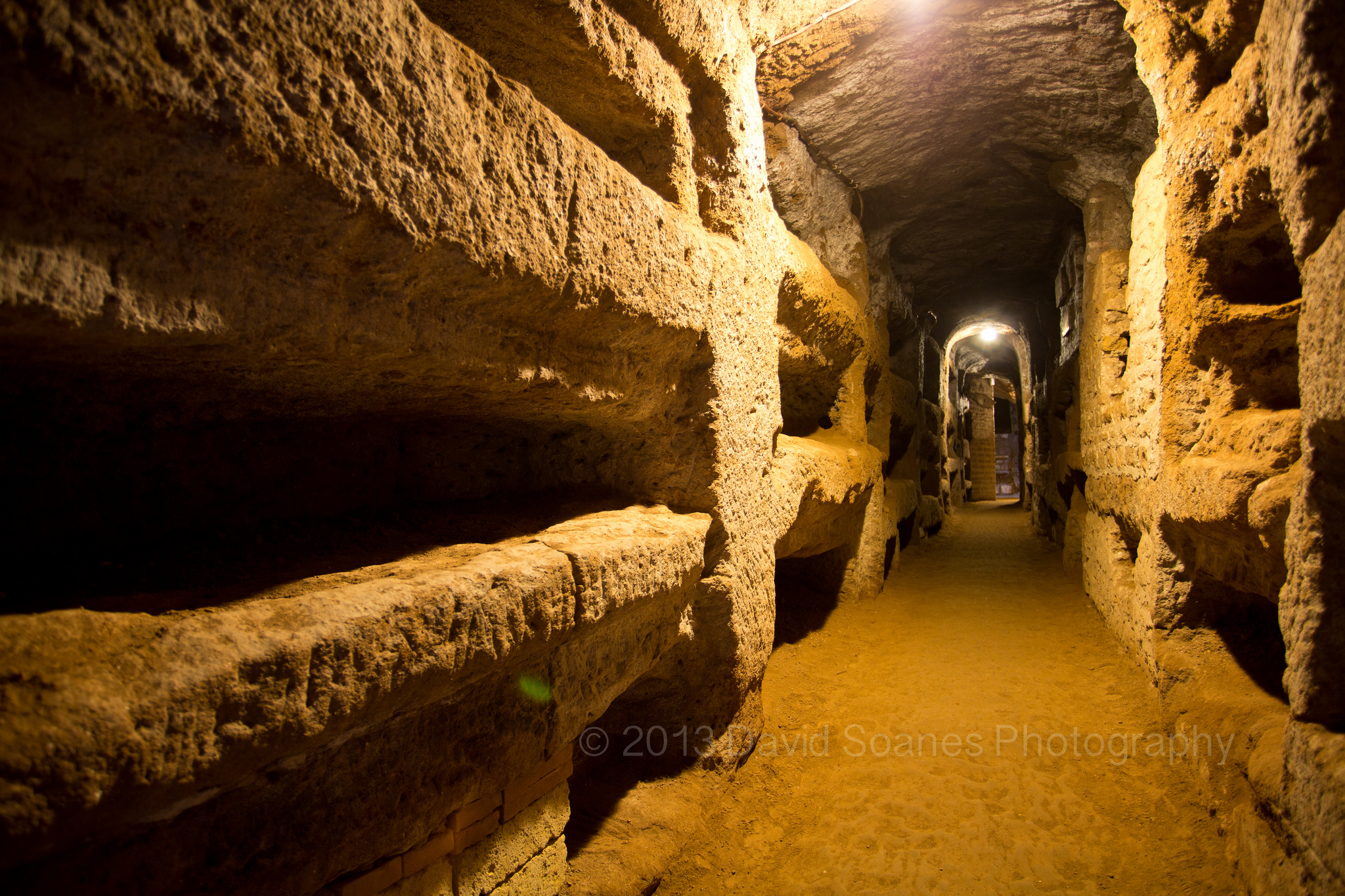
Shortly after founding my own website, I struggled to arrive at a name that would accurately describe Catholics keeping their faith at home without recourse to LibTrad pseudo-clergy. Betrayedcatholics described what had happened to us, but it failed to draw a line between our beliefs and the teachings of those only posing as Catholics. For a while, I simply used the word “homealone” because that is how Traditionalists referred to us. But just as with the term Roman Catholic, why should we allow non-Catholics daily offending Our Lord to demean us with this pejorative label, first mockingly assigned to us by none other than the LibTrad Anthony Cekada? So at first I referred to us as catacomb Catholics, but some readers objected to this because pf Pope Benedict’s ruling, noting that even Catholics in the catacombs had access to a true pope. I then used the term stay-at-home Catholics for a while, but later pray-at-home Catholics or Catholics who pray at home seemed a better term.
And while I entirely accept the ruling of Pope Benedict XV that no labels be used at all, I find it very difficult, in a bewildering world filled with so many sects falsely calling themselves Catholic, not to set us apart somehow. It seems imperative to separate ourselves as members of the one, true Church from those who refuse to follow the teachings of the popes and the ecumenical councils as well as Canon Law in order to make the truth better known. Perhaps it would help to make a distinction here. We may not add a qualifier to our name, for the pope forbids it. But we can rightfully distinguish ourselves from the rest, for circumstances demand it. The Church Herself might call us “Catholics de jure,” meaning those “having a right or existence as stated by law;” versus those who claim to be “Catholic” only de facto — LibTrads “exercising power AS IF legally constituted” (definitions from Merriam-Webster), and therefore having no actualright to call themselves the Church.
As proven repeatedly on this site from thoroughly sound theological sources teaching prior to Pope Pius XII’s death, there is no longer any valid clergy remaining in the Catholic Church. And in their absence Pope Pius XII, in an address entered into the Acta Apostolica Sedis and hence binding on the faithful, has appointed the laity to assume all their responsibilities. That constitutes a legal right, providing no Church teachings or Canon Laws are violated. And yet LibTrads appeal to Canon Law in an attempt to establish this same right, although they fail miserably in their attempt to prove they are even de facto “Catholics.”
Their appeal is based on the ridiculous moral/legal person principle, detailed in Canons 100, 101 — a false interpretation of these canons granting them power over their followers for at least the next 35 years. They claim, using a “legal fiction,” which falls in the same category, from a legal standpoint, as epikeia, that this principle perpetuates the Church indefinitely. A legal fiction is defined as: “…a rule of law which assumes as true, for a just cause, something which is false but is not impossible… ‘Where there is truth, fiction of law does not exist.’…Legal fiction is admissible only in cases explicitly mentioned by law. It must not be extended to similar cases…” (A Manual of Canon Law by Rev. Matthew Ramstein, S.T., Mag., J.U.D, OFM, 1947).
In further commentary on these canons Ramstein writes: “To be such, a moral person in the Church must have obtained a charter of incorporation either in virtue of the law or by decree of the competent ecclesiastical superior…” Paragraph three reads: “Where the law itself does not confer corporate personality, this must be obtained from thecompetent ecclesiastical superior.” This requirement also is found in Can. 147: “An ecclesiastic office cannot be validly obtained without canonical appointment. By canonical appointment is understood the conferring of an ecclesiastical office by the competent ecclesiastical authority in harmony with the sacred canons.” But both the incorporation charter according to Canon Law as well as any the decree of a competent superior is lacking.
LibTrads must point to specific a canon law applicable to their case; a civil law would not suffice. But they cannot point to such a law because it doesn’t exist. And they certainly can’t produce a decree issued by a competent ecclesiastical superior who existed before the death of Pope Pius XII. Therefore they cannot establish even a de facto or fictitious claim of any kind to anything in the Church, having separated themselves from Her communion by pretending to be able to operate independently in the absence of a Roman Pontiff. For Rev. Ramstein notes well that where there is truth, a fiction of law cannot exist. And the truth of the matter, as infallibly taught by Pope Pius XII in Vacantis Apostolicae Sedisis that any attempt to establish an alternative hierarchy in the Church during a sede vacante is null, void and invalid.
We have done our best to become Catholics de jure by attempting to follow ALL the teachings of the Roman Pontiffs and the laws of the Church in all respects, to the best of our ability. LibTrads can’t even lay claim to being Catholics de facto and that’s what separates the two of us. All of those involved in LibTrad sects — all Novus Ordo members and any others who claim to be ”Catholic” — fall under the guidelines laid down by Pope Pius IX, as mentioned in the first few paragraphs of this blog. I call them CINOS, Catholics In Name Only, because that’s all they are. They live in the same type of alternative reality that allows some people today to falsely identify themselves not only as members of certain political parties, but also as historical figures, animals, insects and even as members of the opposite sex. It once was called insanity.
Conclusion
In carrying the faith to others and letting people know what true Catholicism is really all about, we must first focus on our family members and those placed in our path. Charity begins at home, as St. Augustine taught, and our near neighbors, those we meet in way of employment or those who somehow come within our sphere of influence God sends us for a reason. It is to these we are intended to convey the faith, providing that God grants them the necessary graces. LibTrad followers have had many years to see the light, and even though it has been shown to them consistently since 1990 and even before, they have refused to recognize the truth. We owe them our prayers for their conversion, but that is about all that is required of us. The effort must be theirs. We are only required to warn them twice before they are handed over to the Church for judgment, (Matt. 18: 15-17), so we have gone well above and beyond the call of duty, (but only because of the mind control element involved and our obligation to defend the faith).
We cannot place any defining adjective anterior to the word Catholic, but we can and should distinguish ourselves to others as true Catholics, or truly Catholic (separating the sheep from the goats), adhering to all the Church taught prior to Pope Pius XII’s death in 1958, adding that we now have no priests or bishops so simply pray at home. If this statement results in any interest expressed by inquirers, then we can simply explain that what has happened to this country in recent years first happened to the Church in the 1940s, 1950s, and is simply an atheistic Communist process that continues until all that is good is destroyed. I have other ideas about how this label business should be addressed but these will be saved until a later date.
by T. Stanfill Benns | Nov 25, 2023 | New Blog
+St. Catherine of Alexandria+
Some may wonder why so much space is devoted here to end-times controversies and prophecies, but there is actually a method to my madness. When I first joined the LibTrad ranks in the late 1970s, I was initially drawn to the many prophecies and private revelations concerning what I believed even then were the last days of the world. Many have confided to me that they too used this as their “starting point” for understanding what had happened to the Church and how and why it happened. And while many of these private revelations gave a credible description of what we have experienced, they also contradicted each other in many points and incorporated ideas that, as we have seen with Abbot Joachim’s work, were condemned by the Church.
So if this is what may bring people to read what is offered on this site, I want them to understand how such prophecies must be viewed and place cautions on the false ideas many of them contain. I have often been asked why it is that so many of these prophecies foresee the See as vacant, or at least temporarily filled by an antipope, yet also see that clergy and the Holy Sacrifice yet exist. And there is a logical answer for this. We know from Christ’s own mouth that even the elect will be deceived, and certainly that would include Saints and holy people gifted with these revelations. St. Thomas Aquinas warned us, as noted in last week’s blog, that Christ has kept the arrival of Antichrist a closely guarded secret. These seers over the ages were experiencing visions, and certainly it must have appeared to them that clergy were ministering to the people for they could not see (or God did not allow them to see) that LibTrads were not lawfully commissioned clergy, that they were indeed false prophets.
That this could actually happen is confirmed by both Pope Benedict XIV and Rev. Adolphe Tanquerey, as Tanquerey explains here in his The Spiritual Life:
— “Many seers, intertwining their own devout meditations with the revelations they receive, give details, numbers, dates, which contradict historical documents or other revelations.
— “An incorrect interpretation of the message can mislead the seer. St. Gregory and St. Norbert both believed Antichrist lived during their lifetime; St. Paul and St. Vincent Ferrer believed they were living in the end times.
— “A revelation may be unwittingly altered by the seer himself when he attempts to explain [what he saw and/or heard], or, still oftener, by those to whom he dictates his revelations. St. Brigit realized herself that at times she retouched her revelations, the better to explain them; these added explanations are not always free from errors. It is acknowledged today that the scribes who wrote the revelations of Ven. Mary of Agreda, Anne Catherine Emmerich and Marie Latest modified them to an extent difficult to determine.”
And From the Catholic Encyclopedia, 1911, on Private Revelations: “Our information concerning a revelation considered in itself or concerning the circumstances that accompanied it might be secured as follows:
“1. Is there an authentic account, in which nothing has been added, suppressed, or corrected?
“2. Does the revelation agree with the teaching of the Church or with the recognized facts of history or natural science?
“3. Have the revelations been subjected to the tests of time and discussion?”
What we are seeing in the revelations available to us today must be qualified by the above. NO, we cannot be certain that these revelations are authentic accounts; many of them were published after the death of Pope Pius XII and DO NOT agree with Church teaching, especially that of the 20th century popes. And the tests of time and discussion (notthose conducted by LibTrads, however) have proven many of these revelations to be flawed. It is primarily the interpretation of such revelations following Pope Pius XII’s death that have led many into troubled waters regarding the coming of Antichrist and the future of the Church. We know that there will not be a lengthy peace and revival of the Church following Antichrist’s reign, although there may well be a time for repentance. And we know that once the Battle of Armageddon ensues, the Second Coming cannot be far off.
The Great Monarch — (predicted by Joachim of Fiore, at La Salette, by Marie Julie Jahenny, Anna Catherine Emmerich and Anna Maria Taigi, among others): This teaching was initiated by Abbot Joachim of Fiore and therefore can be discounted. The Great Monarch arrives with a Holy Pope, and there is no way outside of a miracle that the papacy could ever be restored according to the laws and teachings of the Church.
Three days darkness — (predicted at La Salette, by Marie Julie Jahenny, also several other seers): This may be confused with the great worldwide earthquake/pole shift that occurs during the Battle of Armageddon, if this passage of Apocalypse is to be interpreted literally. Any “peace” that is predicted following this occurrence may only mean the time after it happens allotted to the earth’s inhabitants to do penance before the Second Coming.
Restoration of the Church, time of peace — (Abbot Joachim, the Jesuit Ribera, Our Lady of Quito, La Salette, interpreted as predicted at Fatima, many others): As seen in previous blogs, this teaching was condemned as dangerous by Pope Pius XII. In any event it cannot be thought that it could happen now, since it would require a miracle to restore the papacy, and Holy Scripture nowhere indicates such a restoration, far less a miracle will occur. All commentators prior to the emergence of the Modernist heresy taught that the Second Coming would directly follow the Battle of Armageddon and casting of Antichrist and his prophet into hell.
And yet there are those who at this moment are calling for a papal election. This time it is Eberhard Heller, editor of the German publication Einsicht, who in a 1990 article in his publication refused to support any suggestion made by this author that a papal election should be held. Of course his efforts would be totally rendered null and void by Pope Pius XII’s Vacantis Apostolicae Sedis but there is this to consider as well: All the “bishops” he promotes as candidates for the office were created by a man who, in his very declaration that the Holy See was vacant, incredibly signed himself as a titular archbishop appointed by the very man he was reputedly renouncing — Paul 6! That man of course was the Vietnamese bishop Peter Martin Ngo dinh Thuc, notorious for his indiscriminate ordinations and consecrations of numerous unqualified and scandalous bishops and priests. There is no doubt that he signed himself as the Archbishop of Bulla Regiae, as the documents in his own handwriting below attest:
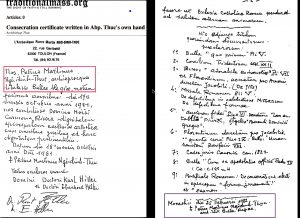
(A clearer image of this document is available on request.)
And as Traditionalist Clarence Kelly rightly documents in his The Sacred and the Profane, there were grave doubts from the beginning that Thuc had ever separated himself from the Novus Ordo and was even sufficiently mentally competent (owing to his advanced diabetes) to have the proper intention to ordain or consecrate anyone. So the promotion of this “election” is yet another rabbit hole now being created to trap unwary Catholics. Below, we see that St. Vincent Ferrer warned us we would be plagued by learned men shall abandon the truth and will fail to preserve the Apostolic Succession.
Highlights from the teaching of St. Vincent Ferrer
“By study of Holy Scripture and by factual experience we know that when any great and heavy affliction is about to come on the world, often some warning sign is shown in the sky or in the upper air. And this happens by the mercy of God, so that people forewarned of impending tribulation by means of these signs, through prayer and good works, may obtain in the tribunal of mercy a reversal of the sentence passed against them by God the judge in the heavenly courts; or at least by penance and amendment of life, may prepare themselves against the impending affliction… So, before the coming of any great mortality, phantom battles are seen in the sky; before famine there are earthquakes; and before a country is laid waste dreadful portents are seen.
“In my text there are four clauses in which we are warned of the four ways in which Antichrist will deceive Christians… (1) The first clause tells us that there will be signs in the sun in the time of Antichrist… The Sun of justice will be obscured by the interposition of temporal goods and the wealth which Antichrist will bestow on the world, inasmuch as the brightness of faith in Jesus Christ and the glow of good lives will no longer shine among Christians…How do the peoples of the world sin against God today? They sin in order to gain honors, dignities and riches. Therefore, by honors, riches and dignities, God permits that Antichrist shall deceive them. If therefore you do not wish to be deceived, now with all your hearts contemn and despise all earthly goods, and long for those of heaven, considering that the goods of this world are transitory and empty, while heavenly and celestial goods are eternal. In this way you will be strong. Saint John gives this counsel: “Love not the world nor the things that are in the world. If any man loves the world the charity of the Father is not in him. And the world passeth and the concupiscence thereof” (1 Jn 2:15-17).
“(2) The second clause says that there will be signs in the moon… In the Holy Scriptures the moon signifies our holy Mother the Universal Church, which implies the world-wide union of Christians… The Church is signified by the moon and its five phases: …The waning moon typifies the inability of men to preserve what the Apostles had acquired. The old moon, because the horns are reversed, typifies that the Church is no longer in the state in which Christ founded it. Christ founded the Church in great lowliness and poverty; now all this is turned round to pride, pomp and vanity, as may be easily seen in every rank of the Church… Nothing is now left to make matters worse but an eclipse which is caused by the interposition of the earth between the sun and moon such as only occurs at full moon. As Isaiah says in 59:2: “Your sins have put a division between us.” In the time of Antichrist, the Church, typified by the moon, will be eclipsed; because then she will not give her light, since Christians will no longer work miracles by reason of their sanctity; but Antichrist and his followers will work miracles, not true miracles, but false ones having the appearance of true miracles, in order that they may deceive the people, as Saint John says in the Apocalypse (13:13)…
“(3) The third clause says that there will be signs in the stars. In the Sacred Scriptures “star” signifies “light-giving”; and so it is the appellation of Masters, Doctors, and Licentiates in Theology. This signification is found in Daniel (12:3) : “And they that are learned shall shine as the brightness of the firmament; and they that instruct many to justice, as stars for all eternity.” In these stars, that is learned men, there will be signs in the time of Antichrist; because, as Christ says in the Gospel of Saint Matthew (24:29) : “Stars shall fall from heaven”; and this is the third combat waged by Antichrist, that of disputation. Then stars, that is the learned, shall fall from heaven, that is, from the truth of the Catholic Faith…
“(4) The fourth clause tells us: “And on earth distress of nations by reason of the confusion of the roaring of the sea and of the waves.” Behold these are the tortures which Antichrist will inflict, and on the earth distress of nations by reason of the confusion of the roaring of the sea and of the waves. That is the preparations for battle, the sanding of the arena before the combat, which will be the work of the lords who are already on the side of Antichrist; because then no one will dare to name Christ nor the Virgin Mary under pain of death; and the waves are those of torments which have never in the past been so dreadful as those which will be inflicted by Antichrist. In Saint Matthew, Christ warns us (24:21): “For there shall then be great tribulation such as hath not been from the beginning of the world until now, neither shall be. And unless those days had been shortened, no flesh should be saved; but for the sake of the elect those days shall be shortened.” (See St. Vincent ‘s entire sermon on The End of the World and the Final Judgment HERE.)
As to no. 1, we have seen strange signs in the skies and have heard strange noises. We have seen the many earthquakes, most likely preceding a coming famine. And other portents also have been seen before nations have been invaded and destroyed. Most certainly we have witnessed the devastating effects of materialism, which has turned everyone form the love of God to the love of earthly goods. This is what prepared the way for the coming of Antichrist.
Regarding no. 2, we have seen this total eclipse of the Church since the death of Pope Pius XII. It is no longer the Church Christ founded because it has no head, only false prophets, thieves and hirelings at its helm. Notice that St. Vincent does NOT interpret this eclipse to mean that the Church will be renewed once this eclipse is past. Holiness has gone out of the Church and She is no longer one.
(3) The fall of the theologians is quite evident, and this began long before the death of Pope Pius XII. What St. Vincent and St. Thomas do not envision is the actual fall of the hierarchy, although St. Vincent insinuates it when he says the Church will no longer exist as Christ constituted it. Note here that Antichrist wages his war by “disputation,” which most certainly refers to the Novus Ordo “dialogue” process but also to the many bitter quarrels and disagreements among the LibTrad crowd.
(4) Antichrist prepares the way for the Battle of Armageddon here. The tortures mentioned are always interpreted as physical and this may well be experienced toward the end by many, but we know from experience that they are primarily mental and emotional, which is why they are so terrible. And these torments have been inflicted for far longer than any three years and a half, which is the length of time St. Vincent and others believe Antichrist will reign, (but as explained elsewhere, this refers only to the HEIGHTH of his reign).
Had St. Vincent’s and St. Thomas Aquinas’ teachings been included in these prophetical works circulating today, Catholics might have had a better understanding of the Church’s total dissolution and the violation of Her constitution. But for obvious reasons, they became available only with the advent of the Internet. Antichrist’s powers of deception far exceeded anything that even the more devout among the faithful ever anticipated.
Virtues to be practiced by faithful Catholics
(See entire sermon here.)
St. Vincent extracts five virtues from Holy Scripture that most become Christ’s sheep: “simple innocence, ample mercy, steadfast patience, true obedience, and worthy penance.” By simple innocence is meant that a person “lives simply, nor hurts anyone in his heart, by hating, nor by defaming in speech, nor striking with hands, nor by stealing. This life “is called simple innocence, which makes a man a sheep of Christ… If you wish to be a sheep of Christ, you should strike no one with horns of knowledge or of power, for lawyers strike by the horns of knowledge; jurists, advocates, or men who have great knowledge. Merchants by deceiving others. Lords and bullies strike with the horns of power, plundering or injuring, and extorting, using calumnies and threats, and the like.
“Listen to what the Lord says by the mouth of David: ‘And I will break all the horns of sinners: but the horns of the just shall be exalted’ (Psalm 74:11).” A neighbor’s reputation is defamed by saying “…nothing good; praising someone, but only the bad… Defamers are not the sheep of Christ, but wolves of hell.” He also warns, “Children, do not hate your parents; nor parents, children; nor young people, old folks; nor the healthy, the sick; nor rich, the poor; nor masters, their servants; nor prelates, their clergy; and vice versa. It is clear what is simple innocence.”
“The second virtue, ample mercy, is when goods, both temporal and spiritual given to you by God, are given out and distributed to the needy. This is how one becomes a sheep of Christ. St. Vincent tells us that this is because, “Among all the animals a sheep is the most beneficial of animals. For the sheep by growing wool, shows us mercy and benefits of mercy, because how many poor people does a sheep clothe? Also it gives us milk, and lambs to eat. We imitate and give love this way: our wool is “external and temporal goods, bread and wine, money and clothes and the like.” Milk means “interior and spiritual goods, by giving good teaching to the ignorant… If you have the milk of knowledge, of devotion, or of eloquence, you should give to those not having them.” For Jesus told the sheep, “For I was hungry, and you gave me to eat; I was thirsty, and you gave me to drink… naked, and you covered me” (Matthew 25:35-36).
Third, steadfast patience comes in different forms, such as when someone “suffering from injuries inflicted or spoken to him does not want to concern himself with taking revenge. Rather he loves everyone in general and prays for them all.” This because, “The sheep is a most patient animal, for if harassed while eating, or if struck, it does not defend itself, but goes elsewhere, nor does it avenge itself like a dog or a goat would do, but humbly yields. O blessed is the person, man or woman, who has such patience, and takes no vengeance for injuries, but forgives, as God forgives him.”
Fourth, true obedience means ordering all thoughts, words and actions according to God’s will, not ours, just as sheep are so obedient that a child with a staff easily “can easily guide 30 or 40 sheep.” If therefore on the day of judgment you wish to be a sheep of Christ, you will be obedient to the shepherd, namely to him who said: “I am the good shepherd; and I know mine, and mine know me,” (Jn 10:14). Let us see now, what this shepherd commanded. First that we live humbly. Matthew 11: “Learn of me, because I am meek, and humble of heart,” (Mt 11:29). “Be you humbled therefore under the mighty hand of God,” (1 Pt 5:6), namely of your shepherd etc. Whoever therefore wishes to go by the path of pride, is not a sheep of Christ but a goat of the devil.” As pointed out here so many times, God’s signified will is found in his laws and those of His Vicars. If we are not following ALL of these, we are not obeying His holy will.
“The fifth virtue is worthy penance, for sins committed. Because no one can be exempt from sins. And so it is said: “For there is no just man upon earth, that does good, and sins not,” (Eccl. 7:21). Therefore worthy penance is necessary, by sorrowing for sins and proposing not to relapse, confessing, and making satisfaction. And in this way penance makes a man a sheep of Christ. Reason: For a sheep and goat differ. Because a sheep covers its private parts with a tail, but not so a goat. Rather it shows everything. Now you know who is a sheep and who a goat. All– how many we are – have “private parts” of sins, which, although they are not now apparent, nevertheless on the day of judgment all evils and sins will be out in the open… But if the private parts of sins are covered here with the tail of penance, then they will not be revealed to your confusion, nor to your shame… “But if the wicked does penance for all his sins which he has committed, and keeps all my commandments, and does judgment, and justice, living he shall live, and shall not die. I will not remember all his iniquities that he has done,” (Ez 18:21-22). So David says in Psalm 31: “Blessed are they whose iniquities are forgiven, and whose sins are covered,” (Ps 31:1).”
So St. Vincent tells us here how we must conduct ourselves during Antichrist’s reign and beyond. We mut be as wise as serpents yet as guileless as doves, keeping to ourselves and keeping the Commandments. We must share what we have and know with others, that they too may come to know the truth. We must suffer wrongs patiently and pray for our enemies, although as St. John Chrysostom also says, “He who can never love Christ enough will never give up fighting against those who hate Him.” We must do God’s will in all things and this means avoiding heretics, hirelings and thieves — false prophets who seek to poison our minds that they might destroy our faith. And finally, we must do penance, and what better penance could we offer to God than to obey His laws in order to avoid the Novus Ordo and LibTrad sects with their parodies of the Mass and Sacraments, their false teaching and their pretended piety? Doesn’t Holy Scripture tell us that obedience is better than sacrifices, and a contrite heart God will not despise?
by T. Stanfill Benns | Nov 18, 2023 | New Blog
+ Dedication of the Basilicas of Sts. Peter and Paul +
As mentioned in last week’s blog, St. Vincent Ferrer seems to have had some sympathy for the teachings of Joachim of Fiore, even though St. Thomas Aquinas, who St. Vincent quotes often and follows in other writings, had already condemned those who held Abbot Joachim’s and similar teachings. (The teachings of St. Vincent will be discussed in greater detail next week.) This week, we wish to address the teachings of St. Thomas, of whom one modern-day philosophy professor notes, “There comes a point, however, where Ferrer breaks with Aquinas over a central topic: the possibility of having knowledge of the end times –– those of the coming of the antichrist and the end of the world. Aquinas had written a series of rebuttals of William of Saint‐Amour and other authors who upheld the possibility of such knowledge. For Aquinas, the end times could not be known about, either through reasoning or through a revelation. Jesus of Nazareth himself appears to have denied this possibility: “It is not for you to know the times or the seasons, which the Father hath put in his own power.” (Acts 1:7).
“He tells how a hermit has assured him that two of his companions had had a revelation that “the antichrist was already born”. Ferrer replies with the same words from the Bible (Acts 1:7) used by Aquinas to counter William of Saint-Amour, although, according to the hermit, Jesus’s words applied only to those he was addressing (the Apostles), not to those destined to undergo the tribulations brought by the antichrist. Then, in a sermon on 8 July 1411 and a letter dated 27 July 1412, Ferrer adopts the hermit’s interpretation as his own…”
So what St. Vincent was doing was basing his mission on the revelation of the hermit (and a vison he possibly attributes to himself) — in other words, on private revelation. Or, as St. Thomas refers to it, “Human reason or conjecture.” And yet St. Vincent does make some distinctions in what he teaches regarding Antichrist. And although St. Vincent may have relied on human reason, it is clear he proved that his mission was from God by the miracles he performed during his lifetime.
St. Vincent Ferrer
“The death of Antichrist and the end of the world will occur at the same time. The shortness of the duration of the world after the death of Antichrist has led me to this conclusion, for nowhere in the whole Bible or in the writings of the Doctors can I find a longer period assigned by God for the repentance of those whom Antichrist has seduced than forty-five days after his death.
“The second conclusion I draw is that until Antichrist is actually born, the time of his birth will be hidden from mankind.
“So, even though there were the most illuminating revelations of the divine Wisdom concerning these matters, it was not necessary for the Apostles and Doctors of the first ages of the Church to know the time of the coming of Antichrist and the end of the world; but after his birth it is expedient for men, even though they be sinners, or so ignorant as to know nothing of the Apostles and Doctors, to know of this birth, so that they may be forewarned and prepared.This is in accordance with the wisdom, mercy and knowledge of God, who from the beginning of the world was accustomed to send messengers to warn men of any great tribulation about to come to pass. Noah was warned before the deluge, Moses before the liberation of Israel, Amos before the destruction of Egypt, and so on.” Before treating these predictions in light of St. Thomas’ teachings, a note is in order on what has been said previously in this blog and in site articles on Antichrist and the Second Coming.
(Clarification of these statements will be provided under the Conclusion heading.)
Antichrist and the Second Coming
I have speculated at length on the relevance of recent events and their possible relation to the Second Coming. Prior to that, I had already written for decades on the identity of Antichrist — the usurper Paul 6. But what I wrote took place AFTER Antichrist had already appeared, and could be credibly identified as such, not BEFORE. And while St. Thomas Aquinas and St. Augustine definitely do teach that no one could actually predict the date of Antichrist’s appearance or that of the Second Coming, once he has actually been credibly predicted to appear and has come and gone it would seem remiss to not warn others that surely the Second Coming is not far off, particularly if signs seem to point to this.
St. Thomas could scarcely have discounted Pope Paul IV’s warning about HOW the abomination of desolation would attempt to insinuate himself into the papacy, while not predicting at exactly what time this would occur. Nor could he dare find fault with Christ’s own Vicar, Pope St. Pius X, who warned in 1903 that Antichrist already had been born. It was common knowledge that Pope St. Pius X was gifted with precognition, and certainly this sainted pope was no mere hermit who was said to have had a vison, since his teachings were assisted by the Holy Ghost. It has been based on these two predictions, also on Pope Pius XII’s laws regarding papal election, that the identification of Antichrist’s reign became clear and was later able to be determined.
St. Thomas Aquinas: Contra Impugnantes, on the Inability to Determine the Arrival of Antichrist and the Last Judgment
Chapters 3 and 4 (These are random extracts form a very long discourse by St. Thomas)
“Hence religious, because they exercise the office of preaching in a learned manner, are regarded as the forerunners of Antichrist.
- “I saw another beast coming up out of the earth, and he had two horns like a lamb” (Rev. xiii. 11). On these words of the Apocalypse the Gloss remarks: “The description of the tribulation which will be caused by Antichrist and his princes is followed by a narrative of the evils which will befall the Church, by means of the apostles of Antichrist, who will travel throughout the entire world.” Again, “coming up out of the earth” signifies “ going forth to preach” (Gloss). On the words “it had two horns” the Gloss remarks: “These preachers are said to have two horns, because they will profess to imitate the innocent and spotless life of our Lord, to work miracles resembling His, and to preach His doctrine; or else because they will usurp to themselves the two Testaments.” Hence it would appear that they who go forth to preach, with the knowledge of the two Testaments, and with an appearance of sanctity, are the apostles of Antichrist. (Comment: Which is exactly what Novus Ordo and LibTrad pseudo-clergy do.)
“Julian the Apostate was the first to conceive this idea. He, as we are told in ecclesiastical history, forcibly prevented Christians from acquiring knowledge. Those therefore who imitate him, by forbidding religious to study, act in a manner opposed to the precepts of Scripture. We read, for instance, in Isaiah (v. 13): “Therefore is my people led away captive, because they had not knowledge.” “Because,” remarks the Gloss, “they would not have knowledge.” Now voluntary ignorance could not deserve punishment, were not knowledge praiseworthy.
“2. In the Prophet Hosea (iv. 5) we read: “In the night I have made your mother to be silent. My people have been silent, because they had no knowledge; because you rejected knowledge, I will reject you that you shall not do the office of priesthood to me.” This text clearly shows how severely ignorance will be punished.
“3. In Ps. cxviii. 66, we read: “Teach me goodness and discipline and knowledge.” On these words, the Gloss says: “Teach me goodness, i.e. inspire me, with charity; teach me discipline, i.e. give me patience; teach me knowledge, i.e. enlighten my mind. For that knowledge is useful, whereby a man becomes known to himself.”
“4. St. Jerome writes to the monk Rusticus: “Let a book be never absent from your eyes or hand.” Hence the learning of the saints is preferable to the holiness of the unlearned. In the same epistle, after enumerating the books of holy Scripture, St. Jerome continues: “I beseech you, brother, let these books be the companions of your life and the subject of your meditation. I know nothing but these, and seek no other thing. Don’t you see that in this way you may on earth enjoy the Kingdom of heaven?” A heavenly life then consists in the constant study of Holy Scripture.
“5. St. Paul points out that knowledge of the Scriptures is essential to preachers. For, he says (1 Tim. iv. 13), “Till I come attend unto reading, to exhortation, and to doctrine.” It is evident from this that a knowledge of what they are to teach, is necessary for those whose duty it is to preach and to exhort.
“6. St. Jerome writes to the monk Rusticus: “Spend much time in learning what you must later on teach.” Once more he writes to the same, “If you desire to enter the clerical state, study, in order that you may teach.” … (Comment: Catechetical teaching was greatly neglected in favor of promoting the new liturgy, as theologians writing pre-Vatican 2 observed.)
“There shall arise false Christs and false prophets” (Mark xiii. 22), the Gloss says: This verse is to be understood as referring the heretics who attacked the Church, declaring that they were Christs. The first of these impostors was Simon Magus; the last will be Antichrist.” He who preaches without, any commission to do so, or teaches false doctrine, does so inspired by some bad motive, either of covetousness, or pride, or vain glory. Such men are deprived of the grace of God; and consequently commit sins, more or less heinous. But everyone who preaches for the sake of gain or popularity is not, necessarily a false apostle or false prophet; otherwise there would be no distinction between a hireling and a false apostle. They who preach for the sake of anything save of the glory of God and the good of souls are hirelings; let their preaching be true or false, authorised or unauthorised. BUT SUCH MEN CANNOT BE CALLED FALSE PROPHETS, UNLESS THEY EITHER BEAR NO COMMISSION, OR TEACH FALSE DOCTRINE. (Comment: Here we have a definition of LibTrads from St. Thomas own mouth!) “In the same way, every sinner who administers the sacraments, or preaches the Word of God, is not necessarily a false apostle or a false prophet. For true prelates are true apostles; although at times they may be sinful.
Chapter 5
“1.St. Augustine says (Epist. ad Hesychium): “You say the Gospel tells us that no man knows that day or hour. I tell you, as far as my understanding will suffice, that no man can know the month nor the year of the coming of the Lord. This seems as if the words had been understood to mean that, though none can say in what year the Lord will come, it is possible to know in what septet or decade of years his coming may be expected.”
“2. Certain men were condemned in the early days of the Church for teaching, as men teach now, that the coming of the Lord was imminent. We have this on the authority of St. Jerome (De illustr. viris), and of Eusebius, (Ecclesiast. Histor.).No period, either long or short, can be determined, in which is to be expected the end of the world, or the coming of Christ or of Antichrist. It is for this reason that we are told that “the day of the Lord shall come as a thief” (1 Thes. v. 2), and that as “in the days of Noah they knew not till the flood came and took them all away, so also shall the coming of the Son of man be” (Matt. xxiv). St. Augustine, in his Epistle to Hesychius, speaks of three classes of men who made assertions respecting the coming of our Lord. One class expects Him soon; another later; and the third declares its ignorance of the time of His coming. This last opinion meets with the approbation of St. Augustine, and he censures the presumption of the others. Then he concludes by saying: “It is thus uncertain by what generations the final period of time, which begins with the coming of our Lord and is to end with the end of the world, is to be counted.” God has chosen, for some wise purpose, to keep this hidden. So it is written in the Gospel. St. Paul also declares that “the day of the Lord is to come like a thief in the night.”
“3. (1) They quote the words of Daniel (vii. 25) concerning Antichrist: “He shall think himself able to change times.” That is to say, according to the Gloss, “ His pride is so excessive that he strives to alter laws and ceremonies.” On account of these words the days of Antichrist are said to be at hand, because certain men try to alter the Gospel of Christ into another gospel, which they call “eternal.” The Gospel of which they speak is a certain Introduction to the books of Joachim, WHICH IS CONDEMNED BY THE CHURCH. Or else it is the doctrine of Joachim, whereby they say the Gospel of Christ is altered. But granted that this hypothesis were true, it would be no token of the approach of Antichrist. For even in the days of the Apostles, certain men tried to alter the Gospel of Christ. Thus St. Paul says (Gal. i. 6): “I wonder that you are soon removed from him who called you into the grace of Christ, to another Gospel.”
“(2) The second sign of the coming of Antichrist is supposed to be found in the words of the Psalmist (ix. 21): “Appoint, O Lord, a lawgiver over them.” This the Gloss interprets to mean “the Antichrist, the giver of an evil law.” As the doctrine which we have already mentioned, which they call the law of Antichrist, was promulgated at Paris, it is thought to be a sign that Antichrist is at hand. But it is not true to say that the doctrine of Joachim, or that which is contained in the Introduction to the Gospel of Joachim, however reprehensible it may be, is the doctrine which will be preached by Antichrist.
“(3) The third supposed sign of the coming of Antichrist is found in the Book of Daniel (v) and in Isaiah (xxi). We read there the account of the hand that wrote Mane, Thecel, Phares on the wall of Babylon. Those who believe that Antichrist is at hand, maintain that the same prediction which formerly was written up in Babylon is now written in the Church. Mane was interpreted to mean, “God has numbered your Kingdom and has finished it”; and the Kingdom of Christ is now numbered, for it has been foretold that it is to endure a thousand two hundred and seventy years. Thecel signified, “You art weighed in the balance and found wanting”; and the “Eternal Gospel” is preferred to the Gospel of Christ. Phares meant your Kingdom is divided and is given to the Medes and Persians”; and the Kingdom of the Church is now finished and given to others.” (Comment: It may not have applied in St. Thomas’ time but certainly applies to the Novus Ordo today.)
“Thus, the writing on the wall signified both the destruction of the Church and the ruin of Babylon. (Comment: St. Jerome does say that everything written in the New Testament was foreshadowed in the Old Testament.) “This, however, seems a very foolish idea. St. Augustine tells us (18 de Civ. Dei) that certain men said that Christianity was to last for three hundred and sixty-five years, and that at the end of that time it was to cease to exist. Thus, it is no new thing to assign a limit for the duration of Christianity, since this was done even before the time of Augustine. Hence this is no reason for believing Antichrist to be at hand. St. Augustine says likewise (ibid.) that in his time some men estimated that four hundred years, others that five hundred, were to elapse between the Ascension of Christ and His second coming. Others, again, reckoned that this period was to embrace a thousand years. But the words of our Lord, “It is not yours to know the times or the moments” etc. (Acts i. 7), expose the folly of all such suppositions. St. Augustine, furthermore, blames the kind of arguments.
“(Acts i. 7), (St. Augustine, furthermore, blames the kind of arguments used in such conjectures. He compares them to the hypothesis of some that as there were ten plagues of Egypt, so there were to be ten persecutions of the Church. He says that such opinions are mere human conjectures, established on no foundation of truth. Those who interpret the handwriting on the wall as prophetic of the speedy coming of Antichrist, show their agreement with the Scripture that they reprobate; because, like the Scripture, they say that the beloved Babylon is soon to be destroyed. But there is no real similitude. For the handwriting in Babylon was divinely displayed, and it was therefore a proof of the truth; but the writing, of which these would-be prophets speak, is a figment of error, on which no argument can be founded expose the folly of all such suppositions.” (Comment: Joachim’s writings were a figment of error because he expected the world to end based solely on his own prognostications. The prophecies in Apocalypse are also divinely displayed but were not fulfilled in St. Thomas’ day.)
“6. Many false prophets shall arise and shall seduce many.” We are told that this sign is now manifested, because certain religious appear who are called false prophets. If we compare it with the Gloss on the passage in the Gospel of St. Mark (xiii), where false prophets are understood to mean heretics, or those who, after the Passion of our Lord and before the destruction of Jerusalem, seduced the Jewish nation. We have also already spoken at length on the subject of false prophets.
“7. There have been in all ages men in the Church who appeared perfect, and yet originated heresies. We may mention Pelagius, Nestorius, and Eutyches. There have also been many others of the same description. But they did not, therefore, prove that their charity had grown cold. For, although they did not follow the teaching of the Gospel, they did not persecute it. There is no need of persecution, where there is no defender of the truth. Such a persecution would revive extinct errors; and, under pretext of refuting them, would teach them to the people; and this is the greatest of dangers. Hence St. Gregory says (14 Moral.) that after Eutyches had died leaving no followers, he would not labour to exterminate his errors, lest he should again fan them into flame. (Comment: Modernism, synthesis of all heresies, fanned these flames into a conflagration.)
Chapter 6
“They assert that these seducers will be neither barbarians, nor Jews, nor Gentiles. But this opinion is contrary to the prophecy of the Apocalypse: “Satan… shall seduce the nations which are over the four quarters of the Earth, Gog and Magog” (Rev. xx. 7). On these words, the Gloss says: “Satan will first seduce these two nations; he will then proceed to deceive others.” Or, according to another interpretation, by Magog is understood all persecutors who proceeded, at first by secret, and afterwards, by open persecution. Hence barbarians are not excluded from the persecution of Antichrist, as they would persuade us.
“For St. Paul did not mean that the same men would be guilty of all the vices which he enumerates, but that some of his words would apply to some men, and that other parts of his reproof would be true of other persons. Hence it is not necessary that all those who are likely to endanger the Church should present an appearance of piety. It is merely implied that some of them will do so. In like manner, the early Church suffered persecution from believers and unbelievers alike. “In perils from the Gentiles… in perils from false brethren” (2 Cor. xi. 26).
“The emissaries of Antichrist, we are next told, will not be found among the manifestly wicked. This opinion is, however, clearly opposed to the 82nd Psalm. The Gloss explains that the whole of that Psalm treats of the persecution of Antichrist. It adds that among his other emissaries, the “Philistines” signify those who are drunk with worldly luxury… But, although some of the emissaries of Antichrist may wear an appearance of piety, it is not necessary that they shall all seem godly. Christians of the early Church were persecuted both by the impious and by the apparently pious.” (Comment: Materialism, foundation stone of the Masonic pyramid, paved the way for all other errors.)
“We are further told that the ministers of Satan will be found among those who devote themselves to study… St. Paul was referring not to men who seduce others, but to silly women who suffer themselves to be led astray. Granted, however that the words apply to men who mislead others, they can only refer to those who, in their studies, depart from the way of truth. Hence the text is often interpreted of heretics. Those who hold a contrary opinion, however, quote in support of it the following words of St. Gregory (13 Moral.) on Job xvi.: “My enemy has looked at me with terrible eyes.” “The incarnate Truth,” says St. Gregory, “chose for His preachers poor and simple men. But Antichrist will send as his Apostles men who are cunning and double-tongued and imbued with the wisdom of the world…” Therefore, the true preachers of Antichrist are learned men, who lead worldly lives and attract men to vice. But even if Antichrist were going to ruin the Church by means of learned men, it would not be by their agency alone.
“We are further told that the envoys of Antichrist will be found among those learned men whose opinion is esteemed as peculiarly weighty and valuable… St. Paul says of them, first that they will have an appearance of godliness, and then that they will be “men corrupted in mind, reprobate concerning the faith” (2 Tim iii. 5). Stress is also laid on the words, “they came forth from us” (1 John ii. 19), which means, as the Gloss says, “they shared with us in the Sacraments.” But this quotation is no argument. For St. Paul does not say of the men to whom he refers that at first they wore an appearance of piety, and that then, laying it aside, they became infidels. What he means is that while these men had a superficial semblance of godliness, they were at the same time infidels at heart.” (Comment: And here we see exactly what happened with the rot that entered into the Church and led to Roncalli’s election: the cardinals and bishops had only “a superficial semblance of godliness, they were at the same time infidels at heart.” They were pretenders who could only elect and support a master pretender.)
Summary
“1. The first error lies in defining the heralds of Antichrist as one race of men, when, as “we know by the Gloss on Ps. lxxxii, Antichrists will spring from all classes of men.
“2. The second error lies in the fact that though diverse authorities may be quoted in support of individual points, no class of men furnishes all the necessary conditions.
“3. Even were some such men found amongst religious, other such might likewise be found among men who are not religious. Hence this argument does not tell more against religious than against seculars.
“4. If some religious are to be emissaries of Antichrist, all religious will not be his adherents. Perhaps very few religious will join Antichrist, as he is to recruit his ranks from all classes of men.
“5. It is praiseworthy to be a Christian, a learned man, a prudent counsellor, and a religious. These attributes, therefore, are no reason for concluding that their possessor is to be a forerunner of Antichrist.” (End of of St. Thomas commentary)
Conclusion
Now of course St. Vincent Ferrer wrote and taught long after the death of St. Thomas Aquinas. And if there had really been anything objectionable in his writings, anything even approaching the condemned doctrines that Abbot Joachim taught, he would never have achieved sainthood. Nor would he have been noted for his miracles. So while Saint Thomas Aquinas’ teachings must definitely be honored here and taken to heart, that doesn’t mean that there couldn’t be new developments and new perspectives on the coming of Antichrist and how this would come about. It is clear from what has been written above that we are not predicting Antichrist is going to come as was St. Vincent or naming a date for anything. We are simply observing that it certainly appears that he has already come and that as St. Thomas Aquinas himself says in his own works, we cannot properly estimate the time-period between Antichrist’s death and the end of the world, when so many will believe they have nothing to fear and live “in peace and security.” We must simply pray and watch.
Neither St. Thomas nor St. Vincent Ferrer ever foresaw how everything in the Church would be so utterly destroyed. The death of Antichrist will not be complete until the final perpetrator of his system is annihilated, the last reincarnation of his imposture. We know Antichrist and the false prophet will be thrown alive into the lake of fire and how could this be? Only if the final judgment began with their bodily resurrection and casting into that lake of fire by Christ during the Battle of Armageddon. That is the beginning of the Final Judgment, and on its heels will most likely follow all the rest.
What St. Thomas Aquinas emphasized in his writings above is the inability of forecasting Antichrist’s future coming and the Second Coming according to insufficient evidence, particularly that based primarily on human conjecture. That is not what has been done in the case of the Great Apostasy, the advent of the Novus Ordo church and the Cessation of the Holy Sacrifice. The consequences of these things St. Thomas never even considered. We are not conjecturing anything in the future here; we have witnessed it with our own eyes. St. Thomas also is denying that certain prophecies in the Old Testament can be used by his opponent William St. Amour, a follower of Abbot Joachim, to justify his case. That does not mean it could not and does not apply to the case at hand today. Basically St. Thomas believed that not much would really be known about the coming of Antichrist until the actual event.
Next week, we will see the virtues St. Vincent Ferrer advises Catholics to practice during Antichrist’s reign, and how he viewed Antichrist’s persecution and Christ’s Second Coming.
by T. Stanfill Benns | Nov 12, 2023 | New Blog
+24th Sunday after Pentecost+
It never fails to amaze me how many different ways the enemy can attempt to confuse and defuse those who are trying to defend the faith and obey the laws of God. And this time, while standing next to an oversized portrait of St. Thomas Aquinas, no less! This attack comes from a Novus Ordo apologist, Taylor Marshall, who, ever so slyly insinuates that those praying at home are adhering to an old heresy that has been defended and advanced by some Novus Ordo theorists, but mainly LibTrads and other schismatic sects, for decades. (His video can be viewed HERE.) Of course he makes his accusations based on the assumption that those praying at home actually have valid and licit sacraments available to them but choose instead to forego them in favor of approaching God directly, when no valid Sacraments save marriage and Baptism are available to us today. And needless to say, he is inviting us to receive the infernal parody of the Sacraments offered by the counter-church. When pigs fly.
The heresy Marshall refers to is that of “Bl.” Joachim of Fiore, a 13th century Capuchin abbot, but he fails to inform his viewers that Joachim’s status as a beatus is one arbitrarily assigned to him by his admirers, not by a true pope, (see here). He even gives his feast day as May 29, which can be found in none of the beati listed with the saints in Butler’s Lives of the Saints or elsewhere. Marshall never really classifies the abbot’s teachings as heretical, when in reality Pope Alexander IV, in 1256, condemned Joachim for his teachings and those of his followers, (but this was after his death). The Lateran Council and Pope John XXII also condemned his followers for teaching the same errors. But even before this, his teachings had been condemned by St. Thomas Aquinas and other theological schools, although St. Thomas Aquinas was aware that “…however dangerous the abbot’s doctrines were, the Joachites [his followers] had gone far beyond them” (Bernard McGinn; see Conclusion below for citation). So what was it that Joachim of Fiore taught? We read from the Catholic Encyclopedia, followed by my comments:
“There are three states of the world, corresponding to the three Persons of the Blessed Trinity. In the first age the Father ruled, representing power and inspiring fear, to which the Old Testament dispensation corresponds; then the wisdom hidden through the ages was revealed in the Son, and we have the Catholic Church of the New Testament; a third period will come, the Kingdom of the Holy Spirit, a new dispensation of universal love, which will proceed from the Gospel of Christ, but transcend the letter of it, and in which there will be no need for disciplinary institutions. Joachim held that the second period was drawing to a close, and that the third epoch (already in part anticipated by St. Benedict) would actually begin after some great cataclysm which he tentatively calculated would befall in 1260. After this Latins and Greeks would be united in the new spiritual kingdom, freed alike from the fetters of the letter; the Jews would be converted, and the “Eternal Gospel” abide until the end of the world.”
Comment: No need for disciplinary institutions? Wasn’t this precisely the goal of the Modernists, and wasn’t that goal largely realized in the1983 revision of Canon Law and the rule of LibTrad pseudo-clergy, minus any need for a true pope? Isn’t it indeed the Novus Ordo that has introduced the “Novus Ordo Missae” and the new age of the “Holy Spirit” by sanctioning charismatic “Catholicism”?
“The sect of the “Joachists” or “Joachimists” arose among the “spiritual” party among the Franciscans, many of whom saw Antichrist already in the world in the person of Frederick II, nor was their faith shaken by his death in 1250. One of their number, Fra Gherardo of Borgo San Donnino, wrote a treatise entitled “Introductorium in Evangelium Aeternum”, of which the contents are now known only from the extracts made by the commission of three cardinals who examined it in 1255. From these it is clear that the Joachists went far beyond what the abbot himself had taught. They held that, about the year 1200, the spirit of life had gone out of the two Testaments and that Joachim’s three books themselves constituted this “Eternal Gospel,” which was not simply to transcend but to supersede, the Gospel of Christ. The Catholic priesthood and the whole teaching of the New Testament was to be rendered void in a few years.”
Comment: Well it may have taken them a little over 700 years but isn’t that exactly what they have accomplished?!
“This work was solemnly condemned by Alexander IV, in 1256, [DZ 458, regarding Abbot Joachim’s follower and champion, William of St. Amour] and the condemnation involved the teaching of Joachim himself. His central doctrine was confuted by St. Thomas in the Summa Theologica (I-II, Q. 106, a. 4), and its Franciscan exponents were sternly repressed by St. Bonaventure. Another blow was given to the movement when the fatal year 1260 came, and nothing happened.” So what exactly does St. Thomas Aquinas have to say about St. Joachim’s teachings? From Summa Theologica, I-II, Q. 106, a. 4:
“On the contrary, Our Lord said (Mat. 24:34): “I say to you that this generation shall not pass till all (these) things be done”: which passage Chrysostom (Hom. lxxvii) explains as referring to “the generation of those that believe in Christ.” Therefore the state of those who believe in Christ will last until the consummation of the world…
“I answer that: Therefore no state of the present life can be more perfect than that of the New Law, since the nearer a thing is to the last end, the more perfect it is… We are not to look forward to a state wherein man is to possess the grace of the Holy Ghost more perfectly than he has possessed it hitherto, especially the apostles who “received the first fruits of the Spirit, i.e. sooner and more abundantly than others,” as a gloss expounds on Rom. 8:23… As Dionysius says (Eccl. Hier. v), there is a threefold state of mankind; the first was under the Old Law; the second is that of the New Law; THE THIRD WILL TAKE PLACE NOT IN THIS LIFE, BUT IN HEAVEN.
“Reply to Objection 3: “The Old Law corresponded not only to the Father, but also to the Son: because Christ was foreshadowed in the Old Law. Hence Our Lord said (Jn. 5:46): “If you did believe Moses, you would perhaps believe me also; for he wrote of Me.” In like manner the New Law corresponds not only to Christ, but also to the Holy Ghost; according to Rom. 8:2: “The Law of the Spirit of life in Christ Jesus,” etc. Hence we are not to look forward to another law corresponding to the Holy Ghost.”
“Reply to Objection 4: Since Christ said at the very outset of the preaching of the Gospel: “The kingdom of heaven is at hand” (Mat. 4:17), it is most absurd to say that the Gospel of Christ is not the Gospel of the kingdom. But the preaching of the Gospel of Christ may be understood in two ways. First, as denoting the spreading abroad of the knowledge of Christ: and thus the Gospel was preached throughout the world even at the time of the apostles, as Chrysostom states (Hom. lxxv in Matth.). And in this sense the words that follow—“and then shall the consummation come,” refer to the destruction of Jerusalem, of which He was speaking literally. Secondly, the preaching of the Gospel may be understood as extending throughout the world and producing its full effect, so that, to wit, the Church would be founded in every nation. And in these sense, as Augustine writes to Hesychius (Epist. cxcix), the Gospel is not preached to the whole world yet, but, when it is, the consummation of the world will come.”
According to Rev. R. Gerald Culleton’s The Prophets and Our Times (1941), Abbot Joachim also taught: “After many prolonged sufferings endured by Christians… a remarkable Pope will be seated on the Pontifical throne under the special protection of the angels. Holy and full of gentleness, he shall undo all wrong, recover states of the Church, reunite the exiled temporal powers and shall… recover the Kingdom of Jerusalem. All men will return to the primitive Church and there shall be only one pastor, one law, one master — humble, modest and fearing God (the Pope). The true God of the Jews our Lord Jesus Christ will make everything prosper beyond all human hope because God alone can and will pour down on the wounds of humanity this oily balm of sweetness….
“This angelic Pope will preach the gospel in every country. Through his zeal and solicitude, the Greek church will be forever reunited to the Catholic Church. The dispersed nation of Jews shall also enjoy tranquility… At the beginning, in order to obtain these happy results, having need of a powerful temporal assistance, this holy pontiff will ask the cooperation of the generous monarch of France, the great monarch. At that time a handsome monarch, a scion of King Pepin will come as a pilgrim to witness the splendor of this glorious pontiff whose name shall begin with R… The temporal throne becoming vacant, the Pope shall place on it this king whose assistance he shall ask.”
And all the above might have been a possibility if the papacy had not been usurped unopposed by a canonically elected pope for 65 years, until a certainly valid election became impossible. (According to the Catholic Encyclopedia under Antichrist, Abbot Joachim foresaw this usurpation but not its consequences.) Below we will read at greater length from the essay Joachim of Fiore and Apocalyptic Immanence, by Paul Ziolo, Department of Psychology, University of Liverpool, 2017) regarding the far-reaching implications of Abbot Joachim’s teachings.
“1) Human history is divided into three successive Ages (in Joachimite terms, the Ages or Status (Lat. status (pl.) in the sense of epochs, aeons or psychospiritual ‘conditions’) of the Father, of the Son and of the Holy Spirit). Humanity is currently situated in the Second Age – the age of struggle and transition, while the Third will be the ‘New Age’, bringing the resolution of all conflict and an endlessly static ‘spiritualised’ state of human perfection. Sometimes (as in the Marxist interpretation), time and distance bring about a re-evaluation, so that the age of struggle and transition is transposed to the Third – (modes of production based on hunter-gatherer economies, feudal slavery, then Capitalism as an age of struggle and illumination) – which will finally culminate in a Fourth Age of stasis and perfection (the Marxist ‘withering away of the State’).
2) The New Age will heralded by the victorious struggle of the God-anointed ‘World Emperor’ in alliance with the ‘Angelic Pope’ over the ‘Beast of the Apocalypse’ (the evil, secular power) and the Antichrist ( the Antipope or the incarnation of the secularised Papacy).
3) The New Age will be ushered in or ‘catalysed’ by two new monastic orders – one engaged in the active life, the other – the ‘spiritual order’ – in the contemplative. In later interpretations (e.g. by the Jesuits and modern totalitarian philosophies) these two orders became fused into one.”
Ziolo then provides four illustrations representing the Trinity and the three different phases. The final phase actually points to the establishment of the Novus Ordo church, a fact that conveniently escapes Taylor Marshall. Ziolo continues, and the comment on the title of Fig. 4 is entirely his own:
“Fig.4 is entitled DISPOSITIO NOVI ORDINIS – the Configuration of the New Order (note the somewhat sinister implications of this title). This image depicts the social structures of the Third Status, laid out in the form of the human body (representing the ‘Body of Christ’) and, at the same time, the Cross of Jerusalem (the new Civitas Dei or City of God)… The lowest (and largest [social structure]) is that of the Sheep (Ovis) – i.e. the People. Democracy still has a long way to go.
“For romantics and reactionaries of the 19th and early 20th centuries, the medieval ‘Abbot of Calabria’ [Joachim] had become a remote, mysterious, almost legendary figure whose cryptic prophecies, vast systematisation of history and brilliantly illuminated figurae began to exercise that fascination created by distance in time. The passing centuries had seen an increasing extension, generalisation and abstraction of the Joachimite program within the broader context of the traumatic collapse of the Christian group-fantasy… Throughout the 19th and 20th centuries therefore, the Joachimite visions are found embedded in the writings of a dense network of European literati, feminists, visionaries, reformers and revolutionaries… These fantasies were always latent in European history, given form through the immanence of dynamic trinitarianism and canonical endorsement by the Joachimite prophecies…
“The main vehicle for the diffusion of Joachim’s ideas remained the Eternal Evangel, compiled by Santo Donnino in 1252. Although this work occasionally inspired searches for and scholarly work on, the primary sources, as well as encounters with the hypnotic figurae, it became the main emotional ‘mirror’ through which visionaries sought to re-interpret the present in terms of the past. This European network included such personalities as George Eliot, Pierre Leroux, George Sand, Ernest Renan, Matthew Arnold, John Addington Symonds, Percy Bysshe Shelley, William Pater, Joris-Karl Huysmans, W.B. Yeats, D.H Lawrence, the painter Wassily Kandinsky, the metahistorian Arnold Toynbee and the psychoanalyst, C.G. Jung…” (Marshall explains in his video that a modern psychoanalyst, Jordan Peterson, has stated he is a member of the church of “St.” Joachim of Fiore, so beware — especially given what follows below.)
“Three of these figures deserve special mention in view of their relevance for psychohistory,” [but here we will mention only one of these]. “Joris-Karl Huysmans’ 1891 novel Là-Bas (‘Down There’) is a psychohistorically interesting work — parts of which have actually been transcribed onto psychohistory websites. The novel is a study of Satanism, child abuse and human sacrifice in the form of what is in fact an autobiographical novel (part of a series). Two narratives, displaced in time, are intertwined in the text – the protagonist Durtal’s involvement with Parisian Satanic cults of the late 19th century (the era of the notorious so-called Mass Priests) and a biography of the early 15th century child rapist, mass murderer and Satanist Gilles de Rais. Through this double narrative Huysmans develops his main thesis – that archaic, infanticidally-based psychoclass structures, ever latent but hidden and held in check during periods of comparative social stability (such as the earlier Middle Ages), may re-emerge during times of pronounced social anomie and disintegration. The novel is threaded with Joachimite ideas.
“[But] The darkest fruits of the Joachimite tree were the archaist and futurist totalitarian systems of the 20th century – in which Joachim’s viri spirituales became transformed into the brutal SS and communist party ‘cadres’. How did this happen? As I have stated, the wandering Fraticelli had played a major role in the dissemination of pseudo-Joachimite ideas… from the 13th-14th centuries, thus preparing the ground for the heretic and reformist movements that were to culminate in the Reformation itself. Lutheran reformers in turn transmitted the revolutionary ideas of Joachimism via Bohemia and Poland to Russia… In Russia, the ancient conception of Moscow as the ‘Third Rome’, dating from the fall of Constantinople in 1453, was a natural product of purely Trinitarian (rather than apocalyptic) thinking. After the increasing ‘self-divinisation’ of the Russian Monarchy, beginning with the assumption in 1547 of the title of Tsar by Ivan IV (‘The Terrible’), and especially after the Nikonian Reforms of 1652, apocalyptic movements began to proliferate and acquire a distinctly Joachimite tinge.
“By the late 19th century, philosophers, writers and visionary historians such as Soloviev, Merezhovsky, Dostoievsky and Danilovsky displayed a thorough acquaintance with the Joachimite program and had incorporated it into their own visions of Russia’s ‘destiny’. The ground was therefore well prepared for the Marxist conception of history as comprising three economic phases: primitive communism, class- structured society and the ‘new communism’ (with the Third International inaugurating the transition to the communist version of the Third Status) as well as the later Leninist-Stalinist formulations of the Party as the ‘vanguard of the Revolution’. The ideological ‘cadres’ were to become Joachim’s ‘contemplative’ order while the GPU-NKVD-KGB were to assume the role of the ‘active’ order.
“In Germany, where the seeds of the Joachimite tree had been planted by reformers and long watered by generations of conservative Lutherans, the Third Status was clearly envisaged in terms of the Third Reich (it should be remembered that it had been the Emperors of the ‘First’ Reich that had served as the original prototypes for Joachim’s ‘Worldly Emperor’). Under Nazism, the two orders at first coalesced into the SA, then later into the SS (neither the SD nor the Gestapo served any specifically ideological function). The most poisonous fruit of the tree came to flower after the division of the SS into the Waffen-SS and the Totenkopfverbände (‘Death’s Head’ Guards) in 1936, with the latter specifically entrusted with the engineering of the Holocaust.
The Joachimite vision continues to influence modern conceptions of the future. One of its most specific ‘translations’ is found in [Isaac] Asimov’s Foundation Trilogy…. This vision continues to colour all political and economic visions and policies that conceive of human destiny as a march towards some form of paradise, as unilinear progress or as the realisation of some ‘Manifest Destiny’… Apocalyptic thought will always be part of any re-envisioning of world culture promulgated by the alliance between the Euroamerican scientific-technological establishment and global corporations. In seeking to establish a New World Order built on global capitalism, such entities still strive to realise Joachim’s Dispositio Novi Ordinis in terms of the present…” (End of Ziolo quotes).
The above is confirmed by no less than Novus Ordo “Cardinal” Henri de Lubac, S.J.:
“Joachimism exerted a significant influence upon the thinking of people, de Lubac maintained, as far apart in their views as the once-liberal then utopian-socialist Henri de Saint-Simon, the Nazi racial theorist Alfred Rosenberg, and, above all, Karl Marx and associated Marxist theorists such as the German philosopher Ernst Bloch. Underpinning all these ideas, de Lubac held, was a type of laicized millenarianism which conveyed the sense that a new age was about to dawn as history inevitably progressed toward some type of this-worldly utopia… In his Mémoires sur l’occasion de mes écrits, de Lubac wrote:
“Under the various forms it has assumed, I consider Joachimism to be a still-present and even pressing danger. I recognize it in the process of secularization, which, betraying the Gospel, transforms the search for that Kingdom of God into social utopias. I see it at work in what was so justly called the “self-destruction of the Church” [after Vatican II]. I believe that it can only aggravate the misery and cause the abasement of our humanity.” (See complete article here). It is no surprise that according to Wikipedia and other works by Novus Ordo authors, the condemned Modernist Ernesto Buonaiuti, declared a vitandus heretic by Pope Pius XI, was one of the first researchers in the modern-day application of Joachinism. Buonaiuti was the Modernist seminary professor Angelo Roncalli befriended, and this friendship was the reason Roncalli himself was labeled by Pope Pius XI as a suspected Modernist.
So finally we know the actual origins of this Great Monarch, Holy Pope business and where it is now headed — Heaven on earth with technocracy as its god. LibTrads embracing it today have no clue that this is actually a neo-Modernistheresy they are committing themselves to, although their pseudo-clergy at the top most likely do know. Even the secular world understands this as the following quote demonstrates: “Joachim has always had a double reputation, as saint and as heretic, for cautious Christian thinkers and leaders have seen his writings as HIGHLY DANGEROUS. The debate as to whether he was orthodox or heretic continues today” (Encyclopedia Britannica). But of course there can be no such debate on the part of Catholics in view of the papal condemnations listed above. And while LibTrads may object that it is a spiritual revival they are anticipating, not a secular one, they need to heed the teaching of the Angelic Doctor St. Thomas and other Church Fathers, as will be explained below.
Conclusion
“The nature of this third age explains why Joachim’s views can be characterized by the term “radical eschatology.” All medieval thinkers were eschatological in the sense that they accepted the Christian understanding of history that looked forward to the definitive event of the return of Christ and the end of time. Joachim’s sense of the imminence of his third age does not of itself make his thought distinctive; from Gregory the Great to Norbert of Xanten, popes and saints had been convinced that all things were fulfilled and they themselves would live to see the end. But Joachim saw the terrors of the time of the Antichrist as presaging an age of completion within history and not outside it; after the persecutions of the man of iniquity, God would initiate the age of the Holy Spirit, the perfection of the divine action within history. Only after the third age would come the final tribulation and the sabbath rest of eternity.” (The Abbot and the Doctors: Scholastic Reactions to the Radical Eschatology of Joachim of Fiore, Bernard McGinn, 1971).
McGinn explains in his work that theologians post-Vatican 2 were divided on the intent of Abbot Joachim, some believing that this age meant nothing more than a restoration of the Church, retaining all its institutions and Sacraments, and yet others — de Lubac among them — who saw the abbot’s intent as a church excluding the papacy, the sacraments and the hierarchical order. Whether this was actively intended by Abbot Joachim or whether his followers were the culprits in advancing this notion is anyone’s guess. But the final results leave no room for doubt. They all too clearly point out the failure of the Novus Ordo and LibTrad sects to reject the notion of a spiritualized version of Abbot Joachim’s “New Age” (such a telling term!) and adhere to the teachings of St. Thomas Aquinas, St. Bonaventure and St. Augustine — relying on private prophecy whose works were condemned as heretical versus Church teaching.
If we carefully consider what St. Thomas teaches in the quotes above, several things will become clear.
— “I say to you that this generation shall not pass till all (these) things be done”: which passage Chrysostom (Hom. lxxvii) explains as referring to the generation of those that believe in Christ.” Therefore the state of those who believe in Christ will last until the consummation of the world…” Notice that here St. Thomas says nothing about the ”fact” held by LibTrads that the hierarchy, meaning the cardinals, bishops and priests headed by a canonically elected pope, must be among those who still believe in Christ. As pointed out in other blogs, 70 years is counted as a generation in the Old Testament. And in 2028, it will be 70 years since the death of Pope Pius XII.
— “There is a threefold state of mankind; the first was under the Old Law; the second is that of the New Law;THE THIRD WILL TAKE PLACE NOT IN THIS LIFE, BUT IN HEAVEN… Hence we are not to look forward to another law corresponding to the Holy Ghost.” This excludes any possibility of an “age of peace,” or of “the Holy Spirit,” as Joachim imagined. Joachim believed in two Antichrists; one before the third age and another at the end of the Third age, Gog and Magog, before the Second Coming. Holy Scripture teaches that there will be only one, “the MAN of sin, the SON of Perdition” (2 Thess. 2). The very fact that the papal seat is now vacant and that according to the laws and teachings of the Church there is no way competent electors could elect a true pope should convince those anticipating the age of peace. Truly the Great King and Angelic Pastor “revelation” was only a figment of Joachim’s overactive imagination.
— It is St. Augustine who insists in his City of God “That the thousand-year period of a “first resurrection” (Apoc. 20.4-6) cannot be taken to apply to an earthly future, as is well known. For Augustine (City of God 20.7-10), and for all medieval commentators following him until Joachim, the thousand-year kingdom of Revelation was meant to be understood figuratively as the spiritual resurrection of the elect reigning in the Church in the present.” (Antichrists and Antichrist in Joachim of Fiore, Robert E. Lerner Speculum, Vol. 60, No. 3 (Jul., 1985).
— “The preaching of the Gospel may be understood as extending throughout the world and producing its full effect, so that, to wit, the Church would be founded in every nation… And in this sense, as Augustine writes to Hesychius (Epist. cxcix), the Gospel is not preached to the whole world yet, but, when it is, the consummation of the world will come.” Was not the Church “founded in every nation” before Her demise, then, if only imperfectly? So should we not then expect the consummation?
— As St. Thomas teaches in the Supplement to the Summa (73:1), “Although men be terrified by the signs appearing about the judgment day, yet before these signs begin to appear the wicked will think themselves to be in peace and security after the death of Antichrist and before the coming of Christ, seeing that the world is not at once destroyed as they thought hitherto.” And these seem to be the times in which we live. As stated in an earlier blog, it is most likely that the first to be judged at the Final Judgement will be Roncalli and Montini, whose resurrected bodes will then be cast into the lake of fire.
The final nail in Abbot Joachim’s coffin is Pope Pius XII’s decision on even mitigated millenarianism. In this decree binding on the faithful the (AAS 36, 1944, 212) Pope Pius taught:
“In recent times on several occasions the Supreme Congregation of the Holy Office has been asked what must be thought of the system of mitigated millenarianism which teaches, for example, that Christ the Lord before the final judgment, whether or not preceded by the resurrection of the many just, will come visibly to rule over this world. The answer is the system of mitigated millenarianism cannot be taught safely” (Denzinger’s Sources of Catholic Dogma, DZ 2296). Notice that Pope Pius XII uses the word “for example.” This can only mean that there are several other aspects of this teaching. And the teaching referenced can only be that of Manuel Lacunza, who is identified in the official notice of the Holy Office condemnation as the author of this system (see here). So what was it that Lacunza taught?
“Upon his [Antichrist’s] death, the Church, and the whole world, shall begin to breathe again, everything reverting to a perfect calm, and a universal joy. The Bishops, who had concealed themselves in mountains, shall return and resume their sees, accompanied by their clergy and some other Christian families, who had followed them in their voluntary exile. At this time shall come to pass, the conversion of the Jews, according to the universal spirit of the converters” The source for this information adds: “’End of the age’ and ‘end of the world’ refer to two different times. He understood the ‘end of the age’ or “day of the Lord” as merely the end of a phase of human history… If the 20th chapter of the Apocalypse is to be literally understood, Jesus Christ himself with all his saints now risen, ought actually to reign in Jerusalem over the whole orb of the earth, and that for a thousand years… The dragon will once again be loosed and will return to deceive the whole world… “ (see here). And then shall come the Final Judgement.
So much for the LibTrad’s “return of the bishops,” which is among the many things Lacunza erroneously taught in his writings. Didn’t even de Lubac warn that Joachim would eliminate the need for the hierarchy? Why doesn’t Lacunza mention the pope? Because clearly he is a follower of Abbot Joachim, as the entirety of his works easily show. And as we know, Abbot Joachim’s writings were already condemned by the popes before Lacunza wrote. But most importantly, while in past blogs we have spoken of the end of the Church’s age on earth, or consummation of the age at the death of Pope Pius XII, this is not to be taken to mean there could be another or third age. All it means is that Christ is allowing a lengthy interval to elapse between Antichrist’s actual death and the destruction of his system, followed by the Final Judgment. This is in accord with St. Thomas’ own teaching on this subject, as noted above.
So on this the 24th Sunday after Pentecost, when the Gospel of St. Matthew announces the arrival of the abomination of desolation, let us not forget that he has already arrived (although his system is still with us). Surely we must exist in that indeterminate time period following the consummation of the age of the Church described by St. Thomas, awaiting the Second Coming. Next week we will see how even a great saint ran afoul of St. Thomas Aquinas’ teaching and erroneously taught that Antichrist already had been born by relying too heavily on private revelations.